

La storia di Martonvásár Synagogue
Martonvásár is a town in Fejér county, in Transdanubia. Its Jewish congregation was small and belonged to the Neolog stream: a table in Anna Gergely's study of the county's Jews lists 58 people in 1941 and 42 in 1944. The Magyar Zsidó Lexikon of 1929 has no entry for the place, and the earliest dated stones in the Jewish section of the town cemetery are from the 1880s. Anikó Gazda's gazetteer of Hungarian synagogues dates the building to 1903 and counts 117 Jews in the town in 1910.
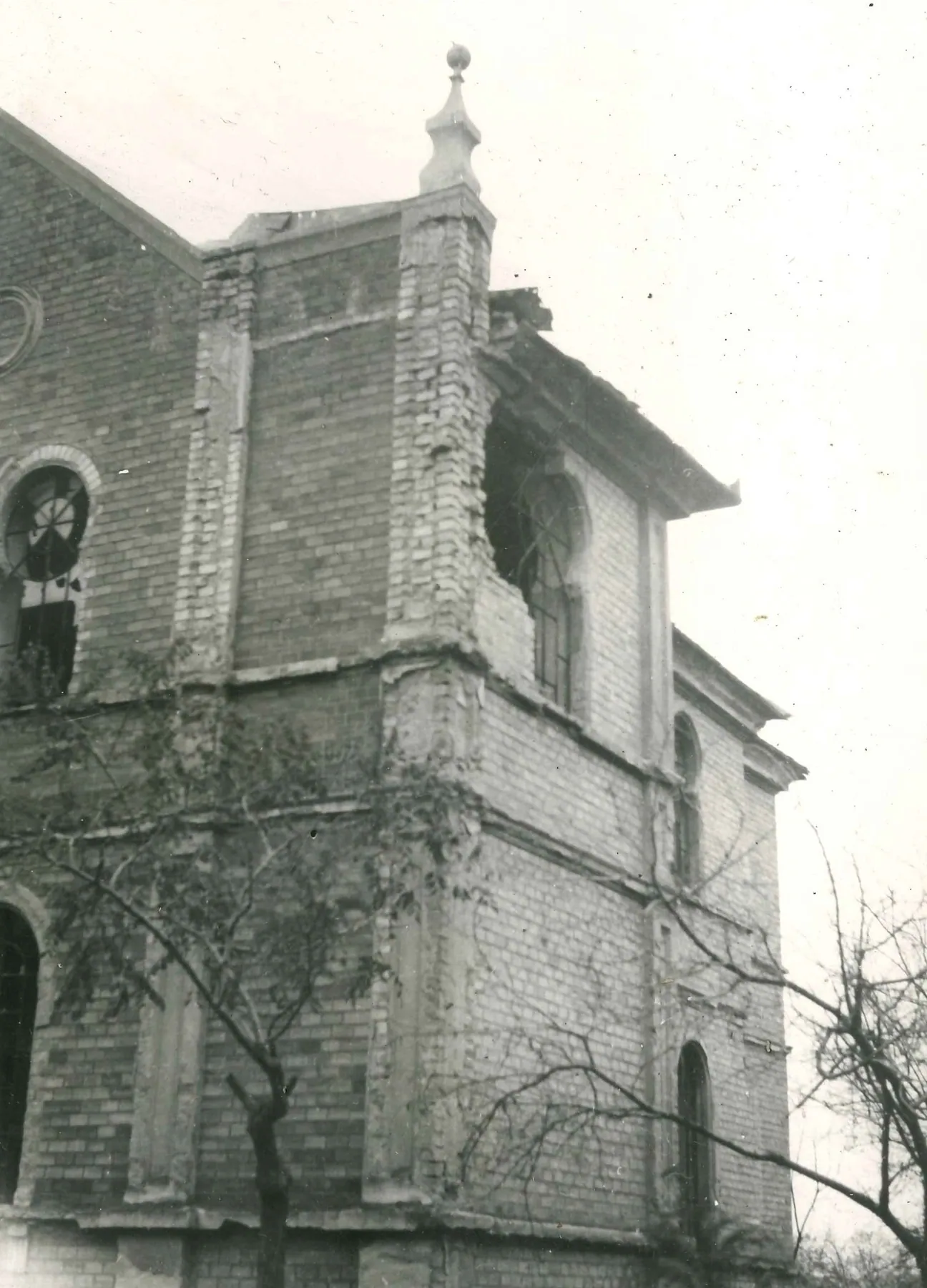
What the building looked like is known from two photographs of October 1948 kept by the Hungarian Jewish Museum and Archives. They show a two-storey hall of exposed brick with a gabled front, a Star of David in the gable, round-arched and keyhole-shaped windows, and small corner blocks crowned by finials.
A bulletin published in the town in 1988 states that 56 Jews of Martonvásár were taken to concentration camps and killed. The synagogue outlived them. An album page in the museum's collection, captioned in ink 'Martonvásár templom 1948. X. hó', shows it standing in October 1948 with its windows smashed and a hole broken through the wall of one corner block. Gazda, who surveyed synagogue sites between 1980 and 1987, recorded it as demolished. No source found says when it was pulled down, by whom, or whether it had first been sold.
Where it stood for nearly 65 years
Historic: Martonvásár, Fejér county; street and house number unknown. Today: unknown; placeholder pin at the centre of 2462 Martonvásár, Fejér county (approximate).
Apri la mappa grande →La comunità ebraica
Little about the congregation's history could be established. Martonvásár has no entry in the Magyar Zsidó Lexikon of 1929, which described most organised communities in Hungary, so its founding date, officers and institutions are not recorded there. Anna Gergely's dissertation on the destruction of Fejér county's Jews lists Martonvásár among the county's Neolog communities, with 58 people in 1941 and 42 in 1944. A survey of the Jewish cemetery by the ESJF European Jewish Cemeteries Initiative gives indirect evidence of how long Jews lived in the town: the burial ground, a fenced section inside the municipal cemetery on Orgona út, holds 32 gravestones, the oldest dated 1881 and 1889 and the latest 1944. Anikó Gazda's gazetteer counts 117 Jews in Martonvásár in 1910 and 58 in 1941, so the congregation that built the synagogue in 1903 was about twice the size of the one deported in 1944. The Hebrew-language Pinkas Hakehillot volume for Hungary has an entry for Martonvásár on page 352, which has not been translated online. The names of the congregation's rabbis, teachers and presidents remain unknown.
Architettura e design
Two photographs taken in October 1948 are the only views found. The entrance front was of exposed brick with pale plaster or stone trim, two storeys high and three bays wide under a steep gable. In the gable a Star of David was set in a round-arched frame between two small roundels. Below it the upper floor had a pair of narrow round-arched windows in the centre and a single keyhole-shaped window on each side, all with circular tracery in their heads. A blank rectangular panel, probably meant for an inscription, sat above the doorway. On the ground floor a round-arched double door in a moulded surround was flanked by two round-arched windows. Flat pilaster strips and string courses divided the wall. At each end of the front stood a slightly lower corner block; the second photograph shows one of them from the side, with a keyhole-shaped window, projecting eaves and a small pinnacle carrying a bulb-shaped finial. The arched and keyhole openings give the building a mildly Moorish, historicist character. The architect, builder, seating capacity and interior are unknown; the corner blocks may have held stairs to a women's gallery, but no source confirms this.
La vita nella sinagoga
Almost nothing is recorded about worship in the building. Gergely's table places Martonvásár among the Neolog communities of Fejér county, so services would have followed the Neolog rite. The two-storey front with tall upper windows seen in the 1948 photographs points to a hall with an upper gallery, the usual arrangement for seating women, though no interior view or description was found. With 117 members in 1910 and 58 in 1941 the congregation was small, and whether it employed its own rabbi or was served from a larger community nearby is unknown; no rabbi, cantor or teacher of Martonvásár is named in any source read. Burials took place in the Jewish section of the town cemetery on Orgona út, where the dated stones run from 1881 to 1944.
Distruzione
The synagogue was not destroyed during the war. An album page in the Hungarian Jewish Museum and Archives, inscribed 'Martonvásár templom 1948. X. hó', carries two photographs of it taken in October 1948; the museum's catalogue dates the page 1949. The building is standing and roofed, but derelict: the window glazing and tracery are broken, parts of the trim are missing, and a large hole has been knocked through the upper wall of one corner block. What caused the damage, and who used the building after 1944, is not stated. A 1947 rabbinical ruling allowed Hungarian congregations to give up their synagogues, and many were sold in the following years, but no record of a sale at Martonvásár was found. Anikó Gazda, who surveyed synagogue sites across Hungary between 1980 and 1987, listed the Martonvásár synagogue as demolished. It was therefore pulled down at some point between late 1948 and the 1980s, under Communist rule. No source found names the year, the owner at the time, or the person or body that carried out the demolition.
Il destino della comunità
Gergely's table records 58 Jews in Martonvásár in 1941 and 42 in 1944. A bulletin issued by the town's Patriotic People's Front committee in 1988 states that 56 Jews were taken from Martonvásár to the concentration camps, and that 56 of the roughly 600,000 Hungarian Jews killed there were from the town. The difference between the figures is not explained; a note to Gergely's table refers to people classed as Jewish who were not of the Israelite faith, which may account for part of it. The sources read do not say where the Jews of Martonvásár were first concentrated, on what date they were deported or from which railway station, and they do not name the officials or gendarmes who carried out the round-up locally. The latest gravestone in the Jewish cemetery is dated 1944. Whether any deportees survived and came back is unknown; no congregation is recorded in the town after the war, and the derelict state of the synagogue in October 1948 suggests that none was using it by then.
Il luogo oggi
The plot on which the synagogue stood has not been identified: none of the sources read names its street, and the 1948 photographs show only the building, a patch of open ground and trees. What occupies the site today is therefore unknown, and the map pin is a placeholder at the centre of Martonvásár, not the synagogue's location. No surviving fragment of the building is recorded. The Jewish cemetery survives as a fenced section of the municipal cemetery on Orgona út, with 32 gravestones in two rows. A memorial to the town's Second World War dead, set up in 1988, also commemorates the 56 deported Jews. The street and plot could probably be fixed from Mária Hornyák's local-history volume or from cadastral maps.
Hai qualcosa da condividere?
Fotografie, documenti, storie di famiglia o ricordi di questa sinagoga e della sua comunità aiutano a mantenerne viva la storia.
- Martonvásár, zsinagóga (F16.051), album page with two photographs captioned 'Martonvásár templom 1948. X. hó'
- Martonvásári zsinagóga szemből (F70.273)
- Zsinagógák és zsidó községek Magyarországon (Fejér county table, PDF p. 26)
- A Fejér megyei zsidóság megsemmisítése (1938-1944), table 'Neológ hitközségek népessége Fejér megyében', p. 54
- Tájékoztató '88/1 and '88/2 (bulletin on the town's Second World War memorial)
- Martonvasar Jewish Cemetery
- Eldózerolt és megmentett zsinagógák
- Magyar Zsidó Lexikon (1929), entries 'Mártonnapi kihallgatás' to 'Martos'
- Pinkas Hakehillot Hungary: Encyclopedia of Jewish Communities, Hungary (table of contents)
- List of synagogues in Hungary
- Martonvásár (OpenStreetMap place node 196190783)
Share a memory or thought
No comments yet. Be the first to add one.