
La storia di Masada Synagogue
Masada is an isolated rock plateau in the Judean Desert above the Dead Sea, made into a palace-fortress by Herod the Great, who reigned from 37 to 4 BCE. Built into the casemate wall on its north-western edge is a hall that Yigael Yadin's expedition uncovered during the excavations of 1963-1965 and identified as a synagogue. The Israel Nature and Parks Authority panel at the site says it was built in Herod's time, most likely as a stable, and became a synagogue during the revolt against Rome; the New Encyclopedia of Archaeological Excavations in the Holy Land likewise calls it the Zealots' synagogue and apparently a stable under Herod. E. Jan Wilson has argued instead that it was a synagogue from the start.
The rebels, whom Josephus calls Sicarii and who were led by Eleazar, lined the walls with plastered benches and closed off a corner room. Under that room's floor the excavators found two pits holding fragments of scrolls of Deuteronomy and Ezekiel. The building is one of very few synagogues known from before the destruction of the Jerusalem Temple.
The Roman army under Flavius Silva besieged and took Masada in 73 or 74 CE, which ended the building's use. What stands today is a roofless excavated ruin, conserved and partly rebuilt since 1965.
Where it stood as a synagogue for about 8 years
Ancient: hall in the north-western casemate wall of the Masada plateau (excavation loci 1042-1043). Today: Masada National Park, Judean Desert, above the Dead Sea, Tamar Regional Council, South District, Israel. Position approximate to within the building's surroundings.
Apri la mappa grande →La comunità ebraica
The people who used the hall were not a town congregation but the fighters and families of a fortress under threat. Josephus, the only ancient narrative source, says that Sicarii commanded by Eleazar had seized Masada, and they held it through the Great Revolt, which began in 66 CE. He counts 960 dead at the end and seven survivors, men, women and children together. Finds from Yadin's excavation give a few glimpses of their communal life. An ostracon inscribed 'priest's tithe' (ma'aser kohen) was found on the synagogue floor, and another there bore the name Hezekiah; Yadin used both as evidence that the building had a religious use. Eleven small ostraca, each with a single name, were recovered in front of the Northern Palace; one reads 'ben Ya'ir' and may refer to the commander, Eleazar ben Ya'ir. Fragments of other scrolls, among them Genesis, Leviticus, Psalms, Sirach and the Songs of the Sabbath Sacrifice, were found elsewhere on the mountain. No officer, teacher or donor of the synagogue is named in any source read, and how the community organised its worship is unknown.
Architettura e design
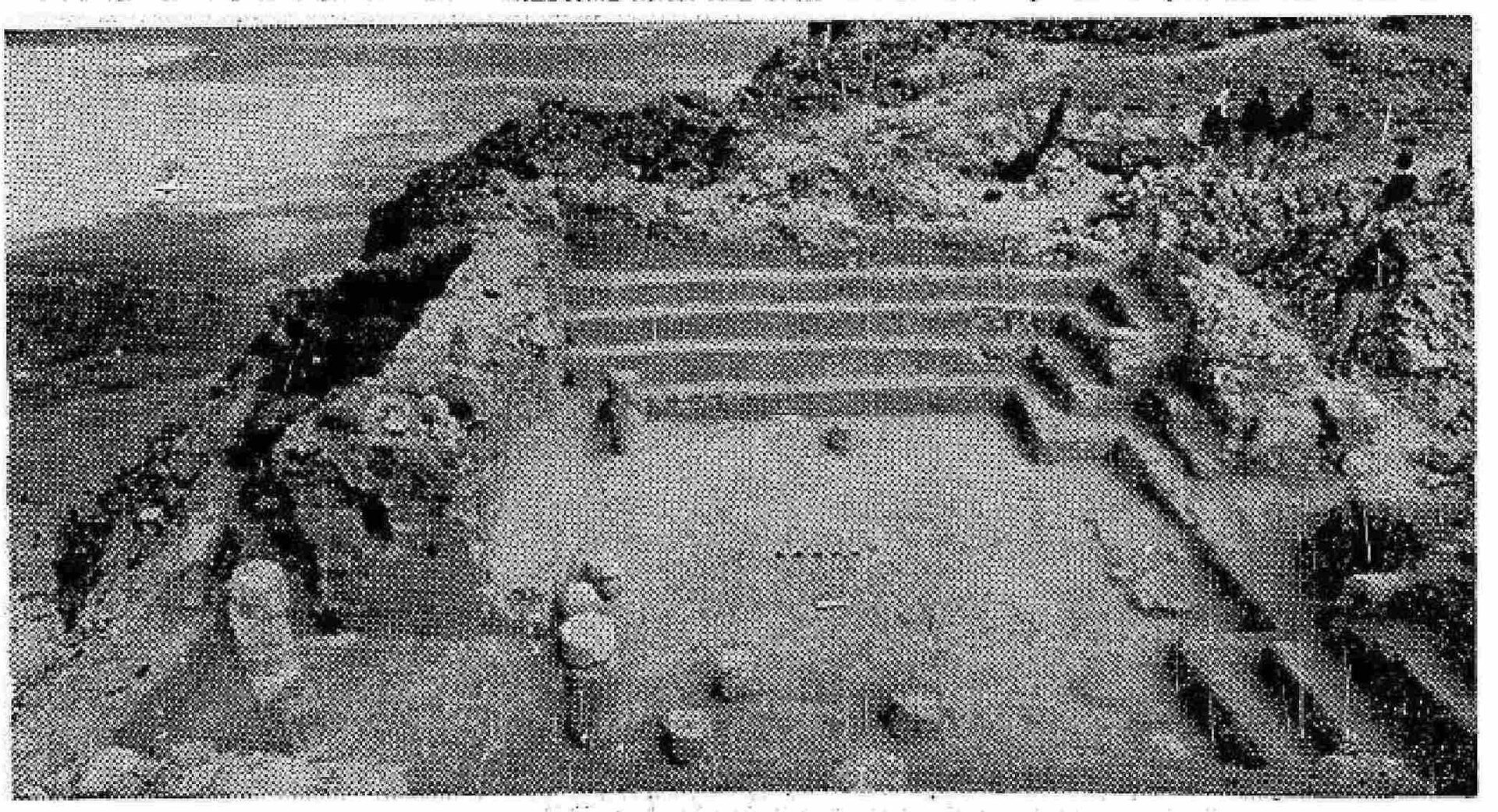
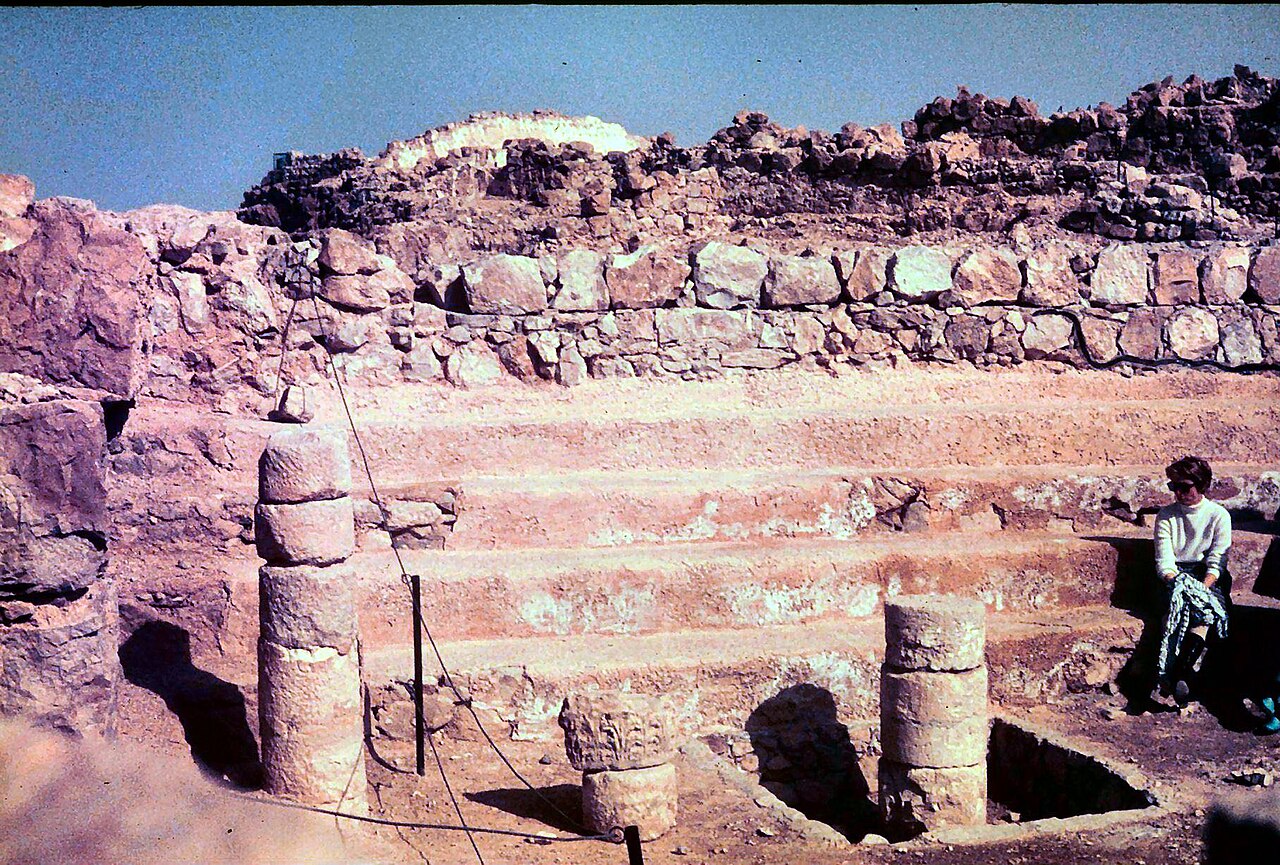
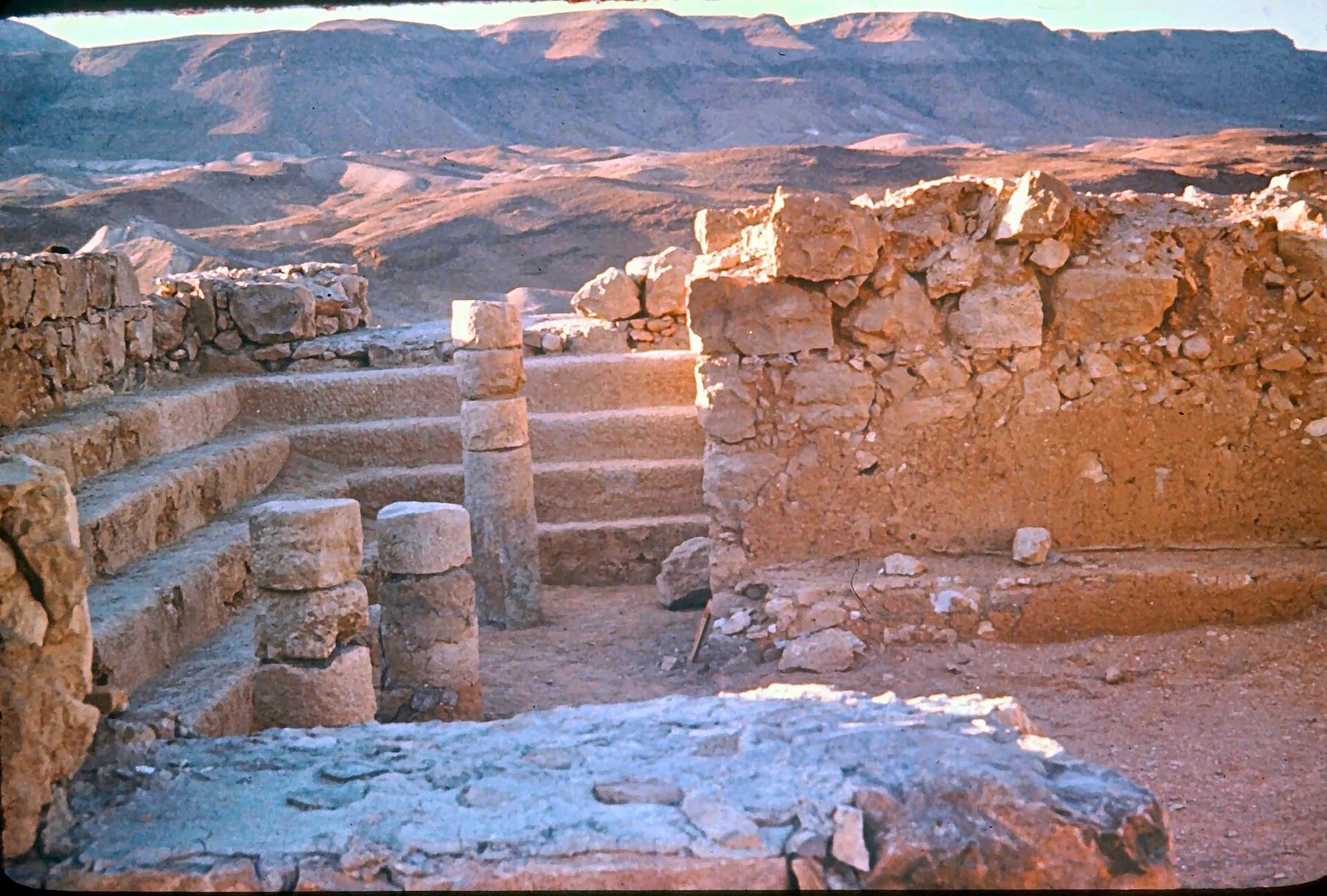
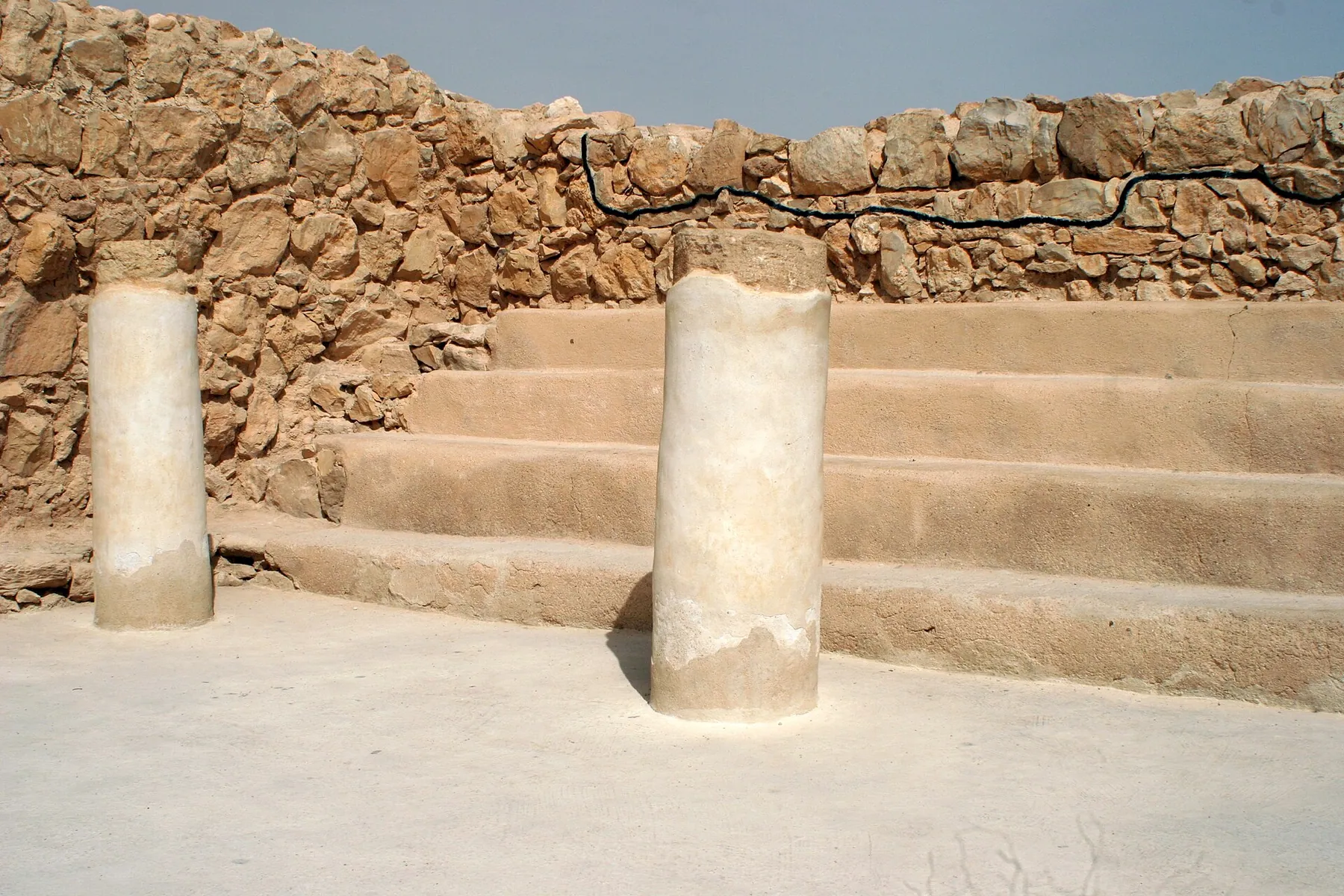
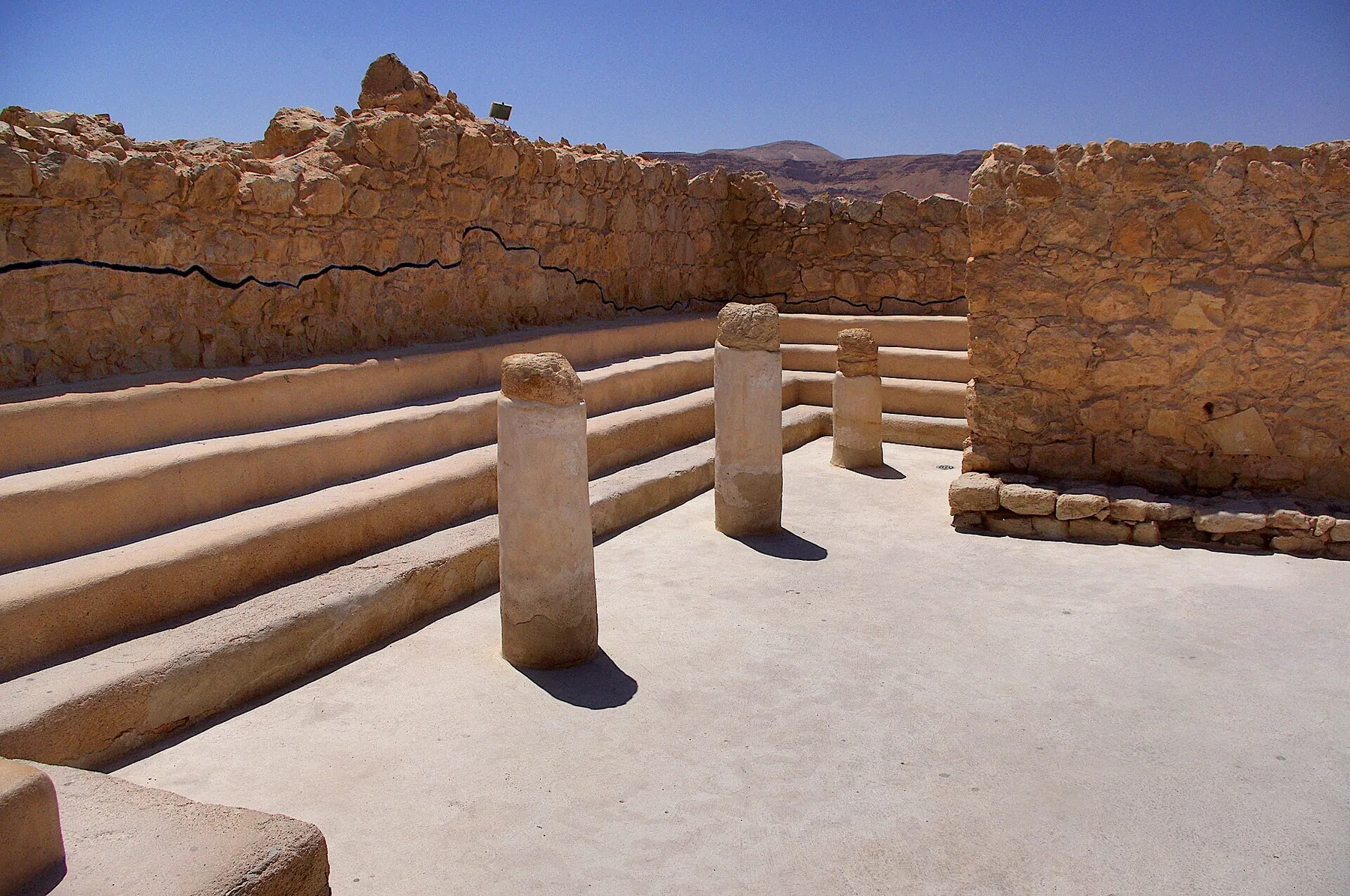
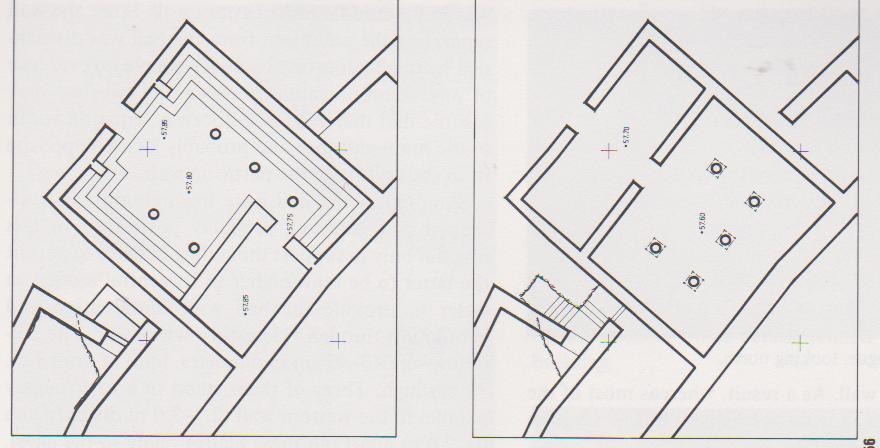
The hall is built against the inside of the north-western casemate wall. Its entrance faced east and the building is described as oriented towards Jerusalem. The Jewish Virtual Library gives its size as 12.5 by 10.5 metres; the Madain Project gives about 15 by 12 metres for the hall and about 5.7 by 3.5 metres for the corner room. Ehud Netzer's two-phase plan, published in the final report Masada III (1991) and reproduced by the Bar-Ilan synagogue database, shows the first building divided into a hall with five columns and a smaller room in front of it. In the second phase the dividing wall has gone, the columns have been rearranged, a small room has been built into a rear corner against the casemate wall, and tiers of benches run round the walls. The Biblical Archaeology Society's caption to a similar plan says the rebels removed walls and columns. Sources count four tiers of plastered benches, though the UNESCO nomination speaks of three rows. Columns of stacked stone drums carried the roof. No mosaic, wall painting, inscription or Torah shrine is reported in the sources read. Seating capacity is unknown, and no builder is named.
La vita nella sinagoga
What is known of the hall's use comes from its fittings and finds, not from texts: Josephus does not mention a synagogue on Masada. People seated on the benches along the walls faced the middle of the room, an arrangement suited to assembly and public reading, and the park authority's panel describes the building as serving 'community meetings and Torah readings'. The corner room is thought to have stored scrolls and served as a genizah, a repository for worn sacred texts. Under its floor Yadin's team found two pits, one holding fragments of a Deuteronomy scroll and the other fragments of Ezekiel, including part of chapter 37, the vision of the dry bones. Because they were buried before the fall, the scrolls can be no later than 73 or 74 CE. Coins of the revolt lay on the floor of the same room, and the ostraca reading 'priest's tithe' and 'Hezekiah' came from the synagogue floor. Which prayers were said, who read or taught there, and who attended are unknown. The identification as a synagogue rests on the benches, the orientation and these finds; no inscription names the building.
Distruzione
Josephus describes the end of Masada in book 7 of the Jewish War. Flavius Silva, the Roman governor, led the army against the fortress; the Jewish Virtual Library names the Tenth Legion, auxiliary units and thousands of Jewish prisoners of war. The Romans brought a battering ram up their siege ramp and breached the wall, then threw burning torches at the wooden wall the defenders had built behind it. Josephus says the defenders heaped up and burned their own possessions before they died, and that the last man set fire to the palace. He dates the end to the fifteenth of the month Xanthicus; modern authors place it in spring 73 or 74 CE. Silva left a garrison on the mountain and returned to Caesarea. No source read says what happened to the synagogue hall itself during the capture or under the garrison. Archaeologists who later re-examined the casemate wall near the ramp reported signs of a violent fire on the tops of the surviving walls there. The hall lost its roof and the upper part of its walls at a time nobody recorded, and nothing read suggests it was used as a synagogue again.
Il destino della comunità
According to Josephus, the defenders resolved that not one of them should be left alive to be subject to the Romans. They burned their goods and died by their own hands, the last man running himself through with his sword after setting fire to the palace. Josephus counts 960 dead. Two women, one of them a relative of Eleazar, and five children had hidden in underground caverns and survived; what became of them is unknown. The Romans, entering the palace, found the bodies. Josephus is the only source for this account and modern scholars are divided about it: the Wikipedia article on Masada, summarising the debate, calls the archaeological evidence ambiguous and says some scholars reject the mass suicide entirely. The excavations found the remains of only about 24 to 29 people, whose identity is disputed; they were reburied as Jewish defenders in 1969. No Jewish community is recorded on Masada afterwards. In the fifth and sixth centuries Christian monks lived on the summit and built a chapel, and the site then lay untouched for more than thirteen centuries.
Il luogo oggi
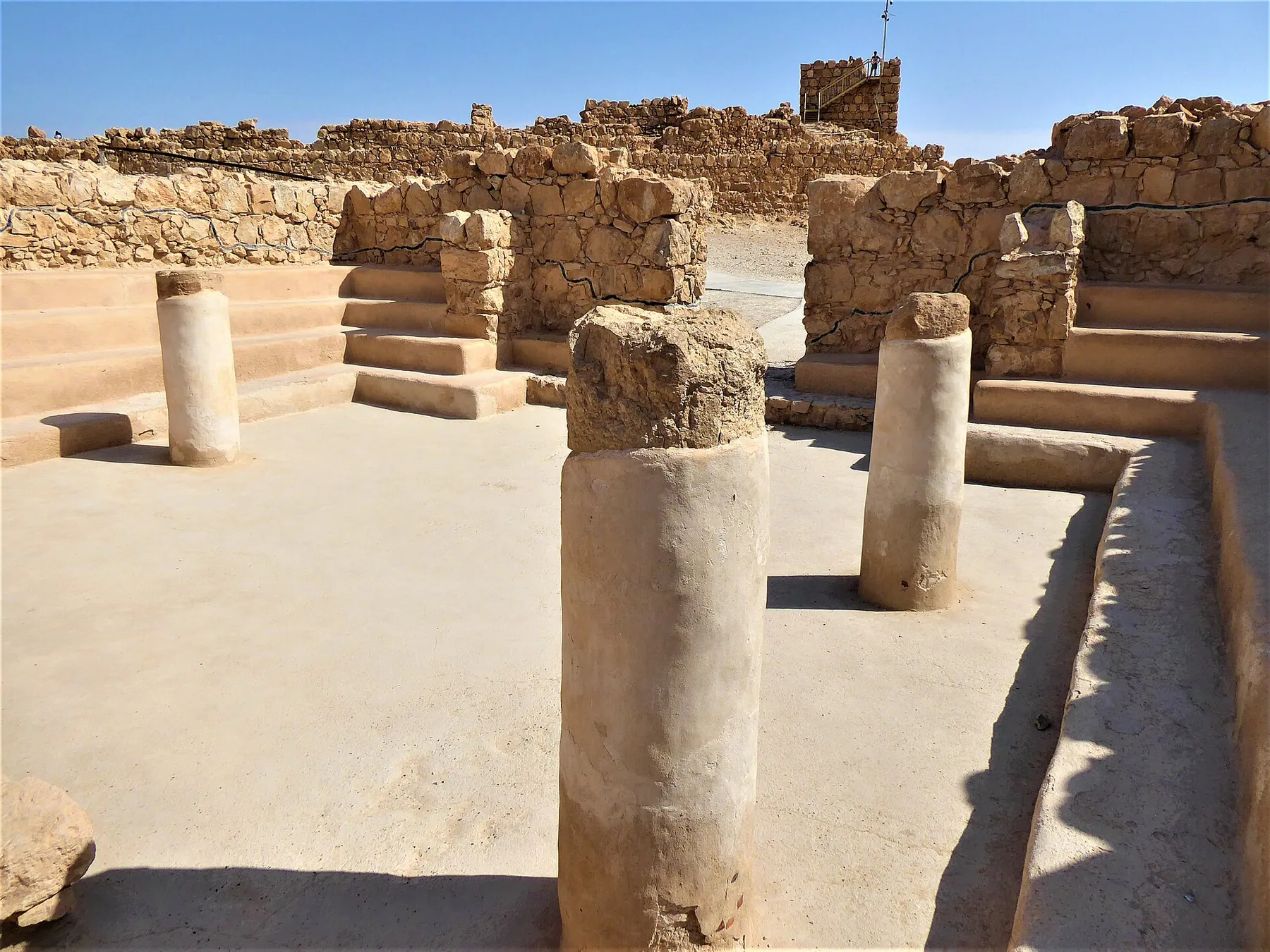
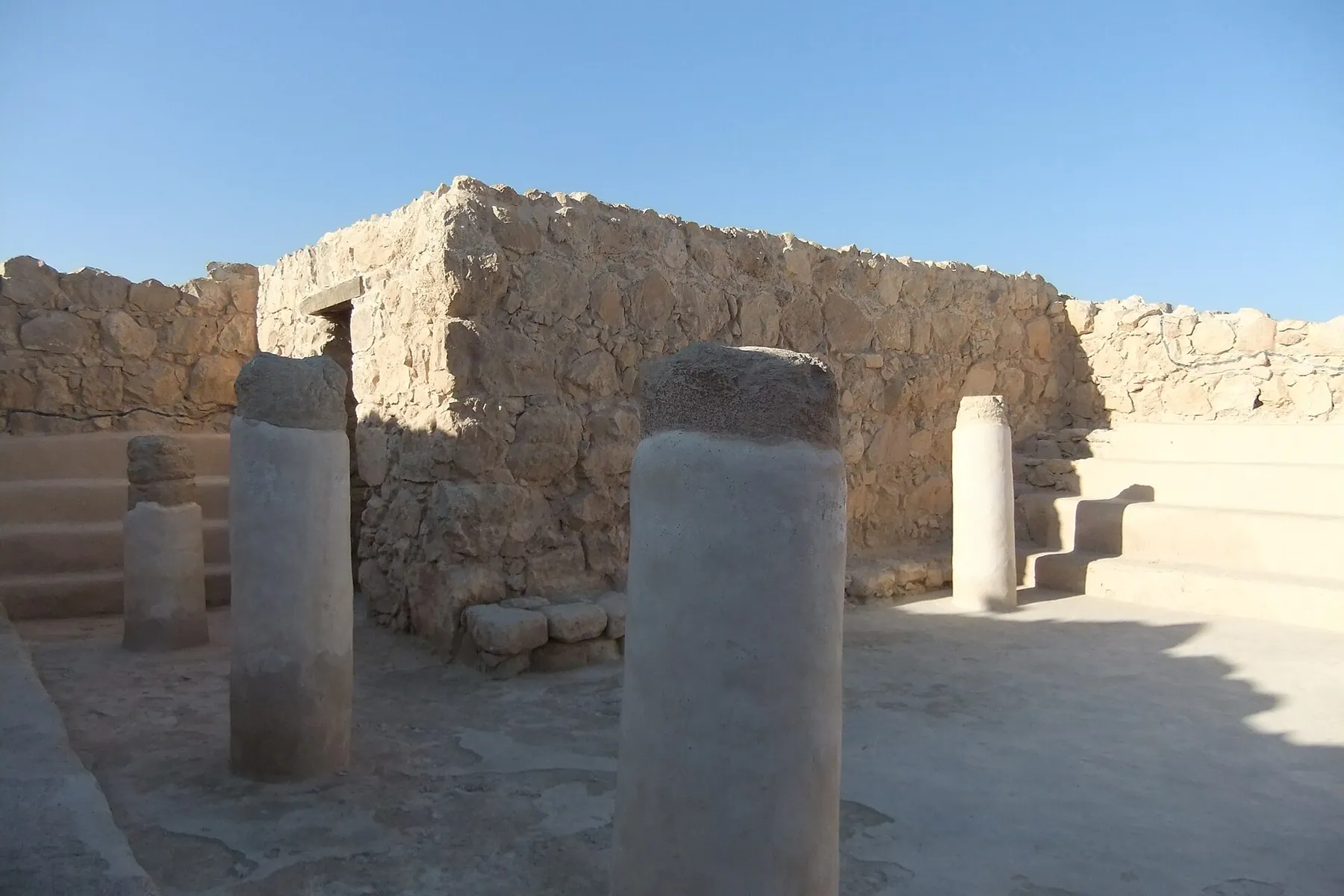
The synagogue is one of the excavated buildings of Masada National Park, managed by the Israel Nature and Parks Authority and a UNESCO World Heritage Site since 2001. The hall is open to the sky. Judging from photographs with visitors for scale, its walls stand to about head height or a little more. A black line set into the mortar, clearly visible in photographs of the room, separates the masonry the excavators found from the courses added in conservation; in places it runs close to the present wall top. Reconstruction was carried out in 1965-1966 and reworked with more suitable mortar in 1995-2000. The benches, floor and column stumps, bare stone in photographs from the 1960s, are now coated in plaster, and the corner room stands rebuilt to above door height. A park information panel stands beside the hall.
Hai qualcosa da condividere?
Fotografie, documenti, storie di famiglia o ricordi di questa sinagoga e della sua comunità aiutano a mantenerne viva la storia.
- Information panel 'The Synagogue' at Masada (photographed 2018; File:Masada synagogue by ArmAg.jpg)
- Masada (entry, New Encyclopedia of Archaeological Excavations in the Holy Land)
- The Masada Synagogue and Its Relationship to Jewish Worship during the Second Temple Period
- Masada: Desert Fortress Overlooking the Dead Sea
- Flavius Josephus, The Jewish War, Book 7 (Whiston translation), chapters 8-9
- Masada (World Heritage List no. 1040)
- Masada: nomination file for the World Heritage List (no. 1040)
- Masada (Ancient Synagogues in the Land of Israel database)
- Image details: plan of the Masada synagogue after the Zealots' remodelling
- Masada Synagogue
- Masada: benches in the south-western corner of the synagogue (photo ICDSMSSY02)
- Masada
- Masada
- Masada III. The Yigael Yadin Excavations 1963-1965, Final Reports: The Buildings, Stratigraphy and Architecture (bibliographic record)
- Masada National Park
- Masada archaeological site (OpenStreetMap way 32231475)
Share a memory or thought
No comments yet. Be the first to add one.