
הסיפור של Mattersdorf Synagogue (Mattersburg)
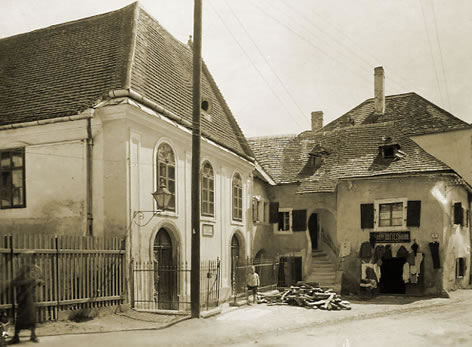
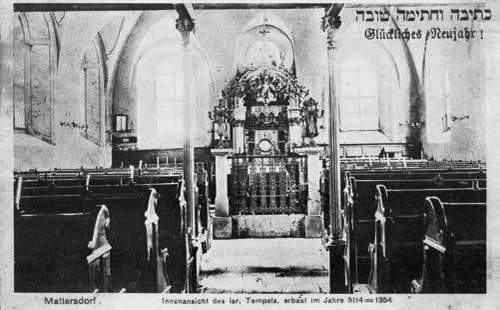
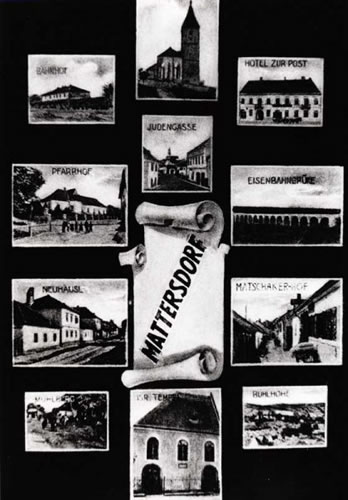
Mattersdorf, renamed Mattersburg in 1924 and known in Hungarian as Nagymarton, lies in the north of the Burgenland. Under the protection of the Esterházy princes it was one of the Schewa Kehillot, the Seven Communities, and became a centre of Orthodox learning whose rabbis included Moses Sofer, the Chatam Sofer. The synagogue stood in the Judengasse, the main street of the Jewish quarter, next to the Abeles house, with the Talmud school behind it. Its age is uncertain. A Hebrew plaque on the street front gave the year 5114, read as 1354, and recorded a rebuilding in 5635 (1875); a postcard of about 1900 repeats the 1354 date, while the local historian Meir Deutsch favoured about 1550, and an inscription in the vault was dated 1702. Fires damaged the Judengasse in 1853 and 1856. Seen from the street, the building was a plain whitewashed block with a steep hipped roof and pilasters, its prayer hall marked by a slightly higher ridge. In 1938 the Nazi mayor hung a white flag on its roof to announce that the town was 'free of Jews'. In September 1940 a Wehrmacht engineer platoon cleared the emptied Jewish quarter and blew the synagogue up. Post-war houses and, from 1969, a fifteen-storey block replaced the street.
Where it stood for 586 years
Historic: Judengasse, Mattersdorf (Nagymarton), beside the Abeles house; house number unknown. Today: Brunnenplatz area of the former Jewish quarter, 7210 Mattersburg, Burgenland, where the memorial stone stands (approximate).
פתיחת מפה גדולה ←הקהילה היהודית
Jews are documented in Mattersdorf from 1526 and the community re-formed in 1527 after an expulsion; one tradition, repeated in community lore, traces families such as the Schischa to the fourteenth century. It grew under the Esterházy princes as one of the Seven Communities of the Burgenland. Figures collected by Veronika Schmid show 60 Jews in 1569, 273 in 1669, 767 in 1785 and a peak of 1,517 in 1813, after which numbers fell to 1,257 in 1850, about 700 in 1883, 577 in 1923 and 511 in 1934. A cholera epidemic in 1830-1832 reduced the community. It was strictly Orthodox, governed by a council headed by a Rosh ha-Kahal, and was known across Hungary for its yeshiva, founded in 1778 by Rabbi Jeremiah ben Isaac and later led by Moses Sofer. From the 1830s a line of the Sofer and Ehrenfeld rabbinical families served the town; the last rabbi, Samuel Ehrenfeld, served until 1938.
אדריכלות ועיצוב
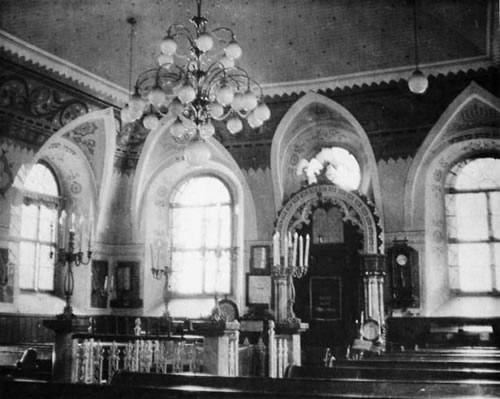
No construction plans survive, and Schmid's reconstruction rests on photographs, cadastral maps and descriptions. The building was probably Gothic in origin and much altered. It had a barrel-like trough vault (Muldengewölbe) supported outside by buttresses, a steep hipped roof whose ridge over the prayer hall was about 130 cm higher than the rest, and a plain whitewashed street façade articulated by pilasters; the windows began about 1.6 m above the floor. A photograph shows the façade with its round-headed doorway, a lantern bracket and the plaque, beside the outside stair of the Abeles house. Inside, the bimah was a raised stone platform with stone corner posts joined by a wrought-iron grille and a wooden reading desk. The Torah ark on the east wall had wooden half-columns and a carved horseshoe arch in Moorish style. A women's gallery rested on two cast-iron columns behind a wooden grille. A brass chandelier with 25 glass globes was hung in 1932, and a starry ceiling and ornamental bands were painted afterwards, replacing older paintings covered around 1910. The architect, builder and seating capacity are unknown.
החיים בבית הכנסת
Men and women entered by separate doors. The entrance hall held a cupboard for the shammes and the large chair used by the mohel at circumcisions. The synagogue's treasury kept goblets, Torah shields and crowns from the sixteenth and seventeenth centuries and Torah ark curtains described as dating from as early as the thirteenth or fourteenth century, which were shown in use on photographs taken before 1924. Religious life was shaped by the rabbis and the yeshiva behind the synagogue. Jeremiah ben Isaac, rabbi from 1770, founded the yeshiva in 1778. Moses Sofer came from Strassnitz in 1798 and taught here until he was called to Pressburg in 1806. Simon Sofer served from 1842 or 1843 until he left for Kraków in 1857. Samuel Ehrenfeld, the first of his family here, served until his death in 1883 and was followed by his son Simcha Bunem Ehrenfeld, who died in 1926, and by Samuel Ehrenfeld. A New Year greeting postcard showing the interior was printed before 1924, and a photograph of 1937 shows a Purim celebration.
הרס
The Anschluss of March 1938 ended the synagogue's use. Before the end of September 1938 the Nazi mayor, Franz Giefing, had a white flag raised on the synagogue and declared Mattersburg 'judenfrei'. The Torah scrolls were reportedly taken to the Schiffschul in Vienna, which was burned in the November Pogrom. The empty building was plundered; a memorial stone in the town wrongly dates its destruction to Kristallnacht. According to Veronika Schmid's study, the Wehrmacht had inspected the former ghetto in early 1939, and in September 1940 an engineer platoon (Pionierzug) of about thirty soldiers pulled down the decaying houses of the Judengasse by hand and with explosives. On the same day the synagogue was blown up: holes were drilled into the masonry for dynamite charges, and Hitler Youth and younger Pimpfe were first led through the building and told they would see 'all this Jewish junk' vanish at the push of a button. Photographs show soldiers with charges, Wehrmacht men, gendarmes and onlookers after the blast, and the ruins. Who ordered the demolition is not recorded in the sources read; the exact day in September is unknown.
גורל הקהילה
On 13 March 1938, the day after the Nazi German invasion, Mayor Michael Koch told the Jews to leave, and looting and violence broke out in the Judengasse that day. In the summer of 1938 the Jews of the community were stripped of their citizenship, and under the Burgenland Nazi leader Tobias Portschy the province was made the first district of the German Reich to be emptied of Jews; by the end of September 1938 none remained in Mattersburg, and the census of 1939 counted none. Most fled to Vienna and tried to emigrate from there. Rabbi Samuel Ehrenfeld and part of his congregation reached New York, where they kept together as a community. Those who could not leave Austria were later deported to the death camps. Family records gathered by descendants name many Mattersdorf Jews murdered in Auschwitz, Stutthof and elsewhere, among them children such as Renée Deutsch, killed in Auschwitz in 1942 at the age of eleven. The Nazis also destroyed the Jewish cemetery. In 1958 Ehrenfeld's followers founded Kiryat Mattersdorf in Jerusalem, which carries the town's name.
האתר כיום
None of the Jewish houses of the Judengasse survives on its old plot apart from a few former Jewish-owned business buildings. The synagogue site was rebuilt after the war; in 1969 a fifteen-storey block, the first high-rise in the Burgenland, went up behind the former synagogue and Talmud school. The street has been rebuilt with post-war houses and shops, one of them now a café. A memorial stone on Brunnenplatz recalls the synagogue. In 2014 the path along the Wulka stream was named Samuel-Ehrenfeld-Weg, and the association 'Wir Erinnern' was founded in 2013. The old Jewish cemetery, wrecked under Nazi rule, survives with a monument built from broken gravestones.
שמות בולטים
Moses Sofer (Chatam Sofer)
1762-1839Rabbi of Mattersdorf, 1798-1806Moses Sofer, known after his main work as the Chatam Sofer, was called to Mattersdorf from Strassnitz in Moravia in 1798. He led the congregation and its yeshiva until 1806, when he accepted a call to Pressburg, where he became the most influential Orthodox authority in Hungary. He is said to have advised that rabbinical studies be pursued in Mattersdorf, and his descendants, the Sofer and Ehrenfeld families, later held the town's rabbinate.
ביוגרפיה או מקור ←Jeremiah ben Isaac (Rosenbaum)
died 1805Rabbi of Mattersdorf from 1770; founder of the yeshivaJeremiah ben Isaac, whose family name is given as Rosenbaum, became rabbi of the community in 1770 according to the list of rabbis compiled by Grunwald and cited by Schmid. In 1778 he founded the Mattersdorf yeshiva, which became the town's chief claim to fame among Hungarian Jews and was housed behind the synagogue. He was succeeded in the rabbinate by Moses Sofer in 1798 and died in 1805.
ביוגרפיה או מקור ←Simon Sofer
1821-1883Rabbi of Mattersdorf, 1842/43-1857Simon Sofer came to Mattersdorf in 1842 or 1843 as rabbi and head of its yeshiva. He served the congregation for about fifteen years, through the fires that struck the Judengasse in 1853 and 1856, and left in 1857 when he was called to be rabbi of Kraków. He died in 1883.
ביוגרפיה או מקור ←Samuel Ehrenfeld
1891-1980Last rabbi of Mattersdorf, until 1938Samuel Ehrenfeld, a descendant of the first Ehrenfeld rabbi of Mattersdorf, succeeded his father Simcha Bunem Ehrenfeld after 1926 and was the last rabbi to serve in the synagogue. He received the Austrian Golden Cross of Merit in 1931. Expelled in 1938, he re-established his congregation in New York, and his followers founded Kiryat Mattersdorf in Jerusalem. A path along the Wulka in Mattersburg has borne his name since 2014.
ביוגרפיה או מקור ←יש לכם משהו לתרום?
תמונות, מסמכים, סיפורי משפחה וזיכרונות מבית הכנסת ומהקהילה שלו עוזרים לשמור על ההיסטוריה שלו בחיים.
- Virtuelle Rekonstruktion der ehemaligen Synagoge in Mattersburg (Nagymarton; Mattersdorf)
- Virtuelle Rekonstruktion der ehemaligen Synagoge in Mattersburg (full text PDF)
- Mattersburg KehilaLinks: Photo Gallery
- Mattersburg KehilaLinks: History
- Mattersburg KehilaLinks: Cemetery
- On the history of Mattersdorf
- Mattersburg (Jewish Communities of Austria)
- Book note on the Jewish community of Mattersdorf
- Memorial for the Jewish Community, Mattersburg
- Brunnenplatz, Mattersburg (OpenStreetMap way 30345636)
Share a memory or thought
No comments yet. Be the first to add one.