
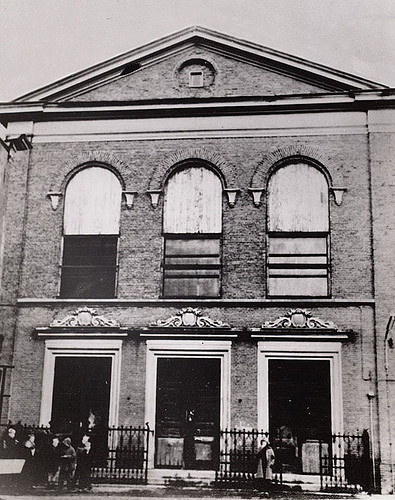
Historia Meppel Synagogue
Meppel, a market town in the south-west of Drenthe, had one of the oldest and largest Jewish communities in the province. Services were first held in a private house; in 1767 the community took a simple house on the Touwstraat, then called the Touwbane, and in 1798 it obtained land beside it and laid the first stone of a synagogue that was inaugurated a year later. It stood on the north side of a narrow lane that became known as the Jodenkerksteeg.
In 1808 Meppel was made the head synagogue of its district, and in 1853 it became the seat of the chief rabbinate of Drenthe. The growing congregation, which numbered 585 in 1869, outgrew the old sjoel, and in 1862 it decided to rebuild and enlarge it. The new building, its first stone laid on 13 May 1865 and inaugurated on 20 October 1865, held about 350 people and was the community's centre for almost eighty years, alongside a school, a ritual bath and a warden's house on the same lane. Its interior was badly damaged during the occupation. After the war the few survivors could no longer maintain it; it was sold and, in 1960, demolished together with the former Jewish school during an urban renewal scheme.
Where it stood for 95 years
Historic: Touwstraat, north side of the Jodenkerksteeg (Jodenkerksteegje), Meppel; house number unknown. Today: corner of Jodenkerksteeg and Touwstraat, 7941 LP Meppel, Drenthe (approximate).
Otwórz większą mapę →Społeczność żydowska
Jews are recorded in Meppel from the eighteenth century: twelve families in 1767, 120 people in 1791 and 200 in 1809, according to the Jewish Cultural Quarter's community encyclopedia. The community grew steadily with the town's trade, reaching 390 in 1840 and a peak of 585 in 1869, and still counted 544 in 1899 and 304 in 1930. In 1767 it elected a committee chairman and governors (parnassim) and employed its own cantor, who also served as teacher and ritual slaughterer. Under Louis Napoleon in 1808 Meppel became the head synagogue of its district; under King Willem I it was placed under the chief rabbinate of Overijssel at Zwolle, and in 1853 it became the residence of the chief rabbi of Drenthe. Jeremias Hillesum held that office from 1853 until his death in Meppel in 1888. Disputes with the former chief rabbinate at Zwolle and internal quarrels split the community in 1875. A school on the Touwstraat was completed in 1844.
Architektura i projekt
The first synagogue of 1799 occupied a plot of about 1.8 ares on the north side of the Jodenkerksteeg and was too small for the High Holy Days. In 1862 the community decided to convert and enlarge it; the work was put out to tender in 1864, and the new building was paid for by members' voluntary contributions, a grant from the state treasury and a loan subscribed by Meppel citizens of all faiths. The Geheugen van Drenthe calls the result a monumental synagogue in Neo-Romanesque style that replaced the old sjoel, while other sources speak of a rebuilding and enlargement, so how much of the 1799 fabric survived inside it is unknown. The surviving photograph shows a tall brick street front of two storeys under a broad triangular pediment with a small square window in its tympanum. Three tall round-arched windows with keystones light the upper storey, and below them three doorways with moulded surrounds are crowned by carved ornaments. An iron railing runs along the pavement. Inside were many stained-glass windows and large chandeliers, lit by gas instead of candles. The architect is unknown.
Życie w synagodze
The synagogue was the seat of the chief rabbi of Drenthe from 1853, and the stone for the 1865 building was laid by the chief rabbi; the sources do not name him, but Jeremias Hillesum held the office at that time. Gifts to the new building included a painting by Jozef Israëls, 'Kerkgang' (Going to Synagogue). The community's cantor doubled as teacher and ritual slaughterer, and the neighbouring houses on the Jodenkerksteeg held a ritual bath, a warden's house and a meeting room that served as school and, before 1865, as an auxiliary synagogue. A hearse was kept in its own shed, built by a contractor from Hoogeveen during the rebuilding. The congregation's internal disputes, and its quarrels with the former chief rabbinate at Zwolle, led to a split in 1875. The only object from the synagogue known to survive is a small silver shield bearing the names of members of the community board, now in the Juliana home for the elderly in Herzliya, Israel. Other ceremonial objects were given to the Eindhoven synagogue after the war.
Zniszczenie
During the Nazi German occupation the synagogue's interior was badly damaged and the Holy Ark was destroyed. After the deportations of 1942 the homes of Meppel's Jews were looted and their furniture was seized and stored in the synagogue, which served as a depot for confiscated property. The Torah scrolls had been taken to Amsterdam and hidden but were never recovered. The sources consulted do not say who wrecked the interior or when. The building survived the war, but the handful of returning Jews could not use or maintain it, and it was sold soon after 1945; the buyer is not named. In 1960 it was demolished together with the former Jewish school as part of an urban renewal scheme in the town centre ('in het kader van een stadsvernieuwing'). Who ordered and carried out the demolition, and whether the municipality or the buyer was responsible, is not recorded in the sources found.
Los społeczności
In 1942 just over 260 Jews lived in Meppel. From August 1942 young Jewish men were sent to labour camps under the Nazi German occupation, and the first deportations to Westerbork began. In early October 1942 most of the remaining Jews were arrested with the cooperation of the Dutch police and deported via Westerbork. Their homes were looted. Only about a tenth of Meppel's Jews survived, mostly by hiding; in 1944 children of mixed marriages were put to forced labour at nearby Havelte. According to a TracesOfWar summary 232 Jewish residents were killed and 18 returned, while the Dutch Jewry survey gives 27 survivors, not all of whom came back to Meppel. In 1951 the town counted only 30 Jews. The community was formally dissolved in 1964 and merged administratively into that of Zwolle. The Jewish cemetery was restored between 1998 and 2001 and is maintained by the local authorities.
Miejsce dzisiaj
The synagogue stood on the north side of the Jodenkerksteeg, at its corner with the Touwstraat, in the old centre of Meppel. The building and the neighbouring Jewish school were cleared in 1960. To the north lies the Slotplantsoen park. TracesOfWar reports that some remnants of the synagogue survive at the corner of the Jodenkerksteeg and Touwstraat. A painting of the interior hangs at the corner of the Synagogestraat and Touwstraat, and a memorial to Meppel's murdered Jews stands in the Slotplantsoen. What exactly occupies the footprint of the building today was not established in the sources consulted.
Ważne postacie
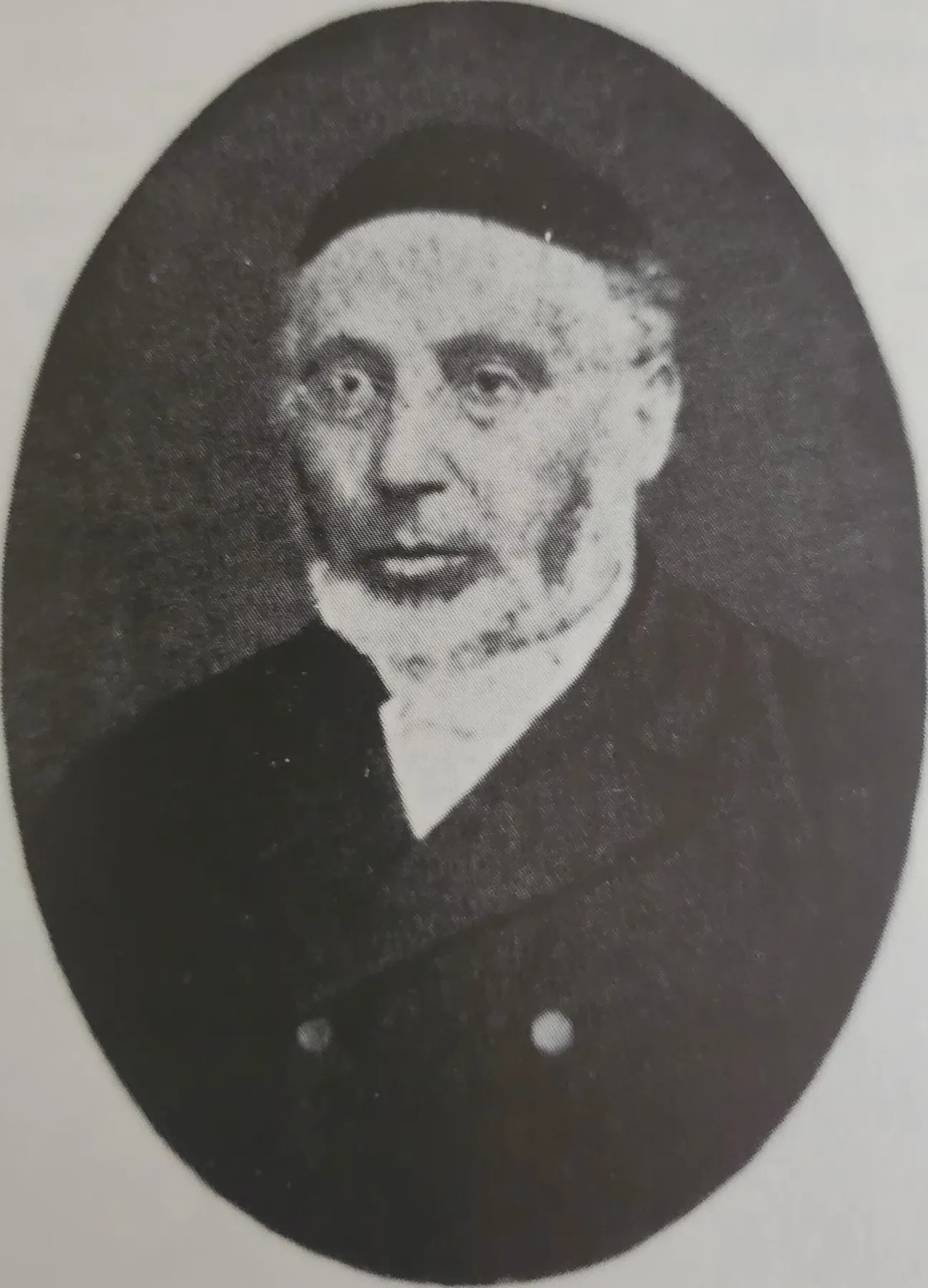
Jeremias Hillesum
1820-1888Rabbi in Meppel from 1849; chief rabbi of Drenthe, resident in Meppel, 1853-1888Born in Amsterdam in 1820, Hillesum became rabbi of the Meppel synagogue in 1849 and chief rabbi of Drenthe in 1853, when Meppel was made the seat of the province's chief rabbinate. He held the office until his death in Meppel in 1888, adding the chief rabbinates of Groningen, Overijssel and other provinces, and so presided over the congregation when the 1865 synagogue was built and inaugurated.
Biografia lub źródło →Czy masz coś do przekazania?
Zdjęcia, dokumenty, historie rodzinne lub wspomnienia o tej synagodze i jej społeczności pomagają zachować jej historię.
Share a memory or thought
No comments yet. Be the first to add one.