
Die Geschichte von Mezőkövesd Synagogue
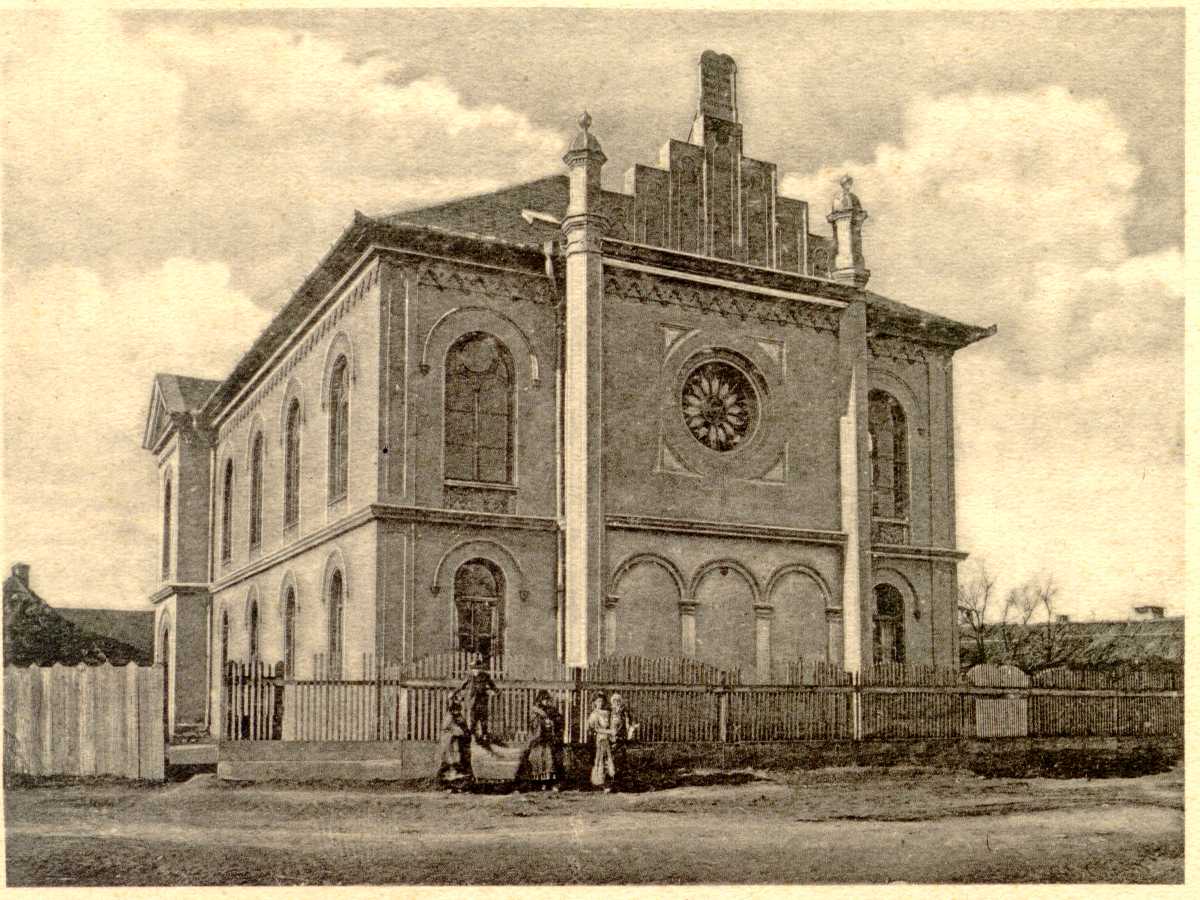
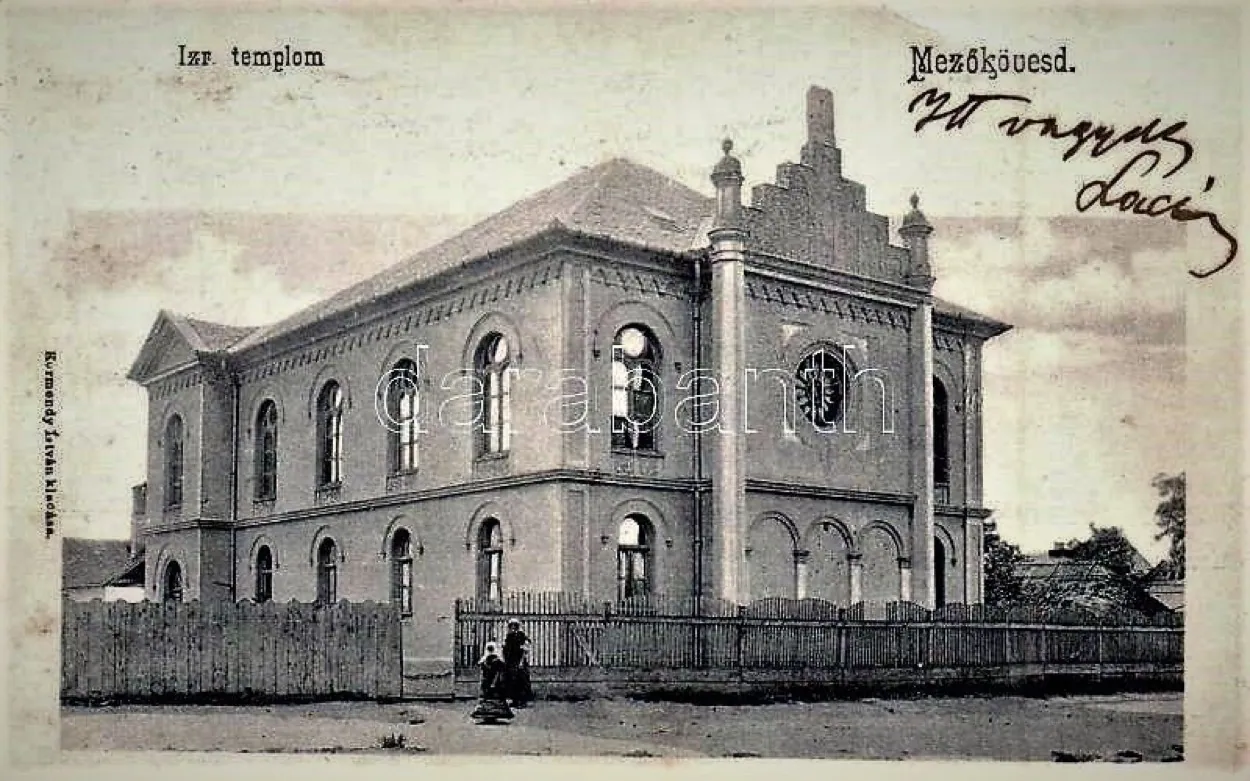
The synagogue stood at Arany János utca 1, a few steps from the main square of Mezőkövesd, a market town at the foot of the Bükk hills in Borsod county, about 40 kilometres from Miskolc. The Jewish community, whose surviving minute book began on 12 October 1850, built its first synagogue in 1853 and replaced it in 1896 with a new one, paid for from its own resources. The architect is not recorded. Postcards show a free-standing two-storey hall with round-arched windows, a rose window and a stepped gable between two slender turrets. From 1871 the congregation was Orthodox, and under Chief Rabbi Izidor Jungreisz, who served from 1904 and founded a yeshiva in 1908, the building was filled for prayer on weekdays as well as on the Sabbath. In May 1944, after the Nazi German occupation of Hungary, the streets around the synagogue became the ghetto; in June its inmates were taken to Miskolc and deported to Auschwitz. A few survivors returned and in 1947 raised a memorial in the synagogue courtyard, but most left after 1956. In the 1960s a watchmaker, Mihály Eisler, still kept services going in the vestibule of the ruinous building. Under Communist rule the Communists demolished it around 1970; the exact year is not recorded. A primary school and its yard occupy the site today.
Where it stood for nearly 75 years
Historic: Arany János utca 1, Mezőkövesd. Today: grounds of the primary school at Hősök tere 14 (Mezőkövesdi Általános Iskola, former Bárdos Lajos Tagiskola), 3400 Mezőkövesd, at the northern end of Arany János utca.
Größere Karte öffnen →Die jüdische Gemeinde
Jews probably lived around Mezőkövesd soon after the Ottoman period; the oldest legible gravestone, that of Juda Schwarc, dates from 1810. Counts record 67 Jews in 1828, 85 in 1851, 669 in 1910 and 798 in 1941. The community's first surviving minute book, written in Hungarian, opens on 12 October 1850; its founders were the brothers Farkas, Vilmos and József Ónodi Sugár, Farkas Wessely, and Gyula and Menyhért Harangi-Leitner, and its first rabbi was Soma Wechsler. At first it belonged to the rabbinate of Ábrány; in 1871 it declared itself Orthodox, and in 1888 Mezőkövesd became the seat of a rabbinical and registry district covering a ring of surrounding villages. An elementary school opened in 1888 or 1889, a Talmud Torah in 1914, a new ritual bath in 1926 and a new school building in 1929. In 1929 the community numbered about 800 people in 180 families, among them 104 merchants, 28 craftsmen, six doctors and five lawyers. A municipal report of June 1944 counted ninety Jewish-owned shops and workshops.
Architektur und Gestaltung
No architect, builder or plan of the 1896 synagogue is recorded in the sources consulted, and it is known chiefly from two postcards. They show a free-standing, two-storey rectangular hall under a hipped roof, set behind a wooden picket fence on an unpaved street. The walls are divided by pilaster strips, a string course between the storeys and an ornamental frieze beneath the eaves, and are lit by two tiers of round-arched windows, an arrangement that suggests a women's gallery inside. The short street front is the showpiece: three arches on slender columns at ground level, a large rose window set in a square frame above them, and two thin engaged turrets that rise past the cornice to small domed finials. Between the turrets the wall is carried up into a stepped gable crowned by a tall central pier. At the far end a lower block with a triangular pediment projects from the hall, probably the vestibule. The style is the round-arched historicism common to Hungarian provincial synagogues of the period. Nothing is recorded of the interior, the ark or the seating capacity.
Leben in der Synagoge
The congregation was Orthodox in practice as well as in name. According to recollections gathered by a former resident, the synagogue filled with worshippers not only on Sabbaths and festivals but every weekday morning and evening; many stayed for the night-long study sessions of Shavuot and Hoshana Rabbah, and almost no one missed the pre-dawn selichot prayers in autumn. The rite was Ashkenazi; there was no Hasidic group, few men wore beards, and a visit by the Hasidic rebbe of Kálló was remembered as a sensation. The two ritual slaughterers doubled as cantors and Torah readers, and a beadle kept the community's records. Chief Rabbi Izidor Jungreisz preached in Yiddish-German on the Sabbaths before Yom Kippur and Passover, while his son, the dayan Mór Jungreisz, addressed the young in Hungarian. In winter, prayers were held in the community's assembly hall. The building was also a target: in July 1924 its windows were smashed after Jewish boys were blamed for an offence against a church the week before.
Zerstörung
The synagogue outlived the deportation of its congregation in 1944. Survivors raised a memorial to the dead in its courtyard in 1947, but during the 1956 uprising Jews in the town were attacked, the name tablet was struck from the memorial, and most of those remaining left. By the 1960s the building was ruinous; boys from the neighbouring primary school threw stones through its last windows, while the watchmaker Mihály Eisler had the vestibule repaired and heated with an iron stove so that services could go on, and a bar mitzvah was celebrated there in 1961. The community's other buildings, among them the assembly hall, school and Talmud Torah, were pulled down and a state school stands in their place. Under Communist rule the Communists demolished the synagogue itself. No source consulted gives the year or names the body that ordered the work: the memorial was removed from in front of the building to the Jewish cemetery in Miskolc in 1970 or 1971, and a national survey compiled in the 1980s lists the synagogue as demolished.
Das Schicksal der Gemeinde
In the summer of 1941 the Hungarian authorities deported three Mezőkövesd families who could not prove Hungarian citizenship; they were murdered at Kamianets-Podilskyi on 27–28 August. Other men died in forced labour service. After Nazi German forces occupied Hungary on 19 March 1944, the district chief, Béla Péterffy, ordered on 17 May that the Jews of the town and district move into a ghetto of 37 houses in the streets around the synagogue. It held 931 people, 818 from Mezőkövesd and 113 from nearby villages. In early June the Hungarian authorities emptied the ghetto and took its inmates to the brickworks in Miskolc; some were sent on to the Diósgyőr ghetto and deported on 12 June, and the rest were deported to Auschwitz on 13 and 15 June 1944. Chief Rabbi Izidor Jungreisz and the dayan Mór Jungreisz were among the dead. Some survivors came back and tried to rebuild, but many emigrated after 1956 and the last families dwindled away. A plaque dedicated at Yad Vashem in 1993 commemorates nearly 900 victims from the town and its surroundings.
Der Ort heute
Nothing of the synagogue survives. Its plot at the head of Arany János utca now lies within the grounds of the primary school at Hősök tere 14, the seat of the Mezőkövesdi Általános Iskola, formerly the Bárdos Lajos school; local researchers place the synagogue in the present schoolyard. A memorial plaque is fixed to the school wall. The 1947 memorial, which had stood in the Jewish cemetery in Miskolc for more than half a century, was restored by the town with the support of Mazsihisz and re-inaugurated on 31 October 2025 on Hősök tere, in front of the school. The Jewish cemetery on Cseresznye út, beyond the railway line, is the other surviving trace of the community.
Bedeutende Namen
Izidor Jungreisz
d. 1944Chief Rabbi of Mezőkövesd, 1904–1944Izidor Jungreisz (also spelled Jungreiss) became rabbi of Mezőkövesd in 1904 and led the Orthodox congregation from the synagogue for forty years. He founded the town's yeshiva in 1908, which had fifteen to twenty students in the 1930s, and preached the solemn sermons of the year in Yiddish-German. The national survey of April 1944 still lists him as the community's registrar rabbi. He was deported and murdered at Auschwitz in 1944.
Biografie oder Quelle →Saul Ehrenfeld
UnknownRabbi of Mezőkövesd, 1896–1904Saul Ehrenfeld, called Samu in one recent account, was the community's second rabbi. He took office in 1896, the year the new synagogue was built, and was therefore the first rabbi to serve in it, remaining until 1904, when Izidor Jungreisz succeeded him; a Hebrew account says the succession followed his death. Nothing further about his life is given in the sources consulted.
Biografie oder Quelle →Mór Jungreisz
d. 1944 or 1945Dayan; rabbi and head of the yeshivaMór (Moshe) Jungreisz, son of Chief Rabbi Izidor Jungreisz, served the congregation as dayan and took over the running of his father's yeshiva. He addressed the younger generation in Hungarian, and the national survey of April 1944 lists him as the community's rabbi beside his father. He appears with his wife Irén in the community's list of Holocaust martyrs.
Biografie oder Quelle →József Plattner
d. before 1944President of the Jewish community (1920s)József Plattner was president of the Mezőkövesd Orthodox community when the Magyar Zsidó Lexikon was compiled in 1929. The lexicon credits him with initiating a new, modern building for the community's two-teacher elementary school, which he inaugurated in 1929. His widow Regina is listed among the town's Holocaust martyrs murdered at Auschwitz.
Biografie oder Quelle →Mihály Eisler
UnknownWatchmaker; lay leader of the post-war congregationThe watchmaker Mihály Eisler held together the handful of Jewish families left in Mezőkövesd after 1956. In the 1960s, when the synagogue was already ruinous, he had its vestibule put in order, heated it with an iron stove and organised the minyan and the ritual supplies needed for the festivals, making possible a bar mitzvah there in 1961.
Biografie oder Quelle →Haben Sie etwas beizutragen?
Fotos, Dokumente, Familiengeschichten oder Erinnerungen an diese Synagoge und ihre Gemeinde halten ihre Geschichte lebendig.
- Mezőkövesd (headword)
- Zsidó élet Mezőkövesden
- Mezőkövesdi zsinagóga (postcard, 1932), F01.324
- Mezőkövesd anyahitközség, in: Magyarországi zsidó hitközségek 1944. április, p. 375
- מזוקובשד (Mezőkövesd), Encyclopedia of the Ghettos
- Zsinagógák és zsidó községek Magyarországon: térképek, rajzok, adatok
- A mezőkövesdi holokauszt-emlékmű
- Visszakerül Mezőkövesdre a mártírok fala
- Október 31-én kerül vissza a mártírok emlékműve a mezőkövesdi főtérre
- A mezőkövesdi zsidó templom
- Egy német fotós mezőkövesdi képei a harmincas évekből
- Újraavatják a mezőkövesdi Holokauszt-emlékművet
- Országszerte új helyszíneken tartanak holokauszt-megemlékezéseket
- Jegyzőkönyv, Mezőkövesd Város Önkormányzata Képviselő-testületének 2025. április 30-i ülése (határozat 78/2025. (IV.30.))
- מזקבשד
- Magyarországi zsinagógák listája
- Beverték a mezőkövesdi zsinagóga ablakait
- A Memorial to the Martyrs of Mezokovesd (translation of Yad le-Kedoshei Mezokovesd, Yad Vashem, 1994), List of Martyrs
- Bárdos Lajos Általános Iskola, Mezőkövesd (way 1056695215) and Arany János utca (way 1058312579)
- File:Bárdos Lajos Tagiskola, homlokzatdísz, 2018 Mezőkövesd.jpg
Share a memory or thought
No comments yet. Be the first to add one.