

Die Geschichte von Mielec Synagogue
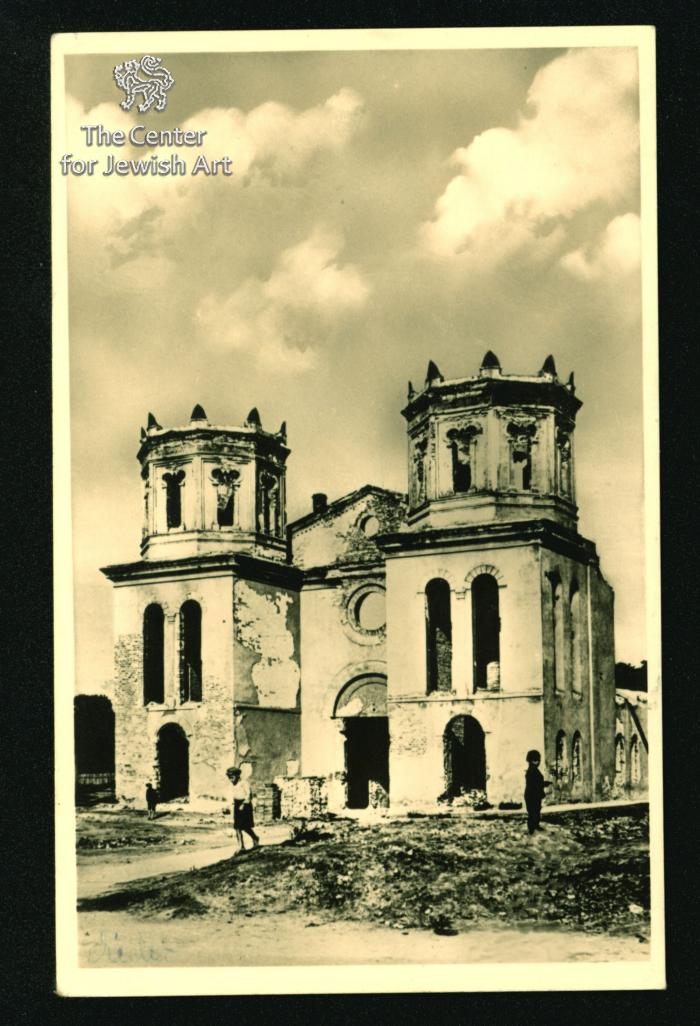
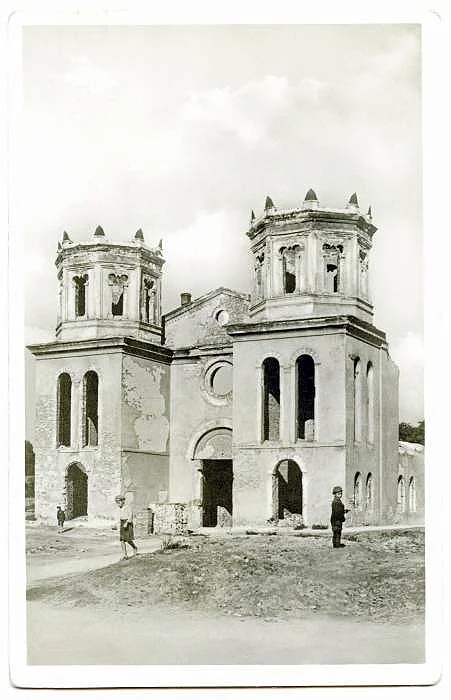
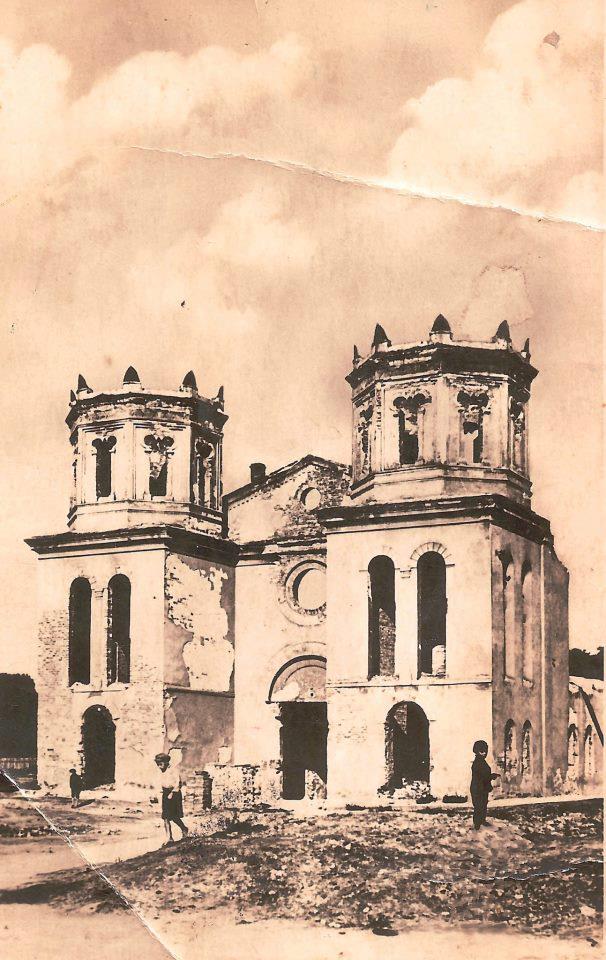
The synagogue of Mielec, in southeastern Poland, was the principal house of worship of one of the region's larger Jewish communities. A brick building with two towers, it was built before 1900 to replace an earlier wooden synagogue, within a communal block that also held prayer houses, a mikveh and a ritual slaughterhouse.
Its interior was unusual. Alongside quotations from the Torah and Talmud and floral and geometric ornament, its walls bore painted scenes of the Creation of the World and the Flood, a rare departure from the usual avoidance of figurative imagery.
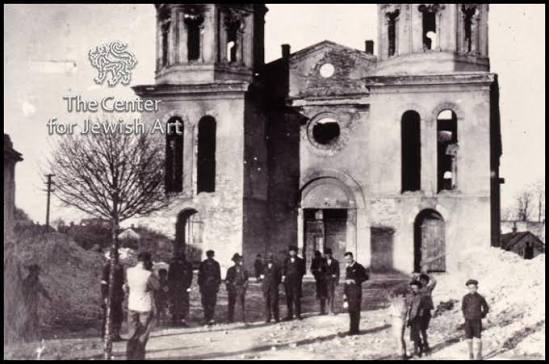
Mielec was occupied by the German army within days of the invasion of Poland. On 13 September 1939, the eve of Rosh Hashanah, Nazi German soldiers shot Jews at the slaughterhouse beside the synagogue, barricaded others inside the buildings, and set the synagogue, two prayer houses and the slaughterhouse on fire. Estimates of those killed range from about 20 to more than 80, and some accounts say hundreds.
The ruins were demolished by the occupiers in 1942 or 1943. In March 1942 the Jews of Mielec were expelled, and the town was declared one of the first in the General Government to be free of Jews. The synagogue was never rebuilt.
Where it stood for 39 years
Historic: synagogue complex in the block bounded by today's ul. Wąska, ul. Sandomierska, ul. Berka Joselewicza and Nowy Rynek, Mielec. Present day: ul. Berka Joselewicza near the corner of ul. Lelewela, where a memorial stone stands on part of the former plot; part of the footprint lies under the Nowy Rynek car park. Location approximate.
Größere Karte öffnen →Die jüdische Gemeinde
Jews are first recorded in Mielec in 1573. By 1765 the kehilla numbered 914 people, making it the ninth largest Jewish community in the area of today's Podkarpackie Province; the Encyclopaedia Judaica gives 585 Jewish taxpayers for the same year. An earlier synagogue was built of wood, reportedly in the early eighteenth century.
Under Austrian rule from 1772 the community grew. From 1827 it was led by the Hasidic Rabbi Jacob Horowitz, and it remained predominantly Hasidic. Jews worked as tailors, bakers, goldsmiths, butchers and musicians, and in the timber and grain trade. By 1900 about 3,993 Jews lived in Mielec, and 41 of the town's 45 shops were Jewish-owned.
The replacement of the wooden synagogue with a representative brick building in the late nineteenth century reflects this growth. In 1923 Jews numbered 3,020, outnumbering the 2,415 Polish residents. Zionist organisations, Mizrachi, Betar and the Maccabi sports club were active between the wars.
Architektur und Gestaltung
The synagogue was a brick building of representative character with two towers, erected before 1900 on the site of an earlier wooden synagogue. The architect and precise construction date are unknown. One description calls its architecture spacious and rarely found in Poland.
The interior decoration was its most distinctive feature. Wall paintings depicted scenes of the Creation of the World and the Flood, alongside quotations from the Torah and Talmud and floral and geometric ornament. Figurative biblical scenes of this kind were unusual in synagogues, where human and animal images were generally avoided.
The synagogue formed part of a communal complex in the block bounded by present-day ul. Wąska, ul. Sandomierska, ul. Berka Joselewicza and Nowy Rynek. Nearby stood a beit midrash and other prayer houses, a substantial mikveh, a ritual slaughterhouse and kosher meat stalls; the rabbi's house was on ul. Sandomierska. Surviving photographs from 1939–40 and a prewar aerial view in the National Digital Archives show the complex.
Leben in der Synagoge
The synagogue served a community that was predominantly Hasidic from the time Rabbi Jacob Horowitz began to lead it in 1827, and Hasidic leaders from nearby towns shaped religious life through the nineteenth century. The names of rabbis and cantors who officiated in this building during its lifetime are largely unrecorded.
The synagogue stood at the centre of a dense complex of Jewish religious institutions. Next to it were a beit midrash and further prayer houses, the community mikveh, a ritual slaughterhouse and kosher meat stalls, so that prayer, study, ritual purity and the supply of kosher food were concentrated in a single block.
The town also supported a Jewish elementary school from 1900 and, between the wars, organisations including Mizrachi, Betar and Maccabi.
In September 1939 Rabbis Chaim Kurtz and Joseph Beck were at the slaughterhouse beside the synagogue preparing poultry for Rosh Hashanah when German soldiers killed them, the first act of the synagogue's destruction.
Zerstörung
Nazi German army units entered Mielec in the first two weeks of September 1939. On 13 September 1939, the eve of Rosh Hashanah, German soldiers attacked the synagogue complex. According to Mielec Yidn, Rabbis Chaim Kurtz and Joseph Beck were shot at the ritual slaughterhouse. Virtual Shtetl reports that 50 to 70 Jews were driven from the synagogue to the slaughterhouse, where windows and doors were barricaded and shots fired at those inside; the synagogue, two prayer houses and the slaughterhouse were then doused with gasoline and set alight. The mikveh was also destroyed.
The perpetrators are identified as Wehrmacht soldiers; the specific unit is not known. Whether the burning took place during services is unconfirmed.
Victim estimates conflict: about 20 (Encyclopaedia Judaica), several dozen (memorial plaque), about 80 (Virtual Shtetl, Radio Leliwa), and hundreds (Mielec Yidn). One or two people reportedly survived. The burned shell was demolished by the Nazi German occupiers in 1942 or 1943.
Das Schicksal der Gemeinde
The burning of the synagogue opened the destruction of Mielec Jewry. On the same day, 22 Jewish refugees were shot at the Berdechów airfield. More than 5,400 Jews, including refugees, reportedly lived in the town before the war; a census in August 1940 recorded about 2,106.
In March 1942 (sources give 9 or 13 March) the remaining Jews were expelled. Several thousand were marched to the aircraft factory at Cyranka, and those unable to keep up were shot. About 2,000 were deported to towns in the Lublin district, and Mielec was declared one of the first towns in the General Government free of Jews. A forced labour camp at the Heinkel aircraft factory operated until 24 August 1944.
Survivor numbers vary: 47 listed on 15 May 1945 (Mielec Yidn), about 200 (Encyclopaedia Judaica) and about 300 (Virtual Shtetl). After a pogrom in October 1946, only about 20 Jews remained in the town.
Der Ort heute
Nothing of the synagogue survives. Its site, in the former Jewish quarter near ul. Lelewela, is partly covered by the Nowy Rynek area, where a local history site reports a car park and a Biedronka supermarket.
A memorial obelisk, erected in the 1970s, stands on part of the former synagogue plot. That plot is reported to be owned or managed by the Jewish Community of Warsaw, and local press has reported neglect of the grounds. No surviving foundations or other synagogue fabric have been documented, and no archaeological investigation of the footprint has been identified.
Bedeutende Namen
Chaim Kurtz
d. 13 September 1939RabbiAccording to Mielec Yidn, Rabbi Chaim Kurtz was at the ritual slaughterhouse beside the synagogue on 13 September 1939, preparing poultry for Rosh Hashanah, when German soldiers shot him. His killing was the first act of the assault in which the synagogue was burned. His birth date and precise rabbinic position are not verified.
Biografie oder Quelle →Joseph Beck
d. 13 September 1939RabbiAccording to Mielec Yidn, Rabbi Joseph Beck was killed together with Rabbi Chaim Kurtz at the slaughterhouse adjoining the synagogue on 13 September 1939, the eve of Rosh Hashanah, immediately before German soldiers set the synagogue complex on fire. His birth date and position in the community are not verified.
Biografie oder Quelle →Haben Sie etwas beizutragen?
Fotos, Dokumente, Familiengeschichten oder Erinnerungen an diese Synagoge und ihre Gemeinde halten ihre Geschichte lebendig.
- Synagoga w Mielcu (ul. Berka Joselewicza)
- History of the Jewish community in Mielec
- The Shoah in Mielec: 1939-1945
- A Walk in the Footsteps of Jews from Mielec
- Synagoga i łaźnia w Mielcu. Gdzie stały, jak wyglądały?
- Synagoga (dawna), ul. Lelewela Joachima, Mielec
- Mielec: 82 lata temu płonęła synagoga
- Kto ma zadbać o teren wokół synagogi?
- Mielec
- Synagoga, Mielec - 1939 rok
- Memorial stone: Miejsce spalenia przez hitlerowców żywcem kilkudziesięciu osób narodowości żydowskiej
Share a memory or thought
No comments yet. Be the first to add one.