

Historia Mistelbach Synagogue
Mistelbach, the main town of the Weinviertel north-east of Vienna, had no Jewish community until the second half of the nineteenth century. Jewish families settled there after 1848 and especially after the town charter of 1874, and in 1891-92 the Israelitische Kultusgemeinde Mistelbach was formally set up, with a district that reached across much of the surrounding countryside. The new community needed a house of prayer, and in April 1895 it bought a plot at the corner of Gartengasse and Oserstraße. Building took about ten months under the local master builder Dunkl and an engineer named Edelstein, to designs by Friedrich Schön, a pupil of Theophil Hansen. The synagogue was consecrated on 25 February 1896 with a procession led by the district rabbi Sor; the mayor stayed away despite having accepted the invitation. The building held the prayer hall, the community office and a large meeting room hung with a portrait of the emperor. In 1938 the Nazis ended Jewish life in Mistelbach within months and took the building for their own purposes. It survived the war damaged, was returned to the Jewish community in the 1950s, sold to private owners and pulled down in the later 1970s. The community's cemetery of 1898 on Waldstraße is its only surviving trace.
Where it stood
Historic: corner of Gartengasse and Oserstraße, Mistelbach, Lower Austria (house number unknown). Today: Gartengasse / Oserstraße, 2130 Mistelbach; approximate.
Otwórz większą mapę →Społeczność żydowska
Jews were barred from settling in the Weinviertel for centuries after a pogrom in 1337, and only around ten Jewish families lived in Mistelbach in 1869. Religious instruction for Jewish pupils at the town school began in 1886-87. The Kultusgemeinde was founded in 1891-92 and in 1890 its whole district, which covered several surrounding court districts, counted 1,073 Jews. Affiliated with it were the smaller groups in Hohenau and Niederabsdorf, Hausbrunn, Palterndorf, Rabensburg and Laa an der Thaya. Most Jewish families in the town were shopkeepers and traders, as their advertisements in the local press between 1915 and 1933 show. The Jewish cemetery on the edge of town was laid out in 1898. The community never had a rabbi of its own: it was served by visiting rabbis from Vienna, among them Israel Taglicht, later chief rabbi of Vienna. According to the ANU Museum, 382 Jews lived in Mistelbach in 1932, a figure that probably covers the whole district; the 1934 census counted 94 Jews in the town itself, and about 25 Jewish families remained in March 1938.
Architektura i projekt
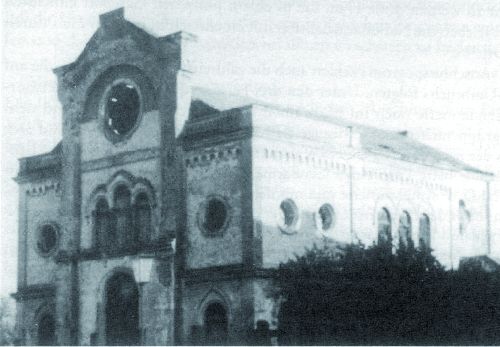
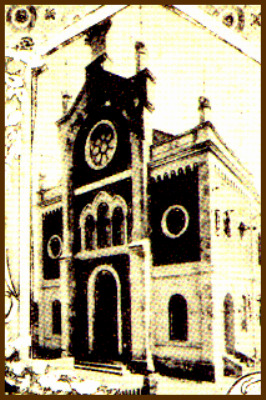
Schön designed a three-aisled basilica in exposed brick, using the Byzantine-Romanesque vocabulary his teacher Theophil Hansen had made popular. The walls were of red facing brick with white cornices and white frames to the windows and doors. Surviving photographs show a tall, gabled entrance front set between two slim towers or pilasters carrying small pinnacles. The gable held a large rose window with a Star of David, below it a stepped group of three round-arched windows, and at ground level a round-arched portal reached by a short flight of steps. Lower side blocks flanked the front, each with a round window. The long side walls had a row of round windows at gallery level above tall round-arched windows, under a corbel-table cornice, and the hall was covered by a pitched tiled roof. A newspaper report of 1896 called the temple architecturally well executed though not large. The interior was left plain at the consecration because the walls had to dry before they could be painted, and nothing more is known of it. The seating capacity is unknown.
Życie w synagodze
The synagogue was the centre of a community spread over many villages, so it served also as the seat of the Kultusgemeinde administration: besides the prayer hall it contained the community office and a large meeting room with a portrait of Emperor Franz Joseph. At the consecration on 25 February 1896 the district rabbi Sor led the procession into the building, the community president Ludwig Abeles presided, and the head of the district administration attended; a banquet in the town hall followed, at which the architect's work was praised. Because the community had no rabbi of its own, services and teaching depended on rabbis who came out from Vienna, Israel Taglicht among them. Alongside the synagogue the community kept a burial society and a Jewish women's charitable association, and by about 1932 it also counted three prayer houses in its district and cultural and welfare organisations. No record of the cantors, the order of services or the interior furnishings was found.
Zniszczenie
In August 1938 the chairman of the Kultusgemeinde, Wilhelm Kohn, was made to hand the synagogue over to the town as a so-called gift. Under the Nazis it served as a home for the Hitler Youth and as a store for the Nazi welfare organisation (NSV). According to the town, residents climbed the fence in May 1939 and stole the ritual objects, in 1944-45 twenty-one Hungarian Jewish forced labourers were held in the building, and in 1945 SS men set the storehouse on fire to keep the food stocks from the advancing Red Army. The walls survived the war, heavily damaged. The building was returned to the Jewish community after the war (in 1952 according to Ursula Prokop, 1956 according to the town). With no Jews left in Mistelbach it stood unused and decayed, and the Israelitische Kultusgemeinde sold it to private owners, a couple according to the town, in about 1976. They had it demolished, on the pretext that it was unsafe, in the later 1970s; the TU Wien study gives 1979. The demolition firm is not recorded.
Los społeczności
Nazi rule in Mistelbach began on 11 March 1938. Two days after the Anschluss the SA posted boycott guards in front of every Jewish shop. Jews were humiliated, put under curfew and beaten; some Jewish men of the town were locked in an ice cellar and, when they were taken out before they froze, beaten. In the following months their businesses were 'Aryanised' and the families were pressed to leave, and by August 1938 the town boasted in its Nazi press that it was the first 'Jew-free' town in Lower Austria. The Kultusgemeinde was dissolved by March 1939. Most Jews of Mistelbach went to Vienna, from where some emigrated and others were later deported and murdered; the number of victims from the town is not given in the sources read. In 1943-44 Hungarian Jewish forced labourers were held in a barrack on Siebenhirtener Straße. Only two former members of the community returned after the war.
Miejsce dzisiaj
The synagogue stood at the corner of Gartengasse and Oserstraße in the centre of Mistelbach. No source read describes what was built on the plot after the demolition, and no visible remains of the building are recorded. The community's Jewish cemetery of 1898 on Waldstraße, with about 140 graves, survives and is maintained by the municipality. In 2018 a permanent exhibition on the Jewish community of Mistelbach up to 1938, prepared by the local historian Christa Jakob, opened in a renovated house beside the cemetery. The map pin marks the approximate meeting point of Gartengasse and Oserstraße, not the exact plot.
Ważne postacie
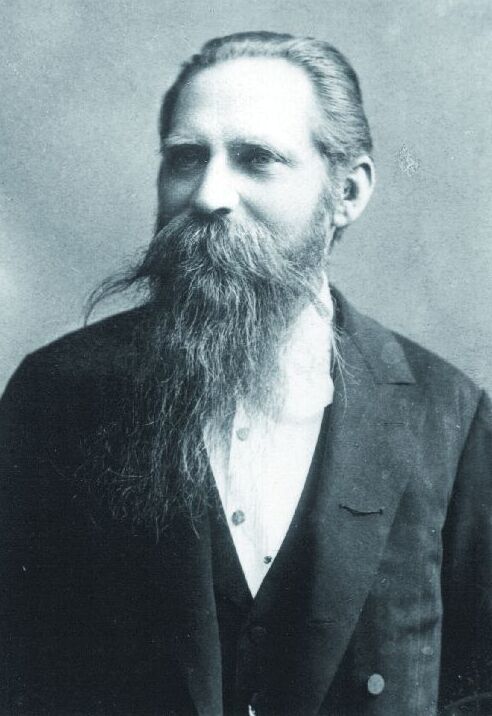
Friedrich Schön
1857-1941Architect of the synagogueBorn in Lovasberény in Hungary and trained in Budapest and Vienna, where he studied under Theophil Hansen at the Academy of Fine Arts, Schön settled in Vienna in the mid-1880s and later built the Zwieback and Pollak department stores and the Industriepalast. He designed the Mistelbach synagogue as a brick basilica in Hansen's Byzantine-Romanesque manner and was honoured at the banquet after its consecration in 1896. In November 1941 the Nazis deported him and his daughter Klara from Vienna to Kaunas, where they were murdered.
Biografia lub źródło →Ludwig Abeles
UnknownPresident (Vorstand) of the Kultusgemeinde Mistelbach in 1896Abeles headed the Israelitische Kultusgemeinde Mistelbach when it built its synagogue and presided at the consecration on 25 February 1896, which was attended by the district administrator but boycotted by the mayor. As lay leader he was responsible for the young community that had bought the plot at Gartengasse and Oserstraße the year before. Nothing more about his life was found.
Biografia lub źródło →Rabbi Sor
UnknownDistrict rabbi (Bezirksrabbiner) at the consecration in 1896Ursula Prokop and the jüdische-gemeinden.de account both name a district rabbi Sor as the cleric who led the consecration procession into the new Mistelbach synagogue on 25 February 1896. His first name and the length of his service to the community were not found in the sources read.
Biografia lub źródło →Israel Taglicht
UnknownVisiting rabbi from ViennaBecause the Mistelbach community never had a rabbi of its own, it was served by rabbis who came from Vienna. The ANU Museum names Dr Israel Taglicht among them; he later became chief rabbi of Vienna. The years in which he served Mistelbach are not given in the source read.
Biografia lub źródło →Wilhelm Kohn
UnknownChairman (Obmann) of the Kultusgemeinde in 1938Kohn was chairman of the Kultusgemeinde Mistelbach in 1938, its last year. In August 1938 he handed the synagogue over to the town as a so-called gift, an act the Nazi local press presented as the symbolic end of Jewish life in Mistelbach; the building then became a store for the Nazi welfare organisation. His later fate was not found.
Biografia lub źródło →Czy masz coś do przekazania?
Zdjęcia, dokumenty, historie rodzinne lub wspomnienia o tej synagodze i jej społeczności pomagają zachować jej historię.
- Virtuelle Rekonstruktion der Synagoge in Mistelbach (diploma thesis, abstract)
- Die Synagoge von Mistelbach und ihr Architekt Friedrich Schön (1857-1941)
- Mistelbach (Niederösterreich)
- Die jüdische Gemeinde Mistelbachs bis 1938: denkwürdige Ausstellung in einem denkwürdigen Haus
- Mistelbach (Niederösterreich)
- Der letzte Jude hat den Tempel verlassen. Juden in Niederösterreich 1938-1945 (summary)
- Mistelbach - Modern Era
- Oserstraße and Gartengasse, Mistelbach (OpenStreetMap ways 23102563 and 26230728)
Share a memory or thought
No comments yet. Be the first to add one.