
Die Geschichte von Mladá Vožice Synagogue
Mladá Vožice, known in German as Jung-Woschitz, lies about 17 kilometres north-east of Tábor in South Bohemia. Jews are recorded there from about 1700, and the community's first synagogue dates from that early period. In the mid-nineteenth century, after 1850 according to the Jüdische Gemeinden survey, it was replaced by a new building in Neo-Gothic style. The synagogue stood in Židovská (Jewish) Street, just behind the north-west side of the town square, among a row of houses once owned by Jews; four of those houses survive as the last Jewish monument in the town.
The community was never large: about 150 people at its height around 1880 and some 63 in 1930 according to the JewishGen cemetery survey. It buried its dead in a walled cemetery four kilometres away at Běleč, founded before 1723. Its best-documented possession is a brocade and velvet curtain for the Torah ark, given to the synagogue in 1855 by Moses and Chayele Liftschitz, which survives today in the Jewish Museum in Prague. Regular services continued until the Second World War. The Nazi authorities closed the synagogue by 1941 at the latest. After the war it was left to decay and was demolished in stages, from after 1949 until about 1960; its remaining walls are now part of a house.
Where it stood
Historic: Židovská ulice (Jewish Street), behind the north-west side of the square, Mladá Vožice; house number unknown. Today: residential house on the site in Židovská, 391 43 Mladá Vožice, Tábor District (approximate: street midpoint).
Größere Karte öffnen →Die jüdische Gemeinde
Jewish settlement in Mladá Vožice goes back to about 1700; the JewishGen cemetery survey gives 1701 as the earliest known date of the community, and the Jüdische Gemeinden survey places the first synagogue in the same early period. A few Jewish families also lived in the neighbouring village of Běleč from the late eighteenth century, three to five of them in the nineteenth century, and the community's cemetery lay in Běleč's territory. It covers nearly 3,000 square metres inside a rubble-stone wall and keeps around 150 to 180 gravestones, with a ceremonial hall whose walls bear inscriptions; several Jewish refugees from Galicia who died during the First World War are buried there. The JewishGen survey gives a peak of 152 Jews in 1880 and 63 in 1930, the decline caused by migration to larger towns. The Jüdische Gemeinden survey instead says the community had more than 250 members after the First World War, a figure that probably includes the surrounding villages. Mladá Vožice's Jews lived mainly in Židovská Street. No rabbi, cantor or community officer is named in the sources read.
Architektur und Gestaltung
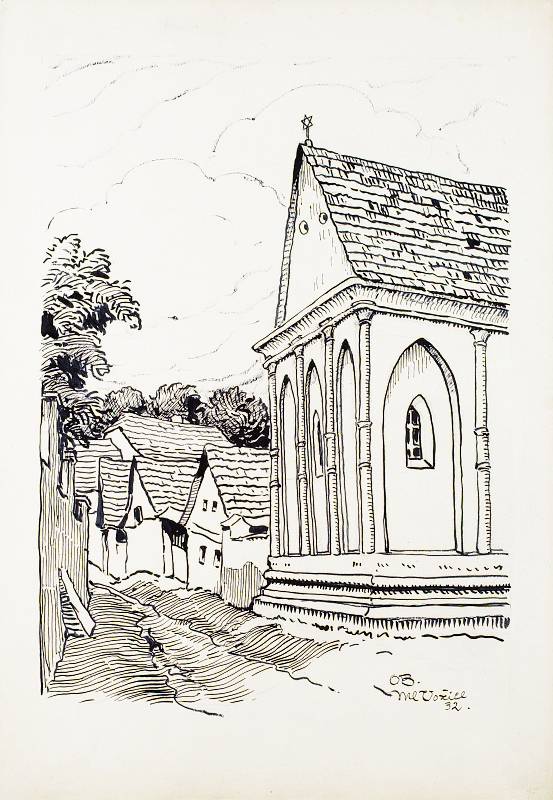
The synagogue built in the mid-nineteenth century is described by the South Bohemian region's guide to Jewish monuments as Neo-Gothic. Its appearance is known from a pen drawing signed 'O.B., Ml. Vožice 32', made in 1932 and published by the local-history website vozice.webnode.cz. The drawing shows a free-standing hall on a raised plinth at the side of a sloping, unpaved lane lined with small gabled houses. Its long wall is divided by slender clustered pilasters into bays, each filled by a tall pointed-arch recess, and one bay has a small pointed window set high in the wall. A moulded cornice runs along the top of the wall. The steep tiled roof ends in a plain gable pierced by two small round openings, and a Star of David stands on the gable peak. The entrance front and the interior are not shown. The architect, builder, exact year of construction, seating capacity and interior arrangement are unknown.
Leben in der Synagoge
Very little is recorded of worship in the building. The Jüdische Gemeinden survey states only that regular services were held until the outbreak of the Second World War, by which time the congregation had shrunk to a few dozen people. The one object from the synagogue that is well documented is its Torah ark curtain (parochet), a silk and velvet brocade hanging donated to the community in 1855 by Moses and Chayele Liftschitz, which would have hung before the ark during services. In 1943 the curtain was sent to the Jewish Museum in Prague, the wartime collection point for Judaica from the Protectorate's destroyed communities, where it was catalogued. It went missing from the museum in 1956, reappeared in April 2013 at a Sotheby's New York sale of the Michael and Judy Steinhardt Judaica collection, was identified by the museum's curators and withdrawn, and was returned to Prague on 10 March 2014, the first successful repatriation of such an object to the Czech Jewish community from abroad.
Zerstörung
The synagogue was closed by the Nazi authorities of the Protectorate of Bohemia and Moravia by 1941 at the latest, and from the end of 1942 it stood empty. In 1943 its Torah ark curtain was taken to the Jewish Museum in Prague; what became of its other furnishings is unknown. No source read records damage to the building during the war. After 1945 there was no congregation to use or maintain it. The Jüdische Gemeinden survey says the building fell into decay after the war and was demolished around 1960. The South Bohemian Jewish heritage guide says it was partly demolished after 1949 and that the remaining masonry, which it shared with the neighbouring house, was built into a residential house that stands there today. Both accounts place the demolition under Communist rule in Czechoslovakia, but neither names who ordered or carried it out, or whether the building had first been sold; who demolished it is not recorded in the sources read.
Das Schicksal der Gemeinde
The Jews of Mladá Vožice lived under the Nazi German occupation from March 1939 and were subjected to the anti-Jewish laws of the Protectorate of Bohemia and Moravia. At the end of 1942 they were deported through Tábor to the ghetto of Theresienstadt (Terezín). According to the Jüdische Gemeinden survey, most of them were sent on about two months later to Auschwitz and to Maly Trostinec near Minsk, and were murdered there. The number of deportees, of victims and of survivors from Mladá Vožice is unknown in the sources read. No Jewish community was re-established in the town after the war, and the JewishGen cemetery survey records fewer than ten Jews living there today. The cemetery at Běleč, with its last burial before 1943, is owned by the Jewish Community of Prague. A Geni genealogy project on the Jewish families of Mladá Vožice collects their names and family histories.
Der Ort heute
The synagogue stood in Židovská Street, behind the north-west side of the main square of Mladá Vožice. According to the South Bohemian Jewish heritage guide, the masonry that survived the partial demolition, shared with the adjoining house, now forms part of a residential house on the plot; the Jüdische Gemeinden survey describes the site as occupied by a residential house. Nothing of the synagogue's Neo-Gothic exterior is recognisable. A small plaque on the house commemorates the victims of the Shoah. A group of four former Jewish houses in the same street survives. The exact house number of the synagogue plot was not found, so the map pin marks the midpoint of Židovská Street.
Bedeutende Namen
Moses (Moshe) Liftschitz
UnknownMember of the Mladá Vožice congregation; donor, with his wife Chayele (Chayil), of the synagogue's Torah ark curtain in 1855Moses Liftschitz and his wife Chayele gave the Mladá Vožice congregation a silk and velvet brocade curtain for the Torah ark in 1855, around the time the new synagogue was built. It is the only furnishing of the synagogue known to survive. Sent to the Jewish Museum in Prague in 1943, it vanished in 1956, surfaced at Sotheby's New York in 2013 and was returned to Prague in 2014. Nothing else about the couple was found.
Biografie oder Quelle →Haben Sie etwas beizutragen?
Fotos, Dokumente, Familiengeschichten oder Erinnerungen an diese Synagoge und ihre Gemeinde halten ihre Geschichte lebendig.
- Tabor (Böhmen) – section on Jung-Woschitz/Mladá Vožice
- 03. Běleč a Mladá Vožice (Jewish monuments in South Bohemia)
- Return of the Torah Ark curtain from Mladá Vožice (press release, 26 March 2014)
- Ark cover returned to Prague Jewish Museum
- Mladá Vožice (Jewish cemetery record)
- Mladá Vožice
- Jewish Families from Mladá Vožice (Jungwoschitz), Bohemia, Czech Republic
- Židovská, Mladá Vožice (OpenStreetMap way 25810695)
Share a memory or thought
No comments yet. Be the first to add one.