
Historia Mödling Synagogue
Mödling had a Jewish settlement in the Middle Ages, with a synagogue in the Judengasse (today Kaiserin-Elisabeth-Straße), until the expulsion of 1420-21. Jews returned from the 1840s, formed a prayer-house association in the 1860s and in 1888 bought Enzersdorferstraße 6, a former locksmith's workshop, which they converted into a temple. The Israelitische Kultusgemeinde Mödling became independent of Baden in 1892.
The growing community replaced the converted workshop with a purpose-built synagogue on the same plot. The Viennese architect Ignaz Nathan Reiser was chosen after several designs had been considered. The building permit was issued on 16 August 1912, the cornerstone was laid two days later on the Emperor Franz Joseph's birthday, and the solemn opening took place on 16 August 1914, days after the outbreak of the First World War. The domed building served the community for 24 years. It was attacked several times, by stone-throwers in 1927 and twice in 1938 before the November Pogrom, when it was wrecked and burned. The burnt-out shell passed to the city of Vienna, to which Mödling then belonged, and was returned to the Jewish community of Vienna in 1955. The ruin was finally cleared in November 1987, and a residential and office building now occupies the plot.
Where it stood for nearly 50 years
Historic: Enzersdorferstraße 6 (land-register entry EZ 2020, plot 1441, house no. 803), Mödling. Today: Enzersdorfer Straße 6, 2340 Mödling, Lower Austria, the residential and office building on the former synagogue plot (exact address; pin on the OpenStreetMap address point).
Otwórz większą mapę →Społeczność żydowska
Jews are recorded in Mödling before 1350, and the medieval community was expelled during the Vienna Gesera of 1420-21, when its synagogue fell to Duke Albrecht V. Settlement resumed in the 1840s. A prayer-house association existed by the 1860s, held its first burial in May 1876 and in 1888 acquired the house at Enzersdorferstraße 6. In 1892 the Israelitische Kultusgemeinde Mödling was founded as a community separate from Baden; it called itself a Cultusgemeinde from 1894. Its rabbis were Leo Bardowicz from 1892 to 1925, Wilhelm Reich briefly in 1926, and Albert Schweiger from 1926 to 1938. Presidents included Ignaz Belai (1904-1915), Ernst Moser (1916-1927), Fritz Rosenberg (1934-1935) and Alfred Eisler (1936-1938). Figures for 1938 differ within the same study: a report of May 1938 gives 530 members, while another passage gives 1,012 members in 1938, falling to 35 a year later. The community had its own cemetery, which holds 373 graves, and in 1926 Reiser also converted its administration building.
Architektura i projekt
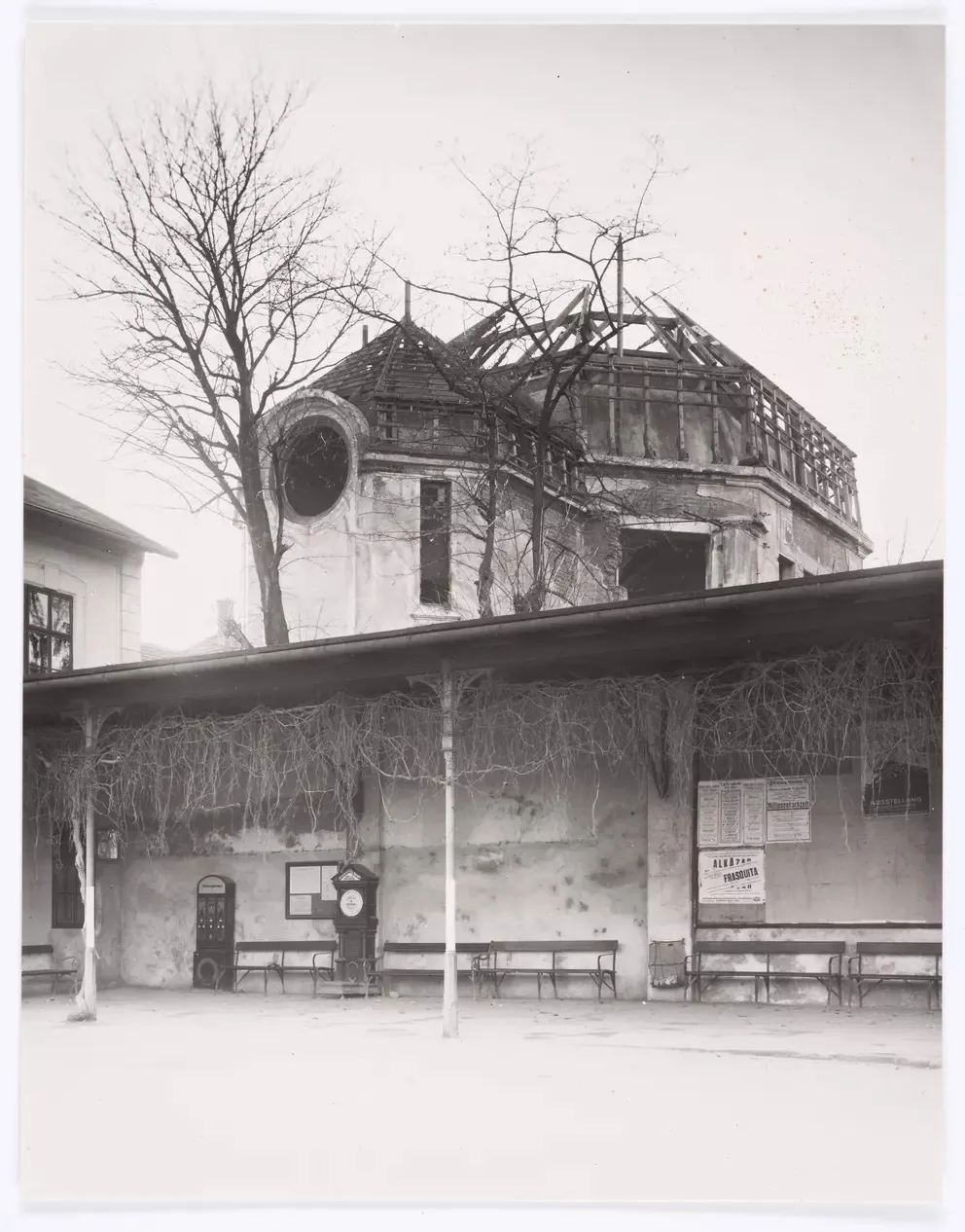
The synagogue stood on a plot of 816 square metres at Enzersdorferstraße 6, recorded in the land register as house no. 803, 'israelitisches Gotteshaus'. The local building inspection of 8 August 1912 approved the plan for 232 worshippers. Building files and newspaper reports used in Julia Neuruhrer's 2011 study mention a dome with structural calculations, crowned by a lantern, a concrete gallery, and a floor raised 60 cm above street level, with doors opening outward. Besides the main hall the building contained a winter synagogue, an entrance hall, two cloakrooms and two terraces; the main entrance was on the west front. The estimated cost of 140,000 crowns was exceeded, and the congregation appealed to its members and to the communities of Vienna and Baden for help, giving the work to local tradesmen where it could. The only photograph found, taken after the fire, shows a rendered building with a large oval window in its upper wall and the charred ribs of the dome and lantern above. Further detail of the facade, the seating and the ark is unknown.
Życie w synagodze
The synagogue was consecrated on 16 August 1914 by Rabbi Leo Bardowicz, who had served the community since its foundation in 1892 and remained until 1925. The cornerstone document, signed by community officers, had been sealed into the keystone at a ceremony on 16 November 1913. The building had a separate winter synagogue for weekday and cold-season services alongside the domed main hall. After Bardowicz, Wilhelm Reich served briefly in 1926, and Albert Schweiger was rabbi from 1926 until the community was broken up in 1938. In 1926 the community also had its administration building converted by Reiser, the architect of the synagogue. Hostility reached the building well before 1938: in April 1927 stones broke its windows. After the Anschluss, attacks on 17 May and 28 September 1938 damaged the ark, the lighting and the windows. Little else is known about the order of services or the community's institutions.
Zniszczenie
On the morning of 10 November 1938 a crowd that the Nazi local paper, the Mödlinger Nachrichten, called 'outraged national comrades' gathered at the synagogue and smashed its furnishings. A fire, which the paper attributed to a 'short circuit', was put out, but in the afternoon the building burned again; the roof and the dome burned out and the fire brigade only protected the neighbouring houses. According to Neuruhrer, the Nazi district leader (Kreisleiter) Dr. Tavs ordered the firemen to stop work at about 5 p.m., and Max Kuderna, one of the Jews seized that day, said he was tortured in the synagogue's cellar before being sent to Dachau. Fire chief Josef Mayer put the damage at about 4,000 Reichsmarks, charged to the community. In October 1940 the authorities ordered the dangerous ruin demolished within two months, but the community lacked labour and transport, and the city of Vienna bought the plot in June 1941 for 6,000 Reichsmarks. After restitution in 1955 the ruin remained until November 1987, when it was removed; who carried out that demolition is not recorded in the sources read.
Los społeczności
Persecution began immediately after the Anschluss. In the night of 11 to 12 March 1938 Nazi party members carried out house searches and confiscations among Jews and political opponents, and on 27 April Jewish shopkeepers were forced to daub antisemitic slogans on their own shops; one held his First World War bravery medal as he did so. In the night before the pogrom, the Nazi press reported, 'politically suspect' Jews in Mödling and nearby towns were arrested, and Max Kuderna was among those sent to Dachau, where he was held until December. The Kultusgemeinde Mödling was dissolved on 11 April 1939 and its property passed to the Jewish community of Vienna; its registers were handed over in 1940. The city of Vienna acquired the administration building in 1939 and the cemetery in 1940. According to Neuruhrer, almost all of Mödling's Jews were deported in the following years; she names the poet Albert Drach and the physician Dr. Eisler as two who escaped. About a third of the Jews of Lower Austria were deported and murdered. The number of Mödling victims is unknown.
Miejsce dzisiaj
A three-storey residential and office building stands on the plot at Enzersdorferstraße 6, built after the ruin was cleared in 1987. No part of the synagogue is known to survive on the site. A memorial plaque recalls the synagogue there. The Jewish cemetery of Mödling survives; it was restored in 1995-96 by the association Schalom and is maintained by the town. A Gothic doorway believed to come from the medieval synagogue is kept in the Mödling museum.
Ważne postacie
Ignaz Nathan Reiser
1863-1940Architect of the synagogue (1912-1914)Reiser, a Viennese architect born at Magyarbél in present-day Slovakia and trained at the Technische Hochschule in Vienna, was chosen to design the Mödling synagogue after several designs had been considered. Built from 1912 to 1914, it was among his principal works, alongside the Pazmanitentempel in Vienna. In 1926 he also converted the Mödling community's administration building. He died in Vienna in January 1940; his wife Rosalie was murdered at Maly Trostinec in 1942.
Biografia lub źródło →Leo Bardowicz
UnknownRabbi of Mödling, 1892-1925Bardowicz was the first rabbi of the independent Kultusgemeinde Mödling, serving from its foundation in 1892 until 1925. He led the congregation through the planning and construction of the synagogue and consecrated the new building at its opening on 16 August 1914. He served the community in the converted workshop that preceded it and then for eleven years in the new domed synagogue.
Biografia lub źródło →Albert Schweiger
UnknownRabbi of Mödling, 1926-1938Schweiger was the last rabbi of Mödling, serving from 1926 until the community was broken up after the Anschluss in 1938. He officiated in the synagogue through the attacks of May and September 1938 and was rabbi when it was wrecked and burned on 10 November 1938. His photograph is reproduced in Julia Neuruhrer's 2011 study of the synagogue. His later fate was not established in this research.
Biografia lub źródło →Ignaz Belai
UnknownPresident of the Kultusgemeinde Mödling, 1904-1915Belai headed the Mödling Jewish community from 1904 to 1915, the years in which the new synagogue was planned and built. Under his presidency the community chose Reiser's design, obtained the building permit in August 1912, raised money from members and from the communities of Vienna and Baden when costs exceeded the estimate of 140,000 crowns, and opened the synagogue in August 1914.
Biografia lub źródło →Alfred Eisler
UnknownPresident of the Kultusgemeinde Mödling, 1936-1938Dr. Alfred Eisler was the last president of the Mödling Jewish community, from 1936 until it was dissolved after the Anschluss; the community was formally wound up in April 1939. The abstract of Neuruhrer's study connects him with the construction of the synagogue, but her text dates his presidency to 1936-1938. She also names a physician Dr. Eisler as one of two Mödling Jews who escaped deportation; whether this is the same man is not stated.
Biografia lub źródło →Czy masz coś do przekazania?
Zdjęcia, dokumenty, historie rodzinne lub wspomnienia o tej synagodze i jej społeczności pomagają zachować jej historię.
- Virtuelle Rekonstruktion der Synagoge in Mödling (diploma thesis, record and abstract)
- Virtuelle Rekonstruktion der Synagoge in Mödling (full text PDF)
- "Der letzte Jude hat den Tempel verlassen": Juden in Niederösterreich 1938-1945 (summary)
- Mödling Isr. Tempel 1941 (Zerstörte Synagoge in Mödling nach dem Novemberpogrom 1938), inv. 223972/1
- Liste von Synagogen in Österreich
- Synagoge, Mödling
- Ignaz Reiser (Architekt)
- Jewish Communities of Austria: Mödling
- Enzersdorfer Straße 6, Mödling (OpenStreetMap node 2269842752)
Share a memory or thought
No comments yet. Be the first to add one.