

Historia Monor Synagogue
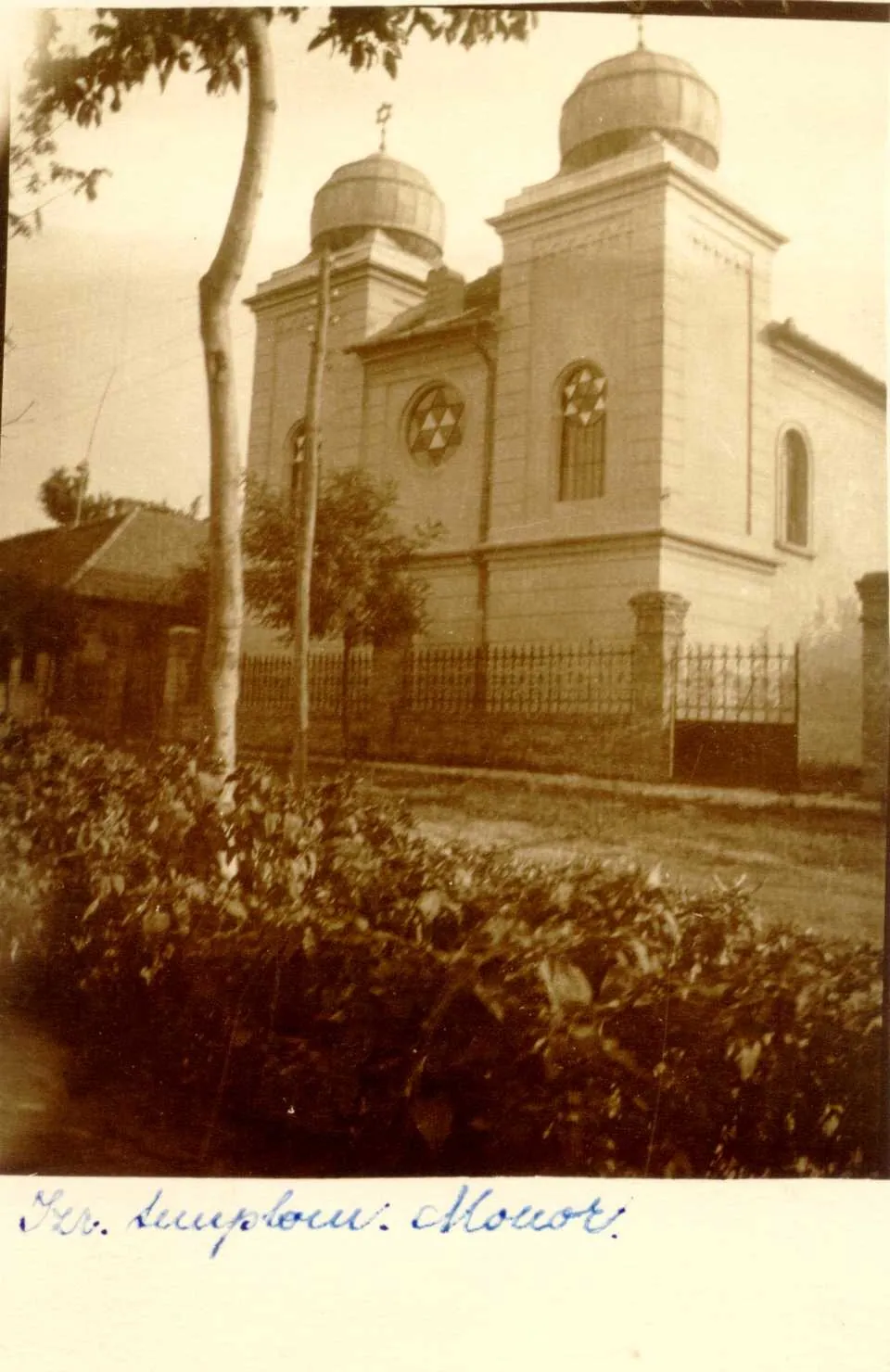
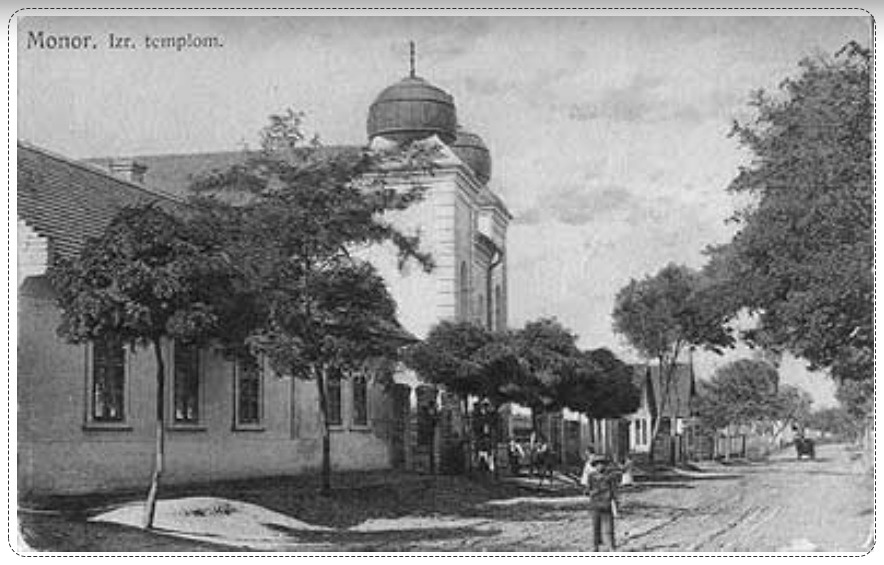
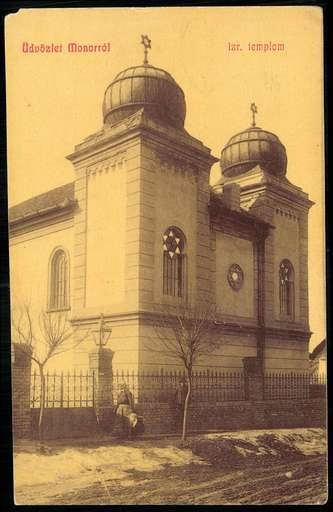
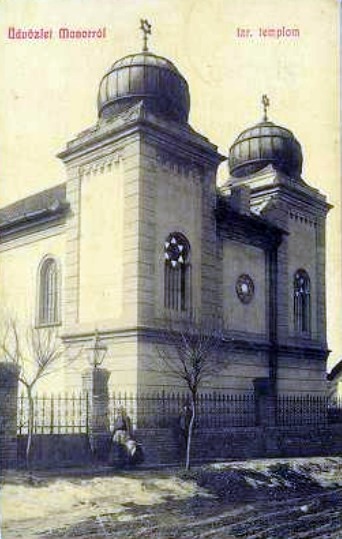
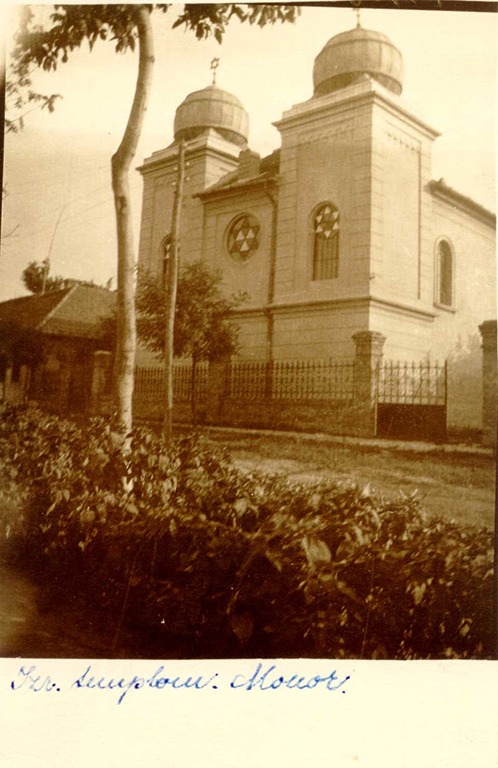
The synagogue stood on the south-western side of Vásár tér utca, later Verbőczy utca and now Dózsa György utca, a residential street a short walk south of the centre of Monor, a market town about 35 kilometres south-east of Budapest. The Jewish community was organised in 1862 with barely 25 families, and in the following year it built a synagogue with the help of a gift from Emperor Franz Joseph and donations from the townspeople. As the congregation grew, the building was enlarged to its final size in 1899 under the community president Jakab Huppert; photographs of the enlarged building show a street front with two towers crowned by ribbed onion domes. A council room, a one-room Jewish elementary school and apartments for the cantor, teacher and caretaker stood on the adjoining plots. For eight decades it was the only synagogue in Monor and the seat of a rabbinate that served a ring of villages; its last rabbi was the poet and scholar Izsák Pfeiffer. In the summer of 1944 the Jews of Monor were deported to Auschwitz, and gendarmes and Nazi German SS men desecrated the Torah scrolls and smashed the windows and doors. The damaged building stood for some years after the war, was sold with its land after 1956, and had been demolished by 1963. A private house now occupies the plot, and nothing marks the site.
Where it stood for nearly 100 years
Historic: Vásár tér utca, later Verbőczy utca 15, Monor. Today: Dózsa György utca (south-west side, between Mátyás király utca and Kistói út), 2200 Monor, Pest County, Hungary.
Otwórz większą mapę →Społeczność żydowska
Jewish families began settling in Monor after 1830; by 1848 there were about a hundred Jews, led by the merchants Mór Lőwy and Antal Feuermann. The community was formally organised in 1862 and at first belonged to the rabbinate of Pécel. At the Jewish congress of 1868 Lőwy represented Monor, which on his motion joined the Congress (Neolog) organisation. In 1885 it became an independent registry district covering the Monor and Gyömrő districts together with Kispest and Pestszentlőrinc, and Mihály Kohn became its first rabbi. Census figures show 221 Jews in 1869, 388 in 1880, 570 in 1910, 445 in 1930 and 344 in 1941; in 1929 the wider community, with its affiliated villages, counted about 850 people. A burial society dated from the 1850s, and there were a women's association, a youth group, a library and an elementary school. Jewish merchants, craftsmen, doctors and lawyers were prominent in the town: the Huppert family's timber and trading firms, Béla Fried's mill and brickyard and Ernő Popper's printing house were among Monor's main employers.
Architektura i projekt
No architect or builder is recorded for either the 1863 synagogue or its 1899 enlargement. Hungarian sources describe the rebuilt synagogue as Romantic-Moorish in style, and the historian László Csorba lists Monor among the provincial synagogues that echo the Dohány Street Synagogue in Budapest. Old postcards show a rendered hall with a pitched tiled roof and round-arched side windows. The street front had two square corner towers with banded quoins and a small arched frieze under the cornice, each carrying a ribbed onion dome topped by a Star of David. Between the towers a recessed bay held a round window with Star of David tracery, and each tower had a tall round-arched window with the same motif. A low brick wall with iron railings and brick gate piers closed the forecourt. A county directory of 1939 states that the synagogue was built for 300 people. A stained-glass window was made after 1938 in memory of the vice-president Adolf Szántó. Nothing is known of the ark, bimah or galleries, and no interior photograph has been found.
Życie w synagodze
Until 1885 rabbis came from Pécel for weddings, funerals and festivals; after that Monor had its own rabbis. Mihály Kohn led the congregation until he was killed in a railway accident in 1912. Sámuel Schlesinger, rabbi from 1914 to 1922, founded a Talmud Torah, a youth association and a library, which the community named after him when he left for Debrecen. His successor Izsák Pfeiffer, who published poetry as Izsák Pap, taught Hebrew, Jewish history and Zionism and ran literary programmes for the young. Cantor Mendel Wachs served from 1886 to 1932 and was followed by Sámuel Klein, remembered for his voice; Simon Grünfeld was the shammes. The synagogue held thirteen Torah scrolls. In 1922 the burial society set up a marble tablet inside naming the members killed in the First World War. A Torah mantle of 1825 embroidered with the crowned Hungarian coat of arms was given to the Jewish Museum in Budapest in 1933. Survivors recalled Pfeiffer's Yom Kippur prayer of 1943, spoken before the open ark for the persecuted Jews of Europe.
Zniszczenie
Antisemitic attacks came first: swastikas were daubed on the fence in 1933, and in 1940 or 1941 a stone was thrown through a window during a Friday-evening service. In the early summer of 1944 Monor's Jews were confined to designated houses, and Nazi German SS soldiers and Hungarian gendarmes were quartered in the community hall beside the synagogue. After the Jews were driven to the brickyard at the end of June, the gendarmes and SS men unrolled twelve of the thirteen Torah scrolls, dragged them through the building and yard, and smashed the ornamental windows, stairs and doors; looting followed. Hungarian Wikipedia says the building was damaged in the war, and an undated photograph shows holes in its roof. A local resident remembers prayers being held there around 1950. According to the community's memorial book, after 1956 the national Jewish representative body sold the ruined buildings and their land to private buyers, who built houses. The synagogue was pulled down around 1960 and was gone by September 1963; no source records who carried out the demolition.
Los społeczności
From 1940 Jewish men from Monor were conscripted into forced labour battalions, and many died in Ukraine and elsewhere. In the early summer of 1944 the town's Jews were moved into designated houses on Pesti and Gőzmalom streets. On 30 June they were driven to the Monor brickyard, the entrainment centre for some 7,500 Jews from the surrounding districts and the towns south-east of Budapest. Between 6 and 8 July 1944 Hungarian gendarmes loaded them into trains for Auschwitz-Birkenau. About 280 to 300 of Monor's Jews, roughly four in five, were murdered. Rabbi Pfeiffer was taken from the brickyard to the Columbus Street camp in Budapest through the Kasztner rescue effort, but after the Arrow Cross takeover he was force-marched west and died at Dachau on 3 May 1945, days after liberation. Cantor Klein survived forced labour; his wife and four sons were killed. Few survivors returned. Prayers were still held around 1950, but in 1963 the weekly Új Élet wrote that the remnant was too small to count even as a scattered community.
Miejsce dzisiaj
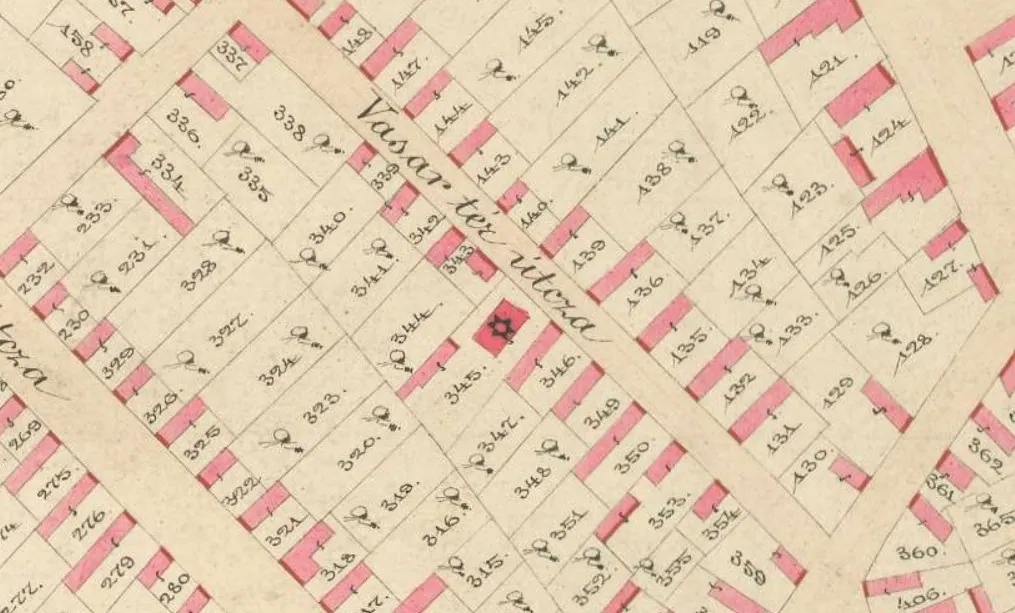
The plot lies on the south-western side of Dózsa György utca, about midway between Mátyás király utca and Kistói út. A local-history blog that matched the 1881 cadastral map to modern aerial photographs places the synagogue on a plot now occupied by a private house and garden; the memorial book instead speaks of an apartment building. A 1967 aerial photograph already shows the synagogue gone. Nothing on the street marks the site. Monor's Jewish cemetery on Bajcsy-Zsilinszky utca survives and is cared for by the Dr. Miklós László Monor Jewish Foundation, founded in 2004; a memorial to the victims was unveiled there in 1963. A street in the town is named after Rabbi Izsák Pfeiffer.
Ważne postacie

Izsák Pfeiffer (Pap Izsák)
1884–1945Chief Rabbi of Monor, 1923–1944Born in Ács and trained at the Budapest Rabbinical Seminary, Pfeiffer served in Sümeg and Pécs before coming to Monor, where he led the congregation and preached in the synagogue for two decades. A poet under the name Izsák Pap, translator and Zionist, he taught Hebrew and Jewish history and ran the youth group. Taken from the Monor brickyard to a Budapest camp in July 1944, he was later marched to Dachau, where he died on 3 May 1945.
Biografia lub źródło →
Sámuel Schlesinger
1884–1937Rabbi of Monor, 1914–1922Elected after a two-year vacancy, Schlesinger served the Monor synagogue for eight years, part of them as an army chaplain in the First World War. He founded a Talmud Torah, a youth association and a library, and had the Jewish school reopened. When he left in 1922 to become chief rabbi of the Status Quo community in Debrecen, the congregation named its library after him and hung his painted portrait in its council room.
Biografia lub źródło →Mihály Kohn
Unknown–1912First rabbi of the independent Monor community, c. 1886–1912When Monor became an independent registry district in 1885, Mihály Kohn became its first rabbi; the memorial book calls him a grandson of Mózes Kohn, the Pécel district rabbi who had served Monor when the synagogue was built. The 1929 Lexikon credits his 26 years of work with making the community one of the most notable in the country, and the 1899 enlargement took place in his time. He died in a railway accident in 1912.
Biografia lub źródło →Jakab Huppert
UnknownPresident of the Jewish communityJakab Huppert was president of the Monor Jewish community when the synagogue, by then too small for the growing congregation, was enlarged to its final size in 1899. The 1929 Lexikon names him with Márton Rosenberg and Ferenc Szilágyi as one of the presidents whose leadership let the community develop and found new institutions despite hard economic times. The memorial book's list of chairmen includes a Dr. Jakab Huppert.
Biografia lub źródło →Mór Lőwy
UnknownFounder and early leader of the communityA shopkeeper who settled in Monor before 1845, Mór Lőwy led the town's Jews by 1857 and organised the community with Antal Feuermann. According to the memorial book he went with Dávid Feuermann and Manó Hirschl to Buda to ask Franz Joseph for help with building the synagogue, and received a donation. He represented Monor at the Jewish congress of 1868, and on his motion the community joined the Congress (Neolog) organisation.
Biografia lub źródło →Sámuel Klein
UnknownCantor of the synagogue, 1933–1946Sámuel Klein succeeded Mendel Wachs as cantor of the Monor synagogue in 1933 and lived with his family in the cantor's apartment beside it. Survivors remembered his exceptionally beautiful voice and his mostly melancholy melodies; like his predecessors he also performed circumcisions. He was taken away for forced labour and survived, but his pregnant wife Gizella and their four young sons were deported and murdered in 1944.
Biografia lub źródło →Mendel Wachs
UnknownCantor and choirmaster, 1886–1932Mendel Wachs served the Monor synagogue as cantor for more than four decades, from the first years of the independent rabbinate through the 1899 enlargement to the early 1930s. The 1929 Lexikon lists him among the community's officers as choirmaster, alongside Rabbi Pfeiffer and the teacher Henrik Friedlander. He was succeeded in 1933 by Sámuel Klein.
Biografia lub źródło →Czy masz coś do przekazania?
Zdjęcia, dokumenty, historie rodzinne lub wspomnienia o tej synagodze i jej społeczności pomagają zachować jej historię.
- Bound by Fate: In Memory of the Jewish Community of Monor – Appendices 3–8 (buildings, Rabbi Pfeiffer, community leaders, Lexikon extract)
- Bound by Fate – Introduction and Chapter 1, "Peaceful" Life in Monor Before 1939
- Bound by Fate – Chapter 8, Monor After the Deportation
- Magyar Zsidó Lexikon (1929), "Monor", p. 613
- Magyarországi zsinagógák és zsidó hitközségek (survey 1980–87), Pest megye table
- A monori zsidóság története
- Sós Endre: A monori mártír-emlékmű (excerpts from Új Élet, 15 September 1963)
- Koltai (Kaufer) Tibor 1998-ban leírt visszaemlékezései
- Rólunk írták 1904–1936 között (local press extracts)
- Emlékezés: név szerinti beszámoló a vészkorszak monori zsidó áldozatairól
- A monori zsinagóga
- Monor (Története)
- A katolikus egyesületek hitéleti, kulturális és társadalmi szerepe a Pest megyei Monoron, 1763–1949, p. 158
- Pest-Pilis-Solt-Kiskun vármegye és Kecskemét th. jogú város adattára (Pécs, 1939), part IV, p. 129
- Jákob háza, Izrael sátra, Budapesti Negyed 8 (1995), p. 50
- Monori zsinagóga (postcard, F70.281)
- Monor; Izraelita templom (postcard, publisher W. L., inv. 0221738)
- Dr. Pfeiffer Izsák fényképe (F66.521)
- Schlesinger Sámuel fényképe (66.501)
- Tóraköpeny / Torah mantle (64.223)
- I. Ferenc király és a magyar zsinagógai szónoklat, A Makói József Attila Múzeum Évkönyve 2 (2018), p. 327
- Pécs híres rabbijai: Dr. Pfeiffer Izsák, Új Dunántúli Napló, 20 March 1996
- Komárom-Esztergom megye településtörténeti kalauza, "Ács", p. 63
- W. Munkácsi Noémi: Pfeiffer Izsák, az ember
- A debreceni zsidó reálgimnázium értesítője 1936/37: Dr. Schlesinger Sámuel (1884–1937)
- OpenStreetMap: Dózsa György utca, Monor
Share a memory or thought
No comments yet. Be the first to add one.