
La storia di Moravský Krumlov Synagogue
Moravský Krumlov, known in German as Mährisch-Kromau, is a small town in the Znojmo district of South Moravia, south-west of Brno. Jews are first recorded there in 1402, and an organised community existed by about the middle of the fifteenth century. Around 1550 the sources mention a house of prayer with a school beside it. The community lived in its own quarter, which grew to about sixty houses; under the Moravian family laws only 49 Jewish families were allowed to live in the town, and around 1800 some 45 houses had Jewish owners. The synagogue stood in this quarter and served the community through its peak in the first half of the nineteenth century, when 356 Jews were counted in 1830, and through its long decline after 1848, when the lifting of residence restrictions drew families to Vienna, Brno and other larger cities. When the synagogue known in the twentieth century was built, and whether it replaced the prayer house of about 1550 on the same plot, is not recorded in the sources read. The town lay in the border area annexed by Nazi Germany in October 1938. In the last days of the Second World War the old town, including the former Jewish quarter, was heavily damaged, and the synagogue was among the buildings lost. Its ruin was cleared shortly after the war.
Where it stood
Historic: Jewish quarter of Mährisch-Kromau; street and house number unknown. Today: unknown site in Moravský Krumlov, Znojmo district, South Moravian Region; placeholder pin at the town centre (approximate).
Apri la mappa grande →La comunità ebraica
Jewish residents are first mentioned in Krumlov in 1402, and by the mid-fifteenth century they formed an organised community. About 1585 there were 26 Jewish families. They earned their living from the grain trade, small shop trade and peddling. Their numbers were capped by law at 49 families, and around 1800 about 45 houses in the town belonged to Jews. The community was largest in the first half of the nineteenth century: 356 Jews lived there in 1830. After the reforms of 1848 many families left for larger cities, and the figures fell to 276 in 1856 (about 16 per cent of the town), 226 in 1869, about 140 in 1880 and 116 in 1900 (about 5 per cent). The Jewish quarter kept its own political municipality until the 1860s, and a German-language Jewish school continued after that. Emigration after the First World War left the community close to dissolution; in 1930 only 34 Jews lived in the town itself, about one per cent of the population, and about 360 in the whole judicial district. The community also kept a cemetery founded in the sixteenth century.
Architettura e design
No description, plan or photograph of the Moravský Krumlov synagogue was found in the sources read for this entry, so its date, architect, style, size and seating capacity are all unknown. The only early building the sources name is a house of prayer mentioned around 1550, which had a school attached; whether the synagogue destroyed in 1945 was that building, a rebuilding of it, or a later structure on another plot is not stated. What can be said is that it stood within the compact Jewish quarter of about sixty houses, which grew up in the old town and was hemmed in by the legal limit of 49 resident families. A general view of the town on a postcard of about 1920 shows the old town packed below the castle hill, but the synagogue cannot be picked out in it. The standard Czech inventories of Jewish monuments, and the 1929 history of the community by Heinrich Flesch, are the most likely places to find a description and may also hold a photograph.
La vita nella sinagoga
Very little is recorded about worship in the Moravský Krumlov synagogue. The sources read name no rabbi, cantor or community officer. The prayer house of about 1550 had a school next to it, and in the nineteenth century the community ran a German-language Jewish school, which outlasted the end of the quarter's separate political status in the 1860s. The best-known person to grow up in the congregation is Löw Schwab, born in the town in 1794 as the son of a peddler. He went to Nikolsburg (Mikulov) in 1805 to study under the Moravian chief rabbi, completed his rabbinical training in Pressburg, and from 1836 served as rabbi of Pest, where he worked for the emancipation of Hungarian Jews and initiated the building of the Great Synagogue. By the 1930s the congregation in the town had shrunk to a few dozen people, and the scale of services in those last years is unknown.
Distruzione
The synagogue had no congregation left after the autumn of 1938, when the last Jewish families were expelled from the town following the entry of Nazi German troops; what it was used for between 1938 and 1945 is unknown. Its end came at the close of the war. On the night of 7 May 1945, the last night of the war in Europe, Moravský Krumlov was heavily bombed by the Soviet air force, and three quarters of the town were left in ruins. The former Jewish quarter was badly hit by the fighting of 1945, and only about half of its roughly sixty houses survived. The synagogue was also destroyed, and its ruin was pulled down soon afterwards. The sources read do not say outright that the synagogue was hit in the Soviet raid rather than in other fighting of those days, nor whether it had already been damaged or stripped under Nazi rule, and who demolished the ruin, and exactly when, is not recorded.
Il destino della comunità
By the time Nazi Germany annexed the Sudeten border areas in October 1938, only seven Jewish families remained in Moravský Krumlov, the community having dwindled since the First World War. Right after the arrival of the Nazi German forces in the autumn of 1938 these seven families were expelled from the town and taken to the new border with the remaining Czechoslovak state. Most Czech inhabitants were also forced to leave the town that year. Almost nothing is known of what became of the expelled families, and no record of their deportation, death or survival was found in the sources read. No Jewish community was re-established in the town after 1945. The Jewish cemetery survives with more than 400 gravestones, the oldest dated 1613.
Il luogo oggi
The exact plot on which the synagogue stood has not been identified in the sources read, so it is not possible to say what occupies it today. Only about half of the houses of the former Jewish quarter survived the war damage of 1945, and the rest of the old town was rebuilt after the war. The Jewish cemetery, founded in the sixteenth century, still exists with more than 400 gravestones, the oldest from 1613; a plaque at its entrance gate commemorates the victims of the Holocaust. The map pin for this entry marks the centre of Moravský Krumlov and should not be read as the site of the synagogue.
Nomi importanti
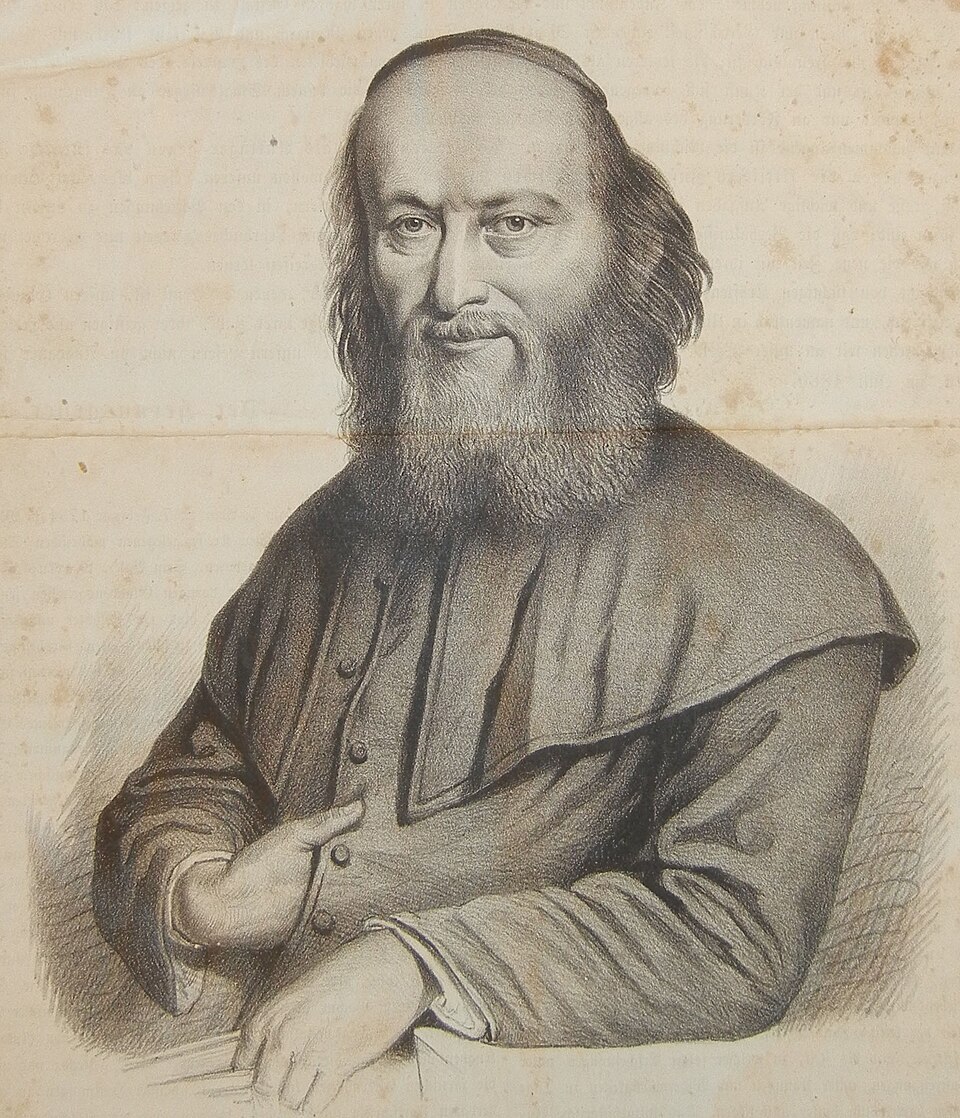
Löw (Leopold) Schwab
1794-1857Native of the Moravský Krumlov congregation; later rabbi of PestSchwab was born in Mährisch-Kromau in 1794, the son of a Jewish peddler, and grew up in its congregation. In 1805 he went to Nikolsburg to study under the Moravian chief rabbi and later trained as a rabbi in Pressburg. From 1836 he was rabbi of Pest, where he campaigned for the emancipation of Hungary's Jews and initiated the building of the Great Synagogue of Budapest. He died in Pest in 1857.
Biografia o fonte →Hai qualcosa da condividere?
Fotografie, documenti, storie di famiglia o ricordi di questa sinagoga e della sua comunità aiutano a mantenerne viva la storia.
Share a memory or thought
No comments yet. Be the first to add one.