
The story of Old Synagogue of Münster
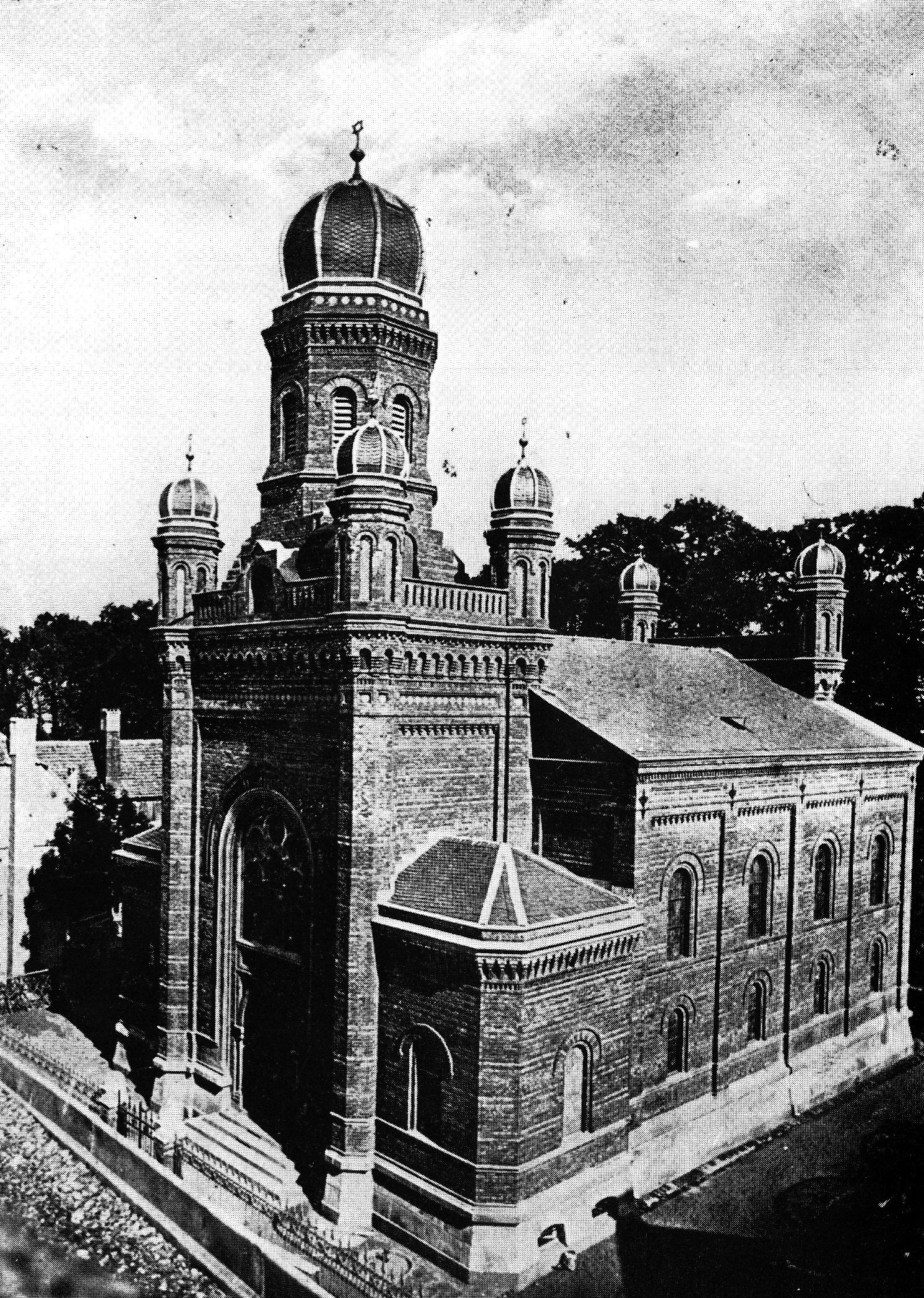
Münster's medieval Jewish community was destroyed in a pogrom around 1350, and Jews could settle in the city again only from about 1810. They first prayed in a private house, then from 1826 in a converted house on Loerstraße, where a makeshift synagogue was soon built in the garden. By around 1870 this too was too small. In 1877 the community bought a plot from the city between Klosterstraße and the Promenade, the tree-lined ring around the old town, and in 1878 held an architectural competition that drew 32 entries. It was won by Karl Hofmann, then in his early twenties. His Romanesque Revival building, given a Byzantine touch by its onion domes, was consecrated in 1880. Neither the district president nor the mayor attended, and the local press gave it four lines. On the night of 9–10 November 1938 Nazis set the synagogue on fire. The community was then ordered to clear the ruins at its own cost, and the city bought the site for 28,000 Reichsmarks. A new synagogue was built on the same site in 1961.
Where it stood for 58 years
Historic: Klosterstraße, between Klosterstraße and the Promenade, Münster. Present day: Synagogue of the Jewish Community of Münster, Klosterstraße, Münster, Germany.
Open larger map →The Jewish community
A Jewish community existed in medieval Münster, with a synagogue and ritual bath in the quarter behind the town hall, but it was wiped out in a plague pogrom around 1350 and its property seized. The only surviving gravestone, from 1324, is the oldest surviving Jewish gravestone in Westphalia. No Jewish community existed in Münster again until the Napoleonic era. From about 1810 Jews were allowed to settle permanently. The community grew steadily, from 312 members in 1858 and 371 in 1871 to 502 in 1900 and 637 in 1910, and numbered about 650 in 1933. Jews played an important part in the city's economic life, and before 1933 organised antisemitism found little echo in Münster, though religiously motivated hostility to Jews was widespread.
Architecture and design
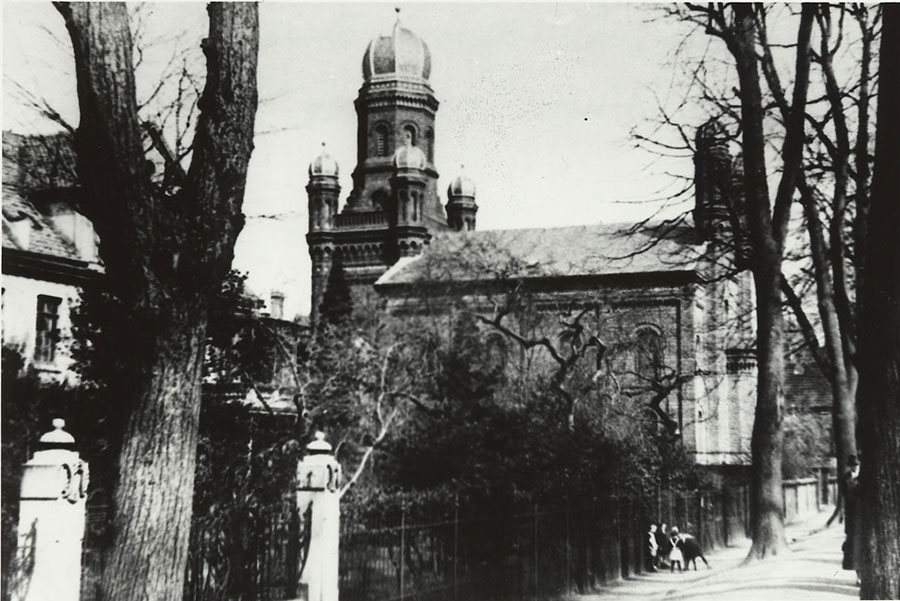
In 1878 the community held an architectural competition for its new synagogue, which drew 32 designs. The winner was Karl Hofmann (1856–1933), who had just finished his studies in Berlin and Vienna; the synagogue was his first work, and he later became a professor at the Technical University of Darmstadt. His building was in the Romanesque Revival style, and the onion domes set on top gave it a touch of Byzantine Revival. A photograph from 1903 shows a tall central tower with an onion dome, smaller domed turrets at the corners and round-arched windows. The board wanted a building on a prime site that would be an ornament to the provincial capital and of monumental value, and it took out a forty- to fifty-year loan to pay for it.
Life inside the synagogue
The community built the synagogue with great confidence in the future, choosing a prominent site on the Promenade and taking on a loan meant to run for two generations. The wider city was less welcoming: neither the Regierungspräsident nor the mayor came to the consecration on 27–28 August 1880, and the local press reported it in a four-line note. The synagogue served the congregation for 58 years. Its last rabbi, Fritz Leopold Steinthal, emigrated to Argentina in 1938. The names of earlier rabbis and cantors, and details of the building's interior and seating, are not recorded in the sources consulted.
Destruction
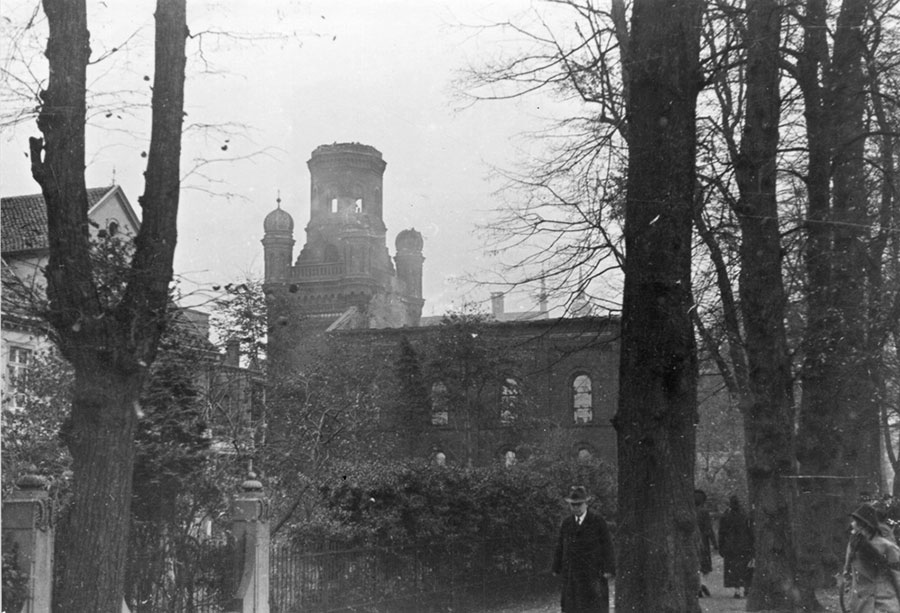
On the night of 9–10 November 1938 Nazi SA men set the synagogue on Klosterstraße on fire. The Münster fire brigade did not intervene until flying sparks threatened the buildings nearby, including the mother house of the Sisters of Mercy across the street, the Hedwig clinic and the Raphael clinic. The synagogue was completely destroyed. In April 1939 the city ordered the Jewish community to clear the ruins at its own expense, and then bought the cleared site for the knock-down price of 28,000 Reichsmarks. From 1939 air-raid trenches and a firefighting water pond were built on the plot. In November 2011, during excavations for an extension of the new synagogue, remains of the old foundations were found where the Torah ark had stood.
The community’s fate
The boycott of Jewish shops began in Münster on 29 March 1933, when SA and SS men blocked the entrances to department stores. The community fell from about 650 in 1933 to about 420 in 1937. In mid-December 1941 nearly 400 Jews from the Münsterland were held in the Gertrudenhof restaurant before being deported, most of them to the Riga ghetto, where almost all died. From February 1942 the remaining Münster Jews were concentrated in the building of the Marks-Haindorf foundation and deported in mid-1942 to Riga and in spring 1943 to Theresienstadt. More than 250 Jews from Münster were murdered in the Holocaust.
The site today
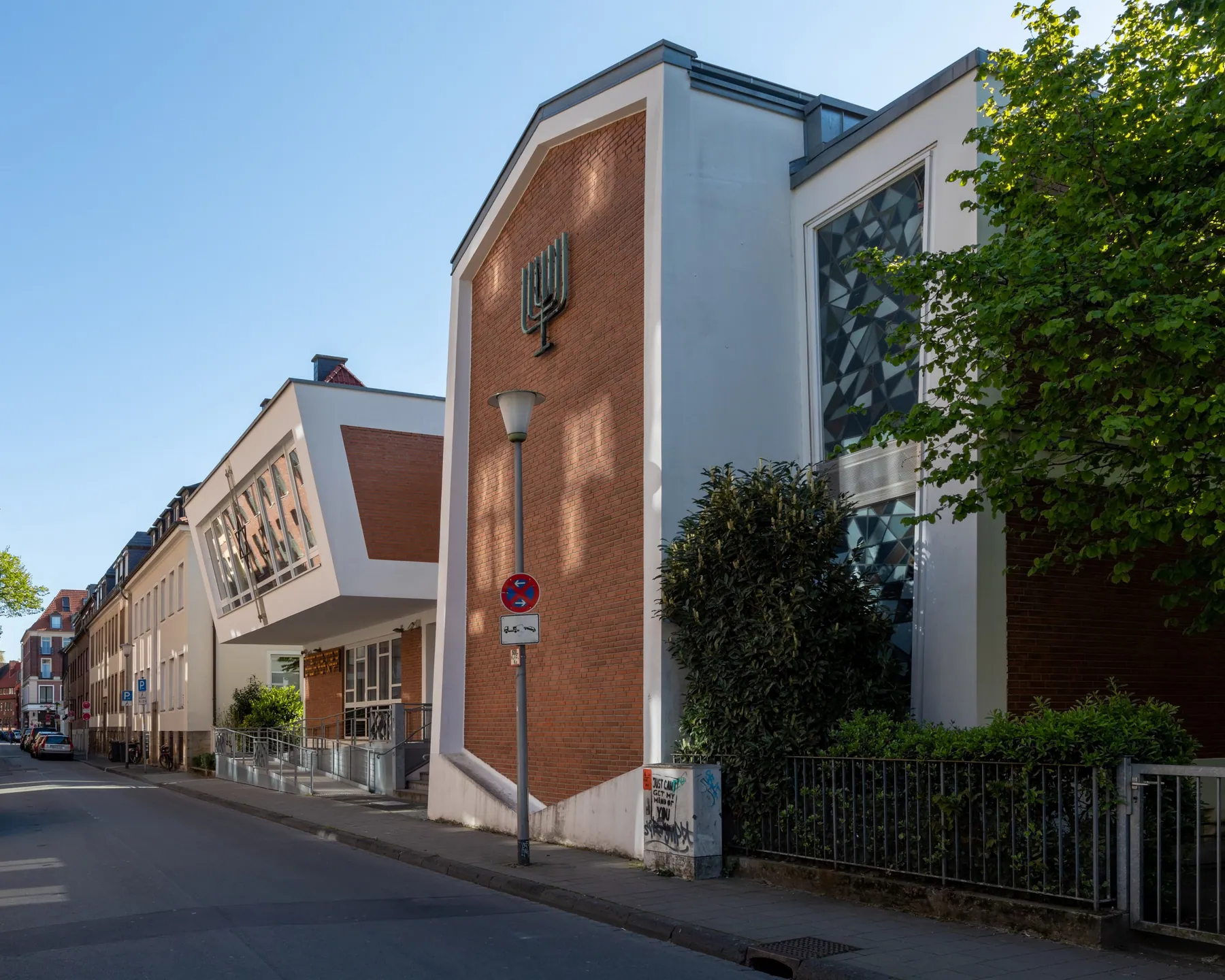
The site of the old synagogue on Klosterstraße, on the Promenade, is again home to Jewish worship. After the war a small community gathered in private rooms, and on 12 March 1961 a new synagogue by the architect Helmut Goldschmidt was consecrated on the old site. Its segmented brick body is said to recall the barracks of Auschwitz. With the arrival of Jews from the former Soviet Union the community grew, and an extension by Nathan Schächter opened in 2012, when the foundations of the old synagogue were uncovered.
Notable names
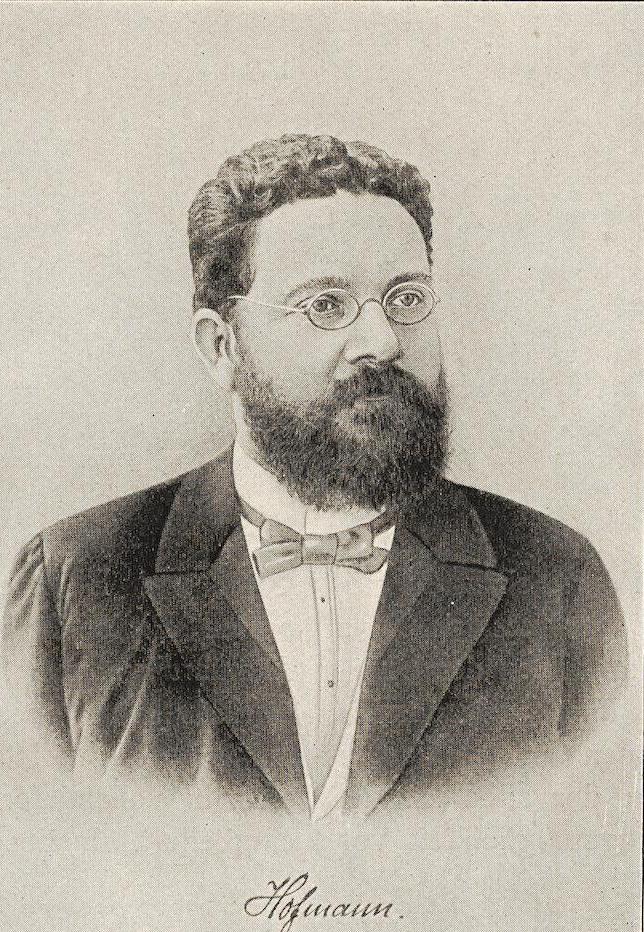
Karl Hofmann
1856–1933ArchitectKarl Hofmann won the competition for the Münster synagogue straight after his studies in Berlin and Vienna; it was his first building. His Romanesque Revival design with onion domes was consecrated in 1880. He went on to design hospitals and public buildings in Worms and Hesse and became a professor at the Technical University of Darmstadt.
Biography or source →Fritz Leopold Steinthal
20th centuryRabbiFritz Leopold Steinthal was the rabbi of Münster's Jewish community in the years before the November pogrom. He emigrated to Argentina in 1938, the year the synagogue on Klosterstraße was burned by Nazis. His community was deported in 1941–1943, and more than 250 Münster Jews were murdered in the Holocaust.
Biography or source →Do you have something to contribute?
Photographs, documents, family stories or memories of this synagogue and its community help keep its history alive.
Share a memory or thought
No comments yet. Be the first to add one.