
The story of Mutěnín Synagogue
Mutěnín, called Muttersdorf in German, is a small village in the Domažlice district of the Plzeň region, close to the Bavarian border. Jews are recorded there from 1635, when Abraham Ditl lived in house No. 85, and by 1669 six Jewish families, about forty people, had settled in the village. In 1662 they asked permission to build a small wooden synagogue, which according to Jüdische Gemeinden was set up around 1660 without the lord's consent and in the face of objections from the parish priest.
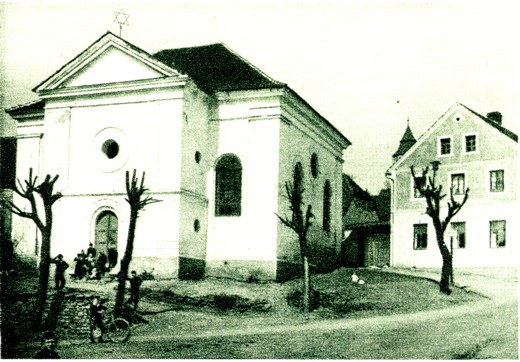
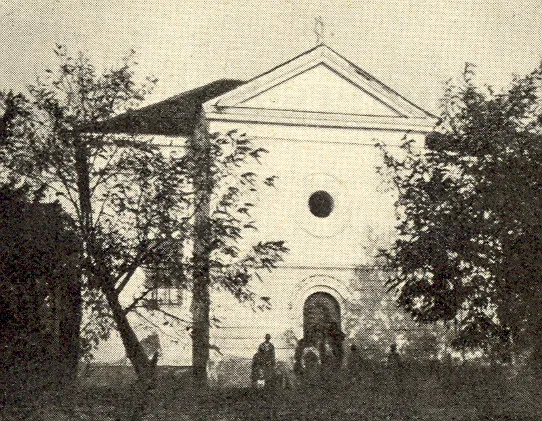
That wooden building was replaced in 1860 by a new synagogue in the classicist style, raised on a plot that had held three houses, one of them later numbered 67. JewishGen's cemetery survey names the master builder as Georg Halla. The village website says the building was reconstructed at great expense in 1923, by which time only about two dozen Jews remained. Surviving photographs show a whitewashed gabled hall with a Star of David on its apex.
The congregation ceased to exist in 1938. Jüdische Gemeinden and the village website both state that the synagogue was destroyed during the Nazi period; JewishGen's survey adds that the Nazis blew it up in 1938. The Jewish cemetery on the Hinterer Schafberg, with about 160 gravestones, is the community's main surviving monument.
Where it stood for nearly 80 years
Historic: Muttersdorf, Bezirk Taus, Bohemia; plot of former houses including No. 67 (exact location not identified). Today: Mutěnín, 345 25, Domažlice district, Plzeň region; pin at village centre (approximate).
Open larger map →The Jewish community
Jewish families are said to have settled in Muttersdorf during the Thirty Years' War. The earliest written evidence is a report of 1669 by Tobias Hankelia, parish priest of Domažlice (Taus), which states that Abraham Ditl lived in house No. 85 in 1635. In 1669 six Jewish families with about forty people lived in the village, and in 1747 there were fourteen families with 49 members. The community peaked in the 1830s: Jüdische Gemeinden gives 154 Jews in 1832, counting those of nearby Wasserau (Ostrov), and 110 in 1837. Numbers then fell steadily as families moved to the towns. The village website gives 65 in 1880, 43 in 1900, six families with 23 people in 1920 and 21 people in 1930; Jüdische Gemeinden gives about 90 around 1880 and in 1893. In its last years the congregation was kept going with the help of a few families from Weißensulz, Wasserau, Schwanenbrückl and Hostau. Its lay leaders included Jonas Fleischner, Simon Schwarzkopf and Bernhard Oesterreicher from the 1850s, Oesterreicher serving until 1897, then Albert Wolf until 1921 and Ferdinand Steiner from 1921. Jewish registers survive from 1793.
Architecture and design
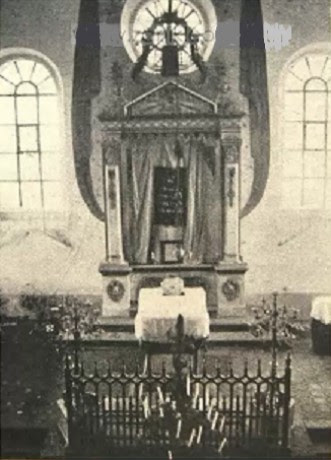
The first synagogue, built around 1660, was a small wooden structure. Its 1860 successor was a masonry building in the classicist style; JewishGen's cemetery survey names its master builder as Georg Halla, and the village website records a costly reconstruction in 1923. Two historic photographs show the exterior. The entrance front was a broad gable treated as a triangular pediment, with a moulded cornice and a Star of David on the apex. Below it was a round window, and at ground level a round-arched doorway. The walls were plastered and whitewashed, and the hall had a pitched roof. The long side wall had a tall round-arched window above a small round window, a two-storey arrangement that suggests a women's gallery inside. The building stood free on an unpaved village square beside two-storey gabled houses. An interior photograph shows tall round-arched windows, a Torah ark framed by columns and a pediment beneath the tablets of the Law and a round window, and in front of it a raised reader's platform enclosed by an ornamental iron railing with candelabra. The capacity and the exact plan are unknown.
Life inside the synagogue
The synagogue was the centre of a small rural congregation that also kept a rabbi's house containing a mikveh, a ritual bath, and had its seat in house No. 131, which no longer stands. A Jewish school is mentioned as early as 1743 or 1747 in the house later numbered 67, on the plot where the 1860 synagogue was built; a Jewish elementary school operated from 1829 to 1870. No rabbi of Muttersdorf is named in the sources consulted. The congregation was run by its elected leaders: Jonas Fleischner, Simon Schwarzkopf and Bernhard Oesterreicher in the 1850s, Albert Wolf until 1921 and Ferdinand Steiner afterwards. The dead were buried in the community's own cemetery on the Hinterer Schafberg south-east of the village, laid out around 1640, where people from Wasserau (Ostrov) and Schwanenbrückl (Mostek) were also buried. The interior photograph shows a well-furnished hall with an ornate ark and an enclosed reader's platform, and the 1923 reconstruction shows that the congregation still invested in the building when it numbered only a few families.
Destruction
By 1938 the congregation had shrunk so far that it was dissolved, and the synagogue lost its users. Jüdische Gemeinden states only that the synagogue building was destroyed during the Nazi period, and the village website, drawing on the historian V. Fred Chvátal of the Tachov museum, says the same, without a date. JewishGen's International Jewish Cemetery Project entry for Mutěnín gives the most specific account: the synagogue was blown up by the Nazis in 1938. A hiking guide entry for the Jewish cemetery likewise says the synagogue was destroyed by the Nazis. None of these sources names the unit or the officials responsible, gives a day or month, or says whether the building was first looted or burned. No document of the destruction was found, and no source mentions any remains of the building being cleared after 1945.
The community’s fate
The Jewish community of Muttersdorf ceased to exist in 1938. According to the village website and Jüdische Gemeinden, only one Jewish family was still living in the village in 1939, during the German occupation. Most members had left in the preceding decades for larger towns, and their later fates are largely unknown; the last community leader, Ferdinand Steiner, still in office in 1934, is recorded with the note that his further fate is unknown. Yad Vashem's records, as cited by both the village website and Jüdische Gemeinden, list nine Holocaust victims from Mutěnín. The sources consulted do not say where these nine lived at the time of deportation, which transports took them or where they were murdered. No Jewish community was re-established in the village after the Second World War. The cemetery on the Hinterer Schafberg survives with about 160 gravestones and fragments, the oldest legible ones from the first half of the eighteenth century, though it has suffered from vandalism and neglect.
The site today
The synagogue stood on a plot formerly occupied by three houses, one of them house No. 67, according to the village website, but the sources consulted do not identify that plot on a present-day map or say what stands there now. No remains of the building are recorded. The map pin for this entry marks the centre of the village and not the synagogue itself. The Jewish cemetery, about a kilometre south-east of the village on the Hinterer Schafberg in the Český les nature park, is the community's surviving site; it is reached by a marked path and holds about 160 gravestones and fragments.
Notable names
Georg Halla
UnknownMaster builder of the synagogueJewishGen's International Jewish Cemetery Project entry for Mutěnín names Georg Halla as the master builder of the Muttersdorf synagogue, in the same note that records its renovation in 1923 and its destruction in 1938. The entry does not make clear whether he built the classicist synagogue of 1860 or carried out the 1923 reconstruction. No other information about him was found.
Biography or source →Bernhard Oesterreicher
UnknownLeader (Vorsteher) of the Muttersdorf congregation, 1850s to 1897Oesterreicher is named on the village website, in a text by the Tachov historian V. Fred Chvátal, as one of the leaders of the Muttersdorf Jewish community from the 1850s together with Jonas Fleischner and Simon Schwarzkopf, and he remained in office until 1897. His term therefore covered the building of the classicist synagogue in 1860 and the decades of the community's largest membership after it. Nothing further about his life was found.
Biography or source →Albert Wolf
UnknownLeader of the Muttersdorf congregation until 1921The village website lists Albert Wolf as leader of the Jewish community of Muttersdorf until 1921, following Bernhard Oesterreicher. He led the congregation during its steep decline at the beginning of the twentieth century, when membership fell from about 43 people in 1900 to six families in 1920. No dates of birth or death and no further details were found.
Biography or source →Ferdinand Steiner
UnknownLeader of the Muttersdorf congregation from 1921, still in office in 1934Steiner became leader of the Muttersdorf Jewish community in 1921 and was still in office in 1934, according to the village website. He therefore headed the congregation when the synagogue was reconstructed at great expense in 1923 and during its last years before it was dissolved in 1938. The website states that his later fate is unknown.
Biography or source →Do you have something to contribute?
Photographs, documents, family stories or memories of this synagogue and its community help keep its history alive.
Share a memory or thought
No comments yet. Be the first to add one.