
The story of Myjava Synagogue
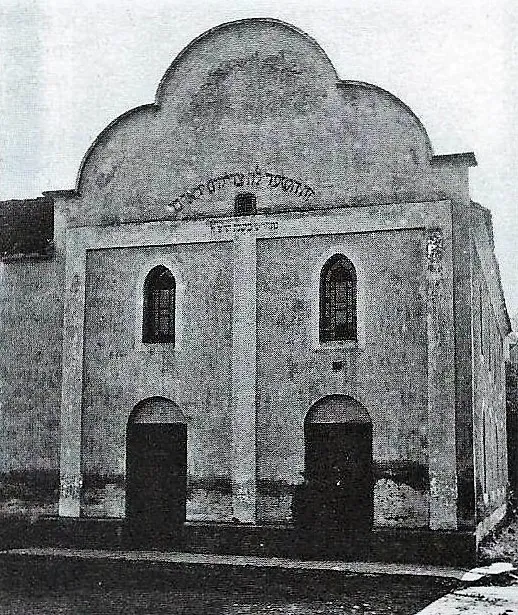
Myjava, known in Hungarian as Miava, lies in the hill country of western Slovakia near the Moravian border, about 85 km north-east of Bratislava. Jewish families are said to have settled there in the seventeenth century after expulsions from Moravia, and for a long time the community depended on Strážnice across the border before becoming independent around the middle of the nineteenth century. Its synagogue stood in the town centre, in the courtyard behind what was later the Myjava Bank building, close to the present Námestie M. R. Štefánika. Local sources, the town chronicle and the regional news site of TIK Záhorie, call it the synagogue 'of 1791'. The German-language reference site Jüdische Gemeinden gives a different sequence: a prayer house from about 1790, replaced by a newly built synagogue in the mid-1840s. Whether these refer to one building or two is not settled by the sources read. The only known photograph shows a plain rendered hall with a curved, scalloped gable and a Hebrew inscription across the front. The community peaked at 430 people in 1880 and was much reduced by emigration before the Second World War. During the Nazi German occupation of 1944-45 the interior was wrecked and the hall was used as a stable. It stood empty after the war and was pulled down in 1964-1966.
Where it stood for nearly 180 years
Historic: Myjava (Miava), courtyard of the former Myjava Bank (Myjavská banka), town centre; house number unknown. Today: the marketplace (trhovisko) on Námestie M. R. Štefánika, 907 01 Myjava, Trenčín region (approximate).
Open larger map →The Jewish community
According to Jüdische Gemeinden, which draws on the Encyclopedia of Jewish Life before and during the Holocaust, Jews came to Myjava in the seventeenth century, driven out of parts of Moravia. The community was at first attached to the congregation of Strážnice (Straßnitz) in Moravia and became autonomous around the middle of the nineteenth century; its first rabbi was Joseph Honig. Besides the synagogue it ran an elementary school and a Talmud Torah, and a burial society, the Chevra Kadisha, looked after the Jewish cemetery. The community counted 75 people in 1786, 183 in 1828 and 430 in 1880, its highest figure. In the revolutionary unrest of 1848 a mob looted and partly destroyed Jewish property in the town. Emigration grew around 1900 and increased after the First World War, partly encouraged by Zionist activity, so that there were 204 Jews in 1919, about 165 in 1930 and about 110 in 1940. The Orthodox community of nearby Turá Lúka, with its own prayer house and mikveh, was a separate congregation.
Architecture and design
The architecture is known only from one undated black-and-white photograph published by TIK Záhorie and reproduced by Jüdische Gemeinden. It shows the entrance front of a free-standing rendered hall, seen almost straight on. The facade is divided into two bays by three flat pilasters standing on a low plinth. Each bay has a round-arched doorway at ground level, perhaps one for men and one leading to a women's gallery, and a tall round-arched window above. Over a plain cornice rises a large curved gable with a scalloped outline of three lobes, its lower edge carrying a painted Hebrew inscription in two lines; a small square opening sits at the centre. A lower roof joins at the left and the long side wall runs back at the right. The curved gable recalls late Baroque and early nineteenth-century synagogues of Moravia and western Slovakia, but no source describes the style, and the architect, builder, seating capacity, interior and Torah ark are all unknown.
Life inside the synagogue
Very little is recorded about worship in the building. Jüdische Gemeinden names Joseph Honig as the first rabbi of the independent community, but gives no dates for his service, and no later rabbis, cantors or officers were found in the sources read. The synagogue formed part of a small communal group with the elementary school and the Talmud Torah; the town chronicle notes that the Jewish school stood near the synagogue. The two doors in the photograph suggest separate entrances, possibly for men and for women going up to a gallery, but this is an inference from the picture. The Hebrew inscription on the gable, which would have given a verse and perhaps a date, cannot be read with confidence in the available reproduction. With the community shrinking from 430 people in 1880 to about 110 in 1940, the synagogue in its last decades served a congregation of a few dozen families.
Destruction
Jüdische Gemeinden states that during the Nazi German occupation of 1944-45 the synagogue's interior furnishings were destroyed and the building was turned into a stable. The source does not say whether German troops or local men did the damage. After the war few Jews returned, and the building was not used again as a synagogue. The TIK Záhorie report of 2016 says only that it was demolished after the war. The Myjava town chronicle for 2016 is more precise: it records that the synagogue was demolished in 1964-1966, and that the Jewish school standing nearby met the same fate in 1968. Both demolitions therefore took place under the Communist government of Czechoslovakia. No source read names the body that ordered or carried out the demolition, or says whether the building was first sold or transferred by the Jewish community.
The community’s fate
When the Second World War began about 120 Jews lived in Myjava. Under the Slovak State they were subject to its anti-Jewish laws and to harassment by the Hlinka Guard. Deportations began in late March 1942, first to Auschwitz and Majdanek; in the summer of 1942 whole families were sent to ghettos and camps in the Lublin district of occupied Poland. When Nazi German troops entered the area in September 1944, the Jews who had remained were seized and deported as well, and only a few escaped. According to Jüdische Gemeinden only a few survivors came back after the war, and no organised community was re-established. The number of victims from Myjava is not stated in the sources read, although the 2016 commemoration at the synagogue site read out some five hundred names of Holocaust victims.
The site today
The synagogue stood in the courtyard of the former Myjava Bank, next to Námestie M. R. Štefánika in the centre of the town. The plot is now the town marketplace (trhovisko), with a grassed area beside it. No part of the building survives. A black granite memorial with a Star of David, unveiled on 18 September 2016, stands on the site and says that a synagogue stood here. The Jewish school that stood nearby has also gone, while the Jewish cemetery of Myjava survives on a hillside in the town.
Notable names
Joseph Honig
UnknownFirst rabbi of the independent Myjava community, mid-19th centuryJüdische Gemeinden names Joseph Honig as the first rabbi of Myjava after the congregation became independent of Strážnice around the middle of the nineteenth century, which would make him rabbi soon after the synagogue was built or rebuilt. No dates of his service, birth or death, and nothing further about his work in the town, were found in the sources read.
Biography or source →Do you have something to contribute?
Photographs, documents, family stories or memories of this synagogue and its community help keep its history alive.
Share a memory or thought
No comments yet. Be the first to add one.