
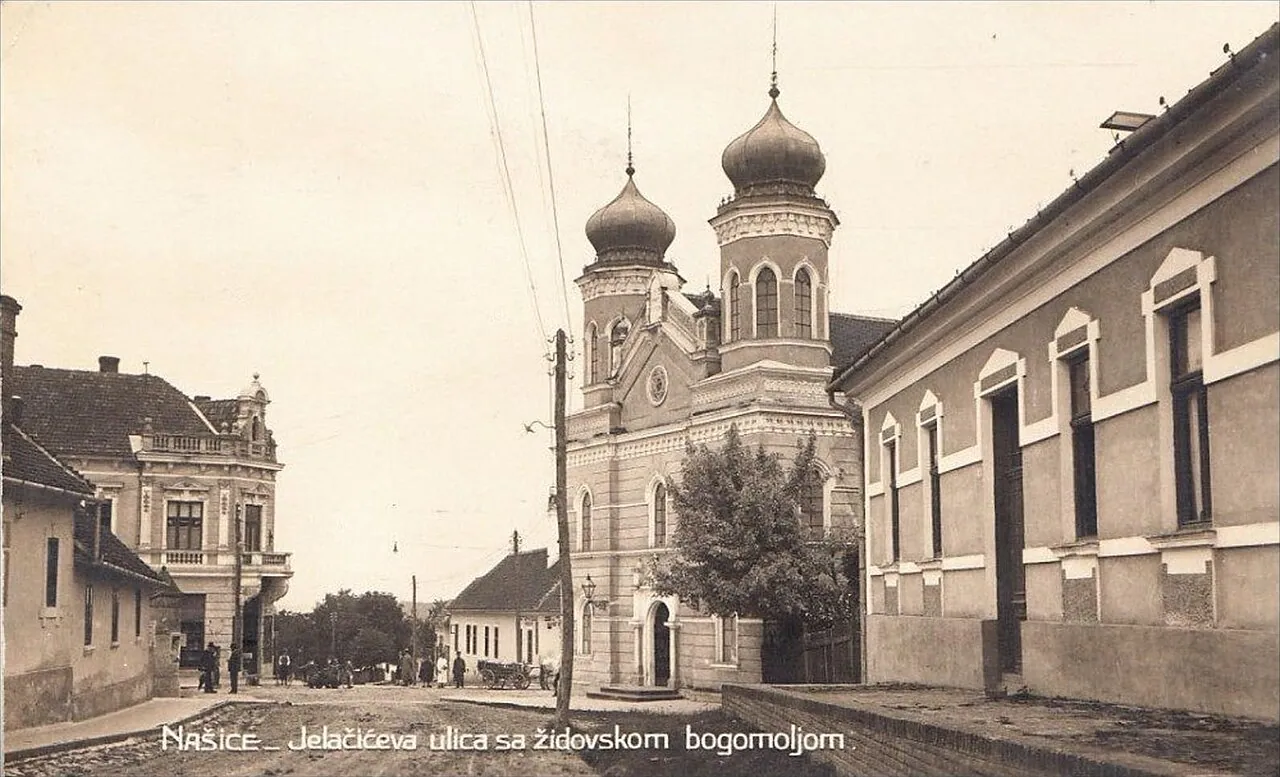
The story of Našice Synagogue
Našice is a market town in western Slavonia, in today's Osijek-Baranja County. Jews were living there by the early nineteenth century: the oldest stone in the Jewish cemetery dates from 1835. The historian Hrvoje Volner counted 75 Jews in the town in 1857 and 237 in 1910, more than eight per cent of its population, with 610 in the wider Našice district; growth came mainly from immigration. A rabbi, Samuel Winter, is recorded from about 1881, and in 1884 the Našice rabbi also took over the duties of the Orahovica rabbinate.
Between 1893 and 1898 the community built its synagogue in the town centre, not far from the main square; a postcard captions its street as Jelačićeva ulica. The architectural historian Zlatko Karač places it among the Croatian synagogues with two towers on the main front and describes its late Rundbogenstil detailing. The community was at its height around 1910; it shrank in the 1920s and 1930s as members moved to larger cities, and numbered 205 in 1937-38. After the Independent State of Croatia (NDH) was proclaimed in April 1941 the community came to an end, and in the spring of 1942 the synagogue was demolished. The land, recorded in the land registry as plots 212 and 213, was confiscated by the state in 1948.
Where it stood for 44 years
Historic: Jelačićeva ulica, Našice, near the main square; land registry folder 37, plots 212 and 213; house number unknown. Today: probably Ulica bana Josipa Jelačića in central Našice, 31500 Našice, Osijek-Baranja County; exact plot not identified (approximate).
Open larger map →The Jewish community
According to Volner's study of the census and registers, the Jews of the Našice district numbered 242 in 1857, 388 in 1880, 493 in 1890, 599 in 1900 and 610 in 1910. In the town itself there were 75 Jews in 1857, 139 in 1890, 200 in 1900 and 237 in 1910, and the share of the district's Jews who lived in the town rose from about a third to about two-fifths. They were mostly merchants, with a number of craftsmen. Jewish shareholders supplied most of the capital for the Našice-Virovitica railway; Jews were members of the volunteer fire brigade from its foundation in 1888; and the entrepreneur Žiga Heim co-founded the Lisinski singing society and was its president in 1893 and 1904. After the First World War the community declined, as many members left for larger cities after an economic crisis. Figures collected by Srdjan Matić give 390 Jews in 1925-26, 314 in 1931 and 205 in 1937-38.
Architecture and design
No plan, architect or builder has been found. Zlatko Karač, as summarised in the Croatian Wikipedia article on Croatian synagogues, dates the synagogue to 1893-98, assigns it to the Croatian synagogues with two towers on the main front and calls its style late Rundbogenstil. The front was finished in shallow fluted rustication, with strongly marked horizontal cornices and polychrome decoration; the portal and gable were Neo-Romanesque, and the gable ended in framed Tablets of the Law above a medallion with a Star of David. A postcard dated 1909 confirms this: it shows a narrow street front set slightly back behind a low wall and a tree, with a round-arched portal reached by steps, tall round-arched windows, banded rendering, a gable with a round medallion, and two slender towers with arched belfry openings capped by onion domes and finials. Capacity and interior are unknown.
Life inside the synagogue
Very little is recorded about worship in the building. Rabbi Samuel Winter, who came to Našice around 1881, kept the community's registers of births, marriages and deaths; Volner notes that these registers were destroyed during the Second World War, probably in 1942, the year the synagogue was pulled down. From 1884 the Našice rabbi also carried out the duties of the Orahovica rabbinate, which suggests that Našice served as a religious centre for the Jews of the surrounding district. Which rite the congregation followed, whether it was Neolog or Orthodox in the Hungarian-Croatian sense, who its later rabbis and cantors were, and what schooling or societies met in or beside the synagogue are all unknown from the sources read. The community also kept a cemetery, established early in the nineteenth century, which still survives on Mavre Spicera Street.
Destruction
The synagogue was in use until the destruction of the community in 1941, after the Independent State of Croatia was set up under the Ustaše in April of that year. The Croatian Wikipedia summary of Zlatko Karač's research states that it was demolished in the spring of 1942, and the 2005 report of the US Commission for the Preservation of America's Heritage Abroad, the JewishGen Cemetery Discovery Project and the ESJF cemetery survey all give 1942 as the year of destruction. The demolition therefore took place under the Ustaše regime, which ruled Našice at the time, but none of the sources read says who ordered or carried it out, whether the building was looted or burned first, or what became of its materials and furnishings. The community's registers were lost at about the same time. The empty plot was confiscated by the state in 1948.
The community’s fate
When Nazi Germany invaded Yugoslavia in April 1941, Našice became part of the Independent State of Croatia, ruled by the Ustaše. The ESJF survey states that Croatian nationalists then began to persecute the Jews and that the entire Jewish community of Našice was deported and killed in death camps; the JewishGen data record that the community ended in 1941. The sources read do not name the camps to which the Jews of Našice were taken, the dates of their arrest and deportation, or the number who died. The registers kept by the community's rabbis were destroyed during the war. In 1947 only three Jews were recorded in Našice, and by 1994 none. Jewish property in the town was confiscated by the state in 1948. The cemetery on Mavre Spicera Street survives, with between about 60 and 90 standing stones according to different surveys, but was described as neglected and overgrown in 2009.
The site today
A postcard dated 1909 is captioned 'Našice - Jelačićeva ulica sa židovskom bogomoljom' (Jelačić Street with the Jewish house of worship), placing the synagogue on Jelačić Street, and Karač places it near the main square; the land registry records the plot as numbers 212 and 213 of folder 37. The sources consulted do not give a house number or say what now stands on the plot. The Croatian Wikipedia article on Našice cites a 2016 Glas Slavonije article headlined 'The Jews of Našice: the synagogue demolished, the buildings remained, the cemetery still awaits restoration', which could not be opened. The map pin marks the present Ulica bana Josipa Jelačića in the town centre, not the exact plot.
Notable names
Samuel Winter
UnknownRabbi of Našice, from about 1881Winter came to Našice around 1881 as the community's rabbi and kept its registers of births, marriages and deaths; the historian Hrvoje Volner notes that these registers were destroyed during the Second World War, probably in 1942. From 1884 the rabbi of Našice also took over the duties of the neighbouring Orahovica rabbinate. Whether Winter was still in office when the synagogue was built in 1893-98, and his later life, are unknown.
Biography or source →Do you have something to contribute?
Photographs, documents, family stories or memories of this synagogue and its community help keep its history alive.
- Sinagoge u Hrvatskoj (section Našice, summarising Zlatko Karač in Historicizam u Hrvatskoj, MUO 2000)
- Jewish Heritage Sites in Croatia: Preliminary Report (site 16, Nasice)
- Našice (Cemetery Discovery Project town page)
- Nasice Jewish Cemetery
- Demografska kretanja Židova u kotaru Našice u 19. i početkom 20. stoljeća
- Našice (article, reference to Glas Slavonije 2016)
- File:Našice. Synagogue.jpg
- Ulica bana Josipa Jelačića, Našice (OpenStreetMap way 38660963)
Share a memory or thought
No comments yet. Be the first to add one.