



История Nazna Wooden Synagogue
Nazna lies about five kilometres from Târgu Mureș (Marosvásárhely) in Mureș county. For most of the eighteenth century Jews were not allowed to settle in Marosvásárhely, so they lived on the estate of the Barcsay family in the neighbouring village, and Náznánfalva became one of the oldest Jewish communities in Transylvania, the second largest in the province after Gyulafehérvár (Alba Iulia). In 1747 the Jews of Náznánfalva and Szentkirály built a synagogue of timber on land given by the widow of László Barcsay. It was a plain, barn-like building outside, but inside its boards were painted over the following decades with Hebrew prayers, verses and images. In 1785 the lay leader Mózes Izsák Frankl had it enlarged, and an inscription above the Torah ark recorded that work.
Once Jews could live freely in Marosvásárhely after 1848, the village community shrank. In 1911 Ferenc Löwy, chief rabbi of Marosvásárhely, called the building the oldest Jewish temple in Transylvania, and in 1918 the remaining eight families asked the state to protect it because they could no longer maintain it. Visitors in 1934 found it abandoned, and by the Second Vienna Award of 1940 it had collapsed. In 1941 György Balázs took eight painted panels to the Jewish Museum in Budapest, where they are kept today.
Where it stood for nearly 190 years
Historic: Náznánfalva, Maros-Torda county, on former Barcsay estate land; street and plot unknown. Today: Nazna, Sâncraiu de Mureș commune, Mureș county, Romania; pin at the village centre (approximate).
Открыть большую карту →Еврейская община
Jews are recorded in Nazna from about 1601, making it, after Alba Iulia, the oldest Jewish settlement in historic Transylvania; some early members had ties to the Sephardi community of Alba Iulia. The community grew because Jews were barred from living in nearby Marosvásárhely and settled instead on the Barcsay family's land here. Its known rabbis include Léb ben Mózes and Léb ben Ábrahám, the first recorded, and Benjámin Zeév Wolf, who between 1764 and 1777 called himself rabbi of Náznánfalva; a teacher, Leb Avram, is recorded in 1753. Population counts give 55 to 60 Jews in 1767-1769, 129 in 1776-1778, 80 to 100 in 1781-1782 and 65 in 1785. After the residence restrictions in Marosvásárhely were lifted in 1848, families moved to the town: 54 Jews were counted in 1850 and 23 in 1900. A mohel, Lázár Diamanstein, was active from 1861. By 1918 only eight families were left, and the village came under the Marosvásárhely community.
Архитектура и дизайн
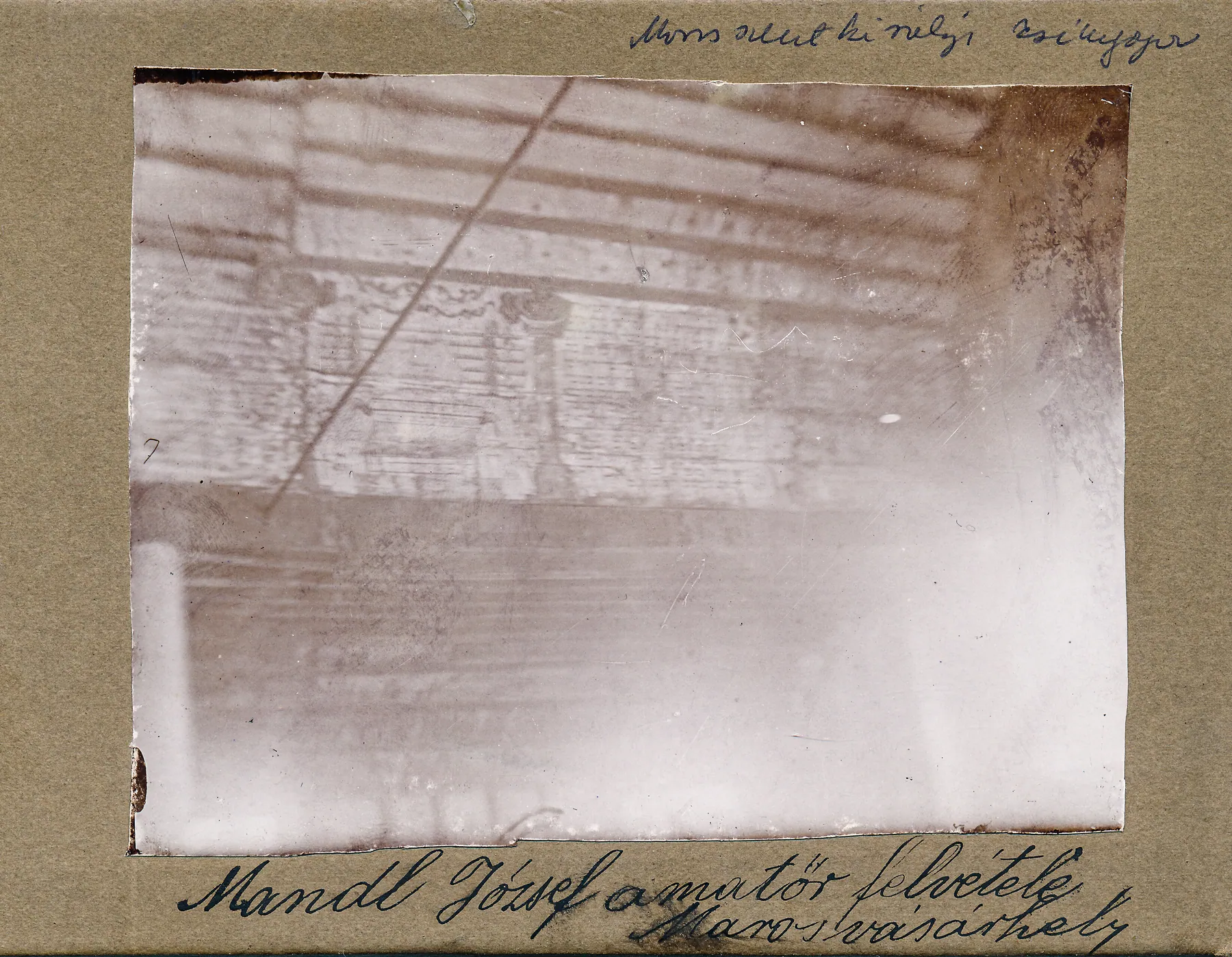
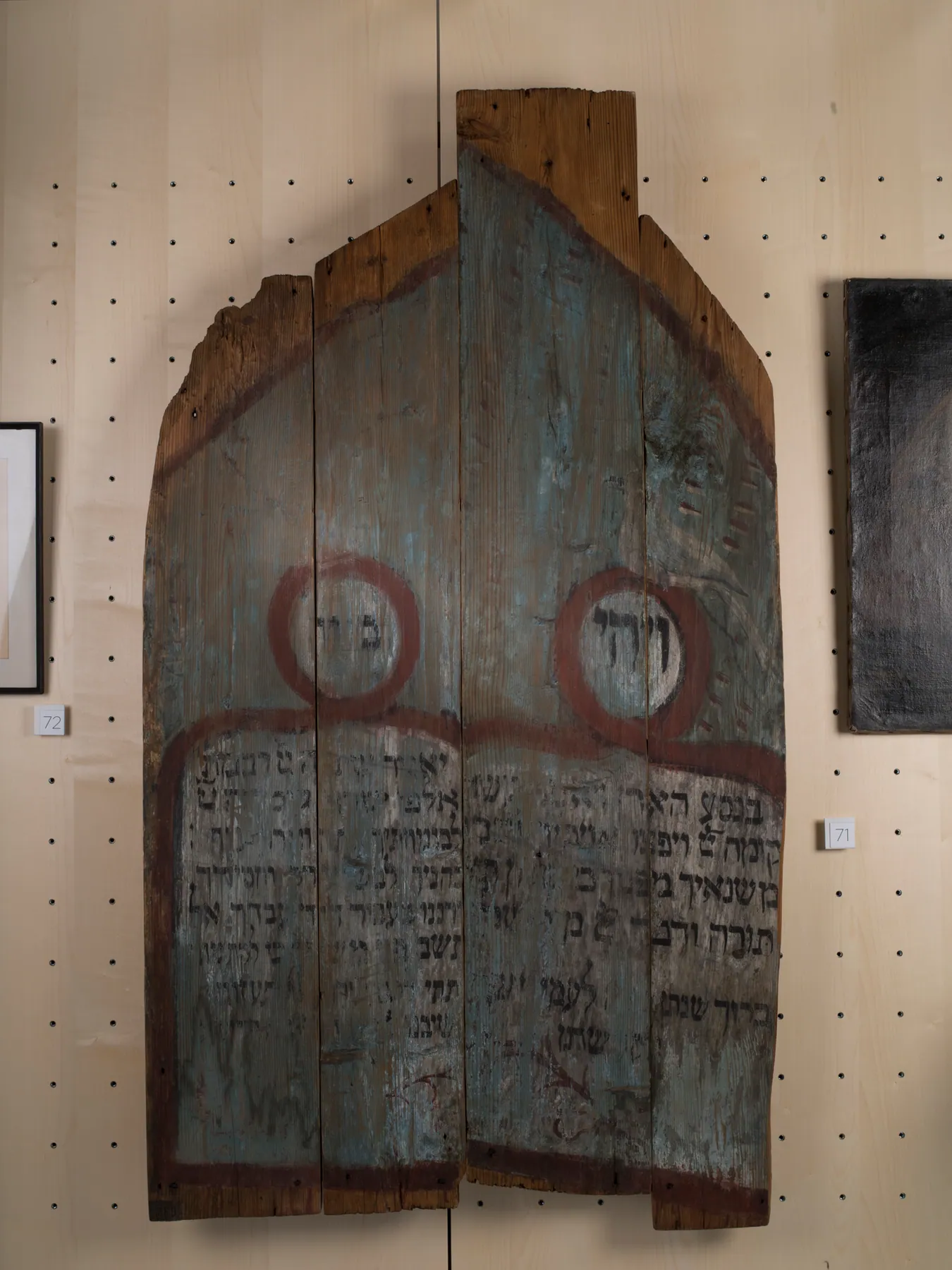
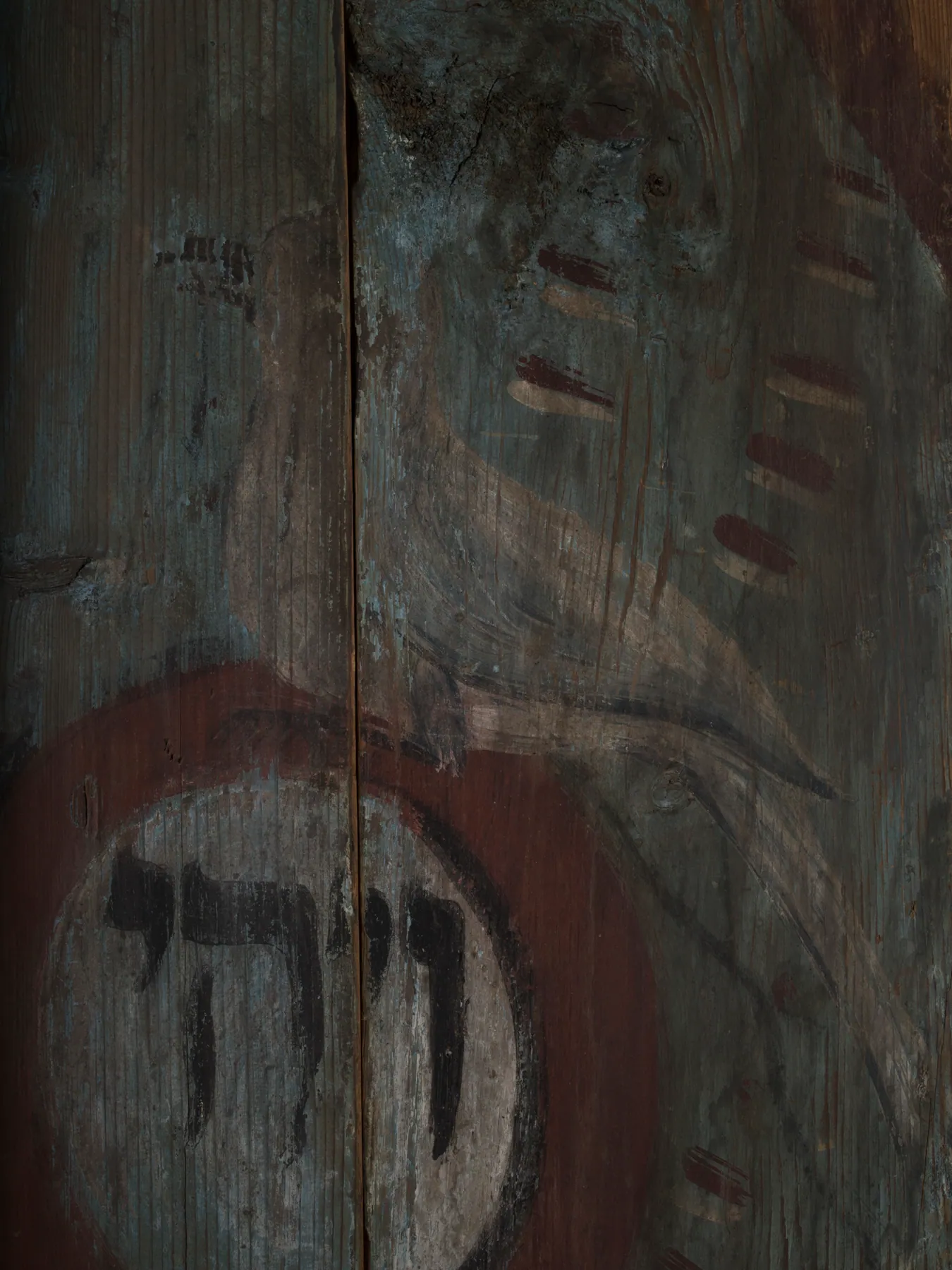
The synagogue was built of timber in 1747 and is described as barn-like from outside and richly decorated within. One source states that its eastern wall was of brick. It stood free on its plot; the men entered at the north-west corner and the women through a door on the south side. In 1785 it was extended and painted decoration was added, and painting continued gradually afterwards. The walls and ceiling were covered with Hebrew texts, including psalms, the selichot penitential prayers and other prayers, in a manner one source compares with the painted interiors of local Unitarian churches. Four panels sat above the Torah ark on either side of a round window, and some boards carried signs of the zodiac with the Hebrew months. Two photographs taken around 1910 by the amateur photographer József Mandl of Marosvásárhely show a plank ceiling, a hanging chandelier, and the ark set within a tall arched frame behind a turned balustrade. The builder, the dimensions and the seating capacity are unknown.
Жизнь в синагоге
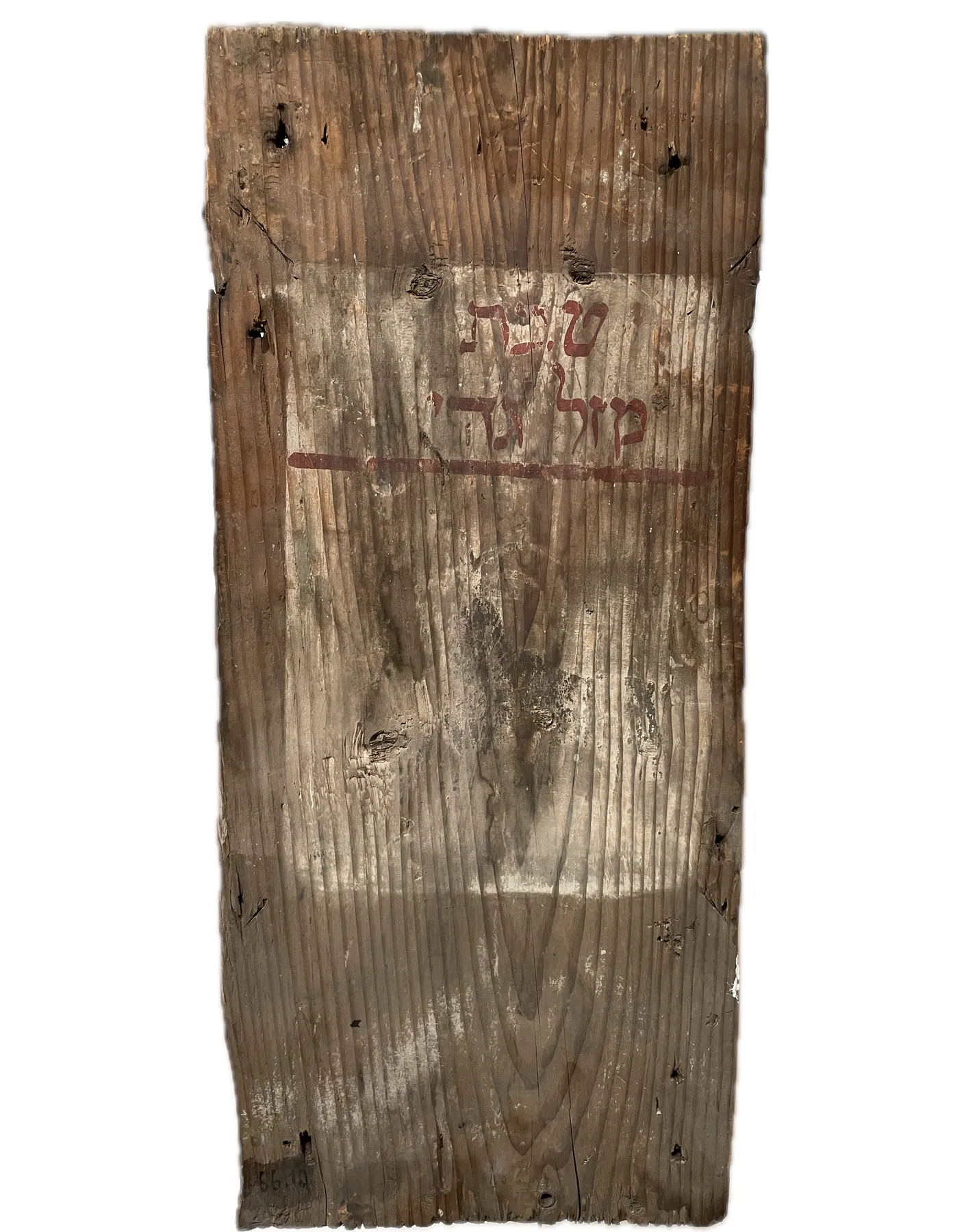
The surviving boards show how the congregation used its walls: they carry long passages of prayer, so that worshippers could read biblical verses and prayers directly from the painted timber. One board quotes a supplication from the selichot, the penitential prayers said before the High Holy Days; another praises the name of the King of kings; a third bears the Hebrew month Tevet with its zodiac sign. The rabbis of the eighteenth century, Léb ben Mózes, Léb ben Ábrahám and Benjámin Zeév Wolf, served a congregation drawn from Náznánfalva and neighbouring Szentkirály, and the lay leader Mózes Izsák Frankl paid for the 1785 extension. A teacher is recorded in 1753 and a mohel from 1861. As families moved to Marosvásárhely in the nineteenth century the building lost its congregation; by 1918 eight families could no longer keep it up, and by 1934 it stood abandoned. Whether regular services were still held in the last decades is unknown.
Разрушение
The synagogue was not destroyed by an attack. It decayed after the community that built it dispersed. In 1918 the president of the Marosvásárhely community, Samu Diamantstein, asked the Hungarian heritage authorities to list and fund the building, because the eight remaining families could not maintain it; the request came at the end of the First World War, and the area passed to Romania in 1920. Visitors in 1934 found the synagogue completely abandoned. By the time Northern Transylvania was returned to Hungary under the Second Vienna Award in 1940, the building had collapsed; one reference work says it was demolished in 1940. No source consulted names anyone who ordered or carried out a demolition. In spring 1941 György Balázs, a staff member of the Jewish Museum in Budapest, collected eight painted panels and sent them, 91 kilograms in all, by train from Marosvásárhely on 30 April 1941. Two further boards stayed with the local community and are now lost.
Судьба общины
By the 1940s hardly any Jews lived in Nazna itself; the village's Jewish life had moved to Târgu Mureș. Northern Transylvania, including Nazna, was part of Hungary again from 1940. After the Nazi German occupation of Hungary in March 1944, the Jews of the area were concentrated in May 1944 in the Târgu Mureș ghetto under Hungarian rule. The last two Jewish residents of Nazna were taken there and later killed. Transports left the ghetto for the Nazi German death camp at Auschwitz on 27 May, 30 May and 8 June 1944. György Balázs, who had saved the synagogue's panels, was murdered on a death march in January 1945. The Jewish community of Nazna was not revived after the war, and no Jews live in the village today. Two Jewish cemeteries survive, one on Liliacului Street and one on Principala Street, with gravestones dating from the eighteenth century.
Место сегодня
No source consulted gives the exact plot on which the synagogue stood. It is known only that it stood free on land that had belonged to the Barcsay estate, and the map pin for this entry marks the centre of Nazna, not the building. Nothing of the structure is recorded as standing in the village. Eight painted panels rescued in 1941 are in the Hungarian Jewish Museum and Archives in Budapest; they were restored in 2016, and three long boards found in the museum attic in 2024 were shown in the exhibition Writing on the Wall in 2025. Researchers have since produced a theoretical reconstruction of the building. The two Jewish cemeteries of Nazna survive.
Значимые имена
Mózes Izsák Frankl
18th centuryLay leader (rosh ha-kahal) of the Náznánfalva community, 1785Frankl was the lay head of the Jewish community of Náznánfalva in the late eighteenth century. In 1785 he had the wooden synagogue of 1747 extended, and painted decoration was added to its walls at that time; an inscription above the Torah ark recorded the renovation date. Nothing more about his life was found in the sources consulted.
Биография или источник →Benjámin Zeév Wolf
active 1764-1777Rabbi of NáznánfalvaBenjámin Zeév Wolf is recorded between 1764 and 1777 and described himself as rabbi of Náznánfalva, the leading Jewish community of the Marosvásárhely area, whose Jews were then barred from living in the town itself. His tenure fell in the synagogue's first decades, before the 1785 extension. Further details of his life were not found in the sources consulted.
Биография или источник →Léb ben Mózes
active 1753Rabbi of NáznánfalvaLéb ben Mózes (Yehuda Leb ben Mozes) is named, with Léb ben Ábrahám, as one of the first known rabbis of Náznánfalva, and JewishGen records him in 1753, a few years after the wooden synagogue was built in 1747. He therefore served the congregation in the building's earliest years. Nothing further about his life was found in the sources consulted.
Биография или источник →Вам есть чем поделиться?
Фотографии, документы, семейные истории и воспоминания об этой синагоге и её общине помогают сохранить её историю.
- A náznánfalvi zsinagóga elméleti rekonstrukciója
- Remains of Transylvania's Only Wooden Synagogue Were Discovered by Chance
- 71 Wooden panels from the synagogue in Náznánfalva (100 years - 100 objects)
- Nasna
- Nazna (Cemetery Discovery Project)
- Náznánfalvai zsinagóga belső (F70.271.1 and F70.271.2)
- Zsinagóga fa panelek (66.8) and Náznánfalvi zsinagóga fa paneljei (66.10, 66.10 a-b, 66.11)
- Synagogues in Romania: past, present, future (review of Streja and Schwarz)
- Nazna (OpenStreetMap node 460207632)
Share a memory or thought
No comments yet. Be the first to add one.