

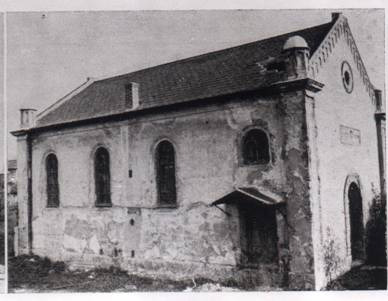
Die Geschichte von Neunkirchen Synagogue
Neunkirchen, a market town south of Wiener Neustadt on the Südbahn railway, had a medieval Jewish community whose prayer house in today's Mühlgasse was turned into a church after the expulsion of 1496. Jews returned only after about 1860, most of them from the Seven Communities of western Hungary, today's Burgenland. Their worship association, founded in 1867, first prayed in a room at the Brückl inn; when the authorities closed that room as a fire risk, the association bought a corner plot on the Rohrbacher Straße on 13 September 1883 and built a synagogue and an administration building on it. The synagogue was consecrated before the end of that year.
The building was a modest, unheated hall modelled on the synagogue of Kobersdorf, with round-arched windows, corner turrets and a gabled roof. It served the Israelitische Kultusgemeinde Neunkirchen, whose district reached to Gloggnitz, Aspang and Kirchschlag, until 1938. In the November Pogrom the Nazis desecrated it and destroyed the interior. During the war it was seized for Nazi organisations and, from 1944, used as quarters for forced labourers. After 1945 it served for a time as a training workshop for apprentice bricklayers, then decayed. In 1984 the roof and most of the walls were removed; only low outer walls, about two metres high, remain on the site.
Where it stood for 101 years
Historic: Rohrbacher Straße, corner of the Hohe Wand-Straße (also described as bordering the Raglitzerstraße), Neunkirchen, Lower Austria. Today: the same corner, where the remaining low walls stand (approximate pin).
Größere Karte öffnen →Die jüdische Gemeinde
Four Jewish families are recorded in Neunkirchen in the mid-fourteenth century; they lived in the Judengasse, today's Mühlgasse, and were expelled in 1496. The modern community began after about 1860 with pedlars and small traders from the Seven Communities of western Hungary. About 80 Jews lived in the town in 1869, 259 in 1890 and 279 in 1897, with 610 in the whole judicial district in 1890. A worship association called the Minjan-Verein and a burial society were founded in 1867, and the association grew into the Israelitische Kultusgemeinde Neunkirchen, constituted in 1890 according to the 2015 TU Wien thesis and in 1898 according to the Jüdische Gemeinden website. Its district covered the courts of Neunkirchen, Gloggnitz, Aspang and Kirchschlag. The community never paid a full-time rabbi of its own; Rabbi Wilhelm Reich of Baden served it from 1894 until his death in 1929. Its own cemetery in the Kernstockgasse opened in the early 1890s; before that the dead were buried at Kobersdorf or Lackenbach. In 1934 the town had 204 Jewish inhabitants. Local antisemitism was open well before 1938: the Catholic parish priest and the Neunkirchner Zeitung agitated against Jews, and the cemetery was desecrated several times.
Architektur und Gestaltung
No building plans survive. What is known comes from a small number of exterior photographs, a field sketch of 1929 and photographs taken during demolition, which Sabrina Seemann used for her 2015 TU Wien thesis. The synagogue stood on a corner plot at the Rohrbacher Straße and the Hohe Wand-Straße, almost on the plot boundary, and was oriented east rather than to the street, with the Torah ark in a niche in the east wall. It was a rectangular hall of brick and stone with rendered walls and a pitched roof, about 9.2 by 16.4 metres according to the German Wikipedia account; a 1940 record of 25 by 12 metres and 320 seats is regarded by Seemann as inaccurate. The design followed the synagogue at Kobersdorf in Burgenland. The photographs show a Rundbogenstil front with four tall round-arched windows between pilaster strips, corner projections topped by small domed turrets, a round window in the gable, a corbel-arch frieze under the eaves and a round-arched doorway. The Viennese master builder Karl Kautz is named as builder in two sources, but Seemann treats his authorship of the design as an inference from a letter of the Minjan-Verein. No interior photograph is known.
Leben in der Synagoge
No plan of the interior survives. The reconstruction in the German Wikipedia account, based on comparable synagogues, places the bima in front of the ark with benches running back towards the west entrance and a women's gallery on the west side reached from a north door. One eyewitness remembered a curved blue ceiling painted with golden stars, but this could not be checked. Because the hall had no heating, from the mid-1930s the congregation held winter services in a room in a house on today's Peischingerstraße. Wilhelm Reich, rabbi of Baden, served Neunkirchen as well from 1894; in his old age the scholar Schimon Goldstein deputised for him. After Goldstein's death in 1927 and Reich's in 1929, Heinrich Weiss, rabbi of Wiener Neustadt, looked after the synagogue until 1938. Several of the synagogue's textiles survive: three Torah mantles, a Torah curtain and a fragment of a second curtain are in the Jewish Museum Vienna, and a Torah scroll kept in the town museum was later handed to the Jewish community of Baden.
Zerstörung
On 10 November 1938, during the November Pogrom, the Nazis desecrated the synagogue and destroyed its interior; none of the sources read names individual perpetrators. The town claimed the property in 1938 for a museum and offices, but in July 1939 the Reichsstatthalter of Niederdonau assigned it to the local branch of the Nazi party, which used it for the Deutsches Jungvolk and as a store of the Nazi welfare organisation NSV. After the community was dissolved in 1940 the property passed to the German Reich, which turned the administration building into a customs office. In July 1944 the Nazi authorities quartered Hungarian Jewish forced labourers in the synagogue, inserting an intermediate floor for them. After 1945 the Israelitische Kultusgemeinde Wien recovered the building as legal successor, and it served for a time as a training workshop for apprentice bricklayers. The Vienna community lacked the money to maintain it, and it decayed. In 1984, because it was in danger of collapse, the roof and most of the walls were taken down. Seemann's thesis names Paul Szávai as architect of the demolition plans and Peter Zernig as site manager; who commissioned the work is not recorded in the sources read.
Das Schicksal der Gemeinde
In the weeks after the Anschluss of March 1938 Nazi supporters and party squads in Neunkirchen searched Jewish homes, seized property and forced owners to sign it away as 'gifts'. The merchant Siegfried Jaul was driven through the streets carrying a placard calling himself a cheat, and SS and SA men stole from Jewish households during the searches. Businesses were taken over in the so-called Aryanisation. Most of the town's Jews left in 1938 and 1939, usually for Vienna in the hope of emigrating; only some got out in time. The Israelitische Kultusgemeinde Neunkirchen was dissolved in 1940, and by then no Jews were recorded in the town. Those who had not escaped were later deported to extermination camps, and more than 50 Jews from Neunkirchen were murdered. In July 1944 about 150 Hungarian Jews were brought to Neunkirchen in two transports for forced labour and held in the former synagogue and a warehouse. The community was not re-established after 1945; the Israelitische Kultusgemeinde Wien became its legal successor.
Der Ort heute
The site lies at the corner of the Rohrbacher Straße and the Hohe Wand-Straße in Neunkirchen, close to where the Raglitzerstraße meets the Rohrbacher Straße. After the 1984 demolition the lower parts of the outer walls were left standing to a height of about two metres, enclosing the former interior, and the place is kept as a memorial site, with a plaque on the outer wall and one where the Torah niche stood. No roof, upper walls, windows or interior survive, so the building itself is gone. The former administration building on the plot is not described in the sources read. The Jewish cemetery in the Kernstockgasse, with about 140 gravestones, survives in an industrial area by the Südbahn line.
Bedeutende Namen
Karl Kautz
1826-1913Viennese master builder; builder of the synagogue (attributed)Kautz, a master builder from Vienna, is named as the builder of the Neunkirchen synagogue in 1883 by Sabrina Freudensprung's DAVID article and in the abstract of her TU Wien thesis. In the thesis itself she notes that his authorship of the design rests on a letter from the Minjan-Verein to the provincial authorities rather than on surviving plans, so his exact role is not fully proven.
Biografie oder Quelle →Wilhelm Reich
1852-1929Rabbi of Baden, also rabbi of Neunkirchen from 1894Dr Wilhelm Reich, rabbi of Baden bei Wien, also served the Neunkirchen community from 1894 until his death in 1929, since the congregation could not afford a rabbi of its own. For thirty-five years he was the rabbi responsible for the synagogue on the Rohrbacher Straße; in his last years the scholar Schimon Goldstein deputised for him.
Biografie oder Quelle →Schimon Goldstein
died 1927Scholar, deputy for the rabbi at NeunkirchenGoldstein, described as a scholar, stood in for the ageing Rabbi Wilhelm Reich in Neunkirchen and so led religious life in the synagogue in the 1920s. His death in 1927, followed by Reich's in 1929, left the congregation without its own religious leader, and its care passed to the rabbi of Wiener Neustadt.
Biografie oder Quelle →Heinrich Weiss
UnknownRabbi of Wiener Neustadt, responsible for Neunkirchen 1929-1938After the deaths of Schimon Goldstein in 1927 and Rabbi Wilhelm Reich in 1929, Heinrich Weiss, rabbi of the neighbouring community of Wiener Neustadt, took over the care of the Neunkirchen synagogue and served it until the community was destroyed in 1938. He was thus the last rabbi of the congregation.
Biografie oder Quelle →Haben Sie etwas beizutragen?
Fotos, Dokumente, Familiengeschichten oder Erinnerungen an diese Synagoge und ihre Gemeinde halten ihre Geschichte lebendig.
- Virtuelle Rekonstruktion der Synagoge in Neunkirchen (diploma thesis)
- Synagoge (Neunkirchen, Niederösterreich)
- Neunkirchen (Österreich)
- Die Synagoge von Neunkirchen
- "Der letzte Jude hat den Tempel verlassen": Juden in Niederösterreich 1938-1945 (summary)
- Rohrbacherstraße and Raglitzerstraße, Neunkirchen (OpenStreetMap ways 29037010 and 28510736)
Share a memory or thought
No comments yet. Be the first to add one.