
La storia di Neolog Synagogue of Nové Zámky
Nové Zámky, known in Hungarian as Érsekújvár and in German as Neuhäusel, is a railway town in south-western Slovakia that belonged to Hungary until 1918 and again from 1938 to 1945. Jews were allowed to settle there only from 1840, but the community grew fast, from 85 people in 1855 to 892 in 1857. Its first synagogue followed almost at once: the Hungarian heritage register of southern Slovakia dates it to 1859, the Encyclopaedia Judaica to 1860, and the Slovak Wikipedia gives a building period of 1859 to 1863. The register says it was built in the style of the Dohány Street Synagogue in Budapest, completed shortly before.
After the Hungarian Jewish Congress of 1868 the community divided. The majority joined the Neolog stream and kept the old building, while a traditionalist minority formed an Orthodox congregation and built its own synagogue in 1880. The Neolog synagogue remained the town's largest Jewish building until the Second World War. It was badly damaged during the Allied bombing of Nové Zámky in 1944 and 1945 and its remains were pulled down after the war. The Orthodox synagogue survived, was repaired and is still in use, and it keeps a marble inscription from the Neolog synagogue's entrance.
Where it stood for nearly 85 years
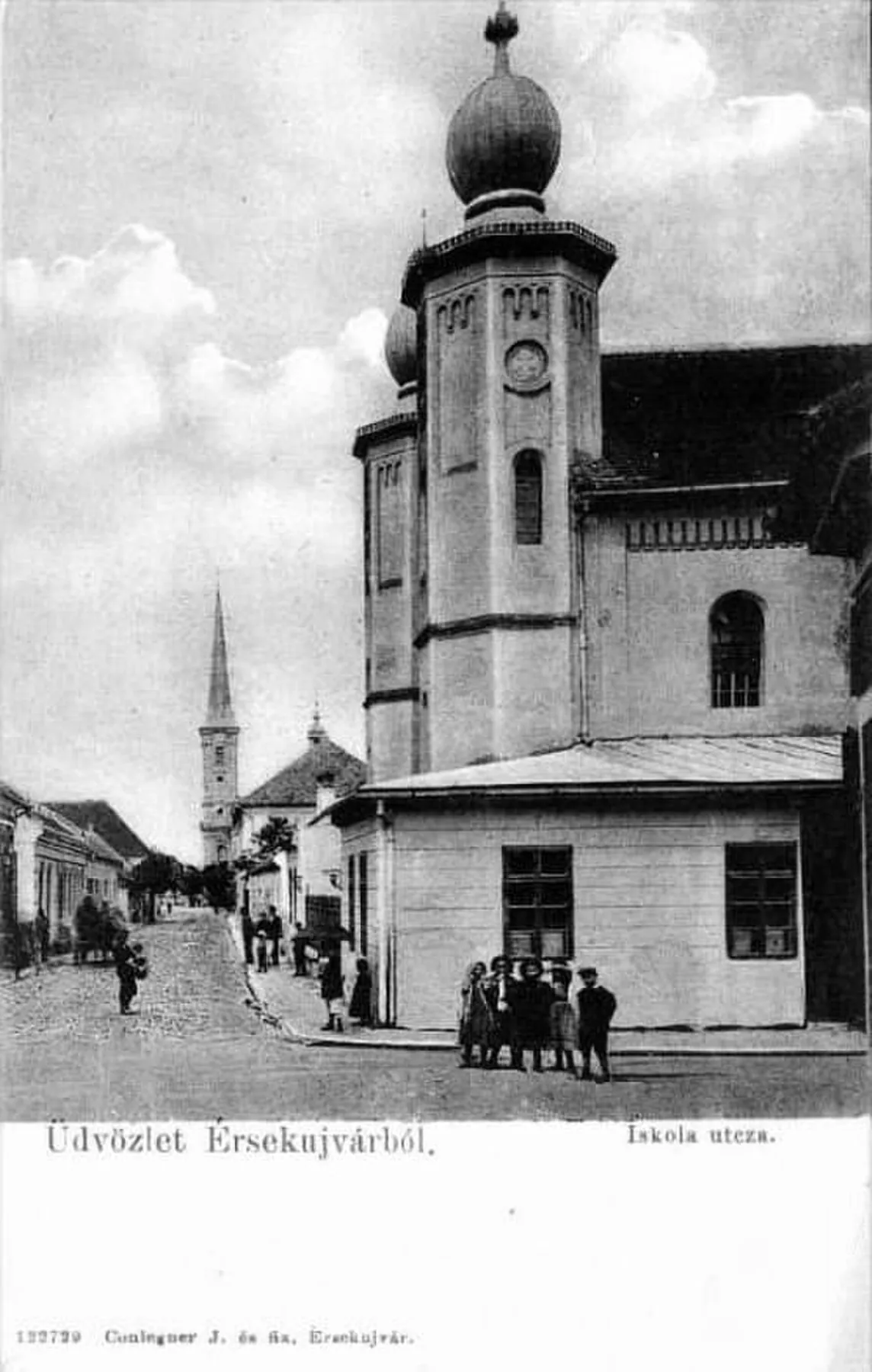
Historic: Iskola utca (School Street), Érsekújvár, on a street corner, per a 1906 postcard; house number unknown. Today: unknown; placeholder pin at the centre of Nové Zámky, Nitra Region (approximate).
Apri la mappa grande →La comunità ebraica
Until 1840 Jews could trade at the markets of Érsekújvár but were not allowed to stay overnight; that year the town was opened to Jewish settlement. The Encyclopaedia Judaica counts 85 Jews in 1855, 892 in 1857, 1,491 in 1890 and 1,540 in 1910, and the Slovak Jewish Heritage Center gives 1,205 members in 1869. At first the Jews of the town belonged to the rabbinate of nearby Šurany; they later broke away and, after the Congress of 1868, the majority joined the Neolog movement, while a traditionalist minority set up an Orthodox congregation. A cemetery was consecrated in 1858. Under Czechoslovakia the community kept growing: 2,087 Jews were counted in 1921 and 2,535 in 1930, and about 2,500 lived in the town when it was annexed by Hungary in November 1938. The Encyclopaedia Judaica gives about 3,000 for the eve of the deportations. The Neolog congregation was led between the wars by rabbis of some standing, among them the historian Samuel Klein and later Ernest Klein, and it maintained a Jewish school that was also damaged in the wartime air raids.
Architettura e design
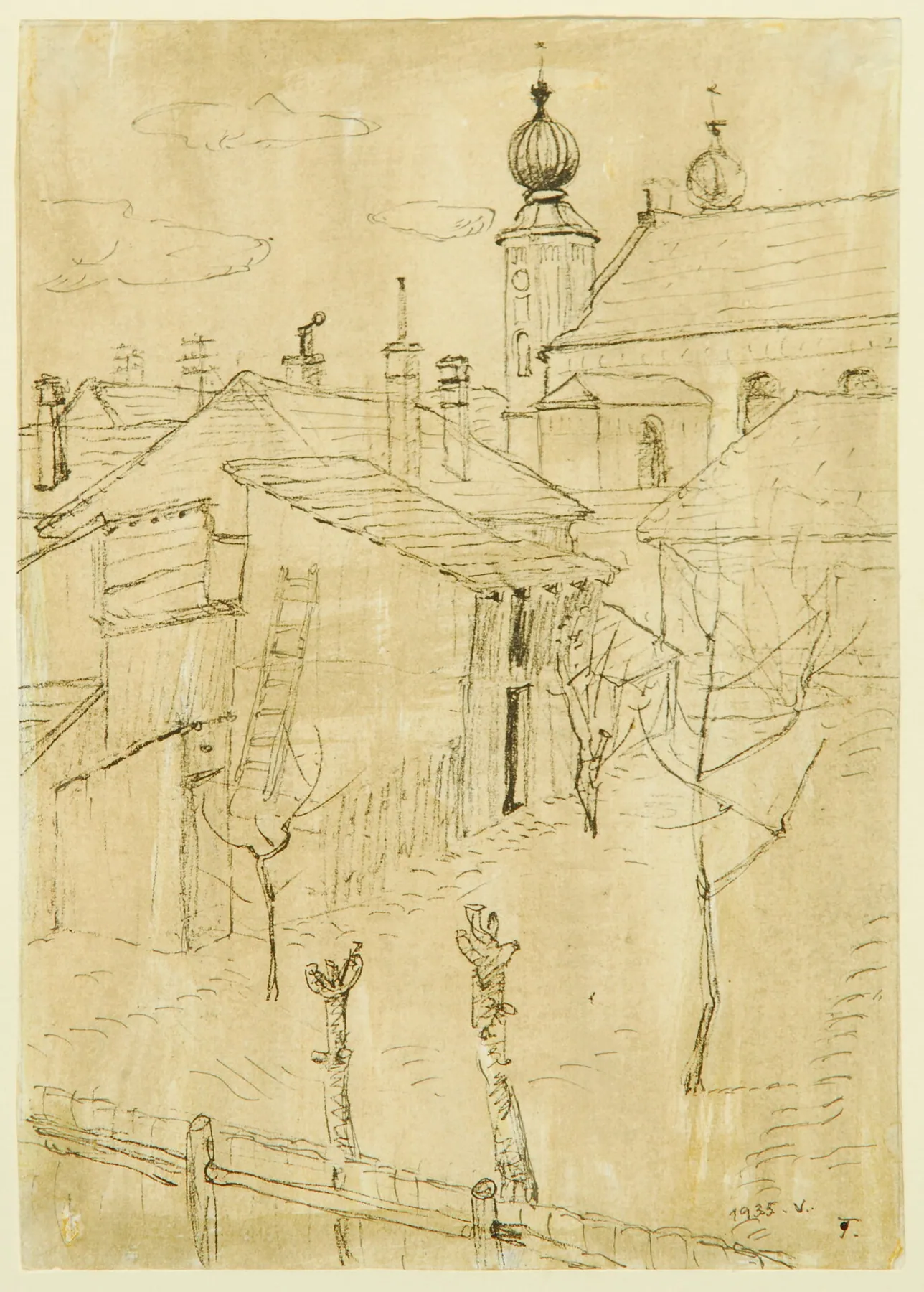
The Hungarian heritage register says the synagogue was built in 1859 in the style of the Dohány Street Synagogue in Budapest, presumably a front with two towers like its Budapest model. A pen drawing of May 1935, catalogued by the Jewish Community of Nové Zámky as a drawing of the Neolog synagogue, confirms the two towers. Seen over low houses and courtyards, it shows a tower with a ribbed onion dome, a second domed tower behind, and a long pitched roof over a hall with round-arched windows. A postcard published by J. Conlegner and Son of Érsekújvár, dated 1906 on Wikimedia Commons and captioned 'Iskola utcza' (School Street), shows what appears to be the same building at a street corner: two octagonal towers with arched corbel friezes, round windows and ribbed onion domes, a tall hall with round-arched windows, and a low single-storey annexe in front. According to the Slovak Wikipedia the towers survived the wartime bombing while the nave was damaged. The architect, the builder, the seating capacity, the exact dimensions and the arrangement of the interior are unknown; no plans have been located.
La vita nella sinagoga
Little has been recorded about worship inside the building. It was the community's first synagogue and from the 1870s the house of prayer of the Neolog congregation, the larger of the town's two Jewish communities. The Encyclopaedia Judaica notes that the Neolog rabbi Samuel Klein and his successor Ernest Klein both encouraged their congregants to use Slovak in daily life after the town became part of Czechoslovakia, which suggests that sermons and communal business in the interwar years moved between Hungarian and Slovak. Samuel Klein, rabbi of the town from 1913 to 1928, was also a scholar of the historical geography of Palestine who later taught at the Hebrew University in Jerusalem. Ernest Klein, rabbi from 1931 to 1944, was a linguist who later compiled an etymological dictionary of English. Above the entrance a marble tablet carried an inscription that the heritage register translates as 'Step through the gates of truth'. The congregation also ran a Jewish school. Details of the services, choir, organ or the rabbis' predecessors were not found.
Distruzione
The synagogue lost its congregation in June 1944 and stood empty from then on. Nové Zámky was a major railway junction and became the most heavily bombed town in Slovakia. The Slovak Spectator records Allied air raids on 7 October 1944, 14 October 1944 and, the most destructive, 14 March 1945, which together destroyed 2,023 of the town's 3,394 houses; it states that the Neolog synagogue and the Neolog Jewish school were among the damaged buildings. Which raid hit the synagogue is not recorded in the sources read. The Hungarian heritage register says the synagogue was significantly damaged by bombing and that its remains were demolished after the war, and the Slovak Jewish Heritage Center also says it was damaged in wartime bombing and later razed. The Slovak Wikipedia adds that the towers survived but that the town authorities had the whole building demolished. The year of the demolition, and whether it happened before or after the Communist takeover of February 1948, are not recorded in any source read.
Il destino della comunità
After the Nazi German occupation of Hungary in March 1944, the Hungarian authorities confined the Jews of Érsekújvár in May 1944 to a ghetto on several run-down streets of the town, while Jews from the surrounding district were held at the Kurzweil brickworks. Two transports left for Auschwitz in June 1944; the Slovak Jewish Heritage Center dates them to 10-12 June, the Encyclopaedia Judaica to 12 and 15 June. According to the Slovak press agency TASR about 4,800 Jews were taken from the town to Auschwitz and 4,386 of them died. Ernest Klein, the last Neolog rabbi, was deported to Auschwitz and Dachau and survived. Only a few deportees returned. In 1947 there were 501 Jews in Nové Zámky. The survivors abolished the division into Neolog and Orthodox congregations, repaired the Orthodox synagogue, the two cemeteries and the ritual bath, and kept religious life going throughout the Communist period, one of the few Slovak communities to do so. About 70 Jews lived in the town in 1990.
Il luogo oggi
A postcard of 1906 places the synagogue on a corner of Iskola utca (School Street), but the plot has not been identified on a modern map, so what stands there now cannot be said with certainty; the town centre was largely rebuilt after the war. The pin on the map is a placeholder at the centre of Nové Zámky. A marble tablet that once stood over the entrance of the Neolog synagogue, inscribed 'Step through the gates of truth', is now set into the wall of the vestibule of the surviving Orthodox synagogue, which is still used by the Jewish community. The Orthodox synagogue also holds a plaque with the names of local Holocaust victims, installed in 1999.
Nomi importanti
Samuel Klein
1886-1940Neolog rabbi of Érsekújvár (Nové Zámky), 1913-1928Klein was rabbi of Érsekújvár from 1913 to 1928, and the Encyclopaedia Judaica names him as rabbi of the Neolog congregation, so this synagogue was his pulpit through the First World War and the town's transfer to Czechoslovakia. He encouraged his congregants to use Slovak in daily life. A scholar of the historical geography of Palestine, he later moved to Jerusalem, where he died on 21 April 1940.
Biografia o fonte →Ernest Klein
1899-1983Neolog rabbi of Nové Zámky, 1931-1944Born in Szatmárnémeti in 1899, Klein was rabbi of the Nové Zámky community from 1931 until the deportations of 1944; the Encyclopaedia Judaica names him as the Neolog rabbi and successor of Samuel Klein. He was deported to Auschwitz and Dachau and liberated by US troops in 1945. He later emigrated to Canada, became known as a linguist and died in 1983.
Biografia o fonte →Hai qualcosa da condividere?
Fotografie, documenti, storie di famiglia o ricordi di questa sinagoga e della sua comunità aiutano a mantenerne viva la storia.
- Az érsekújvári ortodox zsinagóga
- Nové Zámky, Synagogue
- The death came from the skies: Nové Zámky, the most bombed Slovak town of World War II
- Nove Zamky (Encyclopaedia Judaica)
- Nové Zámky (foto, história)
- Nové Zámky (town article)
- Drawing of the Neolog synagogue (NZ 45-IV-06)
- File:Érsekújvár - Nové Zámky, Synagogue (01).jpg
- Ernest Klein
- Samuel Klein (scholar)
- Nové Zámky (OpenStreetMap relation 2218539)
Share a memory or thought
No comments yet. Be the first to add one.