
История Nýrsko Synagogue
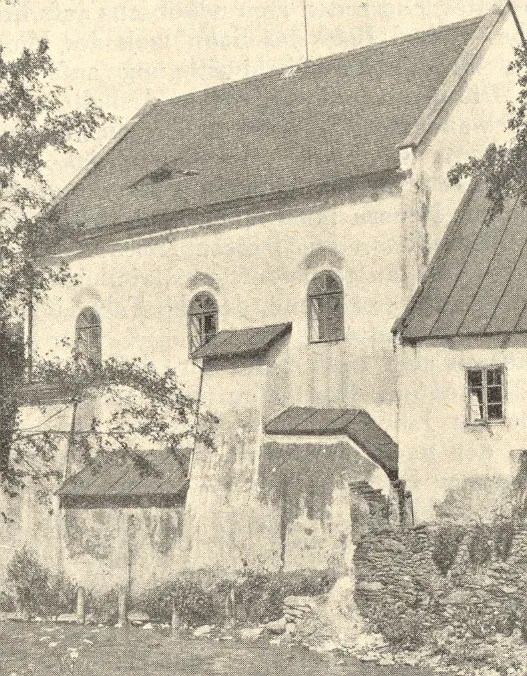
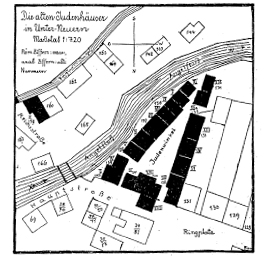
Nýrsko, called Neuern in German, is a small town on the Úhlava (Angel) river in the Klatovy district of western Bohemia, close to the Bavarian border. Jews are recorded there from before 1618, and from the early eighteenth century they lived in a compact quarter, the Judenwinkel, a triangle of houses at the south-western end of the lower town between the square and the river; its houses were shut off at night by a chain. A first prayer house is mentioned in 1724 at the corner of houses X and XII. In 1797 the community bought house V, the old Wünschbach family house on the west side of the quarter, to turn it into a synagogue. That building burned in the lightning fire of 6 September 1798 together with the old one, and was renewed on the same site. A second fire in the quarter on 1 August 1861 destroyed the synagogue and the school again, and the building was then reconstructed in a Classicist style. This is the synagogue shown in photographs of the 1930s. Services were held in it until 1938. After the annexation of the Sudetenland it was looted and then used as a store, and it was demolished around 1958. The neighbouring rabbi's house and school, number 136, still stands.
Where it stood for nearly 170 years
Historic: house V (conscription numbering of 1771), Judenwinkel, lower Neuern, west side of the Jewish quarter by the Angel river, beside the rabbi's house no. 136. Today: Rybářská street area, 340 22 Nýrsko; exact plot not identified (approximate).
Открыть большую карту →Еврейская община
According to a history of the Jews of Neuern compiled by the local historian Josef Blau and published in 1934, Mayer Bloch was already living in the town before 1618, and in 1713 seventeen of the eighteen Jewish houses stood together in the Judenwinkel. Owning a Jewish house carried with it a seat in the synagogue, a grave in the cemetery and usually the right to trade and to slaughter. Jüdische Gemeinden gives five families in 1618, about eighteen households around 1715, 23 families in 1799 and 139 Jews in 1930. Families such as the Bloch, Klauber, Porges, Windspach and Janowitzer lived by trading wool, hides, livestock and above all feathers. In 1895 Wilhelm Ekstein of Vienna founded an optical glass-grinding works in the town. By the early 1930s the community counted 239 members, 90 of them taxpayers, and included branch communities at Dešenice (Deschenitz), Janovice nad Úhlavou (Janowitz) and Drosau, with a single rabbi, the cemetery at Nýrsko and synagogues at Nýrsko and Dešenice. It was led by an elected board; its heads included Eduard Jeiteles (1894-1906) and, from 1933, the timber dealer Karl Jetter.
Архитектура и дизайн
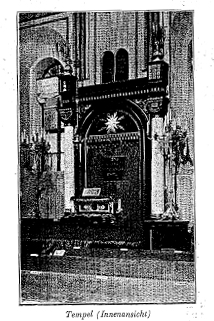
The building is known from an exterior and an interior photograph printed with Blau's history in 1934. The exterior view shows a plain, rendered, free-standing hall under a steep gabled roof with a small dormer, seen from the side. The long wall has a row of tall round-arched windows set high up, and lower down a small projecting porch with its own pent roof gives access to the hall, with a second lean-to roof beside it. The interior view shows the east wall dominated by a tall Torah ark: a carved, dark aedicule framed by columns and slender pinnacles, its doors under an arch bearing a six-pointed star, with two-branched lamps on either side and a reading desk in front. The Jewish Community of Prague's monuments register describes the post-1861 rebuilding as Classicist. The architect, the builder, the dimensions and the number of seats are unknown, and no plan of the hall has been found. A plan of the old Jewish houses in lower Neuern, also published by Blau, shows the synagogue's place on the west side of the quarter facing the river.
Жизнь в синагоге
The rabbi of Neuern also served Dešenice and Bystřice, and the post was filled after a trial sermon. Rabbis Moises Harsl (1786) and Moises Lewith (1793) are the first known by name, followed by Rabbi Nagel (1865-1873) and Rabbi Stern (1873-1876). The longest-serving was Max Reiser, rabbi from 1876 until his death in 1913, an author of Hebrew riddles, of a collection of rabbinic sayings for school and home, and of lives of pious men; Blau's history praises him as a pastor and educator who took great pains to train boys for the temple choir. After him came Arpad Hirschberger (1913-1915), Rabbi Schapira (1915-1917) and A. Beck (1918-1920), and from 1921 Emil Klauber. In the eighteenth century the schoolmaster also led prayers; Samuel Abraham and Lebel Herschel taught in 1713, Samuel Joachim Peck from Prague in 1724, and Herschl Löwy Lipmann is named as Schulsinger, the synagogue singer, in 1774. The religious school and the rabbi's residence occupied house 136 beside the synagogue. A former resident recalled that his father, a Zionist, was on good terms with the rabbi and attended the synagogue from time to time.
Разрушение
Nýrsko lay in the Sudeten border area annexed by Nazi Germany in October 1938. During the Nazi pogrom of 9-10 November 1938 the synagogue was looted, the rabbi's flat was wrecked and a fire was set in the Jewish quarter, although it did not spread; the account, based on Lenka Sýkorová's history of Nýrsko under occupation, does not name the individuals involved. Services ended in 1938. On 13 March 1939 the Reich Commissioner in Liberec asked the district head, Landrat Lippert, whether the synagogues of Neuern had been destroyed or were to be; the reply recorded that the Neuern synagogue was being used as a store, while the two village synagogues of the community were used by the Hitler Youth and the SA. The building thus survived the war. Afterwards it stood without a congregation, became dilapidated and was demolished: in 1958 according to a 2023 study citing Irena Váňkátová, around 1958 according to the Jewish Community of Prague, and at the end of the 1950s according to Jüdische Gemeinden. The demolition therefore took place under the Communist regime, but who ordered or carried it out is not recorded in the sources found.
Судьба общины
Most Jews of Nýrsko left the town in 1938, when the Sudetenland was handed to Nazi Germany, and many emigrated after selling their property; Jewish firms were taken over, the Ekstein optical works passing to Franz Fremuth and the Sigmund Bloch department store to a firm from Cham. Jüdische Gemeinden states that the remaining Jews were deported in 1942 to Theresienstadt and from there to extermination camps, and the 2023 study names Treblinka among the camps to which several were sent; the physician Julius Tanzer was among those murdered. Samuel Rudolf Schwarz, born in Nýrsko in 1921, was deported with his whole family in the Klatovy transport of 26 November 1942 to Theresienstadt, sent to Auschwitz in September 1944 and then to Kaufering, a subcamp of Dachau, and survived. Only a few members of the community lived through the Shoah, and no congregation was re-established. In the spring of 1945 a death march passed through the area, and more than 100 Jewish women were killed near the town.
Место сегодня
The Jewish quarter lay on Rybářská street in the western part of the town, between the square and the river. Most of its houses were demolished during or soon after the Second World War, and the synagogue followed around 1958, so nothing of the building survives. The former rabbi's house and school, number 136, is the one building of the quarter that still stands. The exact plot of the synagogue on the modern map has not been identified in the sources read; the pin marks Rybářská street. The Jewish cemetery, about one kilometre south-east of the town on a hill above the road to Dešenice, survives with about 350 gravestones and is cared for by the Jewish Community of Prague.
Значимые имена
Max Reiser
1839-1913Rabbi of Neuern, 1876-1913Born in 1839 in Hausbrunn, Reiser was rabbi of Neuern for 37 years, from 1876 until his death in the town on 5 January 1913, longer than any other known holder of the post. He published a book of riddles in Hebrew with German translation, a collection of Talmudic sayings for school and home, and a book of lives of pious men. Blau's 1934 history calls him an exemplary pastor and educator who took great care to train pupils for the temple choir and worked for peace in the community.
Биография или источник →Emil Klauber
UnknownRabbi of Neuern from 1921Klauber is named in Josef Blau's 1934 history of the Jews of Neuern as the community's rabbi since 1921, following A. Beck, and as the current rabbi when the history was written. He would therefore have led services in the synagogue during its last years of regular use before 1938. Klauber was an old Neuern family name, but whether he belonged to that local family, and what became of him after 1938, are unknown.
Биография или источник →Karl Jetter
UnknownHead of the Neuern Jewish community from 1933Jetter, a timber dealer, was elected head of the Neuern Jewish community board in 1933, succeeding Franz Stein, and is named as the current headman in Blau's 1934 history. As head of the community he was responsible for the synagogue, the cemetery and the branch congregations at Dešenice, Janovice and Drosau in the years before 1938. How long he remained in office and what happened to him are not recorded in the sources read.
Биография или источник →Eduard Jeiteles
UnknownHead of the Neuern Jewish community, 1894-1906Jeiteles is the first head of the Neuern Jewish community board named in Josef Blau's 1934 history, serving from 1894 to 1906 during the long rabbinate of Max Reiser. The board had five unpaid members elected for three years, and its income went mainly to the upkeep of the synagogue and the cemetery. He was followed by Eduard Vogel, David H. Bloch and Dr Ignatz Bloch. Nothing further about his life was found.
Биография или источник →Вам есть чем поделиться?
Фотографии, документы, семейные истории и воспоминания об этой синагоге и её общине помогают сохранить её историю.
- Neuern/Angel (Böhmen)
- History of the Jews of Neuern (translation of Josef Blau, 'Geschichte der Juden in Neuern', in H. Gold, Die Juden und Judengemeinden Böhmens, 1934)
- Nýrsko (Jewish monuments: history of the community and cemetery)
- Die Koexistenz der Tschechen, Deutschen und Juden in Westböhmen (am Beispiel der Stadt Neuern)
- Rybářská, Nýrsko (OpenStreetMap way 37064378)
Share a memory or thought
No comments yet. Be the first to add one.