

La storia di Ócsa Synagogue
Ócsa lies in Pest county, south-east of Budapest, in what was the Alsódabas district. Anikó Gazda's gazetteer records 78 Jews there in 1828 and 110 in 1910, but Pinkas Hakehillot says an organised community was formed only in 1904, as a dependency of the Pestszenterzsébet congregation, and that most of its members earned their living in Budapest. The community owned a prayer house with a floor area of 32 négyszögöl (square fathoms), a yard and a cantor's house. When the synagogue was built, and by whom, is unknown.
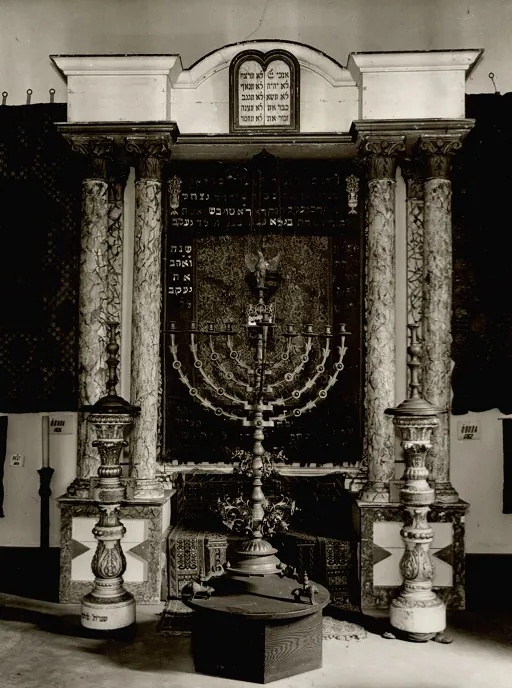
In the spring of 1944 the Jews of Ócsa were confined in a ghetto, and on 29 June they were taken to the collection camp at Monor and from there to Auschwitz-Birkenau. That summer belongings from emptied Jewish homes were stored in the synagogue, and after the Soviet army arrived the store was broken into and emptied. In 1945 a local man, Sándor Biczó, moved his woodworking business into the synagogue and the cantor's house without any permit. In April 1946 the village notary described the building as abandoned, partly collapsed and dangerous. The national Jewish office complained to the Welfare Ministry, which ruled that Biczó held it without legal title, and he agreed to leave that October. A photograph taken after 1945 shows the bare interior with the Torah ark still standing; the ark was later dismantled and re-erected in the Jewish Museum in Budapest. Gazda's survey of 1980-87 found the synagogue demolished. No source found says when or by whom.
Where it stood
Historic: Ócsa, Alsódabas district, Pest-Pilis-Solt-Kiskun county; street and house number unknown. Today: unknown; placeholder pin at the centre of 2364 Ócsa, Pest county (approximate).
Apri la mappa grande →La comunità ebraica
Anikó Gazda's gazetteer gives 78 Jews in Ócsa in 1828, 56 in 1851, 110 in 1910 and 65 in 1941. Pinkas Hakehillot Hungary has different figures: 94 in 1930 and 153 in 1941, in a village of 6,153 people, and ten in 1947. It adds that nothing is known about the first Jewish settlement, that the great majority of Ócsa's Jews worked in Budapest, and that the community was formed only in 1904 and depended on the congregation of Pestszenterzsébet. The historian Borbála Klacsmann, working from the village's own files, describes the Jews as about one per cent of the population in 1944 and counts 78 people whose belongings passed to new owners. No entry for Ócsa was found in the Magyar Zsidó Lexikon of 1929, and no rabbi of the village is named in any source read. The community's property was the prayer house, its yard, the cantor's house and a cemetery. The people named in the surviving papers are the cantor, Endre Lebovits, and, after the war, István Weisz, who signed for the leading committee of the Ócsa Israelite Community, and Sándor Groszmann.
Architettura e design
No exterior view of the synagogue has been found. The village papers of 1946 call it a prayer house of 32 négyszögöl, roughly 115 square metres, with rammed-earth walls, standing with a yard and a cantor's house. A photograph in the Hungarian Jewish Museum and Archives, dated after 1945, shows the east end of a single plain hall. Round-headed windows in deep splayed reveals pierce the end wall on either side of the Torah ark and the side walls beside it, and a moulded frieze of small repeated ornaments runs below a flat plastered ceiling. The ark is a tall classical frame: on each side two columns painted to imitate veined marble stand on a pedestal decorated with a white cross-shaped panel and carry an entablature, and the Tablets of the Law sit in a curved crest above. A Hebrew inscription is painted in an arch over the niche; it appears to be the verse 'How goodly are your tents, O Jacob'. Three steps lead up to the ark. Two other museum photographs show the cantor's house as a low thatched cottage. The architect, the builder, the seating and the women's section are unknown.
La vita nella sinagoga
Very little is recorded about worship in this building. Pinkas Hakehillot says only that the community was organised in 1904 and was dependent on Pestszenterzsébet, on the southern edge of Budapest, which suggests that the village had no rabbi of its own and that weddings, registers and rabbinical supervision came from there; no source read names a rabbi. Services were led by a cantor, who lived in the thatched house that stood with the prayer house and its yard. The last cantor named is Endre Lebovits. Because most of the Jews of Ócsa travelled to work in Budapest, the congregation probably gathered mainly on Sabbaths and festivals, though that is an inference and not a recorded fact. The worshippers faced a painted ark crowned with the Tablets of the Law. Nothing was found about a school, a burial society, a women's association or the rite the congregation followed. After the deportation, in July and August 1944, the hall was used to store belongings taken from the emptied Jewish homes, and in 1946 the notary reported that no prayers had been held in it since.
Distruzione
No source reports damage from fighting. The synagogue lost its congregation in June 1944, when the Hungarian authorities deported the Jews of Ócsa to the Nazi camp of Auschwitz-Birkenau, and in July and August belongings from their homes were stored in the building. The village notary, István Borbás, later wrote that after the Soviet army arrived the store was broken into, partly by 'the Russians' and partly by people who had moved into the village from elsewhere and by a mob, who carried off everything in it. In the spring of 1945 Sándor Biczó, a local man, took over the prayer house, the yard and the cantor's house for his woodworking business without any official allocation. On 18 April 1946 Borbás certified that the synagogue was abandoned and partly collapsed, its rammed-earth walls soaked by rain, and dangerous to life. After a complaint by the National Office of Hungarian Israelites, the Welfare Ministry ruled that Biczó had no legal title; he was ordered out on 15 August and agreed to leave by 19 October 1946. What followed is not documented. Gazda's survey of 1980-87 recorded the building as demolished; the date and the person or body responsible are unknown.
Il destino della comunità
After Nazi Germany occupied Hungary in March 1944, the Hungarian authorities shut the Jews of Ócsa in a ghetto. Borbála Klacsmann, using the village files, places this ghetto in Ócsa itself, shared with Jews from nearby villages; Pinkas Hakehillot says they were first sent to the ghetto of Lajosmizse, which Randolph Braham lists as the collection centre for the Alsódabas district. On 29 June 1944 they were taken to the central collection camp at Monor. Braham writes that about 7,500 Jews were loaded into wagons at the Monor brickworks, where a gendarmerie major named Bajor was in command, and that the 24,128 Jews held in the camps around Budapest were deported in eight trains between 6 and 8 July. The Ócsa Jews were sent to Auschwitz-Birkenau. Their movable property was inventoried and sold at public auction by the finance authorities. According to Klacsmann only about a quarter of the Jewish population came back in the following year; Pinkas Hakehillot speaks of a few individuals and counts ten Jews in 1947. In November 1946 the national Jewish office was already referring to the Ócsa community as defunct.
Il luogo oggi
The street and plot of the synagogue are not given in any source read, so what stands there today is unknown, and the map pin for this entry is only a placeholder at the centre of Ócsa. No surviving fragment of the building is recorded. Its Torah ark was dismantled and rebuilt in the Jewish Museum in Budapest, where a museum album photograph shows it on display hung with a curtain; a note in English Wikipedia's list of Hungarian synagogues says the ark was no longer in the museum's collection in 2010. The Hungarian Jewish Museum and Archives keeps the photograph of the interior and two of the cantor's house. The Jewish cemetery of Ócsa, which the community still owned in November 1946, appears in recent photographs published with Klacsmann's article.
Nomi importanti
Endre Lebovits
UnknownCantor of the Ócsa congregation until 1944Lebovits is the only religious officer of the Ócsa congregation named in the sources read. He led services in the synagogue and lived in the cantor's house that stood with it. After the Jews of the village were deported in June 1944, the chief magistrate of the Alsódabas district, Dr László Teszáry, allocated his house to another resident on 15 September 1944. What happened to Lebovits himself is not recorded in the sources consulted.
Biografia o fonte →István Weisz
UnknownMember of the leading committee of the Ócsa Israelite Community, 1946Weisz acted for the survivors who tried to get the synagogue back after the war. On 19 August 1946 he complained, in the name of the leading committee of the Ócsa Israelite Community, that Sándor Biczó had still not left the synagogue, the yard and the cantor's house although the village had ordered their return four days earlier. His complaint led to police eviction proceedings and to Biczó's agreement to leave by 19 October 1946.
Biografia o fonte →Hai qualcosa da condividere?
Fotografie, documenti, storie di famiglia o ricordi di questa sinagoga e della sua comunità aiutano a mantenerne viva la storia.
- 'Jogcím nélkül használja': az ócsai zsinagóga története
- Zsinagógák és zsidó községek Magyarországon (Pest county table)
- Ócsa (Pinkas Hakehillot Hungary, p. 145)
- Ócsai zsinagóga belső képe (inv. 70.312)
- Az ócsai zsinagóga rekonstruált tóraszekrénye a múzeumban (inv. IV/64.15)
- Fényképalbum a Magyar Zsidó Múzeum megnyitásának 40. éves évfordulójára (inv. F90.184; IV/64)
- Ócsai kántorlakás (inv. 70.313)
- Ócsai volt kántorlakás, Weisz Béla férfiszabó címtáblájával (inv. 70.314)
- A népirtás politikája: a Holocaust Magyarországon, vol. 2, ch. 22, pp. 738-739
- A népirtás politikája: a Holocaust Magyarországon, vol. 2, ch. 22, pp. 740-741
- List of synagogues in Hungary (Ócsa row)
- Ócsa (OpenStreetMap relation 214784)
Share a memory or thought
No comments yet. Be the first to add one.