

История Ónod Synagogue
Ónod is a village on the Sajó river south-east of Miskolc in Borsod-Abaúj-Zemplén county. Jews are recorded there from 1727, when a single family lived in the village, and a Hebrew-inscribed monument of the mid-eighteenth century at the old Rákóczi castle suggests an organised presence nearby by that time. Most Jewish families made their living in the grain trade. The congregation depended on that of Nemesbükk until 1860, when it became independent, and from 1885 it was the mother community for several surrounding villages.
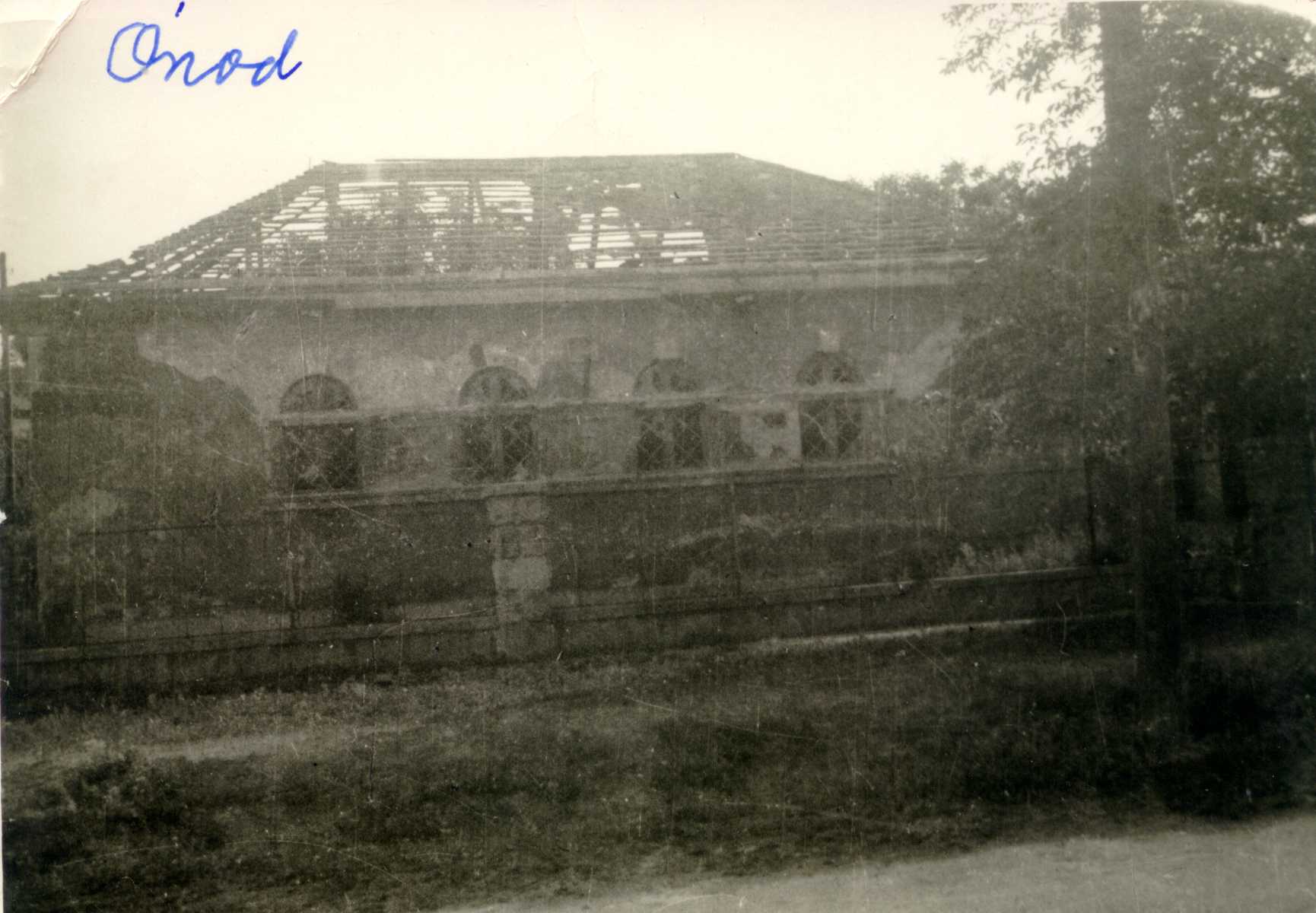
A house of prayer existed by 1830. In 1883 the community built a larger synagogue, the building described here. Two photographs in the Hungarian Jewish Museum and Archives show it: one intact, a white rendered hall behind a picket fence and bare trees, and one roofless, with its tiles gone. From 1892 the congregation was led for half a century by Rabbi Meir Schick, who in 1910 founded a school combining Torah study with training in crafts. Anikó Gazda's survey of 1980-87 records the synagogue as demolished, and the Pinkas Hakehillot volume for Hungary states that a Protestant church was built on its site. The date of the demolition and the people responsible are unknown.
Where it stood for nearly 80 years
Historic: Ónod, Borsod county; street and house number unknown. Today: site of a Protestant church (not identified); placeholder pin at the centre of 3551 Ónod, Borsod-Abaúj-Zemplén county (approximate).
Открыть большую карту →Еврейская община
The Pinkas Hakehillot entry gives the growth of the community in figures: one family in 1727, 31 Jews in 1735, 42 in 1747, 72 in 1830, 159 in 1880 and 184 in 1930, in a village that had 2,369 inhabitants in 1941. It was therefore a small rural congregation that reached its largest size in the decades after the synagogue was built. Most of its members were grain merchants, trading the produce of the Sajó valley. Until 1860 the Jews of Ónod belonged to the community of Nemesbükk; after becoming independent they took on the role of mother community for the Jews of the surrounding villages from 1885. A birth register of the Jews of Ónod and the surrounding area for 1886-1913, sold at auction in Jerusalem, bears the signature of Rabbi Meir Schick from 1895, showing that the rabbinate kept the civil registers for the district. The community ran an elementary school until 1923, when state support ended, and maintained a poor-relief society and a branch of the Keren Kayemet. The Hungarian Jewish Museum also holds a share certificate of the Ónod Talmud and Crafts Association.
Архитектура и дизайн
No plans, architect's name or description of the building in a written source were found; what is known comes from two photographs in the Hungarian Jewish Museum and Archives. The intact view (inventory F96.367) shows a free-standing rendered hall with a steep tiled saddle roof, seen from the front corner. The entrance front is set forward and framed by tall pilaster strips; on it, above the doors, are three tall round-arched windows, with paired small round-arched openings and an arched doorway at ground level. The long side wall is divided into panels by flat pilasters, each panel with a tall round-arched window in the upper zone and small paired arched windows below, which suggests a women's gallery inside. A smaller arched door opens in the side wall. A picket fence and a row of mature trees separate the building from the street. The second photograph (F70.315) shows the long side with its round-arched windows, a stone base wall and the roof stripped to its battens. The capacity and the interior arrangement are unknown.
Жизнь в синагоге
The congregation's religious life for fifty years was shaped by Rabbi Meir Schick, who served from 1892 until 1942. In 1910 he founded a combined Torah school and trades school, an unusual institution for a village community, and the association connected with it issued share certificates, one of which survives in the Hungarian Jewish Museum. As district rabbi he also kept the Jewish birth registers for Ónod and the surrounding villages, which he signed. On his death in 1942 he was followed by his son-in-law, Rabbi Feivel Fülöp Donáth, who had earlier served as a military rabbi and led the community until its destruction in 1944. Alongside the synagogue the community kept an elementary school, a society for the support of the poor and a branch of the Jewish National Fund (Keren Kayemet). No description of services, of the furnishings or of the cantors who served in the building was found in the sources consulted.
Разрушение
No source found describes damage to the synagogue during the Second World War. The building stood empty after the Jews of Ónod were taken away in May 1944, and the community was never re-established after the war. A photograph in the Hungarian Jewish Museum and Archives, catalogued as the ruins of the Ónod synagogue, shows the walls still standing but the roof stripped to bare battens, with the tiles removed, apparently in the course of dismantling; the photograph is undated. The Pinkas Hakehillot volume for Hungary, published in 1975, states that after the war "the synagogue was destroyed, and a Protestant church was built on its ruins", and Anikó Gazda recorded it as demolished in her survey of 1980-87. None of these sources gives the year of the demolition, says whether the building was first sold, or names who ordered or carried out the work; who demolished it is not recorded.
Судьба общины
After the Nazi German occupation of Hungary in March 1944, the leaders of the Ónod community were arrested and beaten. In mid-May 1944 the Hungarian authorities moved the Jews of Ónod to the ghetto at Diósgyőr, near Miskolc. Most men up to the age of 48 had been taken into forced labour service, and many of them died in the labour companies. The people held in the ghetto were deported on 10 June 1944 and reached Auschwitz on 14 June. Many were murdered on arrival; others were selected for work and sent on to an ammunition factory at Allendorf or to Bergen-Belsen. Rabbi Feivel Fülöp Donáth was among those killed. After the war about ten men returned, most of them from labour service, together with about ten young women who had survived Auschwitz. The community was never re-established. The Jewish cemetery of Ónod survives and in 2009 was looked after by a local caretaker.
Место сегодня
According to the Pinkas Hakehillot volume for Hungary, a Protestant church was built on the site of the synagogue after it was destroyed. That church has not been identified with certainty in the sources consulted, so the exact plot is not fixed. OpenStreetMap records a Reformed church on Sajó utca in the village centre, but no source read in this research connects it to the synagogue site, and it may be an older building. No surviving fragment of the synagogue and no marker on its site is recorded. The Jewish cemetery of Ónod still exists. The map pin for this entry is a placeholder at the centre of the village and should not be read as the synagogue's exact location.
Значимые имена
Meir Schick
UnknownRabbi of Ónod, 1892-1942Schick was rabbi of Ónod for half a century, from 1892 until 1942, and so led the congregation for most of the synagogue's life. In 1910 he founded a school that combined Torah study with training in crafts, and as district rabbi he kept the Jewish birth registers of Ónod and the surrounding villages, one of which carries his signature from 1895. His son-in-law Feivel Fülöp Donáth succeeded him.
Биография или источник →Feivel Fülöp Donáth
died 1944Rabbi of Ónod, 1942-1944Donáth, the son-in-law of Rabbi Meir Schick, had served as a military rabbi before he succeeded his father-in-law as rabbi of Ónod in 1942. He was the last rabbi to serve in the synagogue, leading the congregation through the arrests of its leaders and the removal to the Diósgyőr ghetto in 1944. He was killed in the Holocaust.
Биография или источник →Вам есть чем поделиться?
Фотографии, документы, семейные истории и воспоминания об этой синагоге и её общине помогают сохранить её историю.
- Ónod (entry in Pinkas Hakehillot: Encyclopedia of Jewish Communities, Hungary)
- Zsinagógák és zsidó községek Magyarországon
- Ónodi zsinagóga (F96.367)
- Ónodi zsinagóga romjai (F70.315)
- Ónodi Talmud és Kézműves Egyesület részjegye
- Birth register of the Jews of Onod and the surroundings, 1886-1913 (Auction 82, Part I)
- Ónod (Cemetery Discovery Project)
- Ónod (OpenStreetMap relation 1440862) and Református templom, Sajó utca (way 595168537)
Share a memory or thought
No comments yet. Be the first to add one.