

הסיפור של Stadskanaal Synagogue (Onstwedde)
Stadskanaal grew up in the nineteenth century along the canal of the same name in the east of the province of Groningen; until 1969 it belonged to the municipality of Onstwedde, which is why the synagogue is sometimes described as standing in Onstwedde. Jews settled there in the 1840s. They at first belonged to the congregation of Veendam, obtained the status of a branch congregation (bijkerk) in 1850 despite Veendam's objections, and became independent in the following decade. In 1860 they built a synagogue on the Hoofdstraat, the long main street of the village. A ritual bath was part of the building, and the house of the community's teacher stood next door.
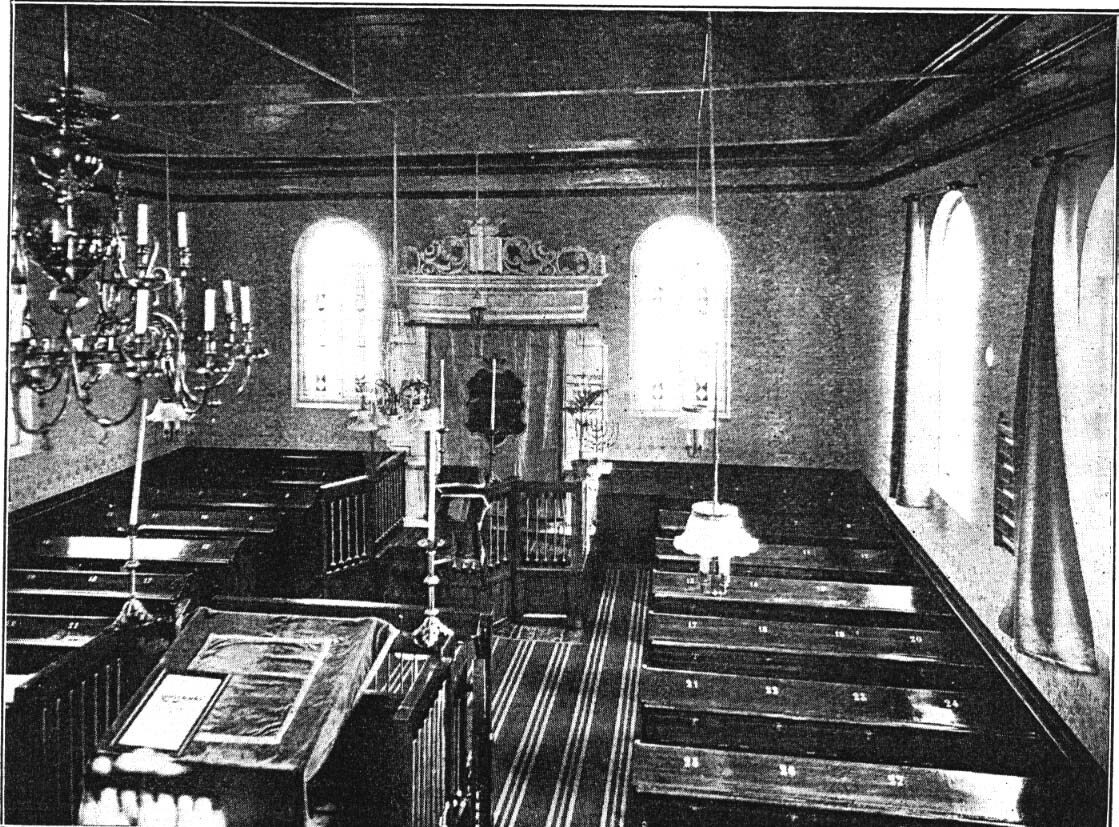
The congregation grew quickly, from 60 Jews in 1869 to 208 in 1899, most of them cattle dealers. Two surviving photographs show the building: an interior view of about 1929, and a later street view, taken when it already stood disused, showing a plain gabled hall with round-arched windows beside the teacher's brick corner house. The synagogue was plundered and heavily damaged during the occupation. After the war the few survivors could not repair it; it was sold and razed in 1958, and services continued in the former teacher's house until 1964. That house too was later demolished.
Where it stood for 98 years
Historic: Hoofdstraat, Stadskanaal, municipality of Onstwedde, province of Groningen; house number unknown. Today: Hoofdstraat, Stadskanaal (municipality of Stadskanaal); exact plot not identified, pin approximate.
פתיחת מפה גדולה ←הקהילה היהודית
Jews are first recorded in Stadskanaal in the 1840s; there were eleven in 1840. They were then members of the Jewish congregation of Veendam, and buried their dead in a cemetery laid out in 1845 along the Afdraai, today the Gedempte Ceresdiep, at the southern end of the village. In 1850 the Stadskanaal Jews were given the status of a bijkerk, a local branch congregation, against the opposition of Veendam, and in the following decade they became a fully independent congregation. The community numbered 60 in 1869 and reached its peak of 208 in 1899. Most of its members earned their living in the cattle trade, which flourished in the peat-colony villages of eastern Groningen. The congregation had its own council, a council for poor relief and several voluntary associations, among them a burial society and societies for the care of the sick and needy. In the 1930s a number of Jewish refugees from Germany settled in Stadskanaal. By 1930 the community had declined to 142 people, still one of the larger Jewish communities in the province outside the city of Groningen.
אדריכלות ועיצוב
The synagogue was built in 1860 on the Hoofdstraat and included a ritual bath (mikve). Its architect and builder are unknown, and no description of its plan or seating has been found. A postwar street photograph in the NIOD collection, titled 'Voormalige Sjoel (Synagoge) van Stadskanaal', shows a modest free-standing brick hall, rendered or whitewashed, with a steep tiled saddle roof and a gable end facing the street. Its long side has three tall round-arched windows. Immediately to its right, at a street corner, stands a lower brick house with a hipped tiled roof and rectangular windows, evidently the teacher's house that the sources place next to the synagogue. The interior photograph of about 1929 shows a single rectangular room with a plain coved ceiling. Rows of numbered wooden benches face east on both sides of a central aisle laid with a striped runner. The Torah ark stands against the east wall between two round-arched windows, framed by a carved crest, with a raised reading desk in front of it. Large brass chandeliers and hanging lamps light the room.
החיים בבית הכנסת
The congregation was large enough to employ two teachers, who gave religious instruction to its many children; the teacher lived in the house beside the synagogue, and the school lessons and much of the communal routine centred on that pair of buildings. The interior photograph of about 1929 gives an impression of the synagogue in use: numbered pews, a reading desk before the ark and polished brass candelabra. The community kept a burial society and societies for the care of the sick and the poor, and maintained its own cemetery on the Afdraai. The names of its teachers, cantors and presidents have not been found in the sources consulted. Before the deportations the community hid its Torah scrolls and ark curtains; they survived the war and were recovered afterwards. Following the war the small surviving congregation no longer used the damaged synagogue but held its services in the former teacher's house next to it, continuing there until 1964. The community was formally dissolved and merged into the Jewish community of Groningen in 1988.
הרס
During the Nazi German occupation, after its congregation had been deported in 1942, the synagogue was plundered and heavily damaged. The Joods Cultureel Kwartier, whose text derives from the Pinkas Hakehillot volume on the Netherlands, does not say who looted it or exactly when, and no source read names the perpetrators. The Torah scrolls and ark curtains escaped because they had been hidden in time. A street photograph by H. Onderwater, held by the NIOD Institute for War, Holocaust and Genocide Studies, shows the building after the war still standing beside the teacher's house, its roof and walls intact but evidently out of use. The few Jews of postwar Stadskanaal could not restore it. According to the Dutch text the building was in such a poor state that it was sold in 1958 and had to be demolished; the English text says it was sold and razed in 1958. Who bought it and who carried out the demolition is not recorded.
גורל הקהילה
Between August and November 1942 most of the Jews of Stadskanaal and the surrounding villages were arrested by the Nazi German occupation authorities and taken to the Westerbork transit camp in Drenthe, from where they were deported to the extermination camps in occupied Poland. Few of them returned. Several dozen local Jews survived by going into hiding. The exact number of victims from Stadskanaal has not been established from the sources consulted. After the war the community was rebuilt on a very small scale: 26 Jews lived in Stadskanaal in 1951 and 18 in 1971. They held services in the former teacher's house until 1964. The Jewish community of Stadskanaal was formally dissolved and merged into that of the city of Groningen in 1988. The Jewish cemetery on the former Afdraai, now the Gedempte Ceresdiep, survives and is maintained by the municipality.
האתר כיום
The synagogue was demolished in 1958 and the teacher's house beside it at a later date, so nothing of either building survives. The sources consulted give only the street, the Hoofdstraat, without a house number, so the exact plot and what stands on it today have not been identified. The postwar photograph shows the two buildings on a street corner with modern street lamps and a road sign pointing towards Onstwedde and Winschoten, which may help to locate the plot on old maps or with local historians. A monument to the murdered Jews of Stadskanaal was unveiled on the Navolaan in 1986. The map pin marks a point on the Hoofdstraat and is approximate.
יש לכם משהו לתרום?
תמונות, מסמכים, סיפורי משפחה וזיכרונות מבית הכנסת ומהקהילה שלו עוזרים לשמור על ההיסטוריה שלו בחיים.
Share a memory or thought
No comments yet. Be the first to add one.