
הסיפור של Medieval Synagogue of Vienna (Or Sarua)
The synagogue of Vienna's first Jewish community stood in the middle of the medieval Jewish quarter, on the square then called the Schulhof and now the Judenplatz. Excavations from 1995 to 1998, made before a Holocaust memorial was built on the square, uncovered its foundations and floors. The archaeologist Paul Mitchell, who led the work, distinguishes three building phases: a first building of about 1240-50, an enlargement of about 1280 that produced a two-aisled hall with a hexagonal bimah, and extensions to east and west in the fourteenth century. In its final form the complex covered about 465 square metres and is described as one of the largest known medieval synagogues.
Vienna was a centre of Jewish learning in these two centuries. Rabbi Isaac ben Moses, author of the law code Or Zarua, headed the rabbinical court and yeshiva there in the thirteenth century, and modern accounts often call the building the Or Sarua Synagogue after him; the historical reference works read for this entry simply call it the synagogue or Judenschule.
The community was destroyed in the persecution of 1420-21 known as the Vienna Gesera, ordered by Duke Albert V. A Jewish chronicle reports that Jews shut in the synagogue killed themselves in autumn 1420 and that Rabbi Jonah set fire to it. In 1421 the building was pulled down and the duke gave its stones to the University of Vienna. The remains can be visited below the square through the Museum Judenplatz.
Where it stood for nearly 180 years
Historic: Schulhof, in the medieval Jewish quarter of Vienna. Today: Judenplatz, 1010 Vienna; the remains lie under the square and are entered through the Museum Judenplatz, Judenplatz 8. Exact site.
פתיחת מפה גדולה ←הקהילה היהודית
The first Jew documented in Vienna is recorded in 1194, and Jewish families soon settled around the present Judenplatz, on ground where wooden buildings of the ducal court had stood. The square, first mentioned in 1294 as the Schulhof, was the centre of the Jewish quarter until 1421. Around it stood the synagogue, a hospital, a bathhouse and the rabbi's house; a slaughterhouse and a ritual bath are also mentioned. The quarter had gates but no surrounding wall. The Jewish Encyclopedia records attacks on the Jews in 1337, in which the duke and nobles intervened, and says that in 1370 they were seized and stripped of their possessions but soon returned. Leading members were moneylenders to the dukes: the same source names David the Steuzz and his son Jonah, and Baruch of Vienna, the 'Judenmeister'. By 1420 the community is estimated at 1,400 to 1,600 people. Over two centuries it produced or attracted rabbis known across the Ashkenazi world, among them Isaac ben Moses Or Zarua, Meir ben Baruch ha-Levi and Abraham Klausner; Israel Isserlein later wrote that Meir had brought the customs of the Rhineland to Vienna.
אדריכלות ועיצוב
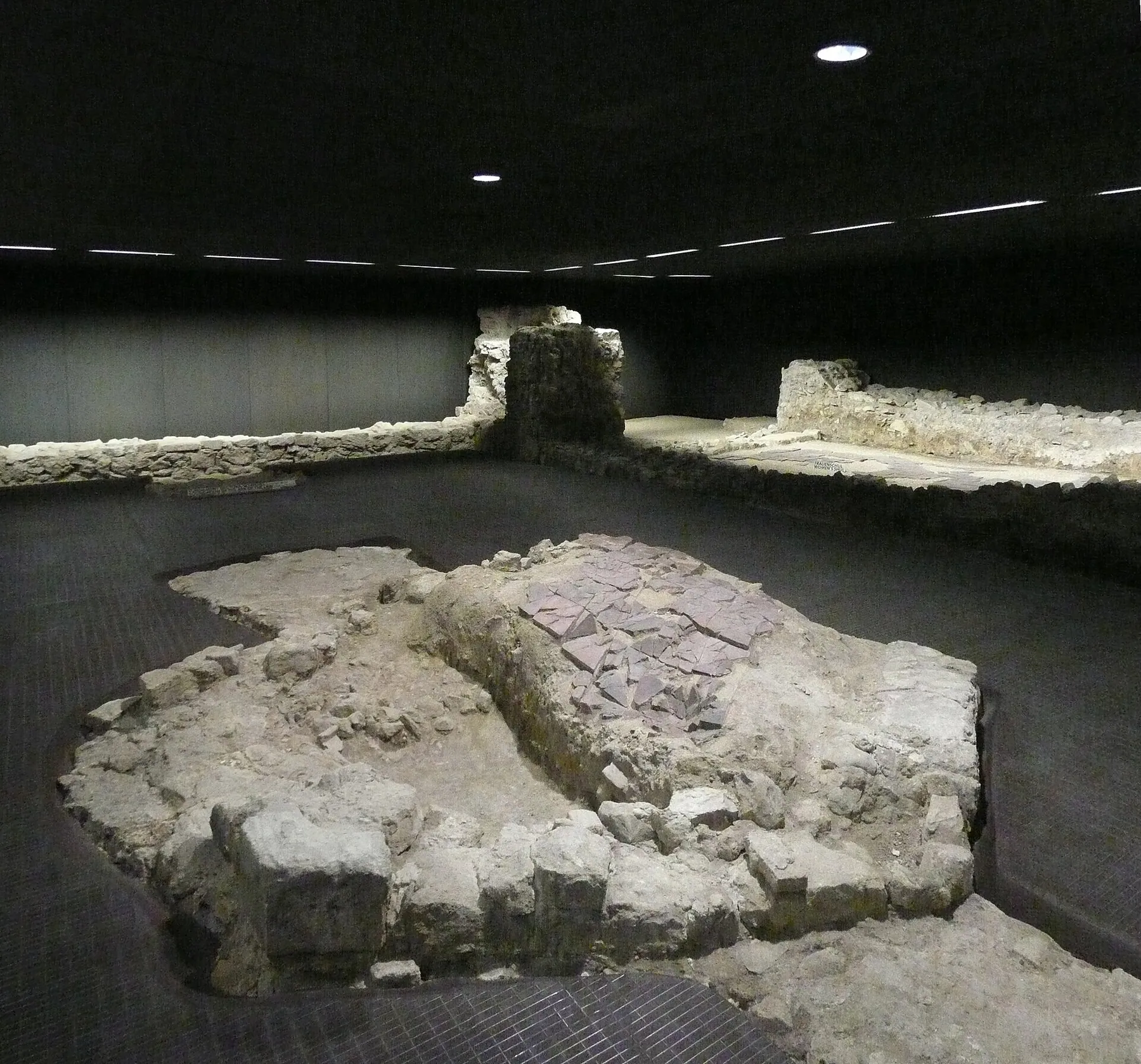
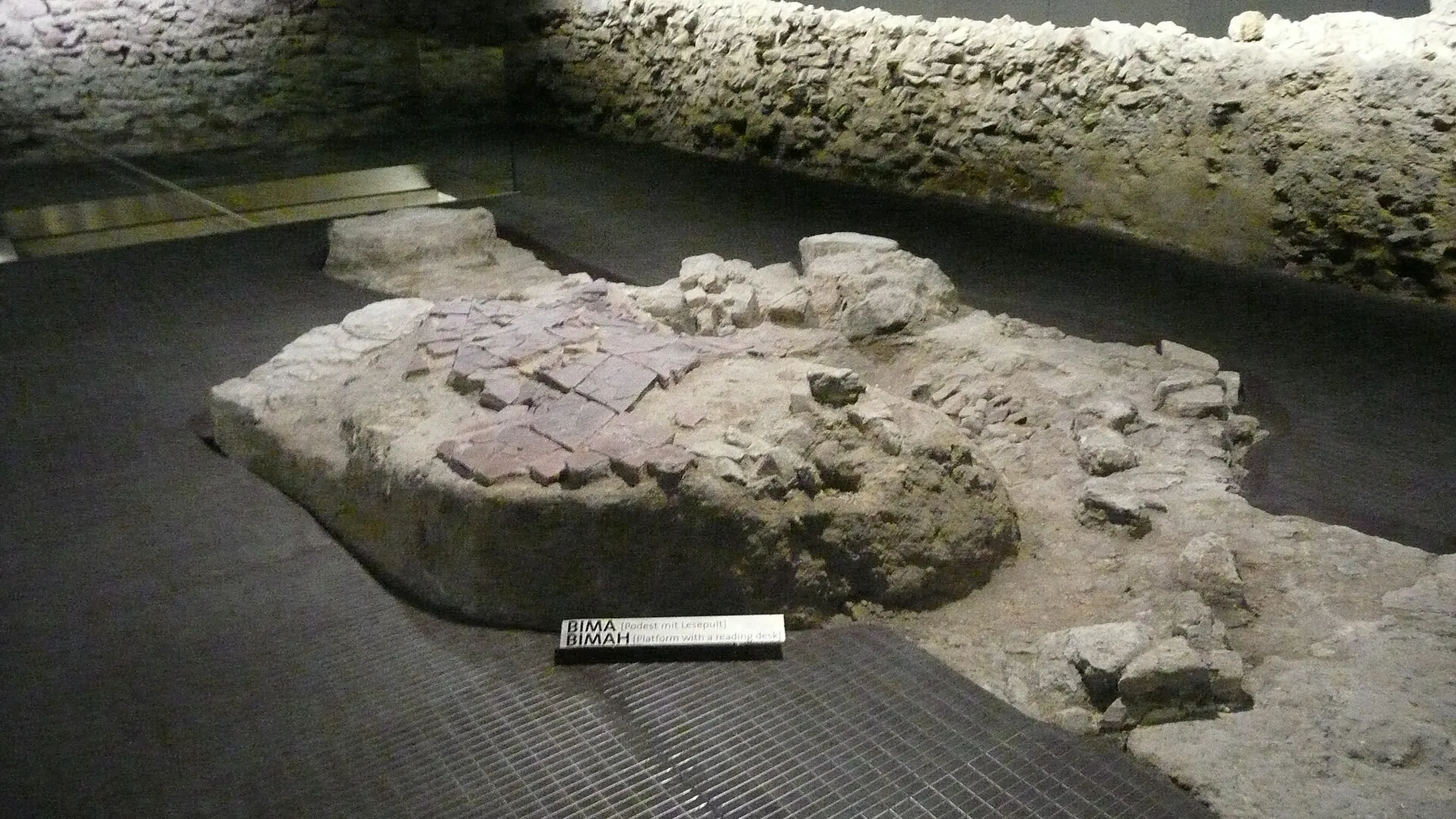
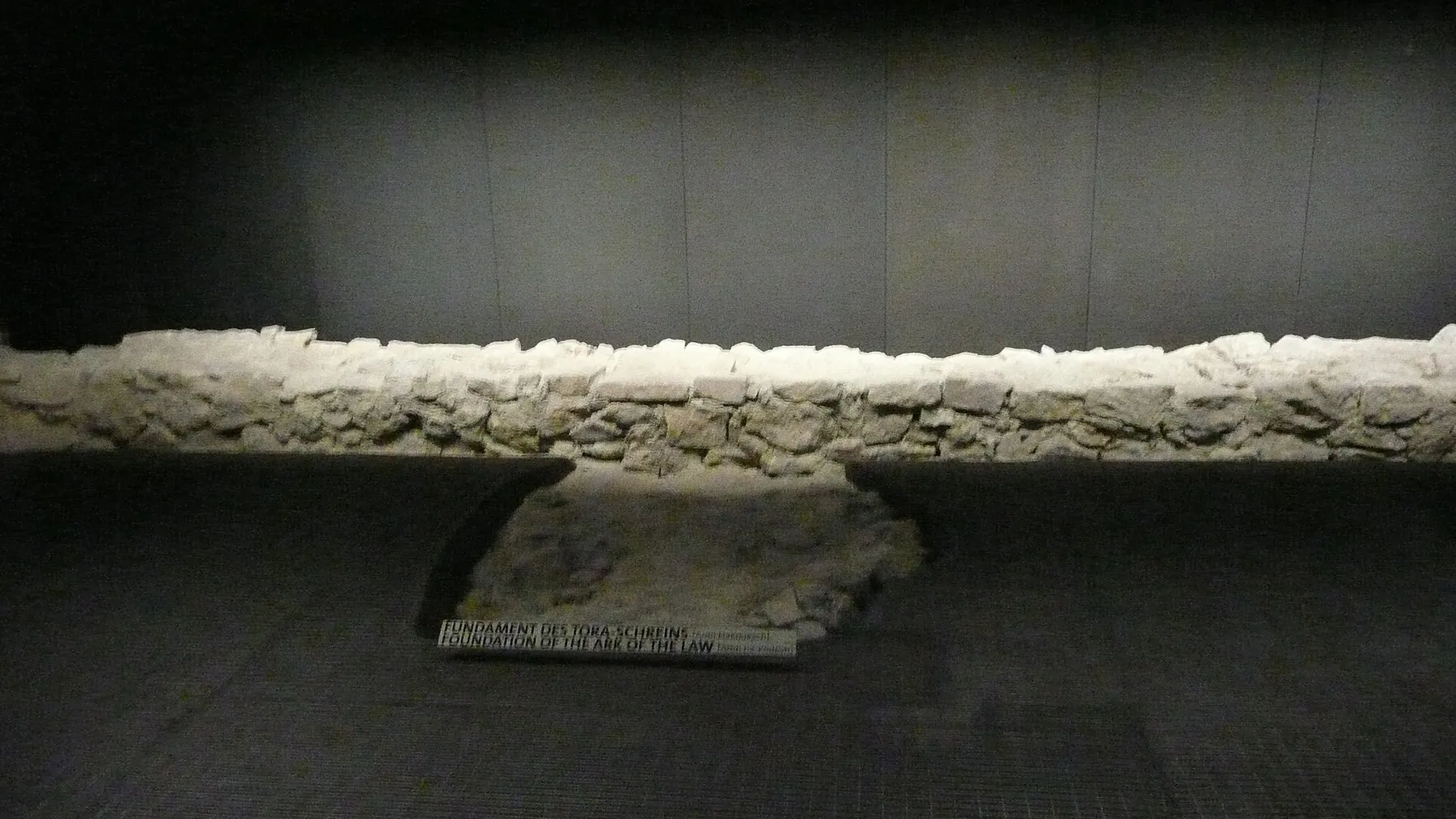
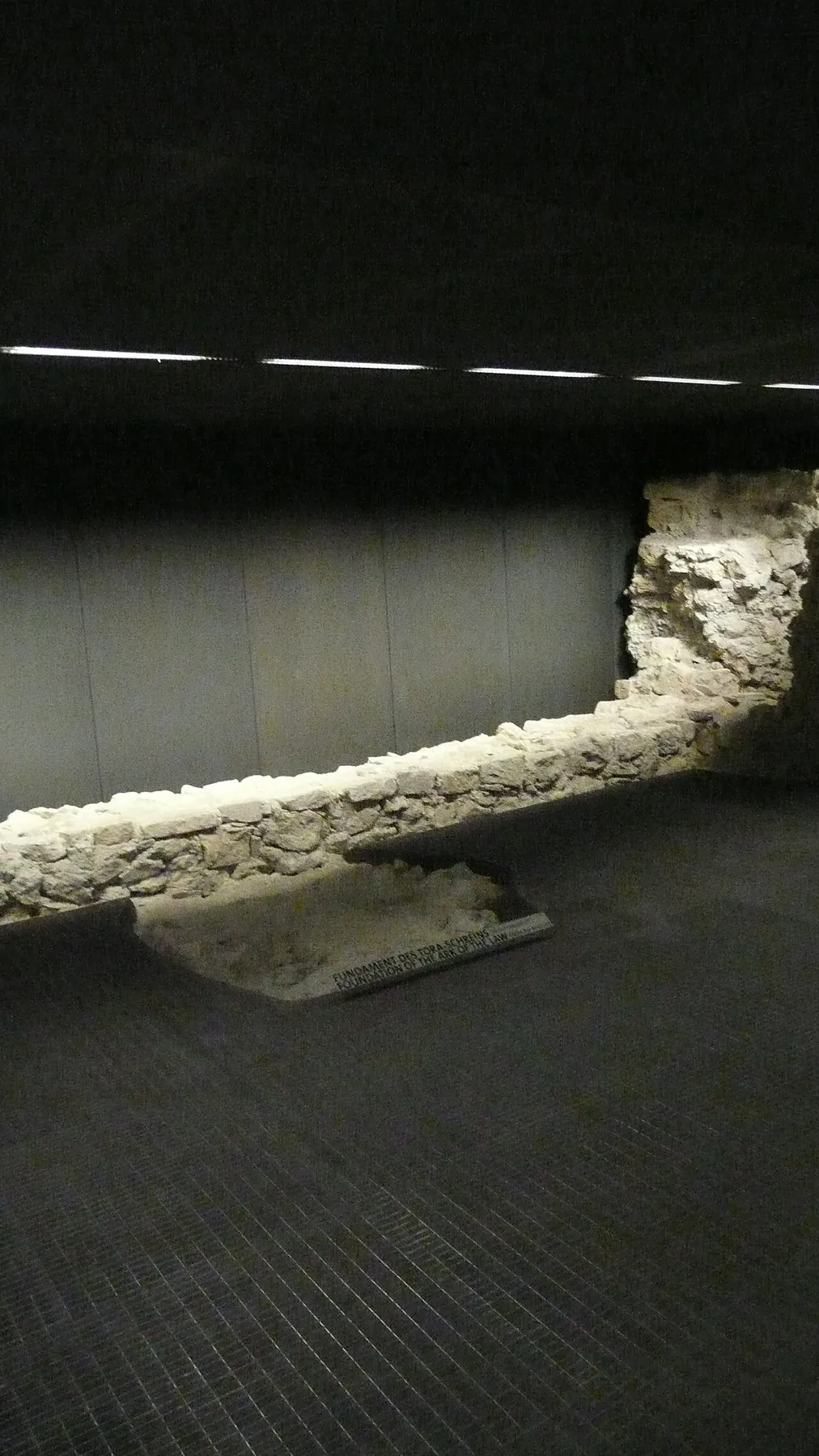
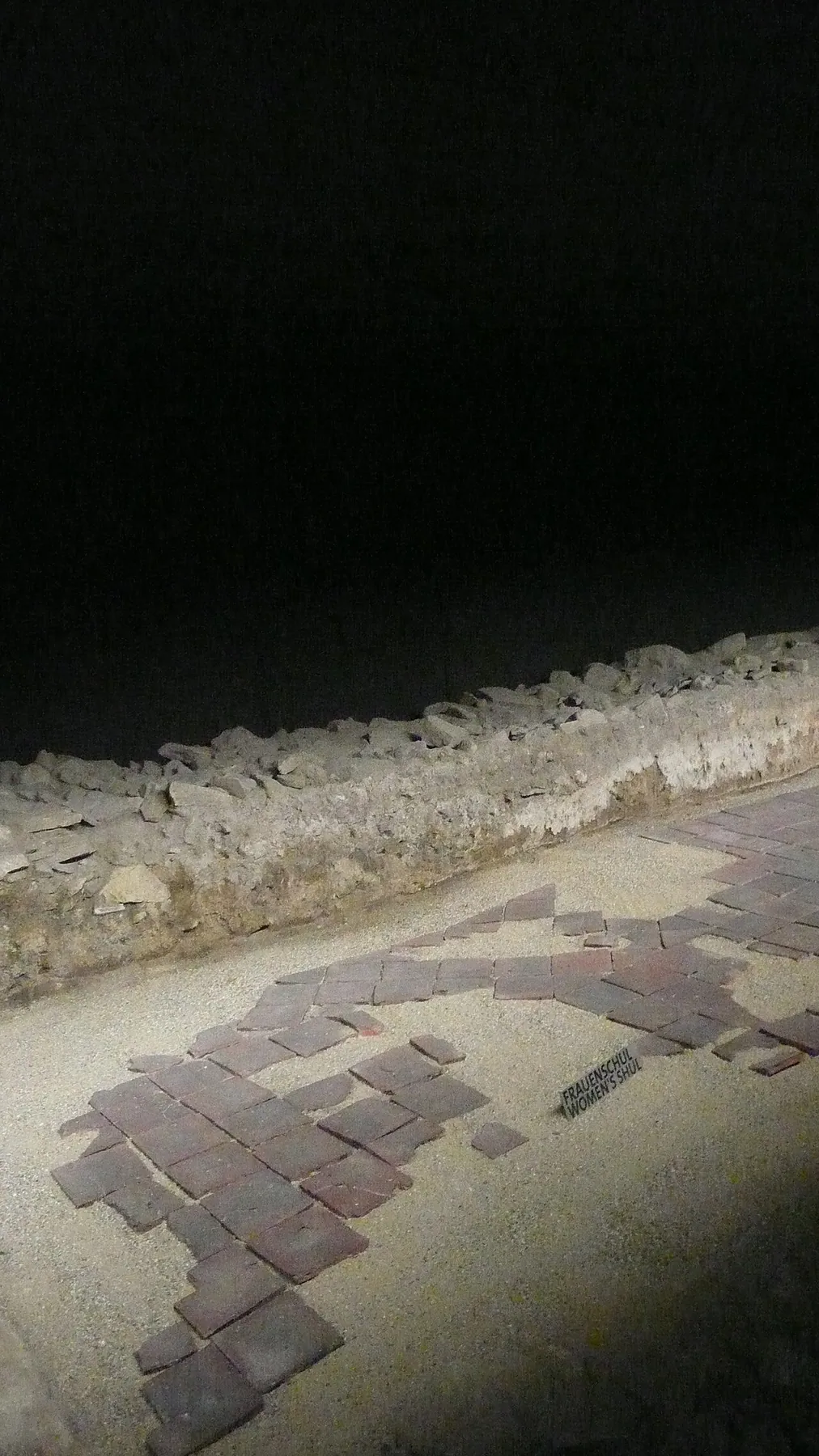
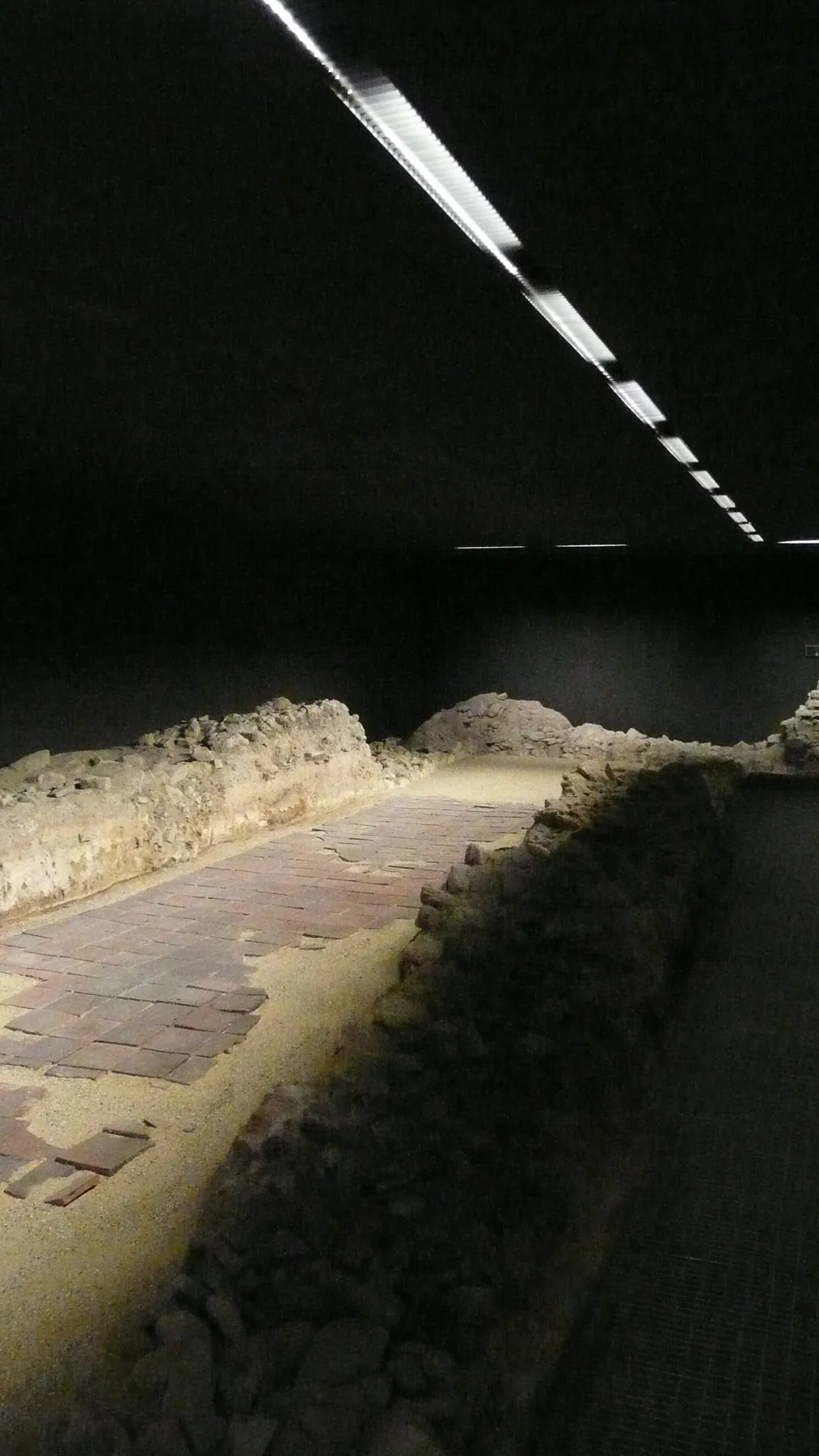
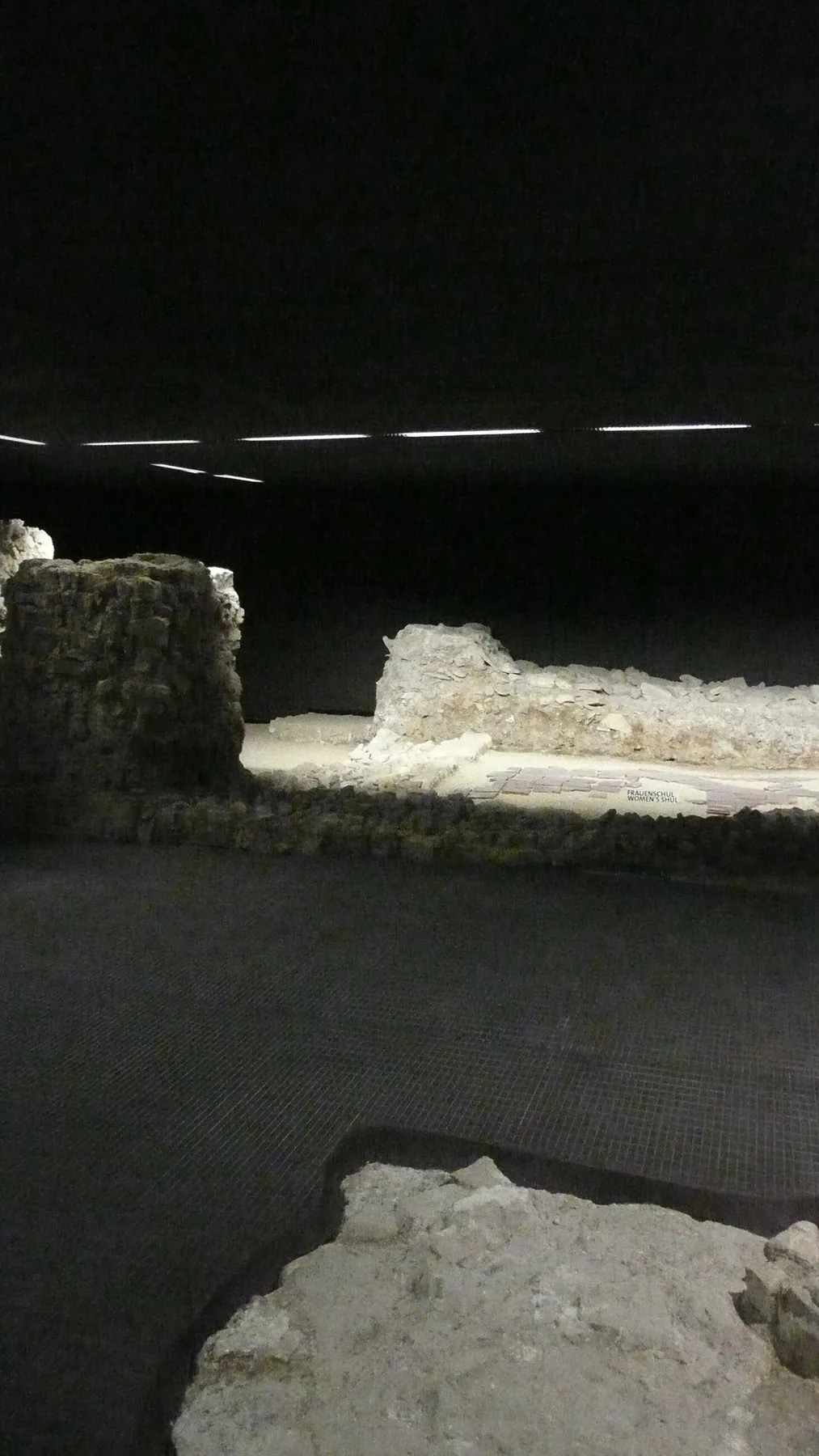
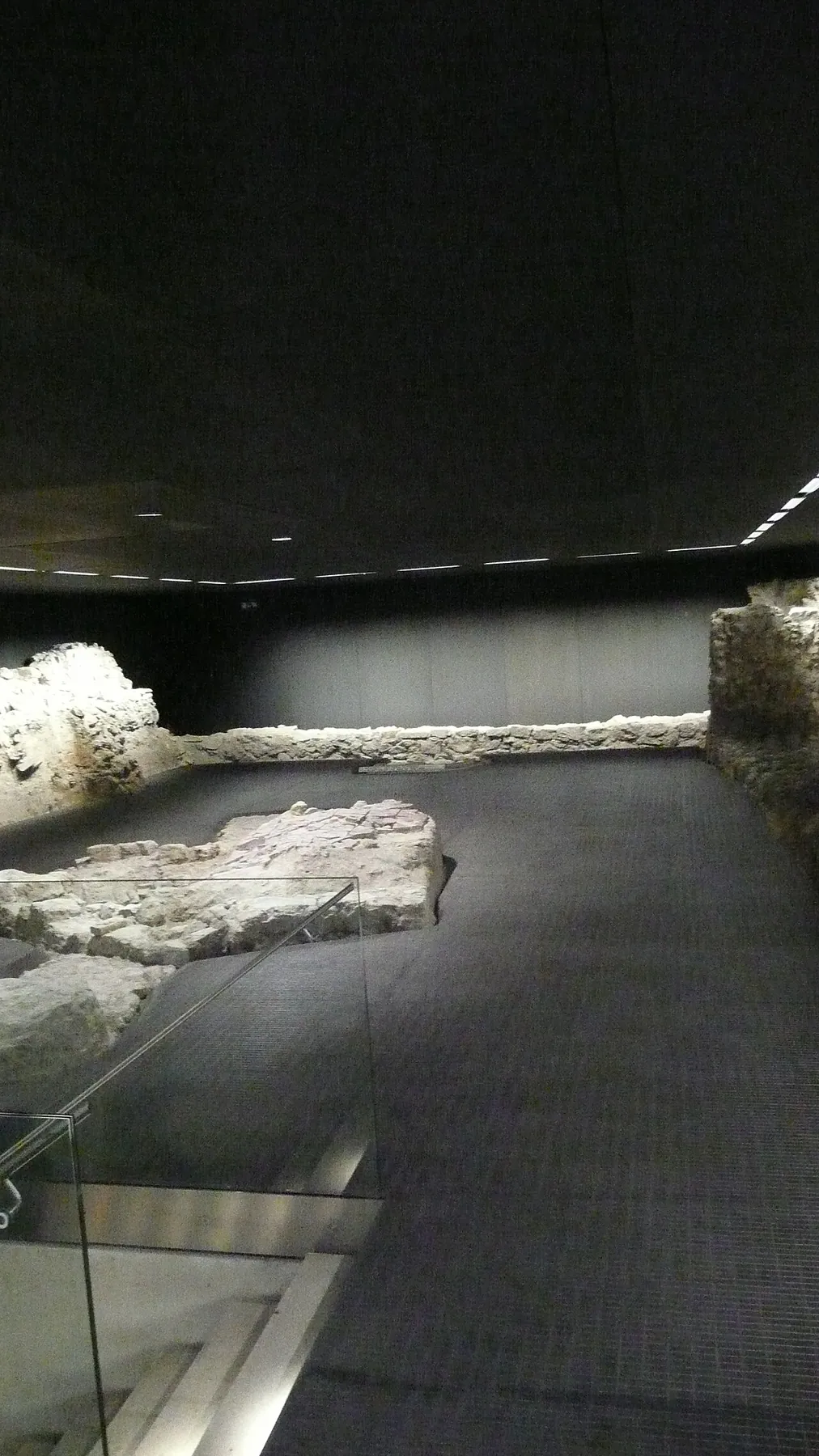
Nothing of the synagogue stands above foundation and floor level apart from a few taller stumps of wall, so its form is known from the excavation. The first building, of about the mid-thirteenth century, was dated by a coin minted in 1236-39 or 1246-51 that lay in the oldest floor of the men's prayer room. The ark stood against the east wall, reached by steps whose foundation survives; a further room lay along the north wall and a narrow women's room against the south wall, linked to the main room by slit windows. Shortly before 1294 the men's room was enlarged into a hall of two aisles and three bays carried on two pillars, with a hexagonal bimah between them. From about the mid-fourteenth century the building was extended east and, above all, west; the north room was lengthened and given a floor of coloured tiles, and the women's room was enlarged. The complex then covered about 465 square metres. Its plan belongs with the two-aisled medieval synagogues of Worms, Regensburg and Prague. The walls are of rubble stone, and the bimah base still carries part of a tiled surface. The builders are unknown.
החיים בבית הכנסת
The main hall was the men's 'shul', used for prayer and study; women followed the service from their own room on the south side through slit windows in the dividing wall. The Torah scrolls were kept in the ark on the east wall and read from the hexagonal bimah in the middle of the hall, which was entered from east and west. Light came from hanging oil lamps of glass, fragments of which the excavators found around the bimah, and from candles. The room on the north side may have housed the yeshiva of Vienna, which made the city a centre of learning: Isaac ben Moses Or Zarua led the rabbinical court and the school in the thirteenth century, Meir ben Baruch ha-Levi headed the yeshiva from 1392, and Abraham Klausner, who also held the Vienna rabbinate, wrote down the community's synagogue customs (minhagim). Small finds from the excavation give a glimpse of daily use: a wooden comb, a toy horse and rider, a key, coins, lead tokens and a metal writing stylus that may have come from the school.
הרס
On 23 May 1420 Duke Albert V had the Jews of Austria arrested. The poor were expelled down the Danube; the wealthy were held, tortured to reveal their valuables and pressed to accept baptism. According to the Wiener Gesera, a Jewish account in Yiddish thought to have been written soon after 1421 and preserved in sixteenth-century copies, young people were shut in the synagogue and starved to force their conversion. At the end of September 1420 the prisoners chose death; Rabbi Jonah, picked by lot to carry out the act, was the last alive, set the fire and died in it. The text is one-sided but is generally treated as reliable. Later retellings speak instead of free Jews who took refuge in the synagogue and held out for three days. In March 1421 the Jews still held in Vienna, 92 men and 120 women, were burned at Erdberg. The duke confiscated Jewish property and had the synagogue demolished. A university document of late 1420 already planned to reuse its stones, and in December 1421 Albert gave them to the University of Vienna for its new building. The demolition was organised to recover material and left little but foundations and floors.
גורל הקהילה
The Vienna Gesera ended the first Jewish community of Vienna. Of an estimated 1,400 to 1,600 people, the poor were made to swear never to return and were put into boats without oars on the Danube in 1420; they drifted downstream to Pressburg and survived. Children were taken from their parents and baptised, although Pope Martin V, appealed to by Italian rabbis, forbade forced baptism under pain of excommunication. Many prisoners died of ill-treatment or by their own hand in the winter of 1420-21. The last 212 were burned on the Gänseweide at Erdberg on 12 March 1421, charged with desecrating a host at Enns and helping the Hussites; the university's own history calls these charges pretexts and names financial and missionary motives. Albert decreed that no Jew might live in Austria in future, a ban renewed in 1453. The houses of the dead and expelled were sold or given away, and the Theological Faculty asked the duke for the Jews' Hebrew manuscripts. Jewish tradition afterwards called Vienna the 'city of blood'. A lasting community formed again only in the seventeenth century.
האתר כיום
The site is the Judenplatz in Vienna's first district, which took its present form only in the fifteenth or sixteenth century. The excavated remains are kept in an underground room below the square, reached from the Museum Judenplatz in the Misrachi-Haus at Judenplatz 8, a branch of the Jewish Museum Vienna opened in 2000. Visitors see low rubble-stone walls, the base of the hexagonal bimah with part of its tiled surface, the foundation of the Torah ark and the tiled floor of the women's room. A Holocaust memorial stands on the square above, and the outline of the bimah is marked in the paving beside it. The museum's permanent exhibition on the medieval community was redesigned in 2021, when the remains were conserved with the help of the city's archaeology service.
שמות בולטים
Isaac ben Moses of Vienna (Isaac Or Zarua)
c. 1200 - c. 1270Head of the rabbinical court and yeshiva of Vienna in the 13th centuryIsaac ben Moses, probably born in Bohemia, settled in Vienna, where he was head of the rabbinical court and of the yeshiva and where he died. He is known by the title of his law code Or Zarua, written about 1260, and a ritual question was sent to him in 1240. The first synagogue on the Schulhof was built in his lifetime, and modern accounts name the building after him; no source read says that he founded it.
ביוגרפיה או מקור ←Meir ben Baruch ha-Levi
died c. 1406Head of the yeshiva of Vienna from 1392Born in Fulda, Meir ben Baruch ha-Levi moved to Vienna in 1392 after being released from imprisonment and headed the yeshiva there; he is last recorded in 1406. He is linked with the Ashkenazi form of rabbinic ordination and the title 'morenu', and Israel Isserlein wrote that he brought the religious customs of the Rhineland to Vienna. He taught in the community during the last decades in which the synagogue on the Schulhof stood.
ביוגרפיה או מקור ←Abraham Klausner
UnknownRabbi of Vienna; compiler of the community's customsThe Jewish Encyclopedia names Abraham Klausner among the rabbis of medieval Vienna, next to Meir ben Baruch ha-Levi, and says that he filled the Vienna rabbinate. He collected the synagogue customs (minhagim) followed in the community, which makes his work a record of how services were conducted in the Vienna synagogue, and the same source notes that he was also a money-broker. His dates were not found in the sources read.
ביוגרפיה או מקור ←Rabbi Jonah (Jona)
died 1420Rabbi named in the Wiener Gesera as the last to die in the synagogueAccording to the Wiener Gesera, the Jewish account of the persecution, Rabbi Jonah was chosen by lot to carry out the martyrdom of the Jews held in the Vienna synagogue, who preferred death to forced baptism. He was the last alive, set the fire and died in it at the end of September 1420. Nothing else about him is recorded in the sources read, and he should not be confused with Jonah, son of David the Steuzz, a moneylender of an earlier generation.
ביוגרפיה או מקור ←יש לכם משהו לתרום?
תמונות, מסמכים, סיפורי משפחה וזיכרונות מבית הכנסת ומהקהילה שלו עוזרים לשמור על ההיסטוריה שלו בחיים.
- Synagoge (1, Judenplatz)
- Geserah (Wiener Geserah)
- Judenplatz
- The Medieval Synagogue in Vienna
- Review of 'Unser Mittelalter! Die erste jüdische Gemeinde in Wien' (ed. A. Peterle, A. Seeger, D. Akrap, D. Spera, 2021)
- Von einer fiktiven Ketzerverschwörung zum Juden-Pogrom
- Wiener Gesera
- Mittelalterliche Synagoge (Wien)
- Judenplatz (Wien)
- Judenplatz
- Wiener Gesera
- Vienna
- Vienna's underground synagogue
- Neue Mittelalter-Schau im Museum Judenplatz
- Our Medieval City! The First Jewish Community in Vienna
- Isaac ben Moses of Vienna
- Meir ben Baruch Halevi
- Vienna Gesera
- File:Museum am Judenplatz (30)-Museum am Judenplatz (32).jpg and the series 'Museum am Judenplatz' (category Synagogue at Judenplatz)
Share a memory or thought
No comments yet. Be the first to add one.