
הסיפור של Orlová Synagogue
Orlová, known in German as Orlau and in Polish as Orłowa, lies east of Ostrava in the Karviná coalfield. Coal mining made it grow quickly around 1900, and a Jewish population of a few hundred settled there; the 1910 census counted 374 Jews, 4.5 per cent of the inhabitants. By the end of the nineteenth century the Jews of Orlová were divided into two congregations, one Orthodox and one Reform, and each had its own synagogue.
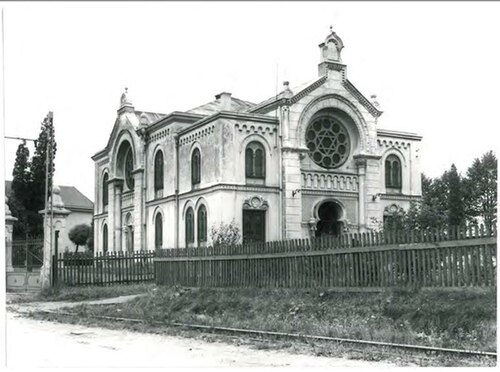
The building described here belonged to the Reform congregation. Around 1900 it commissioned Jakob Gartner, a Vienna-based architect born in Přerov who designed many synagogues across the Habsburg lands. Construction took about two years and the synagogue was dedicated on 10 September 1905, although a list of Gartner's works gives 1900-1901. It was a three-aisled basilica for about 330 worshippers, mixing Romanesque and Moorish motifs.
After the Munich Agreement, Orlová was annexed by Poland in October 1938. When Nazi Germany invaded Poland in September 1939 and took the town, the synagogue was destroyed straight away and its ruins were removed. A 2016 diploma thesis at the Vienna University of Technology reconstructed the lost building digitally. Only foundations survive on the site.
Where it stood for 34 years
Historic: Orlau (Orlová), Austrian Silesia; street and house number unknown. Today: site with surviving foundations in the Město quarter of Orlová, near Petra Cingra street, 735 01 Orlová (approximate).
פתיחת מפה גדולה ←הקהילה היהודית
Jewish settlement in Orlová is dated by JewishGen's cemetery survey to the nineteenth century, with one entry placing it early in the century and another in the middle. The community grew with the coal mines that made the town grow rapidly around 1900. The 1910 census recorded 374 Jews among the town's population, 4.5 per cent of the total, alongside a Roman Catholic majority and a large Protestant minority; the surrounding population spoke Polish, Czech and German. By the late nineteenth century there were two separate congregations, an Orthodox one and a Reform one, each with its own synagogue. A Jewish cemetery was laid out around 1900 on the edge of the town, inside what is now the municipal cemetery. After 1918, when Orlová became part of Czechoslovakia, the Zionist movement gained ground among local Jews. In the early 1930s about 400 Jews lived in the town, roughly four per cent of its population; JewishGen gives 394 for 1930. The names of the community's rabbis, cantors and lay leaders were not found in the sources read.
אדריכלות ועיצוב
Jakob Gartner designed the synagogue as a three-aisled basilica, a hall with a higher central nave flanked by lower side aisles, for about 330 worshippers. According to the German Wikipedia article, which draws on Margit Iwantscheff's 2016 reconstruction thesis, the design combined Romanesque and Moorish elements and had no towers or domes. The building was covered by a pitched roof, and the main front was marked by a central gable crowned with the tablets of the Ten Commandments. Rose windows filled with a Star of David lit the interior. On the east side the Torah ark stood in a rectangular apse projecting from the main body of the building. Construction took about two years and the building opened in 1905. A photograph of about 1935, taken near the tram line, shows the synagogue in its townscape. The dimensions, materials, the arrangement of the women's galleries and the interior decoration are not described in the sources read in full here; the thesis itself, which contains the detailed reconstruction, could not be opened.
החיים בבית הכנסת
The synagogue served the Reform, or progressive, congregation of Orlová, while the town's Orthodox Jews kept a separate synagogue of their own. The sources read do not explain how the two congregations came to divide, how the Reform rite was conducted in Orlová, or which language its sermons used. The building's size, about 330 seats, shows that it was meant for the whole Reform community on the High Holidays. The Reform congregation was able to commission a well-known Viennese architect for it, which suggests a community of some means. The synagogue was dedicated on 10 September 1905 and served the congregation for just under 34 years. After 1918 Zionism became an important current in the town's Jewish life. Nothing specific was found about the rabbis or cantors who officiated, the services held, or the community's schools and societies.
הרס
After the Munich Agreement, Poland annexed Orlová in October 1938 together with the rest of the Trans-Olza region. Under Polish rule Jews holding Czech citizenship were expelled, but the synagogue itself is not reported to have been harmed in that year. In September 1939, at the start of the Second World War, Nazi German forces occupied Orlová and the town was annexed to the German Reich. According to the German Wikipedia article, the synagogue was destroyed immediately after the occupation, in September 1939, and its ruins were cleared at once. Margit Iwantscheff's thesis states that it was destroyed by the Nazi regime in 1939 and pulled down to its foundations, and a Czech military-history site likewise says it was destroyed during the Nazi occupation. The sources read do not say whether the building was burned or blown up, or which Nazi unit or official carried out the destruction. The town's Orthodox synagogue was also destroyed, at a date not given in the sources.
גורל הקהילה
The Polish annexation of October 1938 already broke up the community, since Jews with Czech citizenship were expelled from the town. When Nazi German forces occupied Orlová in September 1939, the Jews who remained came under Nazi rule. According to the Jüdische Gemeinden survey, they were deported to ghettos and extermination camps. The dates of the transports, their destinations and the number of victims from Orlová itself were not found in the sources read. Nearby Ostrava was the starting point of the first Nazi deportations of Jews to Nisko in October 1939, but no source read says that Orlová Jews were among them. No Jewish congregation was re-established in Orlová after the war. The Jewish cemetery, laid out around 1900, survives within the municipal cemetery and is now used by the Jewish community of Ostrava; JewishGen records a last burial in 1980 and memorials to Holocaust victims there.
האתר כיום
The synagogue was not rebuilt after the war. The German Wikipedia article states that only its foundations remain at the site, which it locates at about 49.8470 N, 18.4430 E. On present-day maps that point lies in the Město quarter of the old town of Orlová, close to Petra Cingra street. Coal mining later caused severe damage to the town, so the surroundings may have changed considerably since the synagogue's time. No street address for the building was found. A digital reconstruction made at the Vienna University of Technology in 2016 is the only way to see the synagogue in three dimensions today. The Orthodox synagogue's site was not identified.
שמות בולטים
Jakob Gartner
1861-1921Architect of the synagogueGartner, born in Přerov in Moravia and trained in Brno, Bielitz and Vienna, ran his own practice in Vienna from 1888 and became one of the most prolific synagogue architects of the Habsburg monarchy, with buildings from Moravia to Transylvania. The Reform congregation of Orlová commissioned him around 1900, and he designed its synagogue as a three-aisled Romanesque-Moorish basilica for about 330 worshippers, opened in 1905. Several of his synagogues, Orlová among them, were destroyed under Nazi rule.
ביוגרפיה או מקור ←יש לכם משהו לתרום?
תמונות, מסמכים, סיפורי משפחה וזיכרונות מבית הכנסת ומהקהילה שלו עוזרים לשמור על ההיסטוריה שלו בחיים.
Share a memory or thought
No comments yet. Be the first to add one.