

Die Geschichte von Synagogue of Paderborn
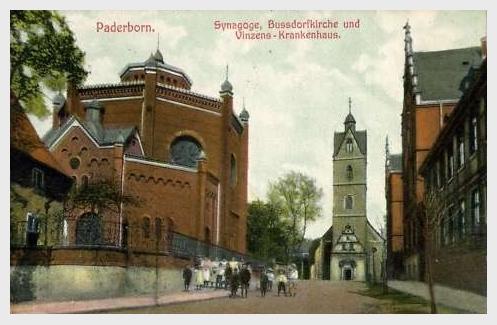
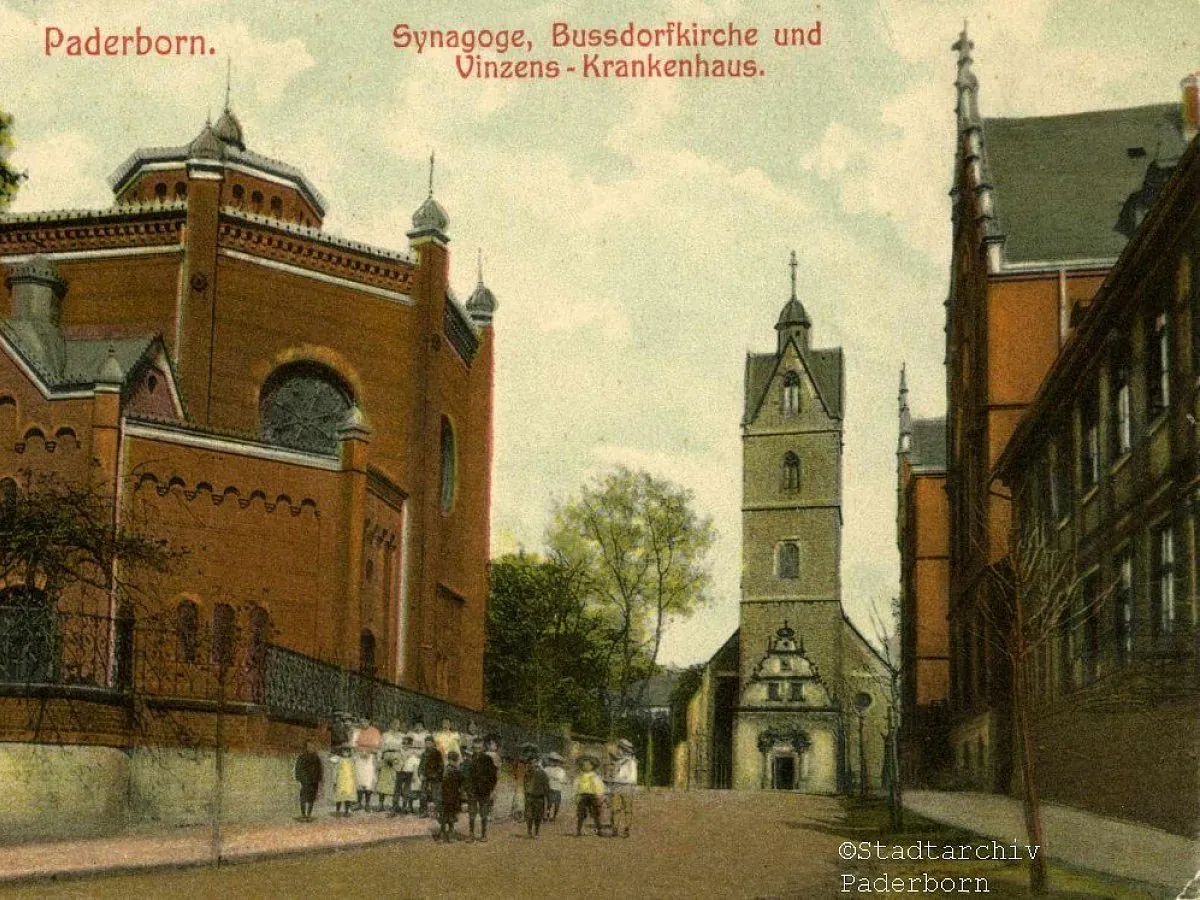
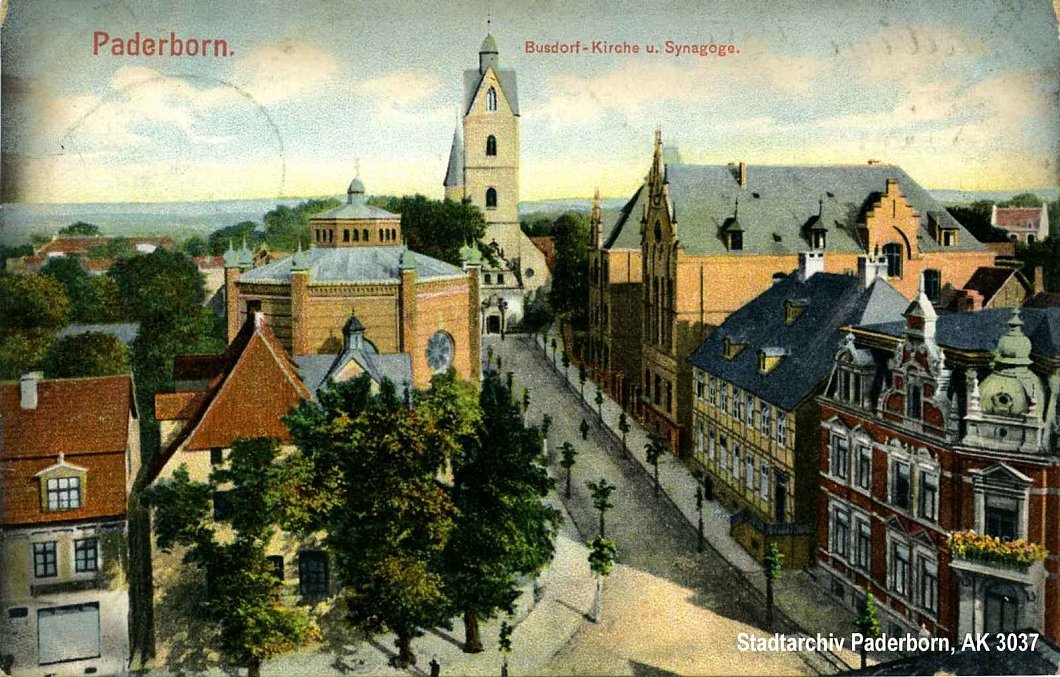
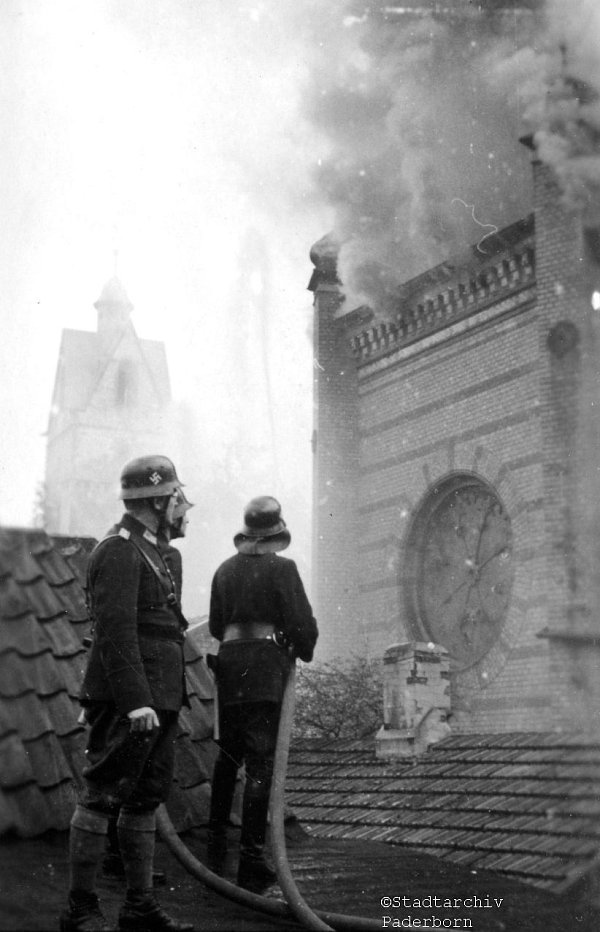
Around 1800 the Jewish community of Paderborn built a synagogue and school on the Padergasse. When that building became unsafe, the community bought a plot on the Busdorf-Immunität in December 1860, the old church precinct around the Busdorf church in the town centre. It first built a Jewish school there, then bought a neighbouring plot, and in August 1882 consecrated a new synagogue in the Moorish style. Its brick octagonal central building and small onion-domed turrets made it a landmark beside the Busdorf church and the St Vincenz hospital. It held 190 men and 103 women. During the November pogrom, on 10 November 1938, the SS set the synagogue on fire, with the city building officer and the head of the municipal vehicle depot taking part. On 30 November 1939 the community was forced to hand over all its property to the city, and the ruins were cleared. Since 1993 a wall of coloured brick opposite today's district court marks the site, and a new synagogue was consecrated nearby in 1959.
Where it stood for 56 years
Historic: Am Busdorf (Busdorf-Immunität), next to the Busdorf church and St Vincenz hospital, Paderborn. Present day: synagogue memorial wall opposite the Amtsgericht (district court), Am Busdorf, Paderborn, Germany.
Größere Karte öffnen →Die jüdische Gemeinde
Paderborn, a Catholic bishop's city in Westphalia, had a Jewish community that numbered 372 in the later nineteenth century and reached 421 in 1901, about 1.7 per cent of the population. Around 1800 the community built its first synagogue and a school building on the Padergasse. When these became dilapidated, it bought land on the Busdorf-Immunität in December 1860 and built a new Jewish school there before the synagogue followed. The town was also home to a Jewish orphanage for Westphalia and the Rhineland, founded in 1863, which later became a last refuge for children and old people. In 1925 the community had 304 members in about 80 families, and 273 in June 1933.
Architektur und Gestaltung
The synagogue was built in 1881–1882 on the Busdorf-Immunität, the precinct around the Romanesque Busdorf church in the centre of Paderborn, next to the St Vincenz hospital. It was designed in the Moorish style, then popular for German synagogues. Its most distinctive feature was an octagonal central building of brick, marked out by small onion-domed turrets. Postcards from the early twentieth century show the red-brick synagogue with a large round window and domed turrets, standing just along the street from the Busdorf church tower. It offered seats for 190 men and 103 women. The memorial wall built on the site in 1993 echoes its striped brickwork and arches.
Leben in der Synagoge
The synagogue at the Busdorf served a mid-sized Westphalian community of about 300 to 400 people for more than half a century, from its consecration in August 1882 until 1938. It stood alongside the community's school, which the congregation had built first on the same land, so that worship and teaching shared one site. The Jewish orphanage in Paderborn brought children from across Westphalia and the Rhineland into the community's life. The names of rabbis, cantors and teachers who served in the synagogue are not recorded in the sources consulted for this entry, and further detail is given in Margit Naarmann's history of the community.
Zerstörung
During the November pogrom, on 10 November 1938, the SS set the Paderborn synagogue on fire. According to the German Wikipedia article, based on Naarmann's research, the city building officer and the head of the municipal vehicle depot took part, showing how closely the town administration was involved. The building burned out. The attacks in Paderborn followed years of harassment: already in March 1933 customers were kept from Jewish shops, and on the night of 28–29 March SA men smashed the windows of Jewish shops and homes. On 30 November 1939 the Jewish community was forced to transfer all its land, including the synagogue site, to the city. The ruins of the synagogue were then removed.
Das Schicksal der Gemeinde
The community fell from 273 in June 1933 to 170 in 1935 as families emigrated under pressure and their businesses were 'Aryanised'. Those who remained, mostly elderly and impoverished, were forced into so-called Jews' houses. The first deportation of Paderborn Jews, together with others from Westphalia, left on 10 December 1941 for the Riga ghetto. A second transport followed at the end of March 1942, probably to Warsaw. In spring 1942 the Jewish school and the orphanage were closed; the remaining children and their carers were deported. By August 1942 no Jews remained in Paderborn. Most of those deported were murdered in the ghettos and camps of the East.
Der Ort heute
Nothing of the synagogue survives. Its site on the Busdorf is marked by a memorial built in 1993 opposite today's district court: a wall of coloured brick with arches recalling the synagogue's architecture. Plaques on the wall list the names of Paderborn's Jewish victims of Nazi persecution, and an inscription records that the synagogue of the Jewish community of Paderborn stood here from 1882. A new synagogue was consecrated nearby on Pippinstraße in 1959 and is used by today's small Jewish community.
Haben Sie etwas beizutragen?
Fotos, Dokumente, Familiengeschichten oder Erinnerungen an diese Synagoge und ihre Gemeinde halten ihre Geschichte lebendig.
Share a memory or thought
No comments yet. Be the first to add one.