
The story of Pärnu Synagogue
Pärnu, the German Pernau, is a port on the Gulf of Pärnu in south-western Estonia and was part of the Russian province of Livonia until 1918. A Russian-language history of Estonian Jewry says Jews settled there earlier than in any other provincial town, and its modern congregation grew out of the families of Jewish soldiers of the Tsarist army, who had a prayer house on Eliisabeti Street by 1859. The building described here stood at Laatsareti 2 in the Eeslinn district, next to the town prison. It was a large two-storey wooden house; the Estonian Jewry Archive identifies a small stone building attached to it as the synagogue's offices and marks the site of a mikveh close by. When the wooden building was put up, by whom, and whether it was built as a synagogue or adapted from an existing house is not recorded in any source read; Jewish Heritage Europe calls it a simple building used as a synagogue before the Second World War. All sources agree that the whole building served as Pärnu's synagogue until 1941, when it became the scene of the murder of the town's Jewish children. After the war it was used as housing and later abandoned. In 2001 the chairman of the Union of Jewish Communities called it the only synagogue building in Estonia to have survived the war and said the community was trying to recover it. It still stood, as a ruin, in 2010, and had gone by July 2013.
Where it stood
Historic and present address: Laatsareti tänav 2, Eeslinn, Pärnu, Pärnu County, Estonia (building demolished 2010-2013). Pin on Laatsareti Street (approximate; house number not found in OpenStreetMap).
Open larger map →The Jewish community
The first records of Jews in Pärnu date from the late sixteenth century, but the modern community began with soldiers of the Tsarist army and their families. By 1859 about ten soldier families lived in the town, with a prayer house on Eliisabeti Street founded by Itzhok Jakobson and Aharon Pavlovsky, and a Jewish cemetery was laid out in the late 1850s. By 1872 there were 57 Jewish families, 11 of them soldiers' families and 46 of craftsmen. That year the community leaders A. Kliwanski, Josef Klein and Sholem Nus engaged Mikhl Ovsha as rabbi. Efraim Shein, Liebesman, the Khaitov brothers, Henig, Muzikant and Glezer petitioned the governor-general of Livonia against him, and the ministry refused to confirm him because Jewish communities were not to be formed in the district; he served for eight years regardless, and Pärnu is said never to have had an officially confirmed rabbi. The authorities granted Pärnu's Jews a permit in 1873. Y. Shats represented Pärnu at the congress of Estonian Jews in 1918, and the community came through the First World War almost untouched.
Architecture and design
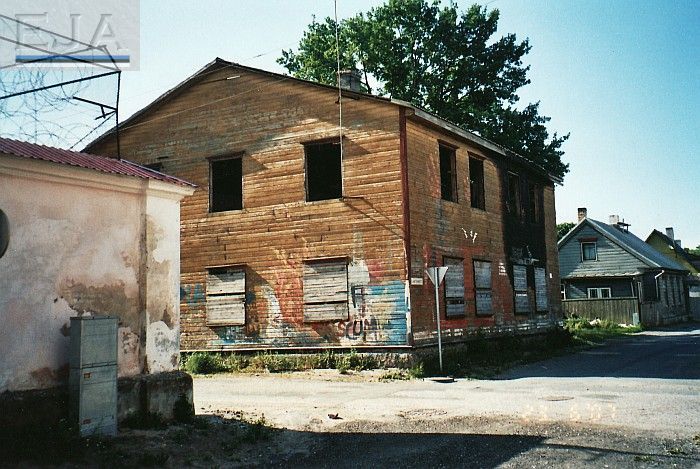
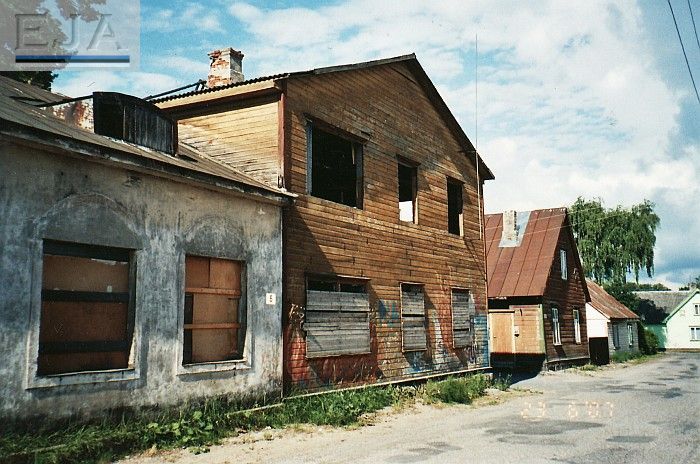
No plan, drawing or pre-war photograph of the synagogue was found, so its appearance is known only from two photographs taken in June 2007, when it was already a gutted ruin. They show a free-standing two-storey timber building of rectangular plan under a pitched roof with a brick chimney, its walls clad in horizontal boards. The gable end faces the street and the long side has a regular row of rectangular windows on each floor. In 2007 the ground-floor windows were boarded up and covered in graffiti, while the upper windows were empty and fire-blackened. Attached to one end is a lower single-storey wing of rendered masonry with two large recessed openings, also boarded up; the archive identifies a stone building here as the synagogue's offices. Nothing in the photographs marks the building as a synagogue, and its windows and plain form may reflect its postwar use as housing. The builder, the date of construction, the seating capacity and the arrangement of the prayer hall, ark and any women's gallery are all unknown.
Life inside the synagogue
No source read describes services, furnishings or officials of this particular building, and it is not known in which decade the congregation began to use it. What is known of Pärnu's religious life comes from the community's general history. Its first prayer house was founded by former soldiers, and the last of these 'Nicholas soldiers' died in 1926. The rabbi Mikhl Ovsha served the congregation for eight years from 1872 without government confirmation, and the community is said never to have had an officially confirmed rabbi. The Estonian Jewry Archive's photographs of 2013 show that the synagogue formed a small complex: the wooden prayer building, a stone office building attached to it, and a mikveh nearby, so that worship, administration and ritual bathing were all on one plot at Laatsareti 2. The 1941 massacre and the postwar history of the building ended this use; after the war Pärnu's surviving or returning Jews prayed in a house on Suur-Jõe Street.
Destruction
Nazi German forces occupied the Pärnu area in July 1941. The synagogue was the place where the town's Jewish children were held and killed in November 1941, and an Estonian Jewry Archive caption records a fire in the building while the children were inside; the stone office wing survived that fire and several later ones. The wooden building nevertheless remained standing. After the war it was used as housing. By 2001 it had stood empty for almost ten years, ransacked and burned, and Estonian Jews wished to place a memorial plaque on its wall and to have the building returned to the community. Photographs of June 2007 show it boarded up, its upper floor burned out. Jewish Heritage Europe reported it still standing in ruinous condition in 2010. A photograph published by the Estonian Jewry Archive in July 2013 shows an empty space where the wooden synagogue had stood, with the burned stone office building still in place. No source read gives the date of the demolition, who owned the building at the time, who carried it out or why.
The community’s fate
Nazi German troops reached southern and western Estonia in early July 1941. Einsatzkommando 1a of Einsatzgruppe A, under Martin Sandberger, with the help of local collaborators including the Omakaitse (Home Guard), killed virtually all of the roughly 950 to 1,000 Jews who had not escaped, and the Nazi occupation regime declared Estonia 'judenfrei' at the Wannsee Conference. In Pärnu Jews were killed in a garden and in the synagogue. On 2 November 1941 local Omakaitse men, whom the Estonian Wikipedia calls local National Socialists, murdered 34 Jewish children in the synagogue. According to David Slomka, chairman of the Union of Jewish Communities, all the Jewish children of Pärnu were killed there by poison put in their food; a man who worked in the neighbouring hospital in 1941 told the archive that the hospital supplied sweetened porridge to the children and that after eating it they were dead. An archive caption also records a fire in the building with the children inside. After the war a small community prayed in a house on Suur-Jõe Street, and the Jewish cemetery, dating from the 1850s, is still in use.
The site today
The synagogue stood at Laatsareti 2 in Pärnu's Eeslinn district, next to the former prison and near a hospital building. In July 2013 the plot where the wooden synagogue had stood was empty, while the burned single-storey stone building that had housed the synagogue's offices still stood beside it; the site of the mikveh was also pointed out at that time. Whether the stone building survives today, and what now occupies the plot, was not established in this research. No memorial on the site was found in the sources read; in 2001 the community had planned a plaque on the synagogue's wall. The map pin marks Laatsareti Street, not the exact plot.
Do you have something to contribute?
Photographs, documents, family stories or memories of this synagogue and its community help keep its history alive.
- Pärnu sünagoog
- Pärnu juudid nõuavad sünagoogi tagasi
- Estonia (country overview)
- In this house was the Pärnu synagogue before the WWII (parnu2.jpg)
- In this house was the Pärnu synagogue before the WWII (parnu3.jpg)
- Empty space in front of the burned house is where the wooden synagogue building was standing (IMG_1388)
- Here was the mikve (IMG_1389)
- Stone building of the synagogue (offices), hospital building to the left and the prison in front of it (IMG_1390)
- Here were the offices of the Pärnu synagogue (IMG_1392)
- In this house in Pärnu on Suur Jõe t. was a Praying house after the WW2
- Беседа с председателем Союза еврейских общин Давидом Сломкой (from Jeruusalema sõnumid, 2001, no. 3)
- История евреев Эстонии (after Gens and Jokton)
- Manna (documentary)
- The Holocaust in Estonia
- Laatsareti (OpenStreetMap way 64094943)
Share a memory or thought
No comments yet. Be the first to add one.