
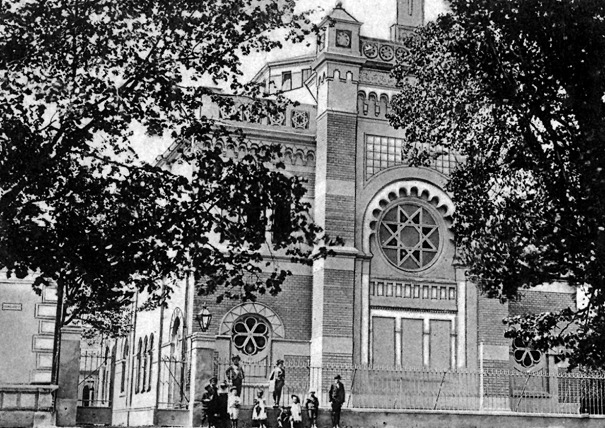
The story of Piešťany Orthodox Synagogue
Piešťany, the spa town known in Hungarian as Pöstyén and in German as Pistyan, had Jewish residents from the 1720s and an independent community from 1795. A first, classicist synagogue was built around 1815. When Hungarian Jewry split in 1869, the Piešťany congregation joined the Orthodox, and it grew quickly as the spa developed, from 140 Jews in 1869 to 732 in 1900. Its great synagogue was built for this growing community and for the Jewish visitors who came to the baths. Pinkas Hakehillot says a large and glorious synagogue with 400 seats was dedicated in 1904, with a house for community officials nearby; the town information centre and the heritage site pamiatkynaslovensku.sk, following the town chronicle, date the Orthodox synagogue to 1893-1894, a dating pamiatkynaslovensku itself calls unreliable. All sources agree that it was the community's main house of prayer. It stood on Winterova street, near the site of the former Teplice cemetery behind today's Pierre de Coubertin grammar school. After a group of members left in 1926, the liberal Yeshurun congregation built a synagogue of its own in 1928; the Orthodox building remained the larger of the two. It was confiscated during the war and was later dismantled; the date of its removal is disputed between the early 1950s and 1979.
Where it stood for nearly 85 years
Historic: Winterova street, Piešťany (house number unknown). Today: plot on or near Winterova, near the park behind the Pierre de Coubertin grammar school, central Piešťany (approximate).
Open larger map →The Jewish community
Two Jewish families were recorded in Piešťany in 1728, and refugees from Moravia soon followed; by 1736 twelve families lived under the protection of Count Forgách. The community belonged to the Vrbové rabbinate until it became independent in 1795. A prayer room existed from about 1780 and a first synagogue from about 1815. The spa drew Jewish settlers and guests in growing numbers: 105 Jews in 1828, 732 in 1900, 1,254 in 1921 and 1,559 in 1940. Jews owned many shops, pensions and hotels, the Winter family ran the spa itself, and in 1921 eleven of the town's nineteen physicians were Jewish. The congregation was Orthodox from 1869. Its rabbis included David Fischer (died 1880), Josef Unger from Boskovice, Noach Baruch Fischer, who opened a yeshiva in 1900, Kalonymus Kalman Weber and, from 1932, Benzion Josef Unger. Zionist and Agudat Israel groups were both strong. In 1926 about 140 families, opposed to the rabbi's anti-Zionism, left and formed the liberal Yeshurun community. In the 1930s the Orthodox community was led by Karol Holzer, Leopold Weinberger and Nathan Nágel.
Architecture and design
Pamiatkynaslovensku.sk, summarising Ľubomír Mrňa's 1995 article in Pamiatky a múzeá, describes the synagogue as a striking example of the Moorish style, built with walls of glazed facing brick, coloured stained-glass windows and cast-iron columns that carried the women's gallery. The ceilings and the most prominent parts of the walls were painted with geometric ornament. The builder is not named; the article only says he must have been an able professional, and the town information centre calls him anonymous. The one view found, a period photograph reproduced by the regional newspaper Piešťanské noviny, shows a tall brick building seen from a street corner, with banded masonry, a large rose window with a six-pointed star tracery in the gabled side front, smaller round windows, arched openings and corner towers ending in small domed lanterns. A low railing fronts the street. Pinkas Hakehillot gives it 400 seats. The plan, the dimensions and the form of the ark are unknown.
Life inside the synagogue
The synagogue served the Orthodox community of Piešťany and the many observant Jews who came to the spa; the community also kept a kosher restaurant for spa guests and a second synagogue in the bath district. Rabbi Noach Baruch Fischer, one of the leading rabbis of the Hungarian kingdom, opened a yeshiva in 1900 before leaving for Prešov in 1902. His successor, Kalonymus Kalman Weber (died 1932), was a noted preacher, a founder in 1919 and president of the Central Bureau of Orthodox Communities in Slovakia, and a firm opponent of Zionism; he ran a yeshiva of about fifty students. The dayan Issachar Shlomo Teichtal, later author of Em HaBanim Semeichah, acted as rabbi and in 1931 opened his own yeshiva, Moriah. From 1932 the rabbi was Benzion Josef Unger, who also kept a yeshiva. Four small communities and 23 villages belonged to the Piešťany rabbinate. The community ran a five-class Jewish elementary school with about 100 pupils in the 1930s, a Talmud Torah, a mikveh, an old-age home and a soup kitchen.
Destruction
During the war the synagogue was confiscated and used as a depot for the property of deported Jews. The town information centre reports that a property appraiser who inspected it in 1949 found the building desecrated and looted, with prayer books and documents scattered inside. Survivors did not return to it: after 1945 the reunited community prayed in the former Yeshurun synagogue. According to the town information centre the Orthodox synagogue was thoughtlessly pulled down at the beginning of the 1950s, in the early years of Communist rule. Pamiatkynaslovensku.sk, citing Mrňa, adds that its materials were too good simply to demolish, so it was taken apart and the material used to build a private house. Neither source names who ordered or carried out the work, so who demolished it is not recorded. Pinkas Hakehillot instead says that the large synagogue of the Orthodox community was destroyed in 1979; no source found explains this later date, which may refer to another structure on the plot.
The community’s fate
Persecution began as soon as Slovak autonomy was declared. On 5 November 1938, 65 Piešťany Jews without Slovak citizenship were expelled to the no-man's-land on the Hungarian border, and in March 1939 the Hlinka Guard organised riots and looting. In 1941 about 260 Jewish businesses in the district were closed or handed to Aryanisers. Deportations began in March 1942: young men were sent to Majdanek, and young women via the Patrónka camp in Bratislava to Auschwitz on 1 April. About 330 people were sent through Nové Mesto to the Opole ghetto on 27 April, and 369 through Sereď on 8 May. Some 90 per cent of the district's Jews were deported in 1942. About 210 with protection papers remained until the suppression of the Slovak National Uprising, when Nazi SS units occupied the town in September 1944; most were caught and sent through Sereď to Auschwitz. Rabbi Benzion Josef Unger was murdered at Sereď. About 1,500 Jews of Piešťany and its district were killed. Some 250 survivors re-formed a united community in 1945; most emigrated in 1949.
The site today
No part of the Orthodox synagogue survives. Pamiatkynaslovensku.sk says an unsightly repair-shop hall first occupied the plot and was later replaced by a house, and the town information centre notes that the community's mikveh and caretaker's flat on the same plot stood into the early 2000s. The site lies on Winterova street in central Piešťany, close to a small park behind the Pierre de Coubertin grammar school, on the site of the former Teplice cemetery. A plaque to Rabbi Issachar Shlomo Teichtal stands in that park near where the synagogue stood. The liberal Yeshurun synagogue of 1928, used as a storehouse after the community dissolved according to Pinkas Hakehillot, is a separate building.
Notable names
Kalonymus Kalman (Koloman) Weber
died 1931 or 1932Orthodox rabbi of Piešťany, 1902 to his deathWeber studied at the Pressburg yeshivot and was rabbi of Rete before succeeding Noach Baruch Fischer at Piešťany in 1902, so he led the congregation through the great synagogue's prime. He served about 29 years, ran a yeshiva of some fifty students, and after the First World War helped found and headed the Central Bureau of Orthodox Communities in Slovakia. His uncompromising opposition to Zionism and Neology led about 140 families to leave and form the Yeshurun community in 1926.
Biography or source →Issachar Shlomo Teichtal
1885-1945Dayan and acting rabbi in Piešťany from 1921; head of the Moriah yeshivaTeichtal came to Piešťany in 1921 as rabbinical judge and, because Rabbi Weber was occupied with communal affairs, acted as rabbi and directed the yeshiva; in 1931 he opened his own yeshiva, Moriah, which lasted until 1942. He later wrote Em HaBanim Semeichah. He survived the 1942 deportations by fleeing to Hungary, was captured after returning, deported through Sereď, and was killed on a transport to Mauthausen on 24 January 1945. A plaque to him stands near the synagogue site.
Biography or source →Benzion Josef Unger
died 1944Orthodox chief rabbi of Piešťany, 1932-1944Unger, son of Rabbi Shmuel David Unger of Nitra and of a well-known rabbinical family, was elected Orthodox rabbi of Piešťany after Weber's death in 1932 and also opened a yeshiva. He stayed with the remnant of the community after the 1942 deportations, was caught when Nazi SS units occupied the town in September 1944 and was murdered in the Sereď camp. He was the last rabbi of the congregation and was reburied in the new Jewish cemetery of Piešťany after the war.
Biography or source →Noach Baruch Fischer
UnknownRabbi of Piešťany, c. 1899-1902Son of David Fischer, the first local rabbi (died 1880), Noach Baruch Fischer became chief rabbi of Piešťany around 1899 and is described by Pinkas Hakehillot as one of the greatest rabbis of the Hungarian kingdom. He founded new institutions, including a kosher restaurant for Jewish spa guests, and opened a yeshiva in 1900. In 1902 he was elected chief rabbi of the Orthodox community of Prešov. If the synagogue dates from 1893-1894, he served in it; if from 1904, it was built just after he left.
Biography or source →Do you have something to contribute?
Photographs, documents, family stories or memories of this synagogue and its community help keep its history alive.
- Piestany (Pinkas Hakehillot Slovakia, pp. 443-447, English translation)
- Piešťany - Ortodoxná synagóga
- Piešťanská synagóga (Piešťany information centre, monuments)
- Sochárske diela, pomníky, pamätné tabule Piešťan
- História Židovskej náboženskej obce v Piešťanoch siaha do 18. storočia
- Weber, Koloman (Encyclopaedia Judaica)
- Yissachar Shlomo Teichtal
- List of synagogues in Slovakia
- Winterova, Piešťany (OpenStreetMap way 19788257) and reverse geocode of 48.590773, 17.828985
- Synagogue Architecture in Slovakia (catalogue entry S0T1201)
Share a memory or thought
No comments yet. Be the first to add one.