
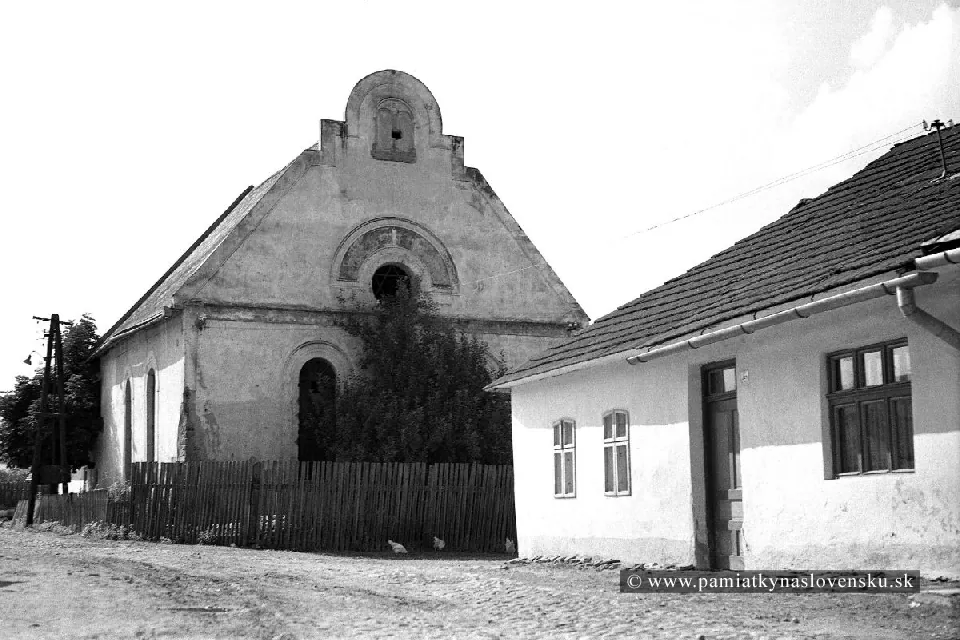
Historia Podolínec Synagogue
Podolínec (Hungarian Podolin, German Pudlein) is a small walled town on the Poprad river in the Spiš region of northern Slovakia, close to the Polish border. Its largely German burghers kept Jews out for centuries, and Jews from the villages of Šariš settled there only in the middle of the nineteenth century, once residence restrictions in the Kingdom of Hungary had been lifted. At first they belonged to the community of Stará Ľubovňa and prayed in a room in a private house. In the 1880s they formed their own Orthodox congregation, and in the last quarter of the century they built a synagogue. Maroš Borský's survey of Slovak synagogue architecture places it on the edge of the historic town, in the area of the former fortifications; the Slovak gazetteer of lost monuments, Pamiatky na Slovensku, locates it behind the town walls at the former lower gate, near the Piarist monastery. It was a simple gabled hall with round-arched windows and the Tablets of the Law set into the top of its gable. After 1945 the few survivors soon left, and the synagogue and the community building were abandoned. A photograph taken by Jiří Fiedler in July 1966 shows the building still standing, its roof intact. It was demolished in 1988.
Where it stood for nearly 90 years
Historic: Podolínec, edge of the historic town in the area of the former fortifications, behind the walls at the former lower gate near the Piarist monastery; street and house number unknown. Today: approximately the car park at Mariánske námestie, 065 03 Podolínec (approximate).
Otwórz większą mapę →Społeczność żydowska
Pinkas Hakehillot Slovakia counts 40 Jews in Podolínec in 1880 (2.6 per cent of the population), 138 in 1900, 163 in 1921, 169 in 1930 and 175 in 1940. The first Jews came from villages in the Šariš region in the mid-nineteenth century and were at first members of the Stará Ľubovňa community and its rabbinate. They organised an independent congregation in the 1880s, with some families from neighbouring villages, and joined the Orthodox organisation of communities; the congregation came under the rabbinate of Kežmarok. A cemetery was consecrated on the outskirts of the town at the beginning of the twentieth century on land the community owned. Around 1930 the community reached its largest size, almost 190 people with about 50 tax-paying heads of household. In the 1930 census 91 of the 169 Jews gave their nationality as Jewish. Most made their living in trade and crafts: in 1921 they owned four taverns, three grocery shops, three textile and clothing shops, a leather-goods shop, two bakeries, a restaurant and the flour mill of Joseph Miller and Sons, and there were also a tailor, a shoemaker, two carters, an agent for farm produce and two doctors.
Architektura i projekt
No plans or interior views of the synagogue were found. Borský describes it as a traditional free-standing building with a saddleback roof that formed a large gable. The exterior was simple and the façades had no decoration apart from round-arched windows. On the eastern façade two such windows flanked the Torah ark, which was further marked by a circular window above it, and the Tablets of the Law were built into the pinnacle of the gable. The 1966 photograph by Jiří Fiedler shows a rendered, single-storey hall under a steep pitched roof. Its gable end has a moulded string course at eaves level, a large arch framing a round window in the middle of the gable, and a stepped top crowned by a small round-headed feature. Below are a tall round-arched opening and, along the side wall, narrow round-arched windows. The construction date is given only as the last quarter of the nineteenth century; the architect, builder and seating capacity are unknown.
Życie w synagodze
The congregation was Orthodox and belonged to the national organisation of Orthodox communities; in religious matters it came under the rabbi of Kežmarok, and no rabbi of its own is named in the sources found. Before the synagogue was built the Jews of Podolínec prayed in a room in a private house. Besides the synagogue the congregation owned a community building and its own cemetery. In the 1920s and 1930s a Zionist group collected donations for the national funds, and on the eve of the 21st Zionist Congress in 1939 the town's Jews bought 60 shekels, the membership tokens that gave a vote in the Zionist Organization. When Jewish children were barred from public schools in the 1940-41 school year, the congregation opened its own school for the children of Podolínec and nearby villages, run by the teacher Martin Elefant. Nothing has been found about the cantors, the ritual officials or the appearance of the interior.
Zniszczenie
No source records damage to the synagogue during the Second World War, although the local German population, most of whom belonged to Nazi organisations, repeatedly broke into Jewish homes and shops after March 1939, stole and destroyed property and attacked Jews. After the deportations of 1942 the building had no congregation. Pinkas Hakehillot states that the survivors who came back in 1945 soon left and that the synagogue and community building were abandoned. Jiří Fiedler's photograph of July 1966 shows the synagogue still standing, fenced off and apparently unused, with its roof whole. Borský's catalogue and the Pamiatky na Slovensku gazetteer both give 1988 as the year of demolition, during the last years of Communist rule in Czechoslovakia. Neither source, nor any other source found, says who ordered or carried out the demolition, or whether the building had been sold or taken over by the state before it was pulled down.
Los społeczności
Persecution began as soon as the Slovak State was proclaimed on 14 March 1939, both by the authorities and by young local Germans. In 1941 most Jewish businesses were closed and the larger ones aryanised, and in October that year Jews without means were sent to labour camps. On 20 March 1942 twenty young Jewish women were taken to Stará Ľubovňa and on to the transit camp at Poprad, and on 25 March they were deported to Auschwitz. A few days later several dozen Jewish men were sent via Stará Ľubovňa to the camp at Žilina and from there to Majdanek. On 26 May 1942 the authorities rounded up most of the remaining Jews of the town and district and took them to Spišská Nová Ves, and on 29 May they were deported by freight train to the Izbica ghetto in the Lublin region. About 25 Jews with exemption certificates were left. Before Nazi German forces occupied the town in September 1944, some hid with farmers; others were arrested and killed. Fifteen Jews were counted in 1948, and those who returned soon left.
Miejsce dzisiaj
The synagogue's exact plot is not documented in a cadastral source consulted. The Pamiatky na Slovensku gazetteer places it behind the town walls at the former lower gate, near the Piarist monastery, and gives coordinates that fall today on a car park at Mariánske námestie on the edge of the old town; this suggests the site was cleared and not rebuilt, but that is an inference from the map. Nothing of the building is known to survive. The Jewish cemetery survives as a neglected, overgrown remnant on a steep slope outside the town, with eleven standing and about twenty fallen gravestones recorded in 2014.
Ważne postacie
Martin Elefant
UnknownTeacher of the Podolínec Jewish community school, 1940-41When Jewish children were excluded from the public schools of the Slovak State in the 1940-41 school year, the Podolínec congregation set up its own school for the children of the town and the surrounding villages. Pinkas Hakehillot Slovakia names Martin Elefant as the teacher who ran it. The school was one of the last communal undertakings of the congregation before the deportations of 1942. Nothing further about his life or his fate was found in the sources consulted.
Biografia lub źródło →Czy masz coś do przekazania?
Zdjęcia, dokumenty, historie rodzinne lub wspomnienia o tej synagodze i jej społeczności pomagają zachować jej historię.
- Podolinec (Pinkas Hakehillot Slovakia, pp. 429-430, trans. Madeleine Isenberg)
- Synagogue Architecture in Slovakia: Towards Creating a Memorial Landscape of Lost Community (catalogue S0P2401, p. 206)
- Podolínec – synagóga (Zaniknuté pamiatky)
- List of synagogues in Slovakia
- Podolinec, Slovakia (Cemetery Discovery Project)
- Reverse geocoding of 49.257710, 20.534792 (OSM way 1116034552)
Share a memory or thought
No comments yet. Be the first to add one.