
La storia di Cikán Synagogue, Prague
The Cikán Synagogue stood in the Jewish Town of Prague, later called Josefov, in the area of today's Bílkova Street. It took its name from its founder, the Prague Jew Salomon Salkind, known as Cikán (Zigeiner in German sources, 'gypsy'), who built it with his wife Golde. The art historian Petr Uličný, whose 2013 study in the journal Umění is the fullest account, concludes that it must have been built, or at least under construction, before 1613. Its building extended the ghetto slightly on its northern side at the end of the reign of Emperor Rudolf II, the period of Rabbi Judah Loew and Mordechai Maisel.
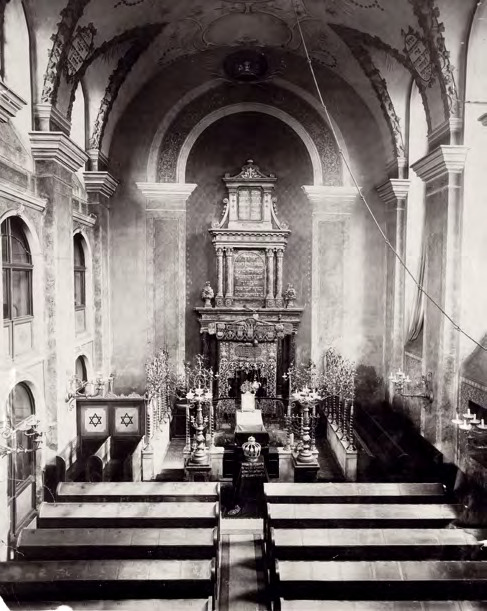
The synagogue was a large rectangular hall with two-storey women's galleries, a barrel vault carried on colossal pilasters and an unusual three-tier Torah ark. Uličný calls it an extraordinary building without parallel in the church architecture of Bohemia at the time, and he argues that it influenced the great Baroque synagogue consecrated in Berlin's Heidereutergasse in 1714. The commissioners of the Prague slum clearance nevertheless judged it a building of no value. It was photographed by Josef Eckert shortly before demolition and pulled down in 1906, the last of the three Josefov synagogues lost in the clearance.
Where it stood for nearly 300 years
Historic: Jewish Town (Josefov), northern edge of the ghetto, Prague; house number unknown. Today: area of Bílkova Street, Josefov, 110 00 Prague 1 (approximate).
Apri la mappa grande →La comunità ebraica
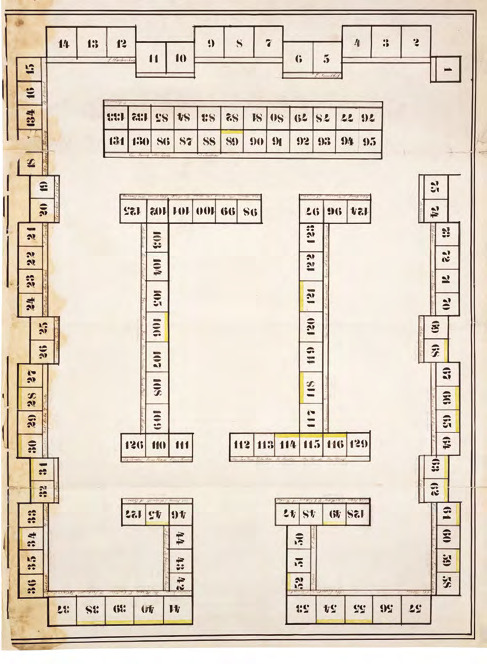
In the seventeenth century the Prague ghetto was the largest Jewish enclave in Europe, and its golden age under Rudolf II continued under Ferdinand II, when Rabbi Yom Tov Lipmann Heller and the community leader Jakob Bassevi were active and the ghetto grew considerably. The Cikán Synagogue belonged to the wave of private foundations of this time, beside the Pinkas, High, Maisel, New, Great Court and Klausen synagogues. Few documents on its founding survive. An inscribed tablet on the west side of the main hall, which remained there until 1906, named Salkind and Golde Zigeiner as the founders, and other records confirm it. Salomon Salkind is mentioned in 1607, 1612 and 1613. After his wife died in 1613 he left his two sons in Prague under guardianship and moved to Vienna, where he died; his damaged tombstone there spoke of the 'exceptional synagogue which he built in Prague'. The synagogue kept his name for its whole existence. Its seats were recorded in a seat book, into which a plan of the seating was pasted in the first half of the nineteenth century.
Architettura e design
The main hall measured 15.8 by 9.1 metres. Two-storey women's galleries framed it on the north and west sides; the ground floor under the northern gallery served as a vestibule, with the stair to the upper floor at its end. Two annexes opened into the hall through paired windows, one of them added after a fire in 1689, when neighbouring properties were bought. Except for the east wall, colossal pilasters with cornice capitals divided the hall into four bays and carried a barrel vault with lunettes whose edges were decorated with stucco vines. Tall windows lit the south wall. The rectangular bima had two opposite entrances set off its axis, copying the Old-New Synagogue. The Torah ark rose in three tiers: the ark itself was framed by an aedicule of two pairs of fluted columns with a full entablature; a second tier with a Doric entablature followed, crowned by a gable with the Ten Commandments in a pilastered aedicule with acroteria. Outside, the walls were articulated by lesenes. The builder is unknown; Uličný tentatively links him to the builder of the nearby Lutheran church of St Salvator, begun in 1611.
La vita nella sinagoga
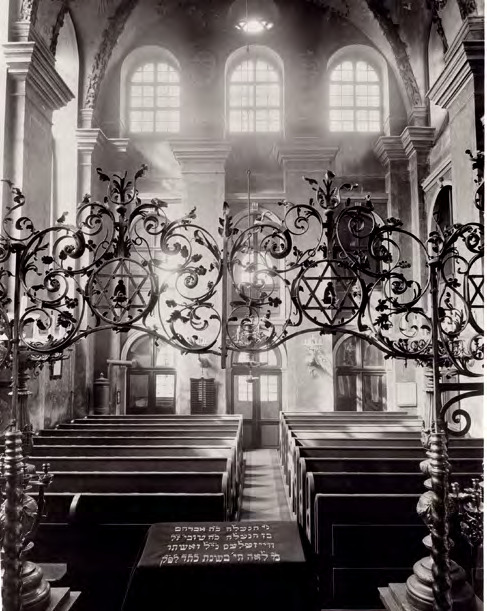
Very little is recorded about worship in the Cikán Synagogue. It was a privately founded house of prayer of the kind the Prague community called a school (škola), and it served the congregation for close to three centuries. The surviving seating plan shows the main hall filled with numbered places: benches along the walls, rows around the large central bima and seats grouped around the steps up to the Torah ark, where a bench probably stood beside the stair as in the Old-New Synagogue. Women prayed in the galleries on the north and west, looking into the hall through large openings on the upper floor and paired windows below. The founders' inscription on the west wall kept the memory of Salkind and Golde before the worshippers until the end. Josef Eckert's photographs of 1906 show the hall still furnished: rows of wooden pews, a wrought-iron screen with Stars of David around the bima, tall candelabra and the richly carved ark. The names of rabbis, cantors and wardens who served the synagogue were not found in the sources read.
Distruzione
At the end of the nineteenth century Prague began the asanace, the clearance and rebuilding of the old Jewish Town and the neighbouring parts of the Old Town under the slum-clearance laws. The clearance commissioners condemned three of the quarter's synagogues to demolition as buildings of no value, among them above all the Cikán and the Great Court synagogues. The New Synagogue went first in 1898 and the Great Court Synagogue in 1902. The Cikán Synagogue was the last, demolished in 1906. Before it came down the photographer Josef Eckert recorded the interior, and Uličný notes that numerous photographs were taken both before and during the demolition, which document the grandeur of the hall. A set of Eckert's photographs is held by the National Heritage Institute in Prague (fund F 2414) and others by the Jewish Museum in Prague. The sources read do not name the contractor who carried out the work or say what became of the ark and the bima screen; the demolition was part of the clearance programme rather than any act of violence against the congregation.
Il destino della comunità
The congregation did not simply vanish with its building. When the clearance began, an association for the construction of a new temple was founded in 1898 to replace the Cikán, Great Court and New synagogues. In January 1899 it bought a house in Jerusalem Street in the New Town, chose a design by Wilhelm Stiassny and had Alois Richter build it. The Jubilee Synagogue, also called the Jerusalem Synagogue, opened on 16 September 1906, the year the Cikán Synagogue came down, and English Wikipedia states that inscribed plaques from the Cikán Synagogue were preserved there. In 1939, when the Nazis occupied Bohemia and Moravia, more than 92,000 Jews lived in Prague. At least two-thirds of them were murdered in the Holocaust. In 1946 Prague counted 10,338 Jews, including 4,986 who had returned from prisons, concentration camps or the Theresienstadt ghetto. How many former members of the Cikán congregation were among the victims is unknown.
Il luogo oggi
Nothing of the synagogue survives above ground. Its site lies in the area of today's Bílkova Street in Josefov, Prague 1, a street laid out during the clearance and lined with apartment blocks of the early twentieth century, in the Art Nouveau and related styles that replaced the old quarter. The exact plot has not been matched to a present-day address in the sources read; Uličný places the synagogue on the northern edge of the old ghetto. No marker on the site is recorded in those sources. The Jewish Museum in Prague holds documentation of the building, including the nineteenth-century seating plan and Eckert's photographs of the interior, while further photographs by Eckert are kept by the National Heritage Institute.
Nomi importanti
Salomon Salkind, called Cikán (Zigeiner)
fl. 1607-1613; died in Vienna, date unknownFounder of the synagogueA Prague Jew recorded in 1607, 1612 and 1613, Salkind built the synagogue with his wife Golde shortly before 1613, and it bore his nickname Cikán until its demolition. A tablet on the west wall of the hall named the couple as founders. After Golde's death in 1613 he left his two sons in Prague under guardianship and moved to Vienna, where he died; his damaged tombstone there recalled the exceptional synagogue he had built in Prague.
Biografia o fonte →Golde Salkind (Zigeiner)
died 1613Co-founder of the synagogueGolde was the wife of Salomon Salkind and is named with him as founder of the synagogue on the inscribed tablet that hung on the west side of the main hall until 1906. Uličný, citing this inscription and other documents, treats the couple together as the builders. Her death in 1613 changed her husband's life: he left their two sons in Prague and moved to Vienna. Nothing else about her is recorded in the sources read.
Biografia o fonte →Hai qualcosa da condividere?
Fotografie, documenti, storie di famiglia o ricordi di questa sinagoga e della sua comunità aiutano a mantenerne viva la storia.
- Architektura pražských synagog 16. a 17. století (Umění/Art LXI, 2013, no. 2, pp. 120-137)
- Architektura pražských synagog 16. a 17. století, full text PDF
- Asanace z přelomu 19. a 20. století zásadně změnila tvář Prahy
- Seznam Zprávy article on the Josefov asanace
- History of the Jews in Prague
- Jubilee Synagogue
- Před 110 lety byla otevřena Jeruzalémská synagoga v Praze
- Bílkova, Josefov (OpenStreetMap way 41492498)
Share a memory or thought
No comments yet. Be the first to add one.