
The story of Old Synagogue of Prostějov
Prostějov, the German Proßnitz, lies in the fertile Haná region of central Moravia. Jews lived there from at least 1445, and the town became a refuge after their expulsion from the Moravian royal towns in 1454. A synagogue is first mentioned in 1552; an older building beside the town walls is said to have been repaired in 1649 after damage in the Thirty Years' War. Its successor, the building of this entry, had its foundation stone laid in 1674 and was completed in 1676 in the Baroque style. It stood at the northern end of today's Demlova street, at the corner of the present náměstí Svatopluka Čecha, at the edge of the large Jewish quarter in the south-eastern part of the old town.
In the early nineteenth century the community enlarged the synagogue by taking over a bastion of the town fortifications. For more than two hundred years it served a congregation that by 1713 numbered 318 families and that was famed for its yeshiva and Hebrew printing. Around 1903, as the surroundings were being redeveloped and the old building no longer met the community's needs, the congregation decided to demolish it. Jakob Gartner's Art Nouveau synagogue, consecrated on 8 September 1904, was built on roughly the same site.
Where it stood for nearly 230 years
Historic: northern end of the Jewish street (today Demlova), Proßnitz. Today: site of the New Synagogue (Husův sbor), corner of Demlova and náměstí Svatopluka Čecha, 796 01 Prostějov (approximate; the new building stands roughly on the old footprint).
Open larger map →The Jewish community
The first written record of Jews in Prostějov, from 1445, concerns a Jew named Abraham who lent money to a local merchant. Larger numbers settled after 1454, when Jews were driven out of Olomouc and the other Moravian royal towns. Jiří Fiedler gives 31 families in 1584 and 64 in 1669; immigrants from Poland and from Vienna then raised the number to 318 families by 1713. From the late eighteenth century to the mid-nineteenth, 328 families were licensed to live in the town, and in 1804 the 1,704 Jews made up about a quarter of the population. There were 1,804 in 1880, 1,553 in 1900 and 1,442 in 1930. Prostějov was a centre of Talmudic learning, called the Jerusalem of Haná, and from 1603 had a Hebrew press founded by Isaac ben Aaron Prostitz. Nearly thirty rabbis are known by name from the late sixteenth century. Jewish families helped build the town's textile industry and in 1859 founded what Fiedler calls the first ready-made clothing manufacture on the European continent. A separate Jewish political municipality existed from 1850 to 1919.
Architecture and design
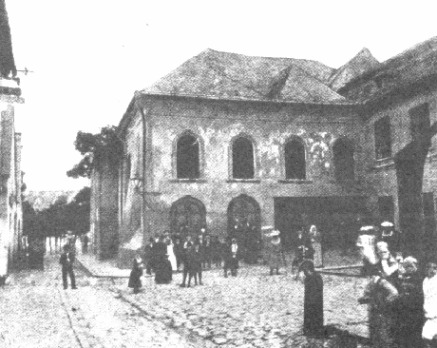
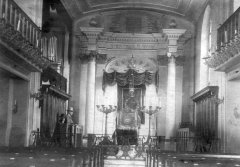
The Klenovský inventory published by the Jewish Community of Prague describes the synagogue as a two-storey corner building in a row of houses, with hipped roofs, laid out in the Baroque style in 1674-1676 and enlarged in the early nineteenth century over a former bastion of the town walls. A photograph taken shortly before demolition shows a plain rendered hall with a steep hipped roof. Four tall round-headed windows light the upper storey of the street front, and below them are two round-arched doorways and a wider opening; lower houses adjoin on the right, and a crowd stands on the cobbled street in front. A second photograph of the interior shows a tall hall with a flat ceiling and galleries with railings along both side walls. The Torah ark at the far end is framed by a pair of columns carrying an entablature and is hung with a draped curtain and valance, with tall branched candelabra on either side and railings in front. The architect, builder and seating capacity are unknown.
Life inside the synagogue
The synagogue was the main place of worship of the Prostějov congregation and its rabbis, who in the late seventeenth and eighteenth centuries included Gershon Ashkenazi, around 1650, and Meir Eisenstadt, around 1700. From 1785 to 1794 Moses Schreiber, later known as the Chatam Sofer, headed the town's yeshiva. In the nineteenth century Prostějov became a seat of moderate reform. Löw Schwab, rabbi from 1830 to 1836, is described by the Jewish Encyclopedia as the first German preacher in Moravia. His successor Hirsch Bär Fassel, rabbi from 1836 to 1853, also preached in German and introduced reforms to the service; his Zwei gottesdienstliche Vorträge, printed in Vienna in 1838, were delivered in the Prossnitz synagogue. Adolf Schmiedl served from 1853 to 1869, Emil Hoff from 1870 to 1897 and L. Goldschmied from 1897, so the last services in the old building were held under him. A separate house of study, the bet ha-midrash, founded by Veit Ehrenstamm and built in the early nineteenth century, stood across Demlova street.
Destruction
The old synagogue was not destroyed by violence. According to Zničené kostely, by the early twentieth century the building no longer met the community's needs, and the Jewish community of Prostějov decided to demolish it and build a new synagogue in its place. The Klenovský inventory says it was pulled down in 1903 in consequence of urban alterations to its surroundings; Zničené kostely dates the demolition to the spring of 1904, and Fiedler says only that it was demolished before 1905. The community, as investor, commissioned a design from the Viennese architect Jakob Gartner (1861-1921), and the local firm Konečný & Nedělník built the new synagogue on the cleared plot. It was consecrated on 8 September 1904. No source consulted records what became of the old building's furnishings, its Torah ark or its building materials, and no account of the demolition work itself was found.
The community’s fate
The new synagogue that replaced this building was closed by the Nazi occupation authorities in the summer of 1939. Many Jews left the town in 1939 and 1940. In June and July 1942 the Nazis deported the Jews of Prostějov and the surrounding district in four rail transports from Olomouc to the Terezín ghetto. Most were sent on from Terezín to Maly Trostinec and Baranovichi in Belarus, where they were murdered. Estimates of the dead differ: Jüdische Gemeinden gives about 1,300, English Wikipedia about 1,390, and a postwar list of victims from the Prostějov region bears 1,227 names. In 1943 the Nazis destroyed the Jewish cemetery on J. V. Choráze street. About 80 to 100 people returned after the war. The community was re-established in 1945, largely by Jews from the eastern part of Czechoslovakia, and worshipped in a prayer room on the upper floor of the community house at Sádky 2. It became a synagogue congregation under Olomouc in 1953 and ceased in the 1970s or around 1980; sources differ.
The site today
Jakob Gartner's synagogue of 1904 still stands on the site, at the corner of Demlova street and náměstí Svatopluka Čecha. It is unusual in being oriented to the south. After the war the community sold it to the Czechoslovak Hussite Church, which had it radically remodelled in 1947-1949 by the Olomouc architect Hubert Aust; it now serves as that church's Husův sbor and none of the Jewish fittings survive. The early nineteenth-century bet ha-midrash across the street has been an exhibition hall since 1970. Most houses of the former Jewish quarter were demolished after the Second World War. Nothing of the 1676 building is known to survive above ground.
Notable names
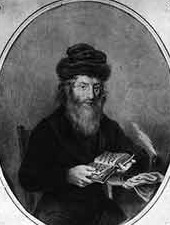
Moses Schreiber (Moses Sofer, the Chatam Sofer)
1762-1839Head of the Prostějov yeshiva, 1785-1794Born in Frankfurt am Main, Moses Schreiber headed the yeshiva of Prostějov from 1785 to 1794, while the 1676 synagogue was the community's main house of prayer. Fiedler names him as the most famous teacher of the town's long tradition of Talmudic learning. He later became rabbi of Pressburg (Bratislava), where he died in 1839, and as the Chatam Sofer became the leading authority of traditional Orthodoxy in Central Europe.
Biography or source →Löw Schwab
UnknownRabbi of Prostějov, 1830-1836Schwab was rabbi of Prostějov from 1830 to 1836, succeeding Nahum (Nehemias) Trebitsch in the town. The Jewish Encyclopedia calls him the first German preacher in Moravia, so his German sermons, a sign of the community's moderate modernisation, were given in the Prostějov congregation while the 1676 building was its synagogue. He was followed by Hirsch Bär Fassel. Nothing further about his life was read in this research.
Biography or source →Hirsch Bär Fassel
1802-1883Rabbi of Prostějov, 1836-1853Born in Boskovice, Fassel was elected rabbi of Prostějov in 1836 in succession to Löw Schwab and was confirmed by the government despite the protest of the Moravian chief rabbi Nehemiah Trebitsch. He preached in German, introduced reforms to the service and promoted education and crafts. His Zwei gottesdienstliche Vorträge (Vienna, 1838) were delivered in the Prossnitz synagogue. He served until 1853 and later became rabbi of Nagykanizsa in Hungary, where he died.
Biography or source →Meir Eisenstadt
c. 1670-1744Rabbi of Prostějov, around 1700The Jewish Encyclopedia lists Meir Eisenstadt among the rabbis of Prossnitz, around 1700, a generation after the 1676 synagogue was completed, when the community was growing rapidly with settlers from Poland and Vienna. He later became rabbi of Eisenstadt in Burgenland, where he died in 1744. Wikipedia's article on him does not mention Prostějov, so the dates of his tenure there are unknown.
Biography or source →Emil Hoff
UnknownRabbi of Prostějov, 1870-1897Hoff was rabbi of Prostějov from 1870 to 1897 according to the Jewish Encyclopedia, the longest tenure in the old synagogue's last decades, during which Prostějov's Jewish population stood at about 1,800 in 1880 and fell to about 1,550 by 1900. He was succeeded by L. Goldschmied, under whom the old building was demolished and the new synagogue built. No further details of his life were found.
Biography or source →Do you have something to contribute?
Photographs, documents, family stories or memories of this synagogue and its community help keep its history alive.
Share a memory or thought
No comments yet. Be the first to add one.