
La historia de Wooden Synagogue of Przedbórz
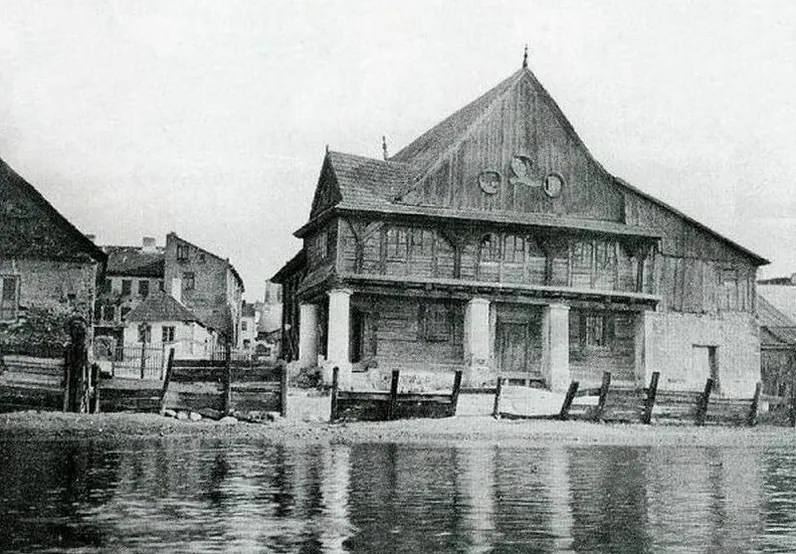
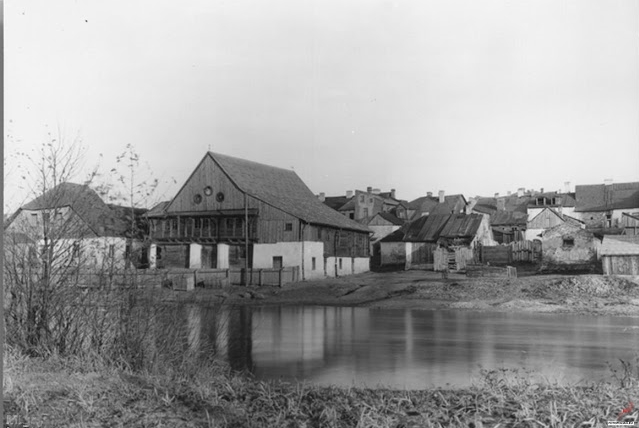
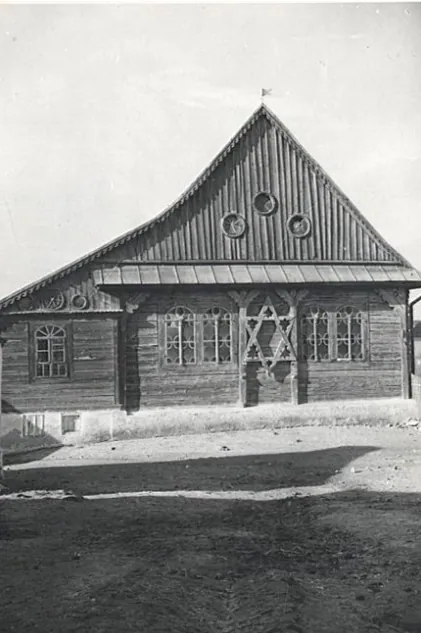
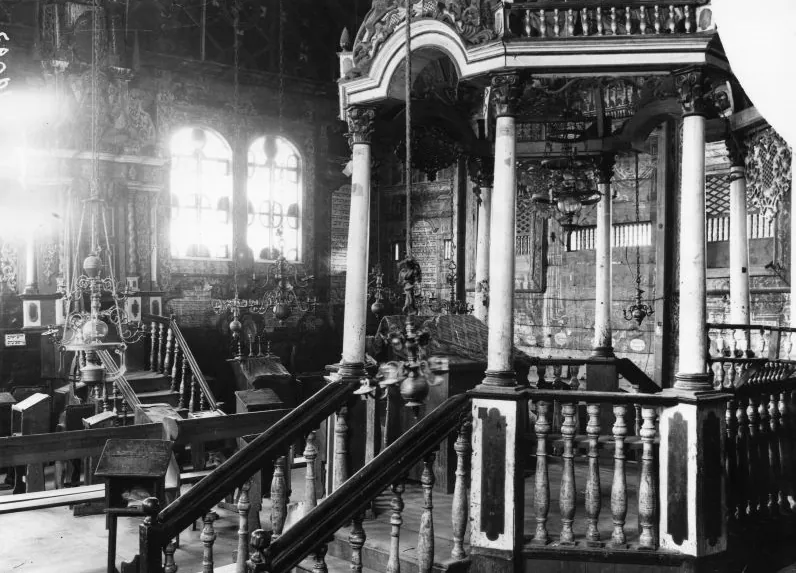
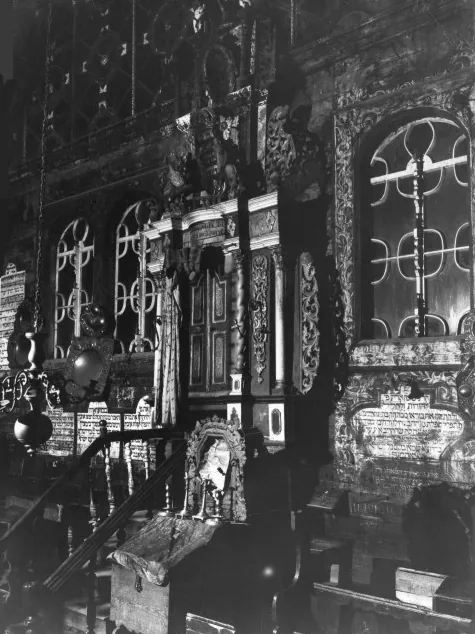
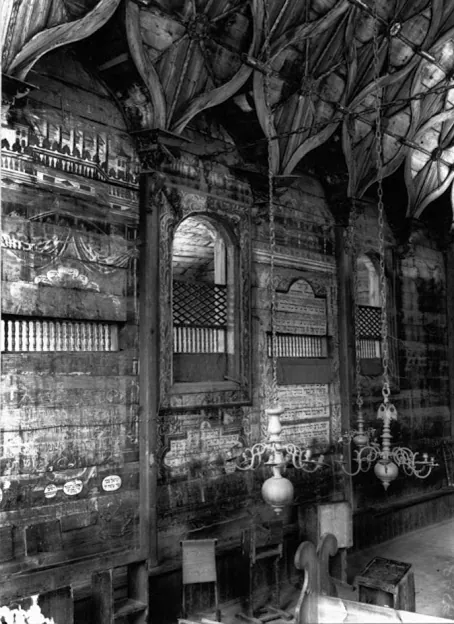
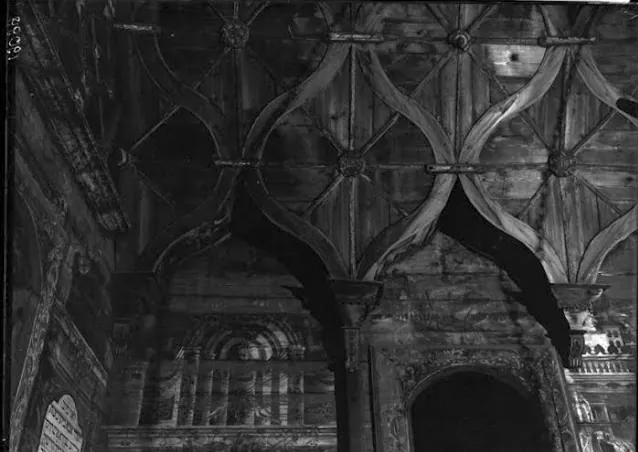
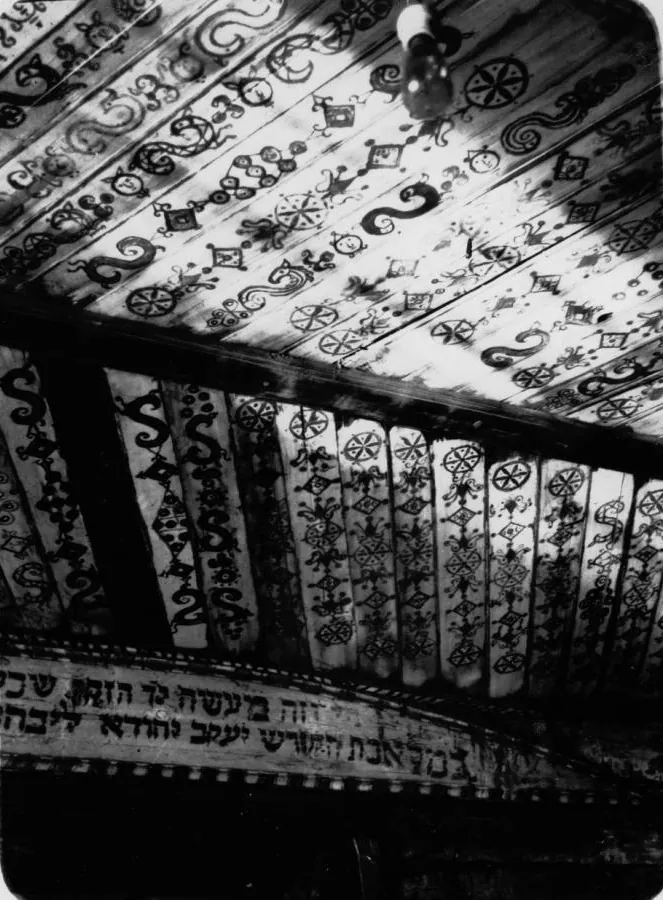
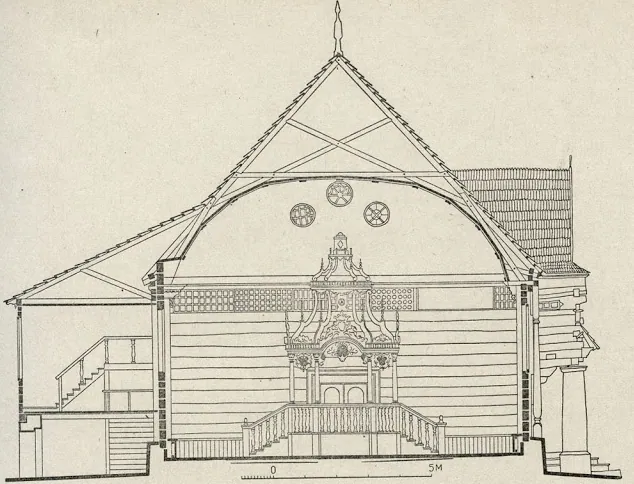
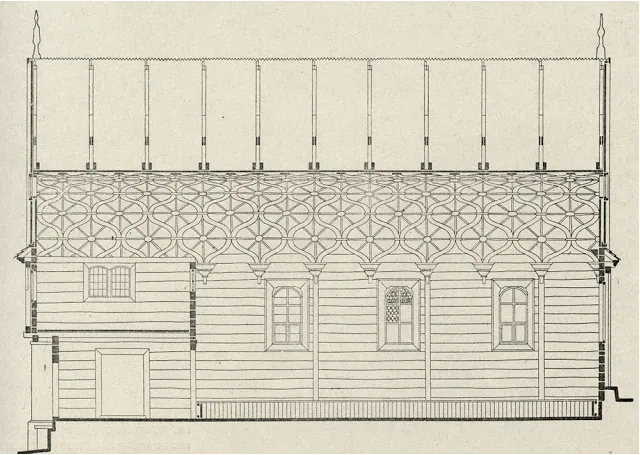
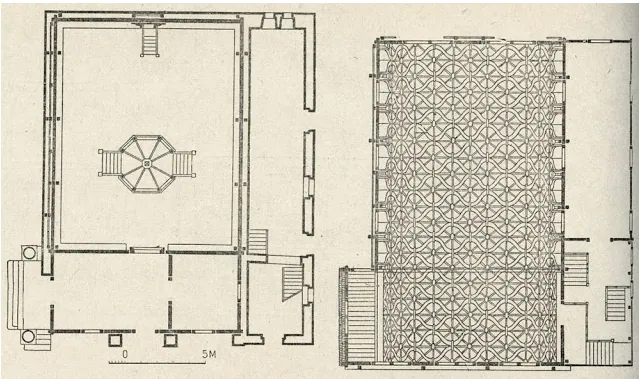
Przedbórz is a small town on the Pilica river in central Poland, where Jews had lived since at least the sixteenth century. Its wooden synagogue stood on Bóżnicza (Synagogue) Street near the river, west of the market square. An earlier synagogue burned in May 1754. King Augustus III granted the community a three-year moratorium on its debts so that it could rebuild. The new building was completed in 1760, and its master craftsman, Yehuda Leib, signed the work on the vault with the dates 1759–1760. It was a timber hall on a stone foundation, about 14.2 metres long, covered by a wooden barrel vault that reached about 8.8 metres and was suspended from the roof structure. The vault was panelled in a lattice of lunettes and stars and painted with prayers, the menorah, Psalm 137 and town scenes. An octagonal three-tier Baroque bimah, crowned by an eagle, stood in the centre, and a richly carved Torah ark with rampant lions stood at the east wall. The architect Adolf Szyszko-Bohusz documented it in 1907–1909 and called it one of the noblest Polish wooden synagogues. On 3 September 1939 it was set alight by an incendiary shell during the German attack, and it burned to the ground.
Where it stood for 179 years
Historic: ul. Bóżnicza, by the Pilica river, west of the Rynek, Przedbórz. Present day: park along ul. Krakowska, Przedbórz. Approximate.
Abrir mapa ampliado →La comunidad judía
Jews are recorded in Przedbórz from the fifteenth and sixteenth centuries. Polish kings granted them tax exemptions in 1550 and 1570, and the congregation was established by 1570. The community grew until, by 1865, about three quarters of the town's inhabitants were Jewish. In 1921 Przedbórz had 3,749 Jews, 63 per cent of the population, and on the eve of the Second World War about 4,500. Its religious life centred on the wooden synagogue by the river. Rabbi Yeshayaleh was remembered as its first Hasidic rabbi. Later rabbis included Rabbi Emanuel and Rabbi Ephraim, who served until he emigrated to the Land of Israel in 1934.
Arquitectura y diseño
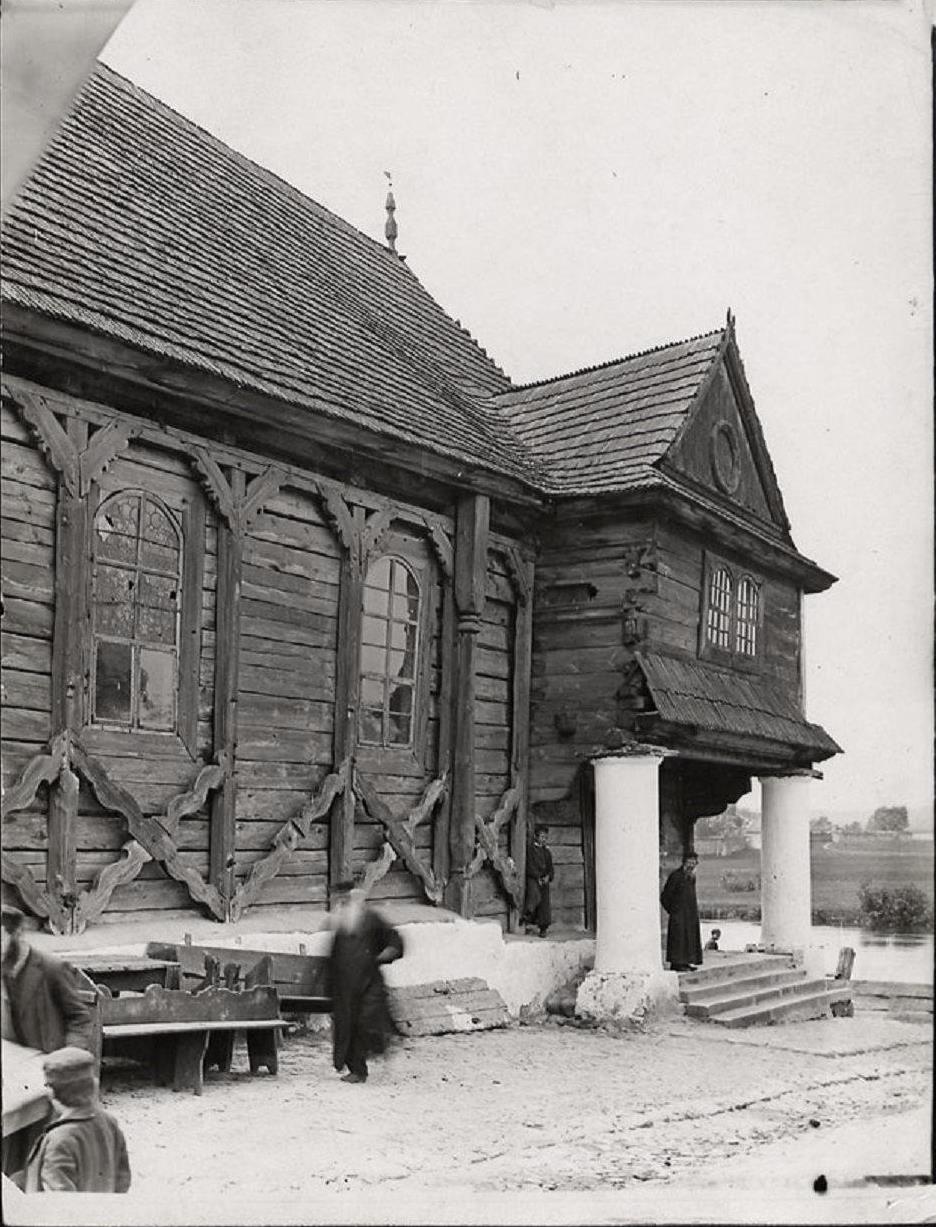
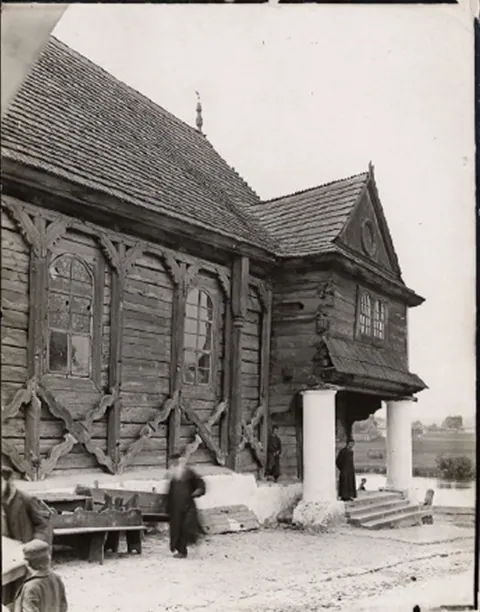
The synagogue was a timber building on a stone foundation, built of long boards of resinous pine up to 14 metres long and 30 centimetres wide, which local tradition said were proof against woodworm. Its main hall, about 14.2 metres long, was covered by a wooden barrel vault rising to about 8.8 metres. The vault was hung from the roof trusses by iron chains, a feature Szyszko-Bohusz singled out. It was panelled in an intricate lattice of lunettes and stars and carried by about 114 carved and painted brackets bearing Hebrew inscriptions, one with the date 1760. The walls and vault were painted with garlands of leaves and flowers framing prayer texts, a menorah, an illustration of Psalm 137 and views of towns. In the centre stood an octagonal Baroque bimah in three tiers, topped by an eagle finial. The Torah ark was carved with rampant lions, flowers and animals. Outside, a porch on columns and a steep roof faced the Pilica.
La vida dentro de la sinagoga
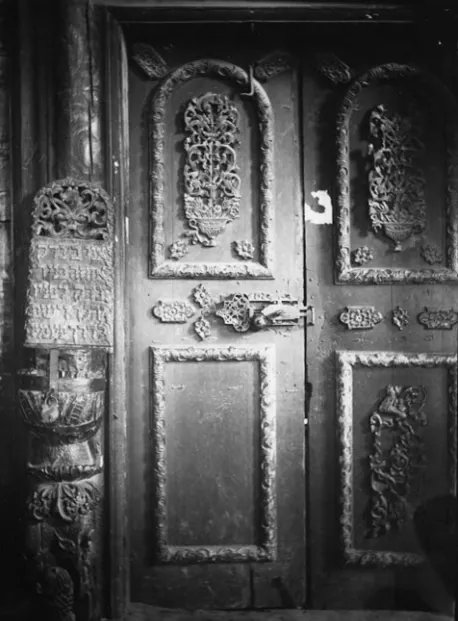
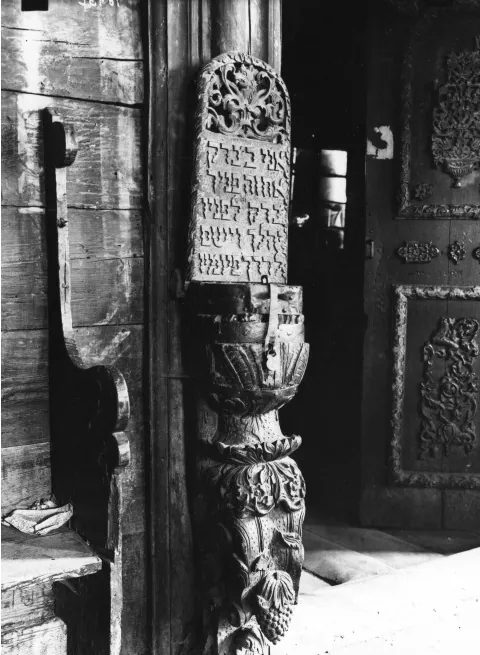
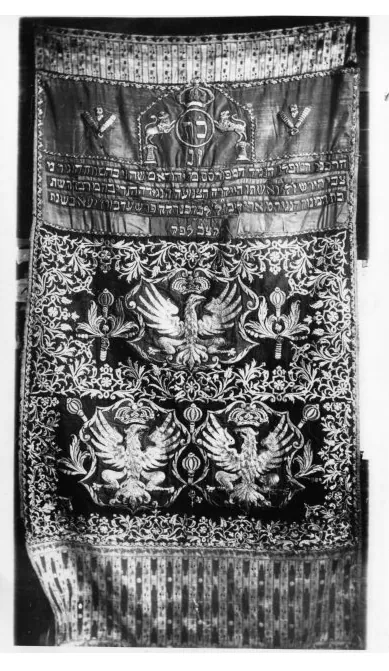
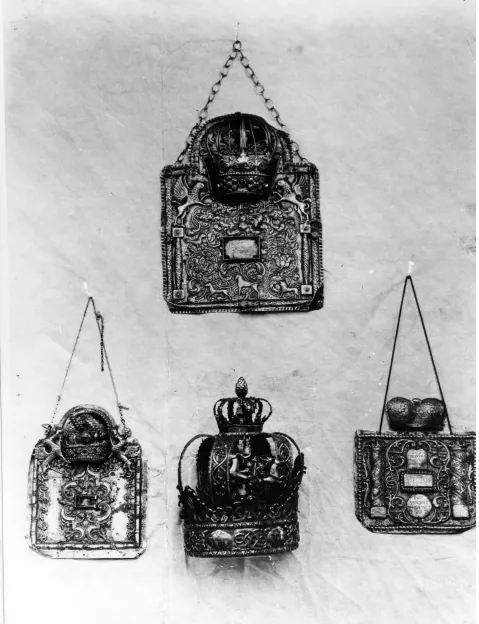
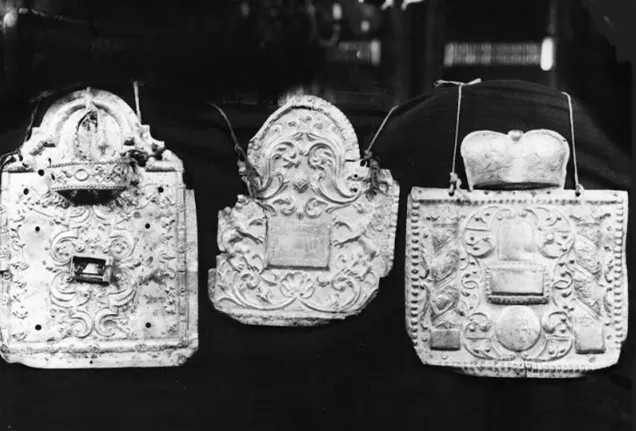
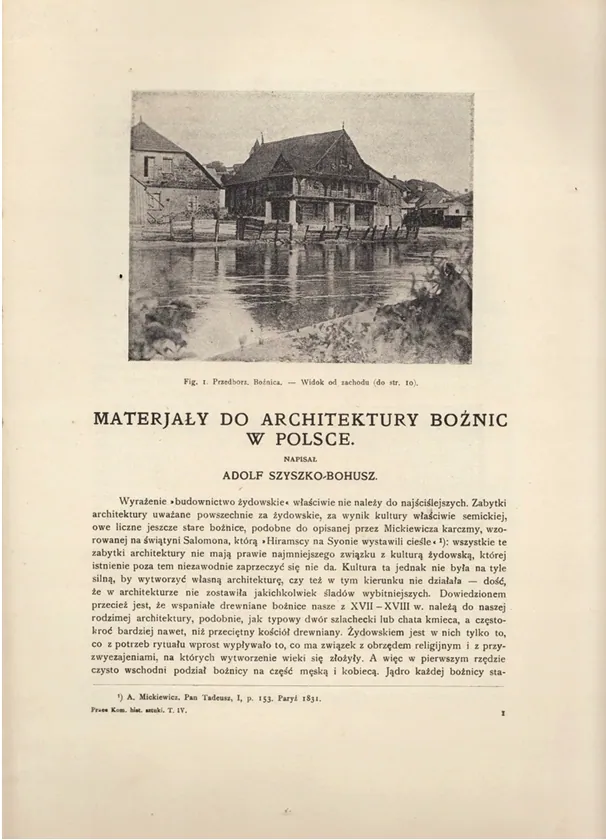
For almost two centuries the synagogue was the heart of Jewish Przedbórz. It held centuries-old Torah scrolls, silver Torah crowns and shields, and a carved charity box by the entrance. One of its Torah ark curtains was said to have been sewn from a Napoleonic-era flag bearing an embroidered Polish eagle. The town was an important Hasidic centre, and its rabbis, from Rabbi Yeshayaleh onwards, led prayer in the old building on Sabbaths and festivals. The synagogue also attracted scholars. Adolf Szyszko-Bohusz measured and photographed it in 1907–1909, and his work, published by the Commission on the History of Art in Kraków, records the vault, bimah, ark, doors and ritual silver. Stefan Zaborowski also photographed it in 1909. Until 1939 it remained the community's main house of prayer.
Destrucción
When Nazi Germany invaded Poland, Przedbórz lay on the line of the German advance across the Pilica. On 3 September 1939, during the German attack on the town, the wooden synagogue was hit by an incendiary shell fired by a German armoured vehicle (a tankette) from the direction of Widoma. The larch and pine building, almost two hundred years old, burned completely. Thirty-three people, Poles and Jews, died in the fighting and bombardment. Nothing of the synagogue survived. Its destruction on the third day of the war, at the hands of the invading Nazi German army, made Przedbórz one of the first wooden synagogues lost in the Second World War.
El destino de la comunidad
From December 1939 the Jews of Przedbórz had to wear Star of David armbands. On 27 February 1940 the German district chief (Kreishauptmann) in Końskie, Gustav Albrecht, ordered a ghetto to be set up, and the Jews had to move into it by 15 March 1940. About 1,800 people were in the ghetto in May 1940. With refugees from Włoszczowa and elsewhere the number rose to about 3,200 in 1941. Between 9 and 13 October 1942, during Operation Reinhard, the Jews of Przedbórz were driven to Radomsko and deported from there to the Treblinka death camp, where they were murdered. After the war a few survivors returned. On 27–28 May 1945 eight of them were murdered in the town by local antisemites. The Jewish community was never re-established.
El lugar hoy
Nothing of the synagogue survives. It stood on Bóżnicza Street near the Pilica river, west of the market square. That street no longer exists, and the site is now part of a park along Krakowska Street. The building is preserved in the photographs and measured drawings of Adolf Szyszko-Bohusz (1907–1909), published by the Commission on the History of Art in Kraków, and in the 1909 photographs of Stefan Zaborowski in the Print Room of the PAU and PAN Library in Kraków. The Institute of Art of the Polish Academy of Sciences also holds photographs of its interior.
Nombres destacados
Yehuda Leib
fl. 1759–1760Master craftsman and painter of the synagogueYehuda Leib was the master carpenter and painter who built and decorated the Przedbórz synagogue after the fire of 1754. He signed the vault with the words 'This is the work of Yehuda Leib's own hands' and the dates 1759–1760. Local historians also connect him with synagogues in Pińczów and Działoszyn, making him one of the few named creators of an eighteenth-century Polish wooden synagogue.
Biografía o fuente →Rabbi Yeshayaleh of Przedbórz
early Hasidic periodFirst Hasidic rabbi of PrzedbórzRabbi Yeshayaleh is remembered in the Przedbórz memorial book as the town's first Hasidic rabbi. Under him Przedbórz became a Hasidic town, and he led the community's worship in the wooden synagogue completed in 1760. His exact dates are not given in the translated memorial-book pages consulted, but his memory remained central to Przedbórz Jewry until the Holocaust.
Biografía o fuente →Rabbi Ephraim of Przedbórz
1880–1946Rabbi of PrzedbórzRabbi Ephraim, remembered in the memorial book as Ephroiml, served as rabbi of Przedbórz in the early twentieth century, when the old wooden synagogue was still the community's main house of prayer. He led the congregation until 1934, when he emigrated to the Land of Israel. He died in 1946, having left Poland before the destruction of his community.
Biografía o fuente →¿Tiene algo que aportar?
Fotografías, documentos, historias familiares o recuerdos de esta sinagoga y su comunidad ayudan a mantener viva su historia.
- Przedbórz Synagogue
- Nieistniejąca bożnica (The synagogue that no longer exists)
- Los żydowskich obywateli Przedborza od września 1939 r. do maja 1945 r.
- Przedborz memorial book, English pages 1–19
- Przedbórz, synagoga. Wnętrze.
- Materiały do architektury bóżnic w Polsce (A. Szyszko-Bohusz), Prace Komisji Historii Sztuki
- OpenStreetMap place node 1854937038: Przedbórz
Share a memory or thought
No comments yet. Be the first to add one.