

Die Geschichte von Radouň Synagogue
Radouň (German: Radaun) is a small village about 15 km north-north-west of Mělník and about 10 km north of Roudnice nad Labem; since the late 1970s it has belonged to the town of Štětí in the Litoměřice district. Jews settled here in the eighteenth century, and in 1789 they laid out a cemetery on the hill north-west of the village, which later served Jews from a wide area, including Dubá, Štětí and Hoštka.
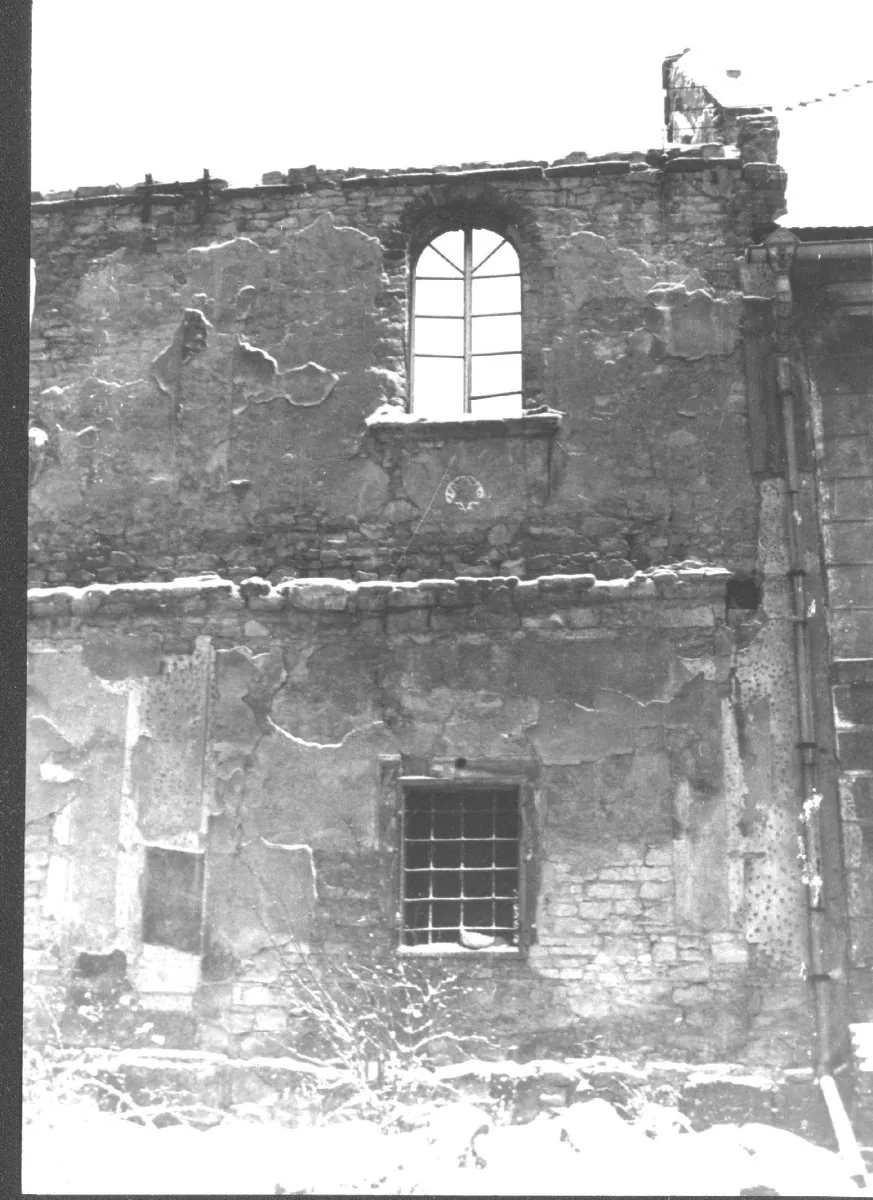
The synagogue stood west of the village green, in the street that leads from the green towards Čakovice. Its date of construction is not recorded. Jiří Fiedler placed it in the first half of the nineteenth century, and the building is already drawn on the stable cadastre map of 1843, so it existed by then. It was a two-storey rendered building that faced the street with its long south side.
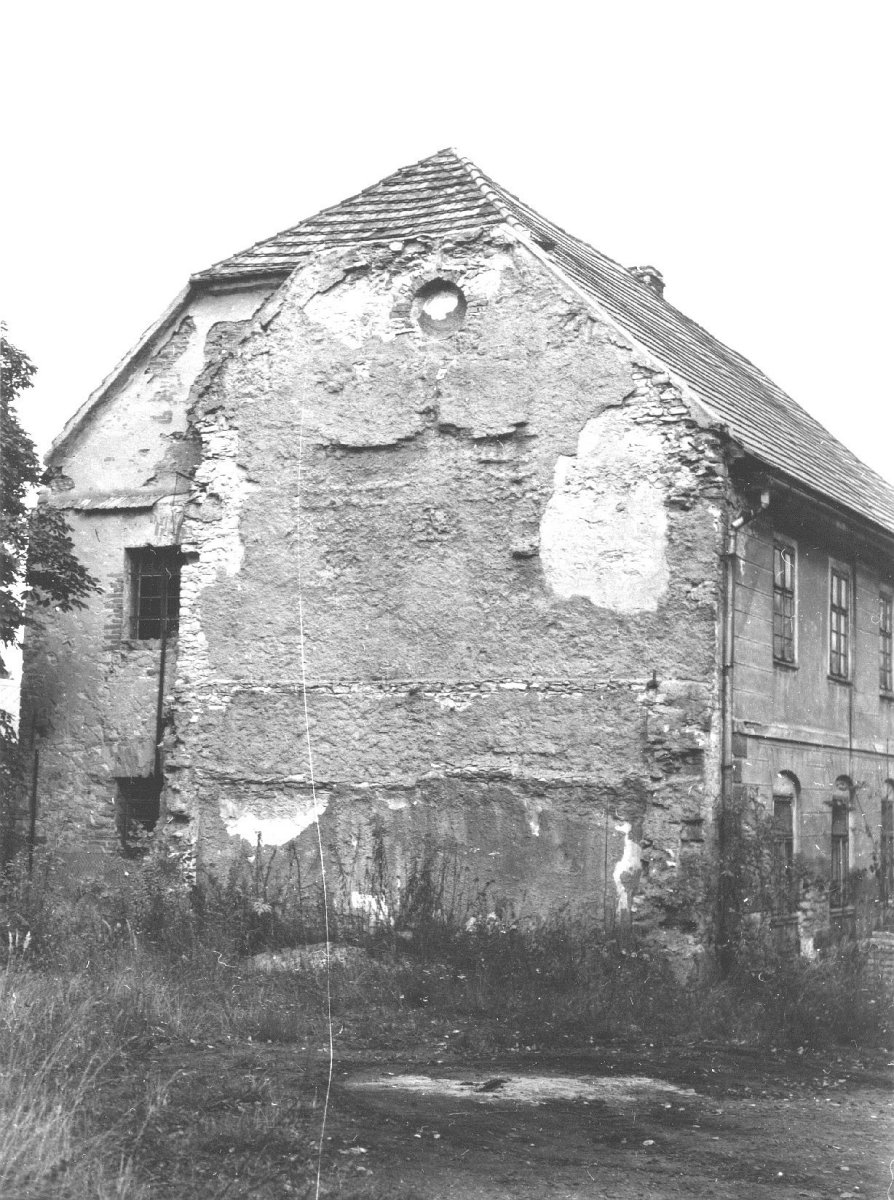
According to Fiedler, the synagogue was used for worship until the 1930s. After the Second World War it stood empty and decayed. Local people gradually took the building apart, and the remaining walls were demolished around 1980. Photographs taken by Fiedler in 1970 and by the regional heritage office around 1979 record the building in its last decade. The plot where it stood belongs to the town of Štětí and has remained empty.
Where it stood for nearly 140 years
Historic: Radouň (Radaun), west of the village green on the street leading to Čakovice, land parcel no. 1765 (stable cadastre 1843). Today: empty plot owned by the town of Štětí, Radouň, 411 08 Štětí, Litoměřice district (exact, from the Zničené kostely register).
Größere Karte öffnen →Die jüdische Gemeinde
Very little has been published about the Jews of Radouň. The Jewish Community of Prague's monuments register dates Jewish settlement in the village to the eighteenth century. The cemetery founded in 1789 is the oldest dated trace of the community; it was enlarged twice, in the first half of the nineteenth century and at the beginning of the twentieth, and has about 200 gravestones, the oldest from the early nineteenth century. It served as a regional burial ground for the Jews of the surrounding towns and villages, among them Dubá, Štětí and Hoštka, which suggests that Radouň was for a time a religious centre for scattered rural families in this part of northern Bohemia. Before 1849 the village belonged to the Chcebuz estate; after 1854 it lay in the Štětí district. The village school, built in 1876, taught in German. The number of Jewish inhabitants at any date, the names of rabbis, teachers or community leaders, and the date when the community ceased to function as an organised congregation are unknown from the sources consulted.
Architektur und Gestaltung
No plan or description of the synagogue has been found, and its builder is unknown. Three photographs from its last decade show its form. Around 1979 the long south side, facing the street, was a plain rendered wall of two storeys divided by a horizontal band. The ground floor had a central doorway and small rectangular windows fitted with iron grilles; the upper storey had a row of tall round-headed windows, and remnants of the end gables still rose at both corners, although the roof had gone. The arrangement of small lower windows and tall upper ones is typical of village synagogues with a women's gallery or with living rooms on the ground floor, but which was the case here is not documented. A photograph taken by Jiří Fiedler in 1970 shows the east end wall under a still intact tiled roof, its gable pierced near the top by a small round window, which Fiedler identified as lying above the place of the Torah ark. The building adjoined other houses, and its masonry, visible where the render had fallen away, was of rough stone.
Leben in der Synagoge
No account of religious life in the Radouň synagogue has been found. What is known is limited to the fact, reported by Jiří Fiedler, that the building was used for services until the 1930s. No names of teachers, cantors or rabbis, and no dates or customs of the congregation, are recorded in the sources read. The importance of Radouň in the region is shown less by the synagogue than by its cemetery, where the Jews of Dubá, Štětí, Hoštka and other places were buried. An octagonal ceremonial hall with a concrete dome, in a neo-Romanesque style, was built at the cemetery between about 1910 and 1922, which shows that the Jewish community of the district was still active and able to finance new building in the early twentieth century, even if the village congregation itself was already small.
Zerstörung
The synagogue was not destroyed in a single act. Services ceased in the 1930s, and no source records any damage to the building during the war. According to Jiří Fiedler, as summarised in the Zničené kostely database, after 1945 local inhabitants gradually took the building apart, and its walls were pulled down around 1980, in the Communist period; the database gives lack of maintenance as the cause of its loss. Fiedler's own gazetteer entry hedges the date, saying the synagogue was 'reportedly' demolished in 1980. Who ordered or carried out the final demolition is not recorded; the Czech Wikipedia article on the village says the building was pulled down because it had become dangerous. The photographs show the stages of decay: in 1970 the roof was still in place over the east gable, while by about 1979 the roof had gone and only the shell of the outer walls with empty window openings remained.
Das Schicksal der Gemeinde
The sources consulted do not say how many Jews still lived in Radouň when services ended in the 1930s, or what happened to them. The village lay in a German-speaking district: its school taught in German until 1945, and after the war its German population was expelled and teaching continued in Czech. The Jewish cemetery, which had served the Jews of the whole surrounding area, was left without caretakers; according to the Jewish Community of Prague it was devastated from 1938 until the 1990s. The fate of the Jewish families who had belonged to the Radouň congregation, and of those from Dubá, Štětí and Hoštka who buried their dead here, during the Nazi persecution and the Holocaust has not been established for this entry. No Jewish community was re-established in the village after 1945. The cemetery is now owned by the Federation of Jewish Communities in the Czech Republic.
Der Ort heute
The plot on which the synagogue stood, west of the village green on the street towards Čakovice, is land parcel no. 1765 in the cadastral area Radouň u Štětí and is owned by the town of Štětí. According to the Czech Wikipedia article on the village, the site has remained empty since the demolition; the Jewish Community of Prague's register says that only fragments of the walls survived, and whether any remain today was not confirmed. The Jewish cemetery about 400 m north-west of the village, founded in 1789, survives with about 200 gravestones and its octagonal ceremonial hall. It has been a protected monument since 1958, was restored from around 2000 with money from the Federation of Jewish Communities, the Ministry of Culture and the Ústí region, and is kept locked.
Haben Sie etwas beizutragen?
Fotos, Dokumente, Familiengeschichten oder Erinnerungen an diese Synagoge und ihre Gemeinde halten ihre Geschichte lebendig.
Share a memory or thought
No comments yet. Be the first to add one.