
La historia de Rakvere Synagogue
Rakvere, known in German as Wesenberg, is a market town in north-eastern Estonia. Jews are first recorded there in 1845, and by the early 1880s the community was large enough to want a building of its own. On 18 August 1883 it petitioned the town government to build a synagogue. According to a manuscript history by Odette Kirss in the Virumaa Museums archive, the town refused, the Jews appealed to the governor of Estland, and the reply was that the town must not obstruct the project. Construction went quickly. The Wesenberger Anzeiger of 4 February 1884 noted that official permission covered only a prayer house, not a synagogue, but that 'the new house is already finished'; the museum says it was consecrated that winter.
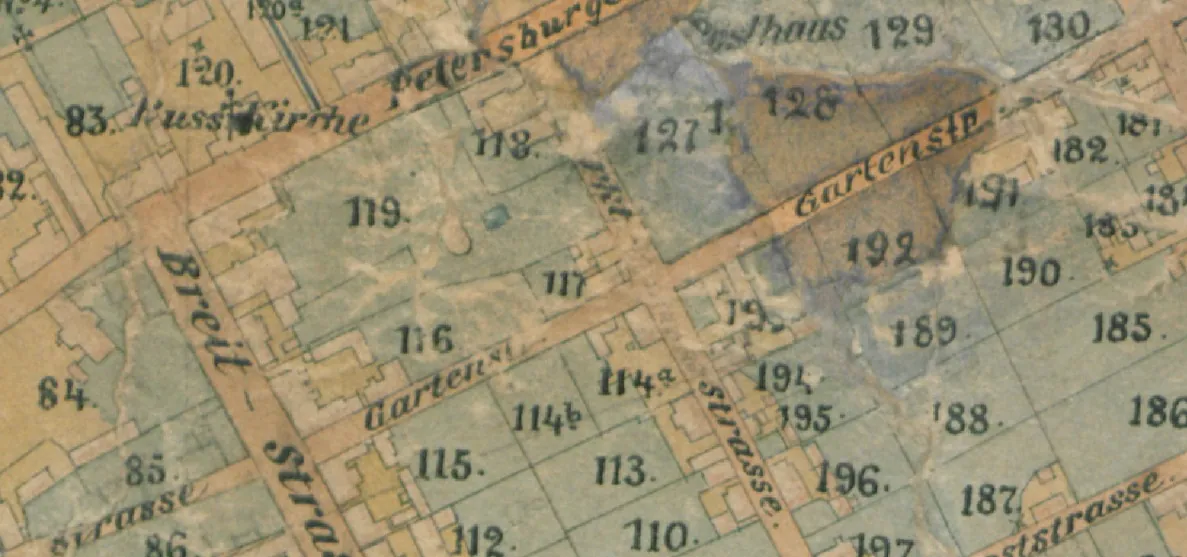
The building stood at Rohuaia (Gartenstrasse) 14, on plot 192 of the 1901 town plan, the second plot east of Laada Street. It was a plain wooden hall that also housed the rabbi and the congregation office, and it served the community for sixty years. It celebrated its fiftieth anniversary in December 1933 after a full interior repair, and in September 1938 the press reported that hooligans had attacked it. During the Nazi German occupation of 1941 to 1944 the army used it as a distribution point for soldiers, and it was destroyed by fire in the autumn of 1944. Nothing was rebuilt, and the site is now partly a block of flats and partly a small park.
Where it stood for 61 years
Historic: Rohuaia (Gartenstrasse) 14, Rakvere (Wesenberg), plot 192 on the 1901 town plan, second plot east of Laada Street on the south side of Rohuaia. Today: partly Rohuaia 22 and partly the green area at Laada 7, Rakvere, Lääne-Viru County (approximate).
Abrir mapa ampliado →La comunidad judía
The Estonian Jewish Museum dates the first mention of Jews in Rakvere to 1845; Kirss found the earliest notice in the town archive in a governorate letter of that year. The museum states that some twenty years later nearly 100 families, about 400 people, lived in the town, mostly merchants and artisans, while Kirss gives 39 Jews about 1870 and 104 in 1913, figures that do not agree with the museum's. Among the families named by Kirss are tinsmiths, a painter, a shoemaker and a butcher; the Blechmann family of tinsmiths lived in Rakvere for generations, and the first Jewish property owners appear in 1880. The Jewish cemetery on Lilleoru Street already existed in 1880. After the Russification years and the upheavals of war and revolution the congregation shrank, but under Estonian independence and the cultural autonomy granted to Estonia's Jews, which a speaker at the 1933 jubilee praised, it grew again. At the 1933 jubilee the newspapers put it at about 100 souls, and members from nearby Tapa also attended. The synagogue's owner was the Rakvere Jewish Religious Society (Rakvere Juudi Usuühing).
Arquitectura y diseño
No photograph of the standing synagogue has been found, so its appearance is known from descriptions. Residents remembered it as a rather tall, one-storey wooden house. Lilli Johari, who grew up at Rohuaia 18, two doors away, wrote in 1995 that it stood on the street line, had tall windows towards the street, and was clad in weatherboarding painted brown. Inside was one large hall. Along one wall, reached only from the entrance hall, ran a raised women's gallery about 1.5 metres deep, screened by a wooden lattice through which the women followed the service. The rabbi lived in the same building on the courtyard side. The rooms together measured 84 square metres, a figure Odette Kirss took from the town government's property records for Rohuaia 14, which list the owner as the Rakvere Jewish Religious Society. The 1901 town plan shows the plot, numbered 192, on the south side of Gartenstrasse, today Rohuaia Street. The architect and builder are unknown, and no drawings are known.
La vida dentro de la sinagoga
The hall was the religious and administrative centre of the community. It held the congregation office, and elections to the council of the Jewish Cultural Autonomy of Estonia were held there. The first rabbi after the opening was probably Abram-Itsik Gorfinkel of Vilnius, who moved to Narva in 1885. Hirsch Grabe served until the late 1920s, and in 1930 the 23-year-old Abram Gurevitsch was elected; the newspaper Virulane reported an ugly quarrel among local Jews at the time. Lilli Johari remembered old men praying, each with his own prayer book, and a wedding watched from the gallery, at which the couple walked round under a red four-cornered canopy and a glass was broken. On 10 December 1933 the congregation marked the building's fiftieth year with a ceremony inside it, attended by the mayor, the county prefect, guests from Tallinn and the press; a member named Rogowski gave a history of the congregation in Estonian, a visiting rabbi recited a memorial prayer, and the interior had just been fully repaired for about 700 kroons.
Destrucción
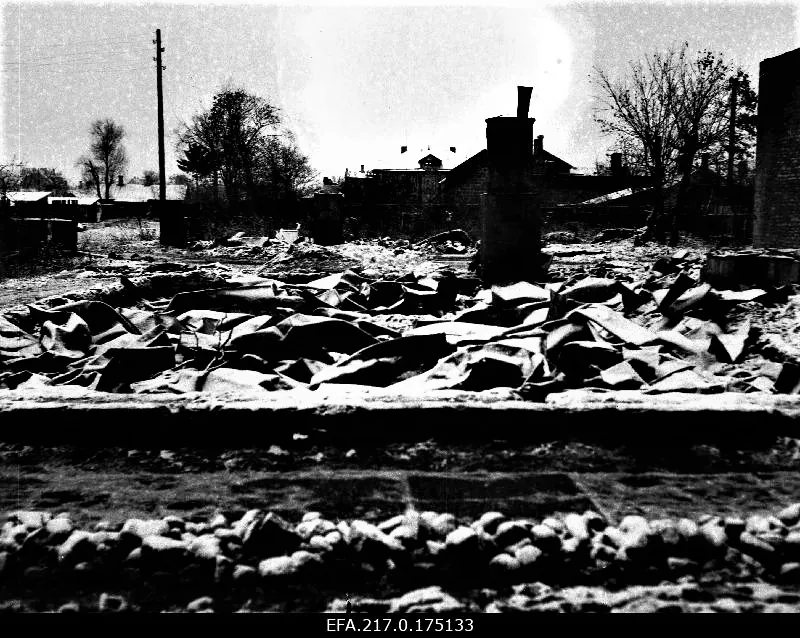
The congregation's use of the building ended with the Nazi German occupation, which reached Rakvere on 7 August 1941. According to the Estonian Jewish Museum and Odette Kirss, the German army then used the synagogue as a distribution point for soldiers. Both state that it was destroyed by fire in the autumn of 1944. Rakvere was bombed by Soviet aircraft on 19 September 1944, the day the German forces left and the day before Soviet troops entered, and Kirss records that the Blechmann family's houses nearby were destroyed in that bombing and fire. No source read says directly that the synagogue burned in the same raid. Lilli Johari, writing in 1995, said it was destroyed in 1944 'either by bombing or by burning', and who set the fire, if anyone did, is not recorded. A photograph in the Estonian Film Archive, captioned by the museum as the burned Rakvere synagogue, shows a snow-covered field of debris with a single chimney stack still standing.
El destino de la comunidad
Many of Rakvere's Jews fled into the Soviet interior before German troops reached the town on 7 August 1941. Isaac Serman, interviewed by Centropa, recalled leaving Rakvere on 6 August, two hours before the Germans arrived. Some of the town's richest families refused to be evacuated, believing that the Germans would kill nobody. He said all members of the one family that remained were killed on 18 August 1941, by the Germans according to some and by local people according to others. The Estonian Jewish Museum states that 22 Jews were murdered in Rakvere during the Second World War. A 2025 memorial ceremony named the Taich family of Rakvere among the victims of the Holocaust. After the war only a few families came back; Serman counted six. The community did not recover, and its numbers declined steadily through departures and emigration. The Jewish cemetery on Lilleoru Street survives.
El lugar hoy
The synagogue stood on the south side of Rohuaia Street, on the second plot east of Laada Street. According to the Estonian Jewish Museum the site is now partly covered by the apartment building at Rohuaia 22 and partly by the green area at Laada 7, part of the small park by the fountain at the corner of Laada and Rohuaia streets. No part of the building survives. On 12 November 2025 the town of Rakvere unveiled an information stand at the corner of Laada and Rohuaia streets marking the location. The neighbouring house at Rohuaia 18, where Lilli Johari grew up, is mentioned in her memoir; whether it still stands was not checked.
Nombres destacados
Abram-Itsik Gorfinkel
UnknownProbably the first rabbi of the Rakvere synagogue, 1883-1885Gorfinkel, from Vilnius, was probably the congregation's first rabbi after the synagogue opened in the winter of 1883, according to the Estonian Jewish Museum, which hedges the identification. He would have led worship in the new wooden hall and lived in the rabbi's rooms on its courtyard side. In 1885 he moved to Narva. Nothing further about his time in Rakvere was found.
Biografía o fuente →Hirsch Grabe
UnknownRabbi of Rakvere until the late 1920sGrabe is one of the two rabbis of Rakvere known by name after Gorfinkel. The Estonian Jewish Museum says he served until the late 1920s. Odette Kirss, citing the newspaper Virulane of 2 December 1930, notes that he was then described as the former rabbi in a report of an unpleasant quarrel among the town's Jews, at the time his young successor was elected. His dates of birth and death and his fate are unknown.
Biografía o fuente →Abram Gurevitsch (Hurevitsch)
born c. 1907Rabbi of Rakvere, elected 1930Gurevitsch was elected rabbi of the Rakvere congregation in 1930, according to the Estonian Jewish Museum. Virulane of 2 December 1930, cited by Odette Kirss, gave his name as Hurevitsch and his age as 23. He was therefore probably the rabbi during the synagogue's last decade, including its fiftieth jubilee in 1933, although the jubilee reports do not name him and mention a visiting rabbi. His later life and fate are unknown.
Biografía o fuente →¿Tiene algo que aportar?
Fotografías, documentos, historias familiares o recuerdos de esta sinagoga y su comunidad ayudan a mantener viva su historia.
- Rakvere Synagogue 1883-1944
- Rakvere sünagoog (Estonian page, with Lilli Johari's memoir and Odette Kirss extract)
- Lilli Johari, handwritten recollections of the Rakvere synagogue, 10 July 1995 (original in SA Virumaa Muuseumid archive)
- Extract from Odette Kirss's manuscript on the Rakvere Jewish community and synagogue (RM_7090_Ar1k2119_38)
- Rakvere sünagoogi galerii (1901 town plan, Wesenberger Anzeiger 4.02.1884, Virulane and Virumaa Teataja 12.12.1933, Uus Eesti 28.09.1938, town records, EFA photograph)
- Rakvere sünagoogi mälestusstendi avamine
- Rakvere synagogue standing place at Rohuaia Street 14 (Rakvere map, 1932)
- Isaac Serman (Centropa interview, tagged text)
- Rakvere
- Rohuaia 22, Rakvere (OpenStreetMap way 32048008)
Share a memory or thought
No comments yet. Be the first to add one.