
История Medieval Synagogue of Regensburg
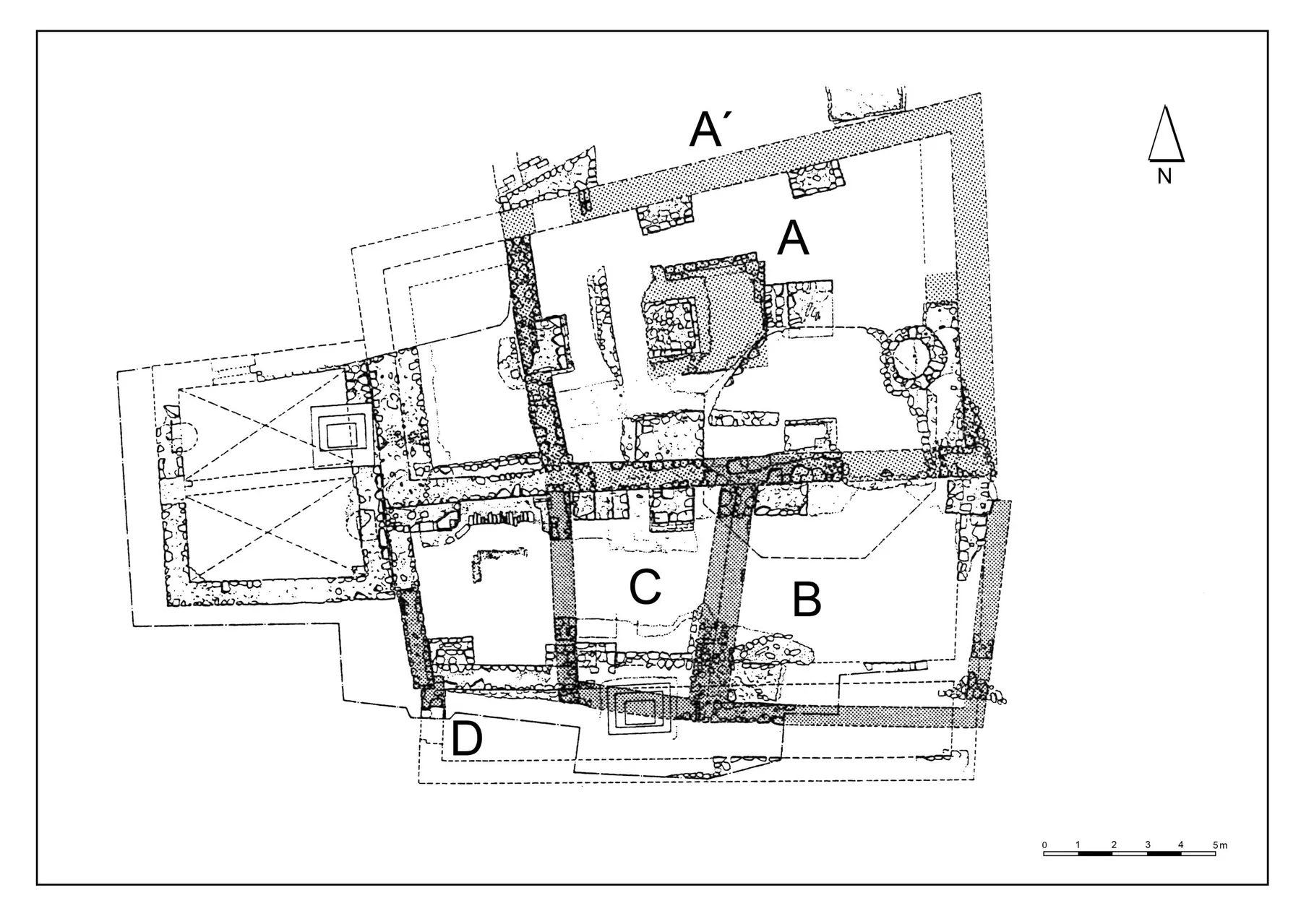
The Jewish community of Regensburg is first documented in 981, and its quarter, inside the walls of the old Roman fortress, is mentioned in the early eleventh century. The synagogue stood in the middle of that quarter, on what is now the western part of the Neupfarrplatz. Excavations by the Bavarian State Office for Monument Preservation, begun in 1995, uncovered two building phases: a plain hall of the late eleventh century, counted with Cologne, Worms and Speyer among the oldest Jewish houses of worship in Germany, and a thorough rebuilding in the first half of the thirteenth century, which older literature dates to 1210-1227. The rebuilt synagogue was a two-aisled, rib-vaulted hall with three columns down its centre and a stone bimah around the middle column.
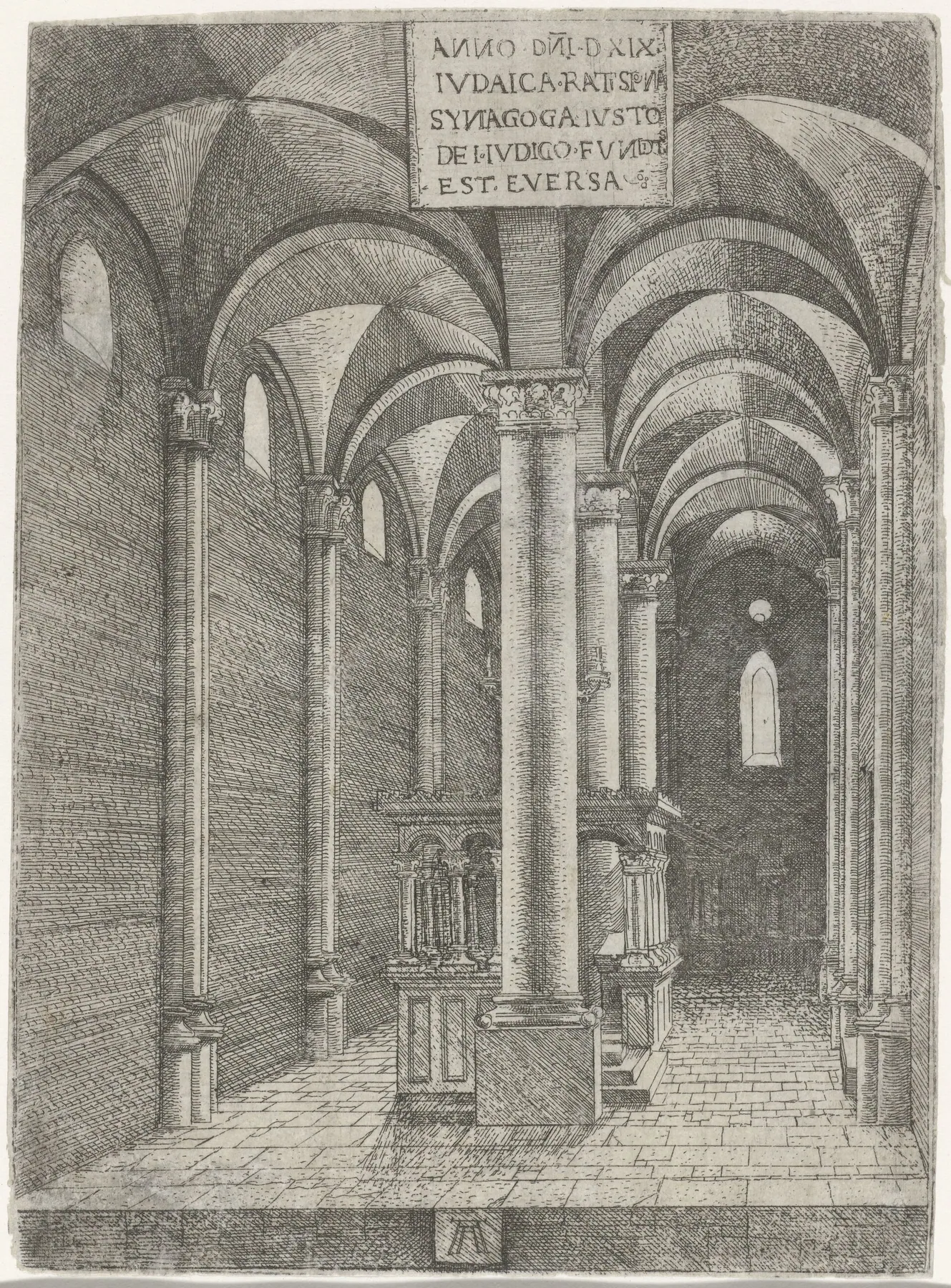
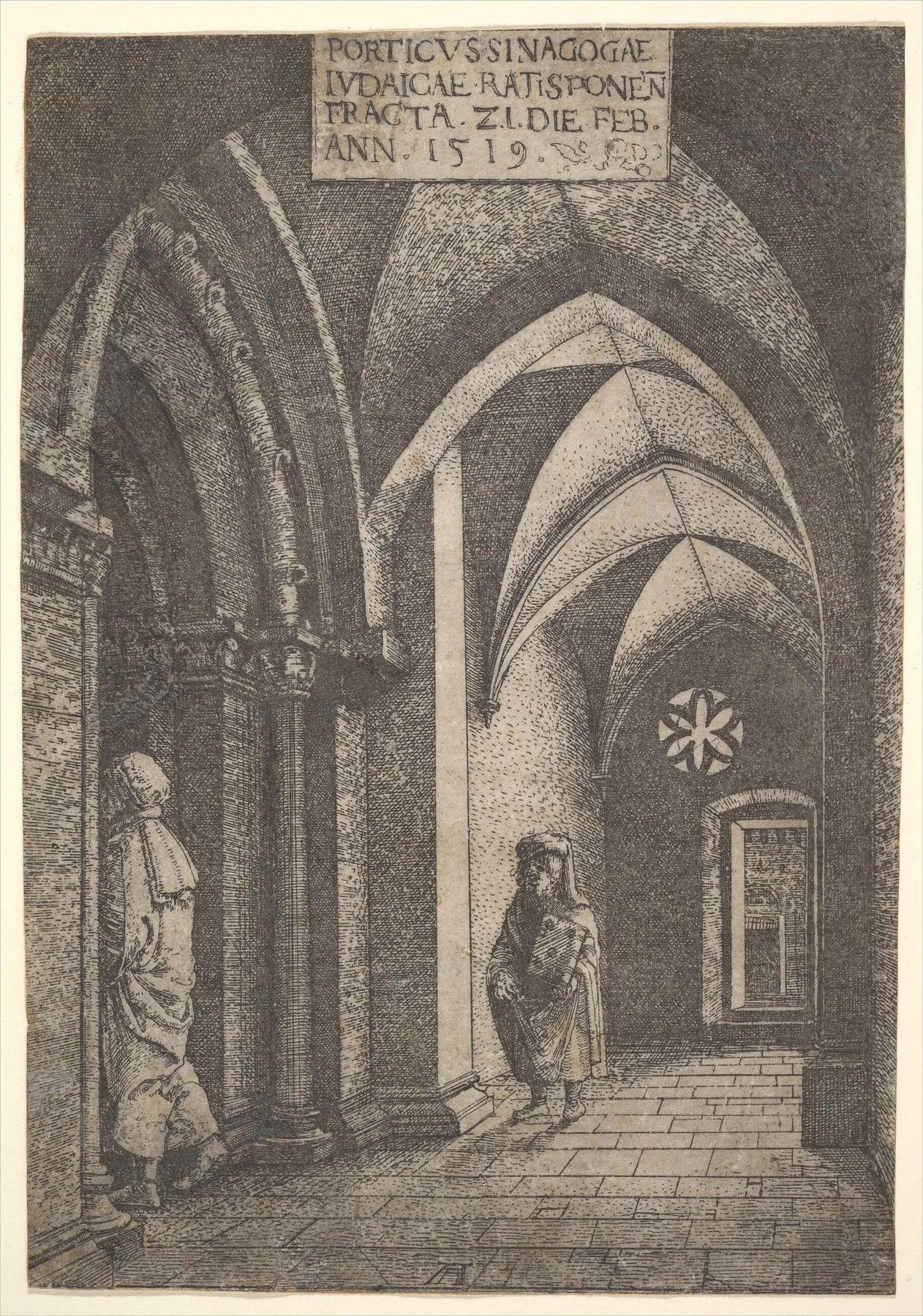
Its appearance is known because Albrecht Altdorfer, a Regensburg painter and member of the city's Outer Council, etched the interior and the porch in 1519, just as the building was being destroyed. After Emperor Maximilian I died on 12 January 1519, the city council, urged on for years by the cathedral preacher Balthasar Hubmaier, resolved to expel the Jews. The order was delivered on 21 February; the porch was broken down that day and the hall the next. A wooden chapel of the Virgin Mary went up on the site and drew crowds of pilgrims. The foundations were found again in 1995.
Where it stood for nearly 300 years
Historic: centre of the walled Jewish quarter of Regensburg. Today: western part of Neupfarrplatz, immediately west of the Neupfarrkirche, 93047 Regensburg (approximate).
Открыть большую карту →Еврейская община
A document of 981 records that the monastery of St Emmeram bought a property from a Jew named Samuel; it is the first secure evidence of Jews in Regensburg and in Bavaria. A donation of about 1020 mentions the 'dwellings of the Jews', and by then the community had a synagogue, ritual bath, cemetery and rabbinical court. Its members were at first long-distance merchants trading with Hungary and Russia; a charter of Emperor Frederick I in 1182 confirmed their rights, and from the thirteenth century they were largely confined to moneylending. The quarter, walled and closed by gates, held about forty houses, with its own administration, seal and judges. In 1210 the community bought land outside the Peterstor for a cemetery that served Jews across Bavaria. The city shielded its Jews during the massacres of 1349, but in the fifteenth century taxes and persecution ruined them: in 1476 seventeen members were arrested on a ritual murder charge and held until 1480, when Emperor Frederick III obtained their release. Sources give about 500 Jewish residents in 1519; one account adds eighty Talmud students.
Архитектура и дизайн
The first synagogue, of the late eleventh century, was a plain hall on a trapezoidal plan under a gabled roof, hardly different from the houses around it. A plastered stone platform of about eleven square metres in the middle of the room served as the bimah; there were two doorways, and the Torah niche was in the short east wall. In the first half of the thirteenth century, possibly after a town fire, the hall was rebuilt in Early Gothic forms. The long walls measured about 16.2 metres, the west wall 6.3 metres and the east wall 9.2 metres. Three columns on the central axis divided the room into two aisles covered by rib vaults, answered by bundled wall shafts. The bimah, about 3.5 by 3.25 metres and raised on three steps, enclosed the middle column and had a parapet of small columns with bud capitals and arches. Altdorfer's interior view shows high windows in the long walls, a pointed window in the east wall and a hanging lamp. His second etching shows the vaulted porch, with a columned portal into the hall and a six-lobed rose window above its outer door. Who designed the building is unknown.
Жизнь в синагоге
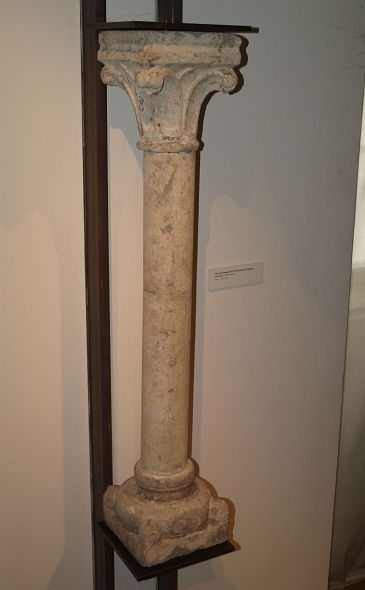
The synagogue was the centre of a community famous for learning. A rabbinical college is attested in the twelfth century, when Ephraim ben Isaac, who died about 1175, headed the rabbinical court and wrote liturgical poems, and Petachiah ben Jacob set out from Regensburg on his journey to the Near East. Judah ben Samuel he-Hasid moved from Speyer in 1195 or 1196 and taught in Regensburg for some twenty years, until his death in 1217; the Sefer Hasidim is linked with his name, and the rebuilding of the synagogue falls in or just after his time. A chronicle of 1478 claimed that the Regensburg school supplied teachers for all Germany. Worship centred on the stone bimah in the middle of the hall, with a lamp hanging above it and the ark on the east wall partly hidden behind it. Altdorfer's porch view shows two men at the entrance, one carrying a large book. A fifteenth-century washbasin found in the excavations and pieces of the bimah are kept in the city's Historical Museum. In 1470 a cantor named Kalman was condemned to death for alleged blasphemy, and Rabbi Israel Bruna was imprisoned on a ritual murder charge in 1474.
Разрушение
The council of Regensburg had asked Emperor Maximilian I more than once to let it expel the Jews, and he had refused. From 1516 the cathedral preacher Balthasar Hubmaier preached against them and proposed turning the synagogue into a church. Maximilian died on 12 January 1519. The city council then acted: its resolution to expel the Jews was announced to them on 21 February 1519 by a delegation that included the painter Albrecht Altdorfer, a member of the Outer Council, and they were told to clear the synagogue. One account says the Jews carried the sacred objects to the rabbi's house and destroyed them there themselves so that they would not fall into Christian hands; the Jewish Encyclopedia says they were made to demolish the interior of the synagogue. Altdorfer's porch etching is inscribed that the porch was broken down on 21 February, and the hall followed on the 22nd. The townspeople pulled the building down; several thousand, clergy among them, are said to have helped demolish the quarter. A master stonemason named Kern fell under a collapsing arch and survived, which was proclaimed a miracle of the Virgin, and a wooden chapel was built on the spot.
Судьба общины
The Jews of Regensburg had to leave within days, in the cold of late February; two women who had just given birth died during the expulsion. About forty houses of the quarter were torn down and the stones taken by citizens as building material. The cemetery outside the Peterstor was desecrated: more than 4,000 gravestones are reported to have been carried off, many built into houses and churches, and about sixty are known today. Parchment manuscripts were reused as bindings for files and books. Some of the exiles settled across the Danube in Stadtamhof and in Sallern, under the Duke of Bavaria, but were driven from there too later in the sixteenth century, and many moved on to Poland and Tyrol. A pilgrimage to the 'Beautiful Virgin' flourished on the synagogue site for a few years, and a stone church was begun in September 1519; left unfinished, it became the Protestant Neupfarrkirche in 1542. Jews are recorded in Regensburg again from 1669. A new synagogue was dedicated in 1841 and another in 1912, which the Nazis burned on the night of 9-10 November 1938.
Место сегодня
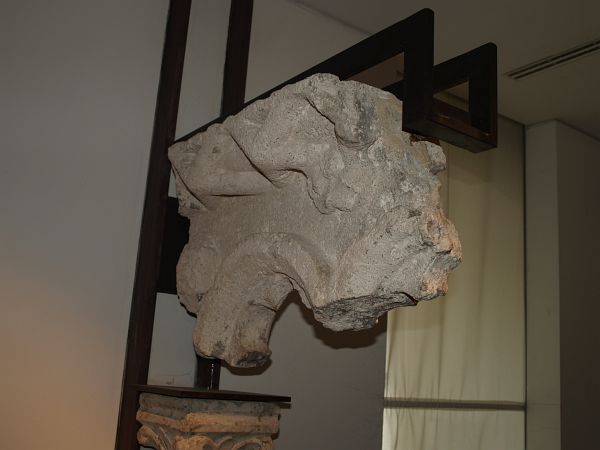
The site is the western part of the Neupfarrplatz, a paved square in Regensburg's old town, just west of the Neupfarrkirche. It was long assumed that the synagogue lay beneath the church; foundation walls with column bases were noticed beside it in 1859, and the excavations that began in 1995 uncovered the complete ground plan there. The foundations of the three central columns matched Altdorfer's etching. Nothing of the building stands above ground. Since 2005 a white concrete floor relief by Dani Karavan has traced the synagogue's ground plan on the spot. Under the square, the 'document Neupfarrplatz' information centre shows Roman walls and medieval cellars of the Jewish quarter, and carved pieces of the bimah are displayed in the Historical Museum on Dachauplatz.
Значимые имена
Judah ben Samuel he-Hasid
c. 1150-1217Rabbi and teacher in Regensburg, 1195/96-1217Judah the Pious moved from Speyer to Regensburg in 1195 or 1196 and taught there for about twenty years, until his death in 1217. He belonged to the pietist circle known as the Hasidei Ashkenaz, and the Sefer Hasidim is associated with his name; some 2,000 stories and tales circulated under it. His years in Regensburg coincide with the period in which the synagogue was rebuilt as a vaulted Early Gothic hall, and the Jewish Encyclopedia calls him the best known of the Regensburg scholars.
Биография или источник →Ephraim ben Isaac of Regensburg
died c. 1175Head of the rabbinical court, Talmudist and liturgical poetEphraim ben Isaac, known as Ephraim the Great of Regensburg, headed the city's rabbinical court in the twelfth century, when the first synagogue hall on the site was in use. He wrote Talmud commentaries and liturgical poems, and the Jewish Encyclopedia lists him among the twelfth-century sages of Regensburg, who were regarded as authorities by other communities. He died about 1175.
Биография или источник →Petachiah ben Jacob of Regensburg
active c. 1174-1190Traveller and member of the Regensburg communityPetachiah set out from Regensburg in the 1170s on a journey that took him through eastern Europe to the Near East and the Holy Land, and the account of his travels preserves observations on the late Crusader state. The sources read name him among the scholars of twelfth-century Regensburg, the generation that worshipped in the first synagogue hall on the site.
Биография или источник →Israel Bruna
15th centuryRabbi and Talmudist in RegensburgIsrael Bruna was a prominent rabbi and Talmudist in Regensburg in the later fifteenth century, when the community was under growing pressure from the town and the clergy. In 1474 he was accused of ritual murder and imprisoned; he was freed only after Emperor Frederick III intervened. The Jewish Encyclopedia lists him among the notable teachers of the Regensburg school. He afterwards left the city.
Биография или источник →Вам есть чем поделиться?
Фотографии, документы, семейные истории и воспоминания об этой синагоге и её общине помогают сохранить её историю.
- Synagogen in Regensburg (Jüdisches Leben in Bayern portal)
- Judentum in Altbayern (bis 1800)
- Ratisbon (Regensburg)
- The Entrance Hall of the Regensburg Synagogue, Albrecht Altdorfer, 1519 (accession 26.72.68)
- Interieur van de synagoge te Regensburg, Albrecht Altdorfer, 1519 (RP-P-1909-2820)
- Alte Synagoge von Regensburg
- Judentum in Regensburg
- Neupfarrkirche (Regensburg)
- Neupfarrplatz
- The Gothic Synagogue and Memorial Misrach (digital city map: the Jewish heritage of Regensburg)
- document Neupfarrplatz
- Projekt zum Regensburger Judenviertel im Mittelalter (press release, 4 March 2019)
- Regensburg: Jüdische Geschichte / Synagogen
- The last journey of Lady Veruna
- History of the Jews in Regensburg
- Portret van Albrecht Altdorfer, Rudolf Füssli, 1755-1757 (RP-P-1914-3214)
- GeoHack: Alte Synagoge von Regensburg
- Neupfarrplatz, western arm (OpenStreetMap way 42440319)
Share a memory or thought
No comments yet. Be the first to add one.