
Die Geschichte von Great Choral Synagogue of Riga
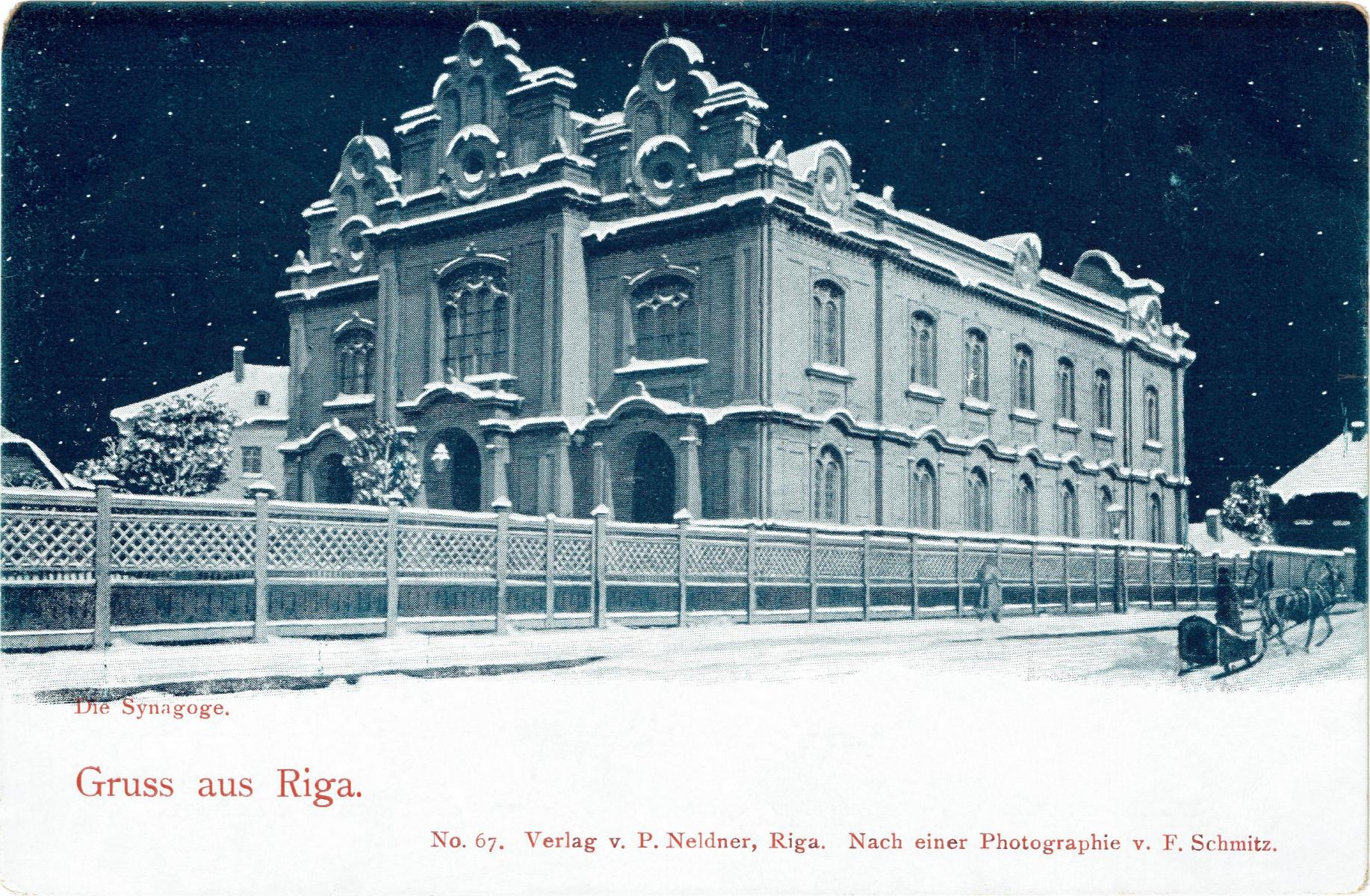
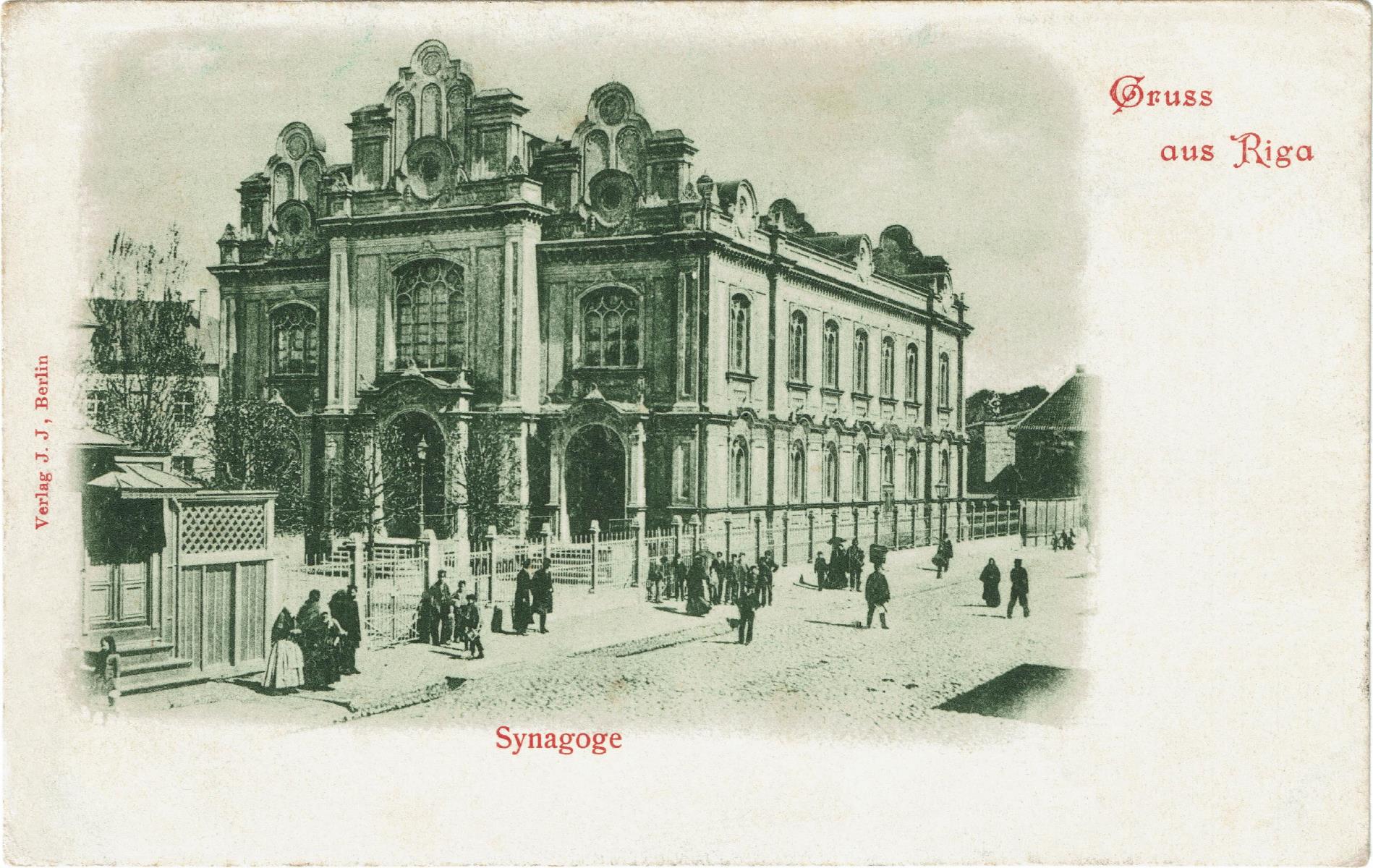
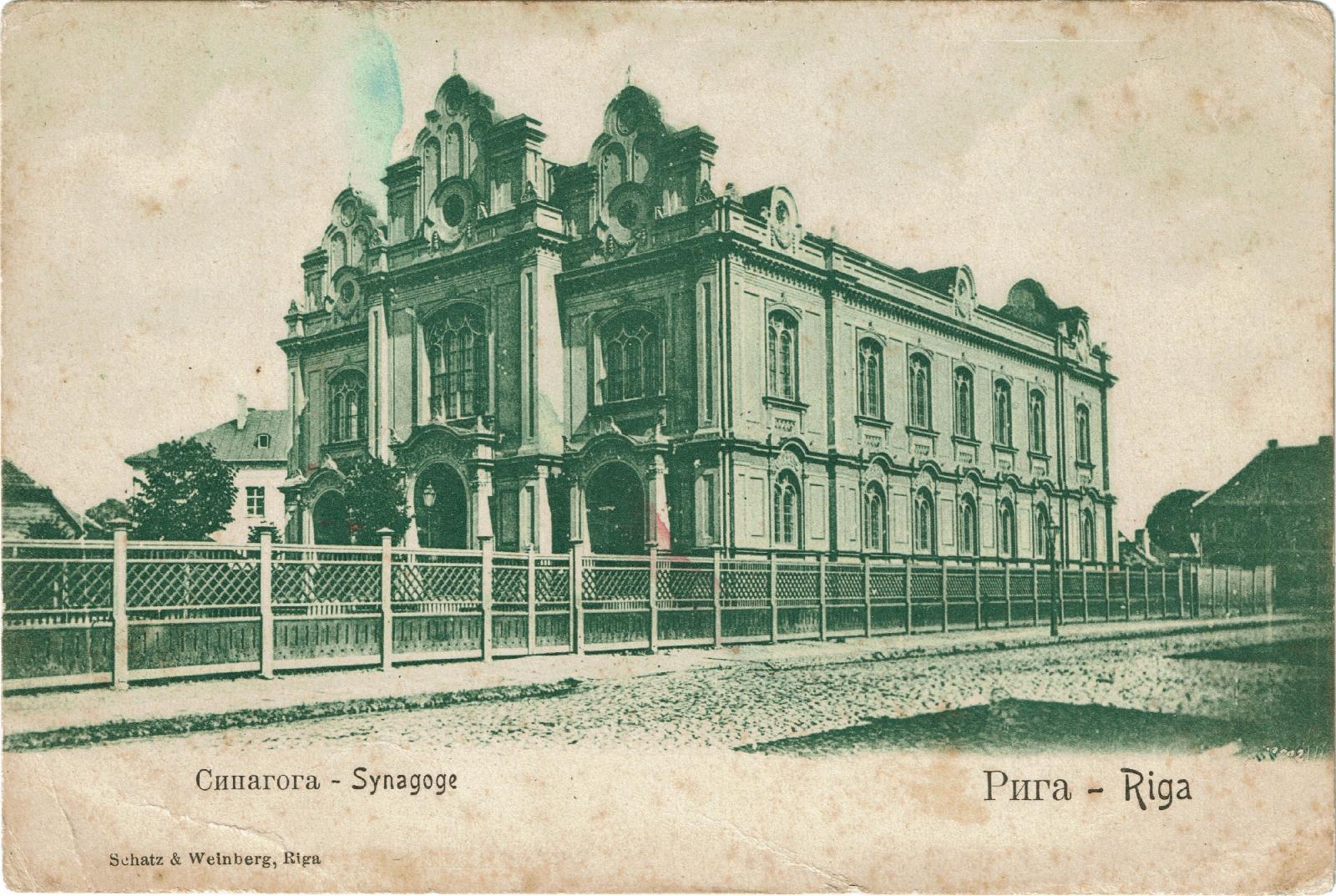
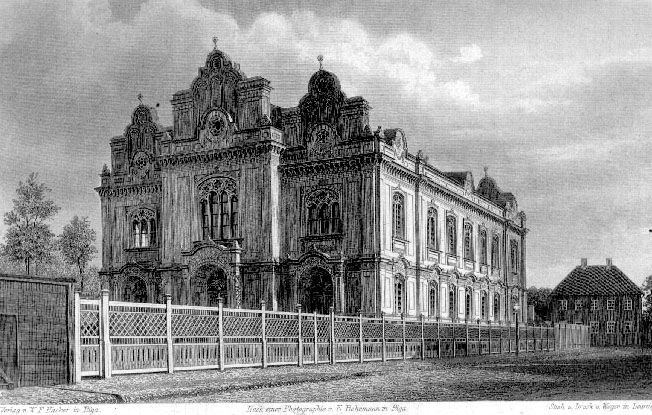
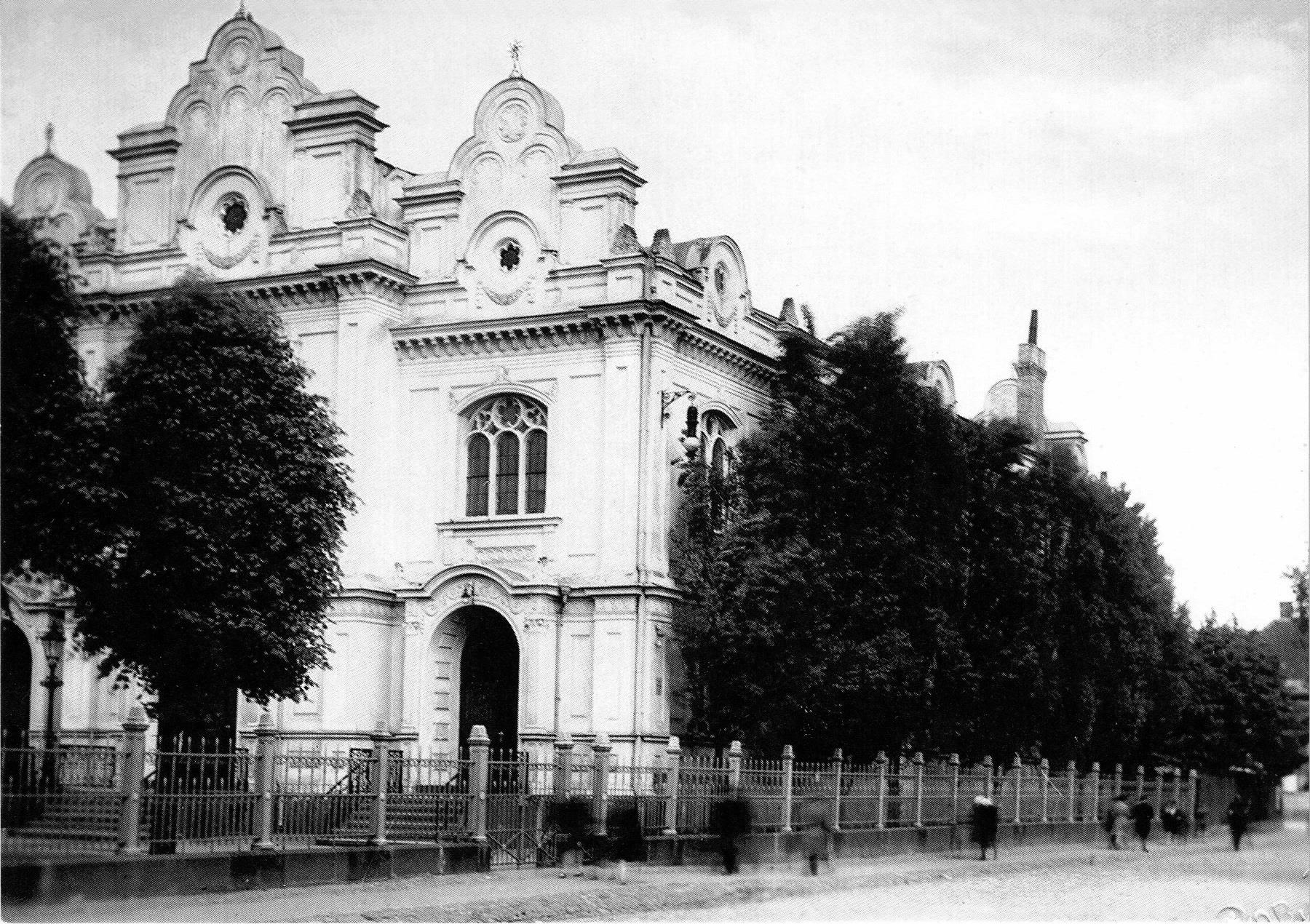
The Great Choral Synagogue stood on a plot between Gogoļa and Dzirnavu streets, at Gogoļa iela 25 in the Moscow suburb (Latgale district) just outside Riga's old town. Construction began in 1868 to designs by Paul von Hardenack, architect of the Livonian governorate, and the synagogue was completed in 1871 as the central house of worship of Riga's Jews. Its richly decorated eclectic exterior, dominated by Neo-Renaissance forms with scrolled gables, arches and round motifs, made it one of the most conspicuous buildings of the district, and a lavish description of it appeared in the Rigascher Almanach of 1873. By the Second World War it was still the largest of Riga's more than ten synagogues, renowned throughout the city for its cantors and choir; at Jewish festivals non-Jewish Rigans came to hear them. Germany invaded the Soviet Union on 22 June 1941 and German troops entered Riga on 1 July. On 4 July 1941 Latvian collaborators of the Arājs Kommando, watched by German officers, set the synagogue on fire; firefighters were allowed only to keep the flames from neighbouring buildings. How many people died inside is disputed. After the war the ruins were cleared and the site became a public square, where the foundations now form part of a memorial.
Where it stood for 70 years
Historic: Gogoļa iela 25, corner of Dzirnavu iela, Moscow suburb, Riga. Today: memorial on the synagogue site, Emīlijas Benjamiņas iela (formerly Gogoļa iela) at Dzirnavu iela, Latgale district, Riga. Exact (site marked by surviving foundations).
Größere Karte öffnen →Die jüdische Gemeinde
Riga's Jewish community grew rapidly in the nineteenth century with the expanding Baltic port. By the 1860s the growing community needed a central synagogue, and in 1868 building began on a plot between Gogoļa and Dzirnavu streets in the Moscow suburb, close to the old town and to the Jewish neighbourhoods of the Latgale suburb. The project was entrusted to Paul von Hardenack, the architect of the Livonian governorate, who in 1875 also designed a synagogue for the Latgale Jews on Elijas iela. Riga eventually had dozens of synagogues and prayer houses, 29 according to one survey, but the Great Choral Synagogue remained the largest and most prestigious. In 1935 Riga had 43,672 Jewish inhabitants out of 385,063, the largest Jewish community in Latvia.
Architektur und Gestaltung
Hardenack's synagogue was an eclectic building in which Neo-Renaissance forms predominated. The west front, facing the street, was given particular emphasis: photographs and postcards show a symmetrical facade between two tall corner towers with scrolled, Baroque-like gables, crowned by small domes and finials, and a raised central gable, with arched windows, round motifs, mouldings and projections richly decorating the surfaces. The building was a rectangular longitudinal structure divided into three aisles. The bimah stood in the centre of the three-aisled prayer hall, and the hall ended in the Torah ark (Aron Kodesh), which was especially splendid, as were the stained-glass windows and columns. A separate mikveh (ritual bath) was built next to the synagogue. A low fence on a stone plinth ran along the street front.
Leben in der Synagoge
As Riga's central synagogue it followed the choral rite, with trained cantors and a choir that became famous throughout the city. During the Jewish festivals Christians and non-believers often came to hear the cantors and choir, a sign of the synagogue's place in the life of the multinational city. It was the largest of Riga's synagogues until its destruction. Among the victims of the burning of Riga's synagogues in July 1941 were the city's chief rabbi Menachem Mendel Zack, his son-in-law Rabbi Moshe Kilov and the cantor Mintz with his whole family, though the sources do not say in which synagogue each died.
Zerstörung
German troops entered Riga on 1 July 1941. On 4 July 1941, five of Riga's six synagogues were burned; only the Peitav synagogue in the old town was spared. The Great Choral Synagogue was set on fire by men in civilian clothes led by Viktors Arājs, members of the Arājs Kommando and the Pērkonkrusts movement, collaborating with the Nazi occupiers, with German officers present as supervisors. The German occupation authorities ordered Riga's fire brigades only to stop the fire spreading to neighbouring houses and forbade them to put it out. The burning was filmed by the Germans and used in a Wehrmacht newsreel. Accounts of victims differ: some witnesses said about 20 Jews were locked in the basement, others that refugees from Lithuania sheltering in the building, perhaps 300 or even 500 people, died; the historians Andrew Ezergailis and Kārlis Kangeris doubt that people were inside, and the 1979 Hamburg trial of Arājs found no reliable evidence of the numbers. The burnt-out ruins were cleared after the war.
Das Schicksal der Gemeinde
About 40,000 Jews were in Riga when German troops arrived. In July 1941, at German instigation, Latvian auxiliaries arrested, robbed and killed thousands of Jews in Riga and its surroundings. From August Jews were forced to wear yellow stars and were excluded from public life, and in October 1941 the remaining Jews of Riga were confined in a ghetto in the Moscow suburb, the district around the ruined synagogue. On 30 November and 8 December 1941 about 25,000 people from the ghetto were shot in the Rumbula forest by German SS and police units with Latvian auxiliaries. Most of the remaining Latvian Jews were murdered over the following years. After the war Riga's Jewish community was rebuilt mainly by survivors and Jews who came from elsewhere in the Soviet Union; the Peitav synagogue is the only pre-war synagogue in the city still in use.
Der Ort heute
After the war the site became a public square. A memorial stone with the date 4 VII 1941 was placed there in 1988, and after Latvian independence was restored a memorial by the architect Sergejs Rižs was built in the 1990s, re-creating the outline of the synagogue walls and incorporating archaeological remains of the original building found on the site. In 2007 a monument to Žanis Lipke and other Latvians who saved Jews was added beside it. Gogoļa iela has since been renamed Emīlijas Benjamiņas iela.
Bedeutende Namen
Paul von Hardenack
UnknownArchitectPaul von Hardenack, architect of the Livonian governorate, designed Riga's Great Choral Synagogue, begun in 1868 and completed in 1871 as the central synagogue of the city's Jews. His eclectic Neo-Renaissance design with an emphasised west front made it one of Riga's most decorated buildings; in 1875 he also designed a synagogue for the Latgale Jews on Elijas iela.
Biografie oder Quelle →Haben Sie etwas beizutragen?
Fotos, Dokumente, Familiengeschichten oder Erinnerungen an diese Synagoge und ihre Gemeinde halten ihre Geschichte lebendig.
Share a memory or thought
No comments yet. Be the first to add one.