
La storia di Lew Jom Synagogue, Rotterdam
In the 1920s many Jewish families moved from the old centre of Rotterdam to the new streets of the western districts around the Schietbaanlaan. To give them a place of worship close to home, residents founded an association called the Westersynagoge, later known by the Hebrew name Lew Jom, roughly 'heart of the west'. By September 1927 it had 110 members. It first met in the prayer room of the Jewish old people's home on the Claes de Vrieselaan, then bought a commercial building in a side street of the Schietbaanlaan, Joost van Geelstraat 68-70, and had it converted into a synagogue. The prayer house was consecrated on 4 March 1928.
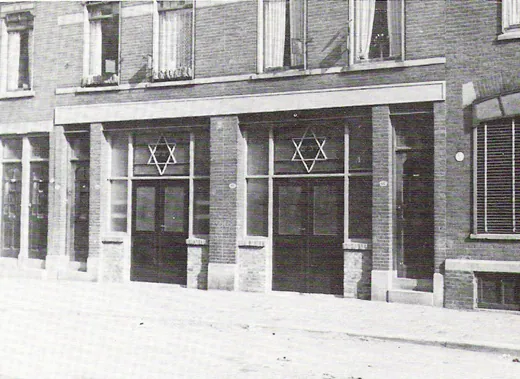
Lew Jom was not a purpose-built synagogue but a modest association synagogue in an ordinary street of shops and flats, recognisable only by the Stars of David in its two entrances. Its importance grew through chance. When the bombing of 14 May 1940 destroyed the great synagogues in the city centre, this side-street building survived undamaged. After the liberation the survivors gathered here, and from May 1945 until August 1954 it was the centre of Jewish religious life in Rotterdam. After the community moved to a new synagogue on the A.B.N. Davidsplein, the building became a business premises again, and it was pulled down in 1993 or 1994.
Where it stood for nearly 70 years
Historic: Joost van Geelstraat 68-70, Rotterdam (Rotterdam-West). Today: Joost van Geelstraat 92, 3021 VK Rotterdam, the house bearing the memorial plaque on the synagogue's site (approximate: plaque position).
Apri la mappa grande →La comunità ebraica
Rotterdam had a large Jewish community: the JCK community encyclopedia gives 10,515 Jews in 1930. In the early twentieth century, as the city grew, Jewish families settled in the new western neighbourhoods, and the Schietbaanlaan area became a popular Jewish residential district, home also to the Jewish hospital and the old people's home. Several small neighbourhood synagogues were founded to serve these districts, Lew Jom among them. A 1989 article in the Rotterdams Jaarboekje says the association aimed to promote religious spirit and a sense of community among the Jewish residents of the west; it gives 16 June 1927 as its founding date, while also mentioning statutes approved in 1923. Its members were Jewish residents of the surrounding streets. Newspaper reports from 1928 to 1937 name many of them as donors of ritual objects, among them E. Eliazar, the Frank-van Creveld family, Minna Simons-Goldschmidt, L. L. van Leeuwen and Fred. de Jong.
Architettura e design
The building at Joost van Geelstraat 68-70 was an existing commercial property, about 9 metres wide and 13 metres deep, in a street of brick houses with flats above. Who built it and what business it first housed are unknown. The architect Jac. van Gelderen designed the conversion, which began in December 1927 on a budget of 6,000 guilders. According to the Rotterdams Jaarboekje of 1989, the conversion gave the building two spacious entrances. The only known photograph shows exactly this: a ground-floor front of brick piers with two pairs of glazed double doors, each crowned by a large Star of David set in the glass, beneath a plain horizontal fascia, with two storeys of ordinary dwellings above. Inside, the plan provided 82 seats for men and 24 for women; a report of January 1928 gave 104 seats in all. The fittings included an Ark, an almemor or bimah, lecterns and cupboards. The vestibule received a terrazzo mosaic floor in April 1928, and the prayer hall had stained-glass windows with emblems such as the priestly hands and the Levite washing jug.
La vita nella sinagoga
The consecration on 4 March 1928 was led by the cantor H. Vleeschhouwer and Rabbi Marcus Cohen; the association's chairman B. J. Stein gave the address, and an evening programme followed with the violinist Sam Swaap. At first services were held only on the Sabbath; weekday services began in 1935. In the 1930s B. J. Stein, administrator of the Stichting Montefiore, also served as Torah reader. Rabbi Cohen gave regular lectures on Rashi here. The members steadily furnished the synagogue: a menorah in 1928, a parochet the same year, Torah mantles in 1928 and 1936, a set of silver Torah ornaments presented on 13 June 1929 after a fundraising drive, a silver Torah crown given by L. L. van Leeuwen for his eightieth birthday, a new Torah scroll dedicated on 1 March 1931, and a silver eternal lamp in 1937 in memory of Bertha Schwab. In spring 1942 a series of cultural Sunday afternoon services was held here, and in December 1941 Dr Elchanan Stein and Eslina de Haas were married in the synagogue.
Distruzione
The building survived the Nazi German bombing of Rotterdam on 14 May 1940, which destroyed the synagogues on the Boompjes and the Botersloot; afterwards a group of Galician Jews found a home in Lew Jom and in the Hamerkaz synagogue. Services continued until 1943, when the Nazi German occupiers prohibited Jewish religious gatherings, and the building then stood unused. It reopened undamaged in May 1945. On 20 August 1954 the community inaugurated its new synagogue on the A.B.N. Davidsplein, and Lew Jom closed. The building was then fitted out again as business premises; the sources do not name the business or say whether the community sold it. It was demolished in the 1990s: Joods Erfgoed Rotterdam gives 1994, while the plaque on the site says the building stood until 1993. Who demolished it, and why, is not recorded in the sources consulted. A house was built on the plot.
Il destino della comunità
The Rotterdam Jewish community was destroyed under the Nazi German occupation. Jewish children were expelled from public schools in September 1941. Deportations began in late July 1942 and were completed by the end of June 1943; nearly all Rotterdam Jews were assembled in the harbour shed Loods 24 for deportation, and most were murdered in the Nazi death camps. According to the JCK encyclopedia only about 13 percent of the pre-war Jewish population survived, in hiding or in the camps. Lew Jom's own people shared this fate. Anna Cohen-Dzialowski, widow of the synagogue's rabbi Marcus Cohen, was murdered in Sobibor on 30 April 1943. Eslina de Haas, married in the synagogue in December 1941, and her baby daughter Lea were murdered in Sobibor on 11 June 1943, and her husband Elchanan Stein on 16 July 1943. After the liberation the survivors gathered at the Joost van Geelstraat; the first post-war service in Rotterdam was held there on the Sabbath before Shavuot 1945. The reconstituted community counted 780 members in 1951.
Il luogo oggi
The synagogue building no longer exists. Its plot on the Joost van Geelstraat, a residential side street north of the Schietbaanlaan in the Middelland district of Delfshaven, is now occupied by a house built after the demolition. A plaque on the facade of that house records that the Lew Jom Sjoel stood here until 1993 and that it was consecrated in 1928 and closed in 1954. The house carrying the plaque is numbered 92 today, whereas the synagogue's address was 68-70, so the street numbering appears to have changed when the plot was rebuilt. Nothing of the converted shop front survives.
Nomi importanti
Jac. van Gelderen
UnknownArchitect of the 1927-28 conversionVan Gelderen designed the conversion of the commercial building at Joost van Geelstraat 68-70 into the Lew Jom synagogue. Work began in December 1927 on a budget of 6,000 guilders. According to the Rotterdams Jaarboekje of 1989 his design gave the building its two spacious entrances, the Star of David doorways seen in the only surviving photograph. Nothing further about him was found in this research.
Biografia o fonte →Marcus Cohen
1868-1941Rabbi; consecrated the synagogue in 1928 and taught thereRabbi Marcus Cohen, born in Arnhem on 3 February 1868, led the consecration of Lew Jom on 4 March 1928 with the cantor H. Vleeschhouwer, and later gave regular lectures on Rashi in the synagogue. He lived at Jan Porcellisstraat 40a in the same district and died in Rotterdam on 22 December 1941. His wife Anna Dzialowski was murdered in Sobibor on 30 April 1943.
Biografia o fonte →H. Vleeschhouwer
UnknownCantor (voorzanger) at the consecration, 1928Vleeschhouwer led the consecration service of the Lew Jom synagogue on 4 March 1928 as voorzanger, together with Rabbi Marcus Cohen. Joods Erfgoed Rotterdam, drawing on the Rotterdamsch Nieuwsblad report of 5 March 1928, names him in this role. Whether he served the synagogue regularly afterwards, and his later life and fate, are unknown.
Biografia o fonte →B. J. Stein
UnknownChairman of the Lew Jom association; Torah reader in the 1930sStein chaired the association that founded the synagogue and gave the address at its consecration on 4 March 1928. The Rotterdams Jaarboekje of 1989 says that in the 1930s he, administrator of the Stichting Montefiore, served as the synagogue's Torah reader. In May 1941 he took Rabbi Cohen's place at a lecture. His relationship, if any, to Elchanan Stein, married here in 1941, is not stated.
Biografia o fonte →Hai qualcosa da condividere?
Fotografie, documenti, storie di famiglia o ricordi di questa sinagoga e della sua comunità aiutano a mantenerne viva la storia.
- Synagoge Lew Jom
- Synagoges (overview)
- Lew Jom Sjoel Historical Marker
- Rotterdam (Jewish communities)
- Rotterdams Jaarboekje 1989, p. 209 (article on Rotterdam synagogues)
- Rotterdams Jaarboekje 1989, p. 210 (article on Rotterdam synagogues)
- Rotterdams Jaarboekje 1989, p. 212 (article on Rotterdam synagogues)
- De Rotterdamse Joden tijdens de bezetting
- Joost van Geelstraat 92, Rotterdam (OpenStreetMap node 2798619751)
Share a memory or thought
No comments yet. Be the first to add one.