
La historia de Šafov Synagogue
Šafov is a small village in the Znojmo district of South Moravia, on the Austrian border. Jews expelled from nearby Weitersfeld in Lower Austria settled here in 1670-71 with the permission of Count Maximilian Starhemberg, lord of Vranov (Frain), and in the first half of the nineteenth century they made up about half of the population. After a separation decree of 1726-28 all Jewish families had to live in a walled quarter in the south-east of the township, and the synagogue stood in the middle of it.
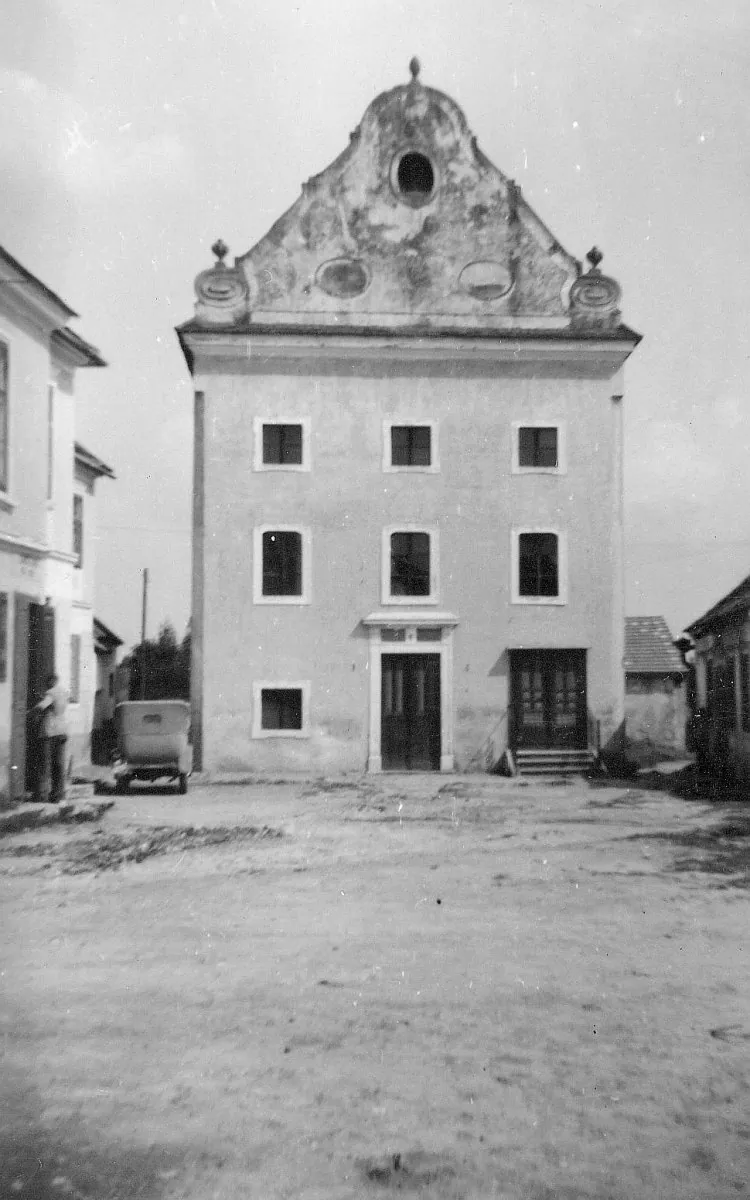
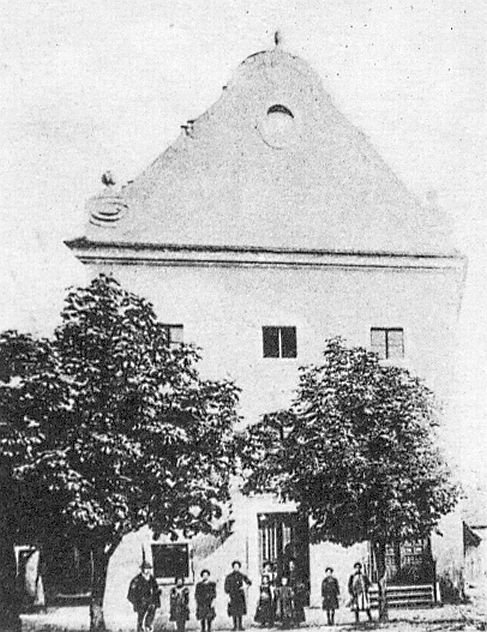
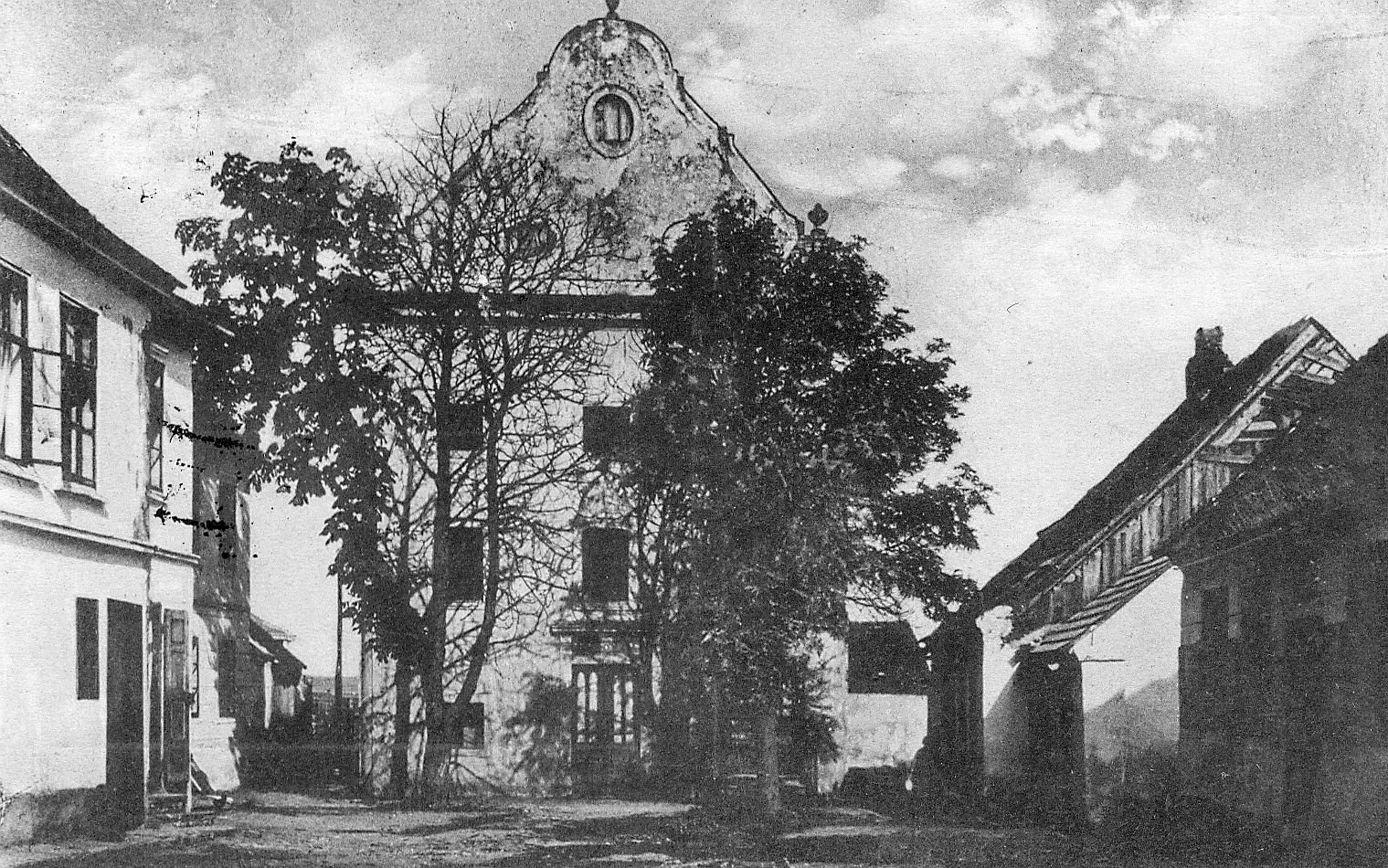
According to Jaroslav Klenovský, the first synagogue on this site was probably a simpler wooden building that burned down in 1729. It was replaced in 1783-85 by a new late Baroque synagogue built on the old foundations; other sources give its completion as 1779 or about 1780. The building was restored after the great fire of 1822, which destroyed more than a hundred houses of the Jewish quarter, and was renovated in 1921. Postcards and photographs from 1898 to 1936 show it as the tallest building in the village. The congregation shrank steeply from the 1870s, when the railways drew trade away, and in 1938 the religious community was dissolved. Klenovský writes that the synagogue was used for worship until the occupation, when the Nazis destroyed it, and that its ruins were removed in 1942.
Where it stood for nearly 160 years
Historic: centre of the Jewish quarter (Židovská obec / Judengasse), Schaffa, Moravia; plots 80/1 and 81/1, cadastral area Šafov (761907). Today: south-east part of Šafov, 671 06, Znojmo district, near house no. 62. Position from the parcel-based record (near exact).
Abrir mapa ampliado →La comunidad judía
The community began in 1670-71, when Jewish families driven out of Weitersfeld were taken in by Count Maximilian Starhemberg to resettle a township left half empty by Swedish troops in 1645. Some 85 families are recorded around 1670-80. Most lived in a defined area in the south-east; a smaller group lived in seven houses with the first synagogue north of the square, until the separation of 1726-28 forced them into the ghetto. A petition by the lords of Vranov stopped Maria Theresa's order of 1744 expelling them. The community numbered 556 in 1790, about half the inhabitants, and 663 in 1837. Schaffa Jews traded cloth, linen and leather and bought wool, flax and hides, and held the trade in country produce between Znojmo, Hollabrunn, Zwettl and Krems well into the nineteenth century. A Jewish school opened about 1800, with Leopold Lederer of Třebíč as first teacher, and had its own school and community house from 1869 to 1883. From 1848 or 1867 until 1919 the Jewish quarter formed a separate political municipality. After the railways opened in the 1870s families moved away, mostly to the Austrian Waldviertel: there were 374 Jews in 1900, 65 in 1930 and 52 in 1938.
Arquitectura y diseño
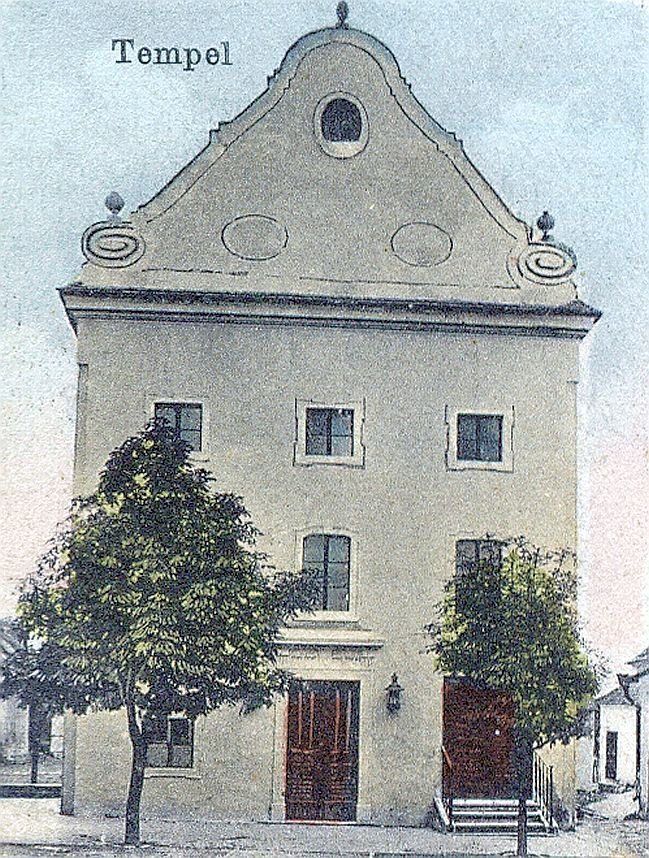
Klenovský describes the synagogue as a free-standing hall building of three storeys with a gabled street front, containing 83 seats for men and 137 for women. Zničené kostely, following Jiří Fiedler, records it on two plots, 80/1 and 81/1, in the south-east part of the village. The photographs show a tall, plain rendered block, much higher than the single-storey houses of the Jewish quarter around it. The main front had two tall panelled doors at ground level, reached by a few steps, and three rows of windows above them, two to a row on the narrow front. Over the eaves rose a large curved late Baroque gable with scrolled volutes at its lower corners, a small round or oval window in the middle and a finial at the top; a postcard of 1912 shows two further oval openings in the gable. A photograph of 1936 shows the building freshly rendered and still intact, with a car parked beside it on an unpaved square. The building's architect and builder are unknown, and no view or description of the interior or the Torah ark was found.
La vida dentro de la sinagoga
Very little is recorded about worship in the building. The community that built it was large: in the 1790s and 1830s more than five hundred Jews lived in Šafov, and the women's gallery, with 137 seats, was larger than the men's hall, with 83. The Jewish school founded about 1800 stood under the supervision of the local Catholic parish priest until the school law of 1869; for some years the Christian schoolteacher Johann Bauer also taught there for two hours a day. JewishGen's Bohemia-Moravia town page records that a Torah scroll inscribed 'weit im felde' was kept in the Schaffa synagogue until 1938. Eurosola names a Dr. Adolf Diamant as a rabbi from Schaffa but gives no dates. The names of the rabbis, cantors and community presidents who served in this synagogue were not found in the sources read. The novelist Ludwig Winder, a member of the Prague German literary circle, was born into a Jewish family in Schaffa in 1889. By the 1930s the congregation numbered only a few dozen people, though the building was renovated as late as 1921.
Destrucción
Šafov lay in the border district annexed to Nazi Germany in October 1938, and the Jewish religious community was dissolved that year. The two inventories that cover the synagogue agree that the Nazis destroyed it but differ on the date. Jiří Fiedler's record, as given by Zničené kostely, states that the synagogue was destroyed as early as 1938, perhaps during the Kristallnacht pogrom of November 1938, and classes the cause as a political decision. Jaroslav Klenovský writes that it was used for worship until the occupation, when the Nazis destroyed it, and that in 1942 its ruins were pulled down and the building material was used to strengthen a road. Neither source names the local Nazi units or individuals involved, or the authority that ordered the clearance in 1942. A photograph of 1936 shows the building intact, so the damage happened between 1938 and 1942. The Jewish quarter around it was also heavily damaged during the Second World War, and only 15 of its original 130 houses survive.
El destino de la comunidad
In 1938, at the time of the annexation, 25 Jewish households with 52 people lived in Šafov. About a third of them managed to emigrate. The rest were deported; JewishGen's town page dates their deportation to 1939, while Jüdische Gemeinden says only that those who remained were deported and that the last Jewish inhabitant had to leave Šafov in 1943. According to Jüdische Gemeinden, 36 Jewish inhabitants of the village are believed to have been murdered in the Holocaust. One of them was a daughter of the writer Ludwig Winder, who had fled to Britain with his wife and another daughter in 1939; the daughter left behind died in the Bergen-Belsen concentration camp. No Jews lived in Šafov after the war. Klenovský records an unsuccessful attempt to re-establish the Jewish religious community in 1945-47. The stone wall of the Jewish cemetery was taken apart for building material in 1945-48.
El lugar hoy
Zničené kostely locates the synagogue on plots 80/1 and 81/1 in the south-east part of Šafov, in the former Jewish quarter, and lists both plots as privately owned today; the inventory classes the building as completely destroyed. The present use of the plots is not described in the sources read. Of the 130 houses of the Jewish quarter only 15 remain, together with the former Jewish town hall; the former school has been converted into a cultural centre. A building that a JewishGen visitor was told in 1992 had been the synagogue is noted on a later JewishGen page to be the former Communist office and theatre building. The Jewish cemetery on the north-west edge of the village, with about 950 gravestones, is freely accessible and maintained by the Federation of Jewish Communities.
¿Tiene algo que aportar?
Fotografías, documentos, historias familiares o recuerdos de esta sinagoga y su comunidad ayudan a mantener viva su historia.
- Šafov (Židovské památky Čech, Moravy a Slezska; text after Jaroslav Klenovský, Encyklopedie židovských památek Moravy a Slezska, 2018)
- Synagoga, Šafov (object 17237)
- Jüdische Gemeinde - Schaffa (Mähren)
- Schaffa / Safov town page (GemeindeView)
- Safov (Schaffa) - Synagogue(?) and Jewish Cemetery
- Die Judengemeinde von Šafov
- Šafov, house no. 62 (OpenStreetMap node 2778607538)
Share a memory or thought
No comments yet. Be the first to add one.