

Historia Synagogue of Šaľa
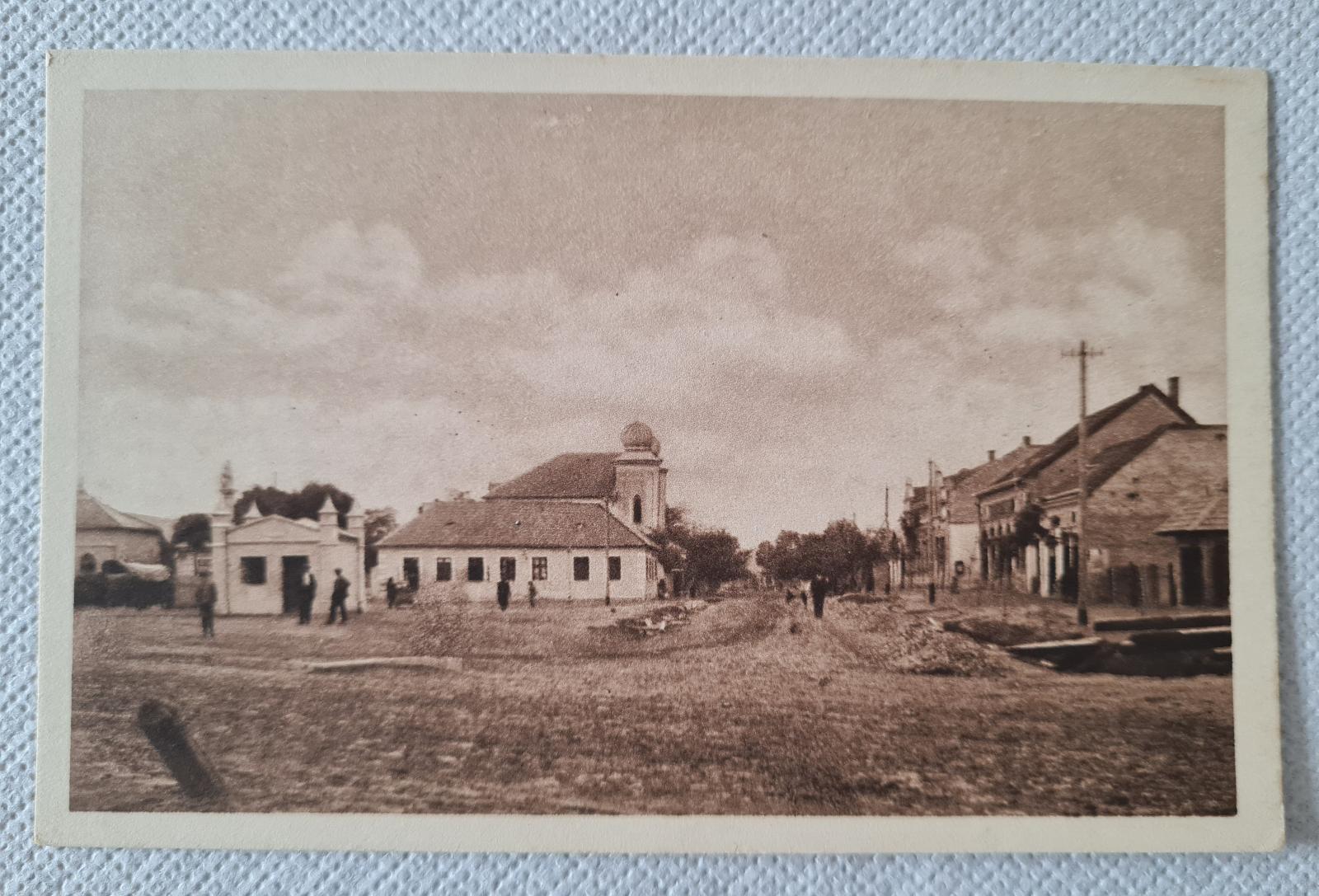
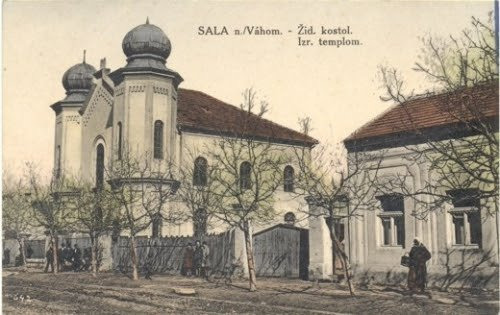
Jews settled in Šaľa (Hungarian Vágsellye) on the Váh river in growing numbers in the second half of the nineteenth century, many of them moving from neighbouring Veča, the older seat of the local rabbinate, and from villages around. The Šaľa community, which declared itself Orthodox, completed its synagogue in 1896 on Vlčianska ulica, with a Jewish school and a ritual bath next to it. For the Šaľa Jews the building marked their coming of age as an independent community; in 1925 Šaľa became the seat of its own rabbinate under Rabbi Marek Strasser. Postcards show a light rendered building whose front was framed by two slender towers topped by onion domes, set behind a fence on a tree-lined street. After the First Vienna Award of November 1938 Šaľa was annexed to Hungary. In May and June 1944 the Jews of Šaľa and the surrounding villages were confined in a ghetto and deported to the extermination camps, together with their rabbi. Few returned. The synagogue was demolished under the Communists in the 1960s.
Where it stood
Historic: Vlčianska ulica, Šaľa (Vágsellye), next to the Jewish school and ritual bath. Present day: Vlčianska ulica, town centre, Šaľa, Slovakia. Approximate.
Otwórz większą mapę →Społeczność żydowska
Jewish settlement in the Šaľa area was long centred on Veča, across the Váh, which had 330 Jews in 1836 and was the seat of the rabbinate and register district. Šaľa itself had only 28 Jews in 1860, but its economic growth drew newcomers from Veča and from villages such as Trnovec nad Váhom, Močenok, Horná Kráľová, Vlčany and Galanta. By 1899 Šaľa's Jewish population had grown to 300, while Veča's had fallen. The Šaľa community was probably formed around 1868 and was officially registered in 1899, first as a branch of the Veča rabbinate. It chose the Orthodox path after the Hungarian Jewish Congress of 1868–69, and after 1918 became an autonomous Orthodox Jewish community. A burial society (Chevra Kadisha) was founded in 1888. By 1929 the community had about 400 members and in 1940 about 410.
Architektura i projekt
The synagogue stood on Vlčianska ulica, with the Jewish school and ritual bath beside it. Surviving postcards show a rendered, light-coloured building with a pitched tiled roof. Its street front was framed by two slender towers topped by onion-shaped domes, with round-arched windows and an entrance between them, and a lower side wing. The building stood behind a wooden fence among young trees. The judaica.cz postcard collection describes the style as neo-Romanesque, while the domed towers show the Oriental motifs common in Hungarian synagogues of the 1890s. No plans or interior views were found, and the architect is not known.
Życie w synagodze
The Šaľa synagogue was the centre of an Orthodox community that grew from a branch of the Veča rabbinate into an independent rabbinate. Cantors from Šaľa are recorded in the local registers from 1887 to 1892, before the synagogue opened. In 1925 the community installed its first and only rabbi, Marek Strasser, and Šaľa became the seat of a rabbinate for the surrounding Orthodox communities. The community was led by elected chairmen, including Maximilián Friedlieb (1923), Salamon Donáth (1924), Július Kollmann (1926–1930), Dezider Menczel (1936), Hugo Wolf (1939), Rezső Kohn (until 1944) and Mikuláš Lempert (1944). A Jewish school and a ritual bath stood next to the synagogue, and a burial society cared for the dead.
Zniszczenie
After Šaľa was annexed to Hungary in November 1938, the community suffered Hungarian anti-Jewish laws. Following the German occupation of Hungary, in May and June 1944 the Jews of Šaľa and the surrounding villages were confined in a ghetto and deported to the extermination camps, together with Rabbi Marek Strasser, and the synagogue was left without a congregation. After the war the community was not re-established on any scale. The synagogue survived the war but stood unused, and under the Communists it was demolished in the 1960s; Pamiatky na Slovensku, citing Borský, gives the 1960s, the judaica.cz collection says 'after 1960', and the Wikipedia list gives 1965.
Los społeczności
The Jewish population of Šaľa, about 410 people in 1940, remained at that level until 1944, when the Hungarian authorities under German occupation confined the Jews of Šaľa and the surrounding villages in a ghetto in May and June 1944 and deported them to the extermination camps, where the great majority were murdered. Rabbi Marek Strasser was deported with his family. Only a few survivors returned after the war. The community's older and newer cemeteries in Veča survive; about 250 gravestones, some moved from the abolished Šaľa cemetery, are maintained by the local civic association Maceva.
Miejsce dzisiaj
Nothing of the synagogue survives. The site on Vlčianska ulica in the centre of Šaľa is occupied by later buildings. The Jewish cemetery in the Veča district, maintained by the Maceva association, is the main surviving trace of the Jewish community.
Ważne postacie
Marek Strasser
Died 1944 (deported)Rabbi, 1925–1944Marek Strasser was installed in 1925 as the first and only rabbi of Šaľa, when the town became the seat of its own rabbinate for the surrounding Orthodox communities. He served the synagogue on Vlčianska ulica until 1944, when he was deported with his family and most of his congregation to the extermination camps.
Biografia lub źródło →Czy masz coś do przekazania?
Zdjęcia, dokumenty, historie rodzinne lub wspomnienia o tej synagodze i jej społeczności pomagają zachować jej historię.
Share a memory or thought
No comments yet. Be the first to add one.