



La storia di Sardis Synagogue
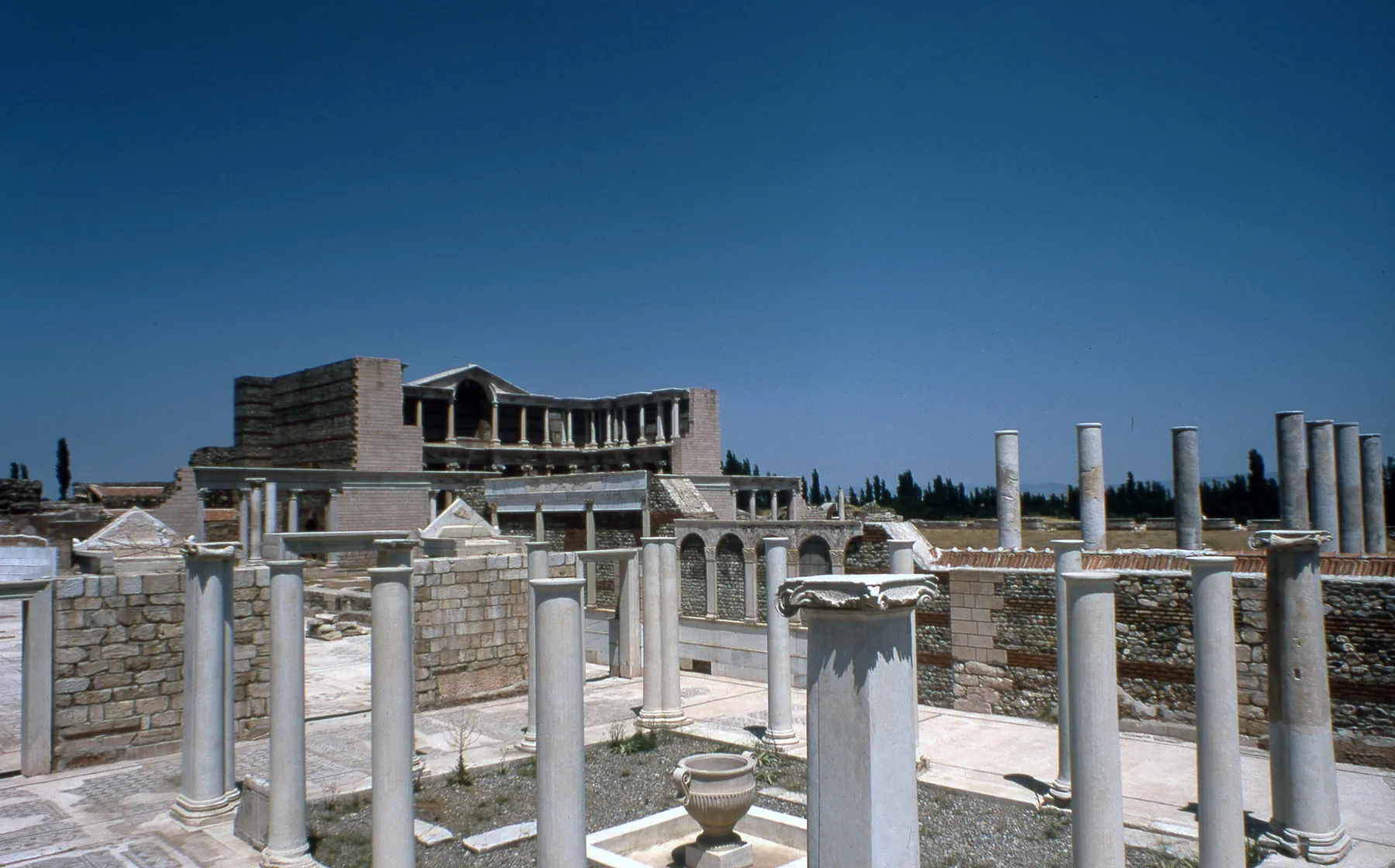
Sardis, the old Lydian capital near the village of Sart in Manisa province, had Jewish residents from the Hellenistic period, and Josephus records their rights under Roman rule. The synagogue that made the site famous was found by chance in 1962, when David Mitten of the Harvard-Cornell expedition dug a trench beside the main street and came upon a marble relief with a seven-branched menorah. It occupied the southern hall at the corner of the great Roman bath-gymnasium complex: a public building converted into a Jewish house of worship. Its main hall was over 50 metres long, with a roof carried on stone piers about 14 metres high, and could hold nearly a thousand people. When the community obtained the hall is debated. Marianne Bonz argued for a late third-century acquisition, and most of the surviving mosaics and marble decoration were added in the fourth and fifth centuries. Jodi Magness, re-reading the coins under the floors, argued in 2005 that the synagogue itself was built only in the mid-sixth century. About eighty Greek and seven Hebrew inscriptions name donors, several of them city councillors. The building was abandoned with much of the city in the early seventh century. Between 1965 and 1973 the expedition and the Turkish authorities conserved it and rebuilt its walls and columns, largely with new material; a protective roof was completed in 2022.
Where it stood
Historic: southern hall of the bath-gymnasium complex on the main colonnaded street of Sardis. Today: archaeological site of Sardis, Sart, Salihli district, Manisa province, Turkey; approximate pin on the synagogue ruin.
Apri la mappa grande →La comunità ebraica
Jews may have lived in Sardis as early as the sixth or fifth century BCE, and their numbers grew when families were moved there from Babylonia in the third century BCE. Josephus, writing in the first century CE, quotes Roman documents confirming the rights of the Sardis Jews in the first century BCE. In late antiquity the community was wealthy and well placed. The Greek donor inscriptions found in the synagogue describe many donors as citizens of Sardis, and several as members of the city council or holders of government posts; Harvard Magazine's summary of the expedition's work lists a city councillor, an assistant in the state archives, a former procurator and a count. Marianne Bonz, by contrast, read their council membership less positively, as a burden that fell on local notables when richer men moved into imperial service. Excavator Andrew Seager saw the inscriptions as evidence of a prosperous, respected community, and John Kroll remarked that without its menorahs the building might have been taken for a church. The size of the community is unknown.
Architettura e design
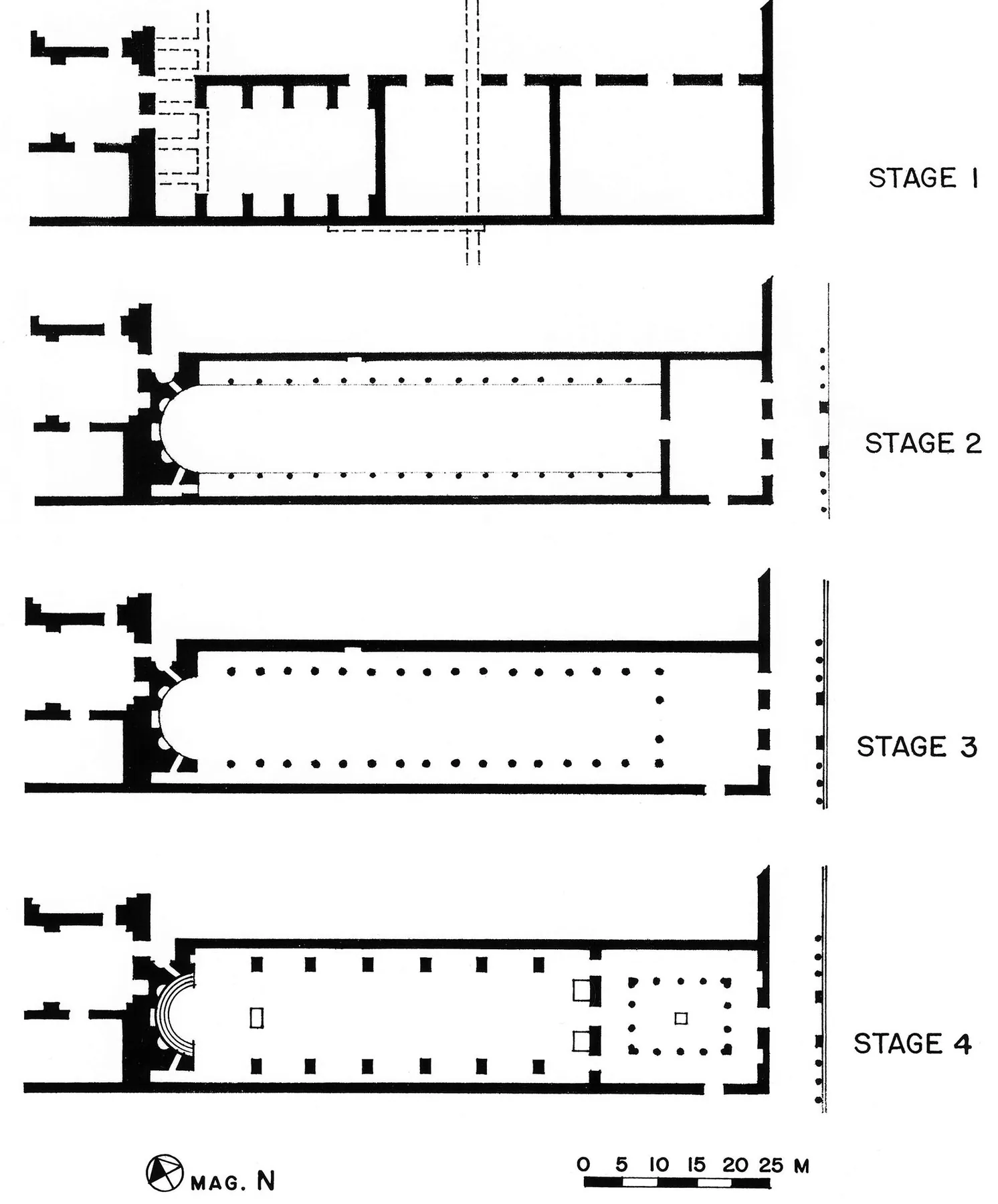
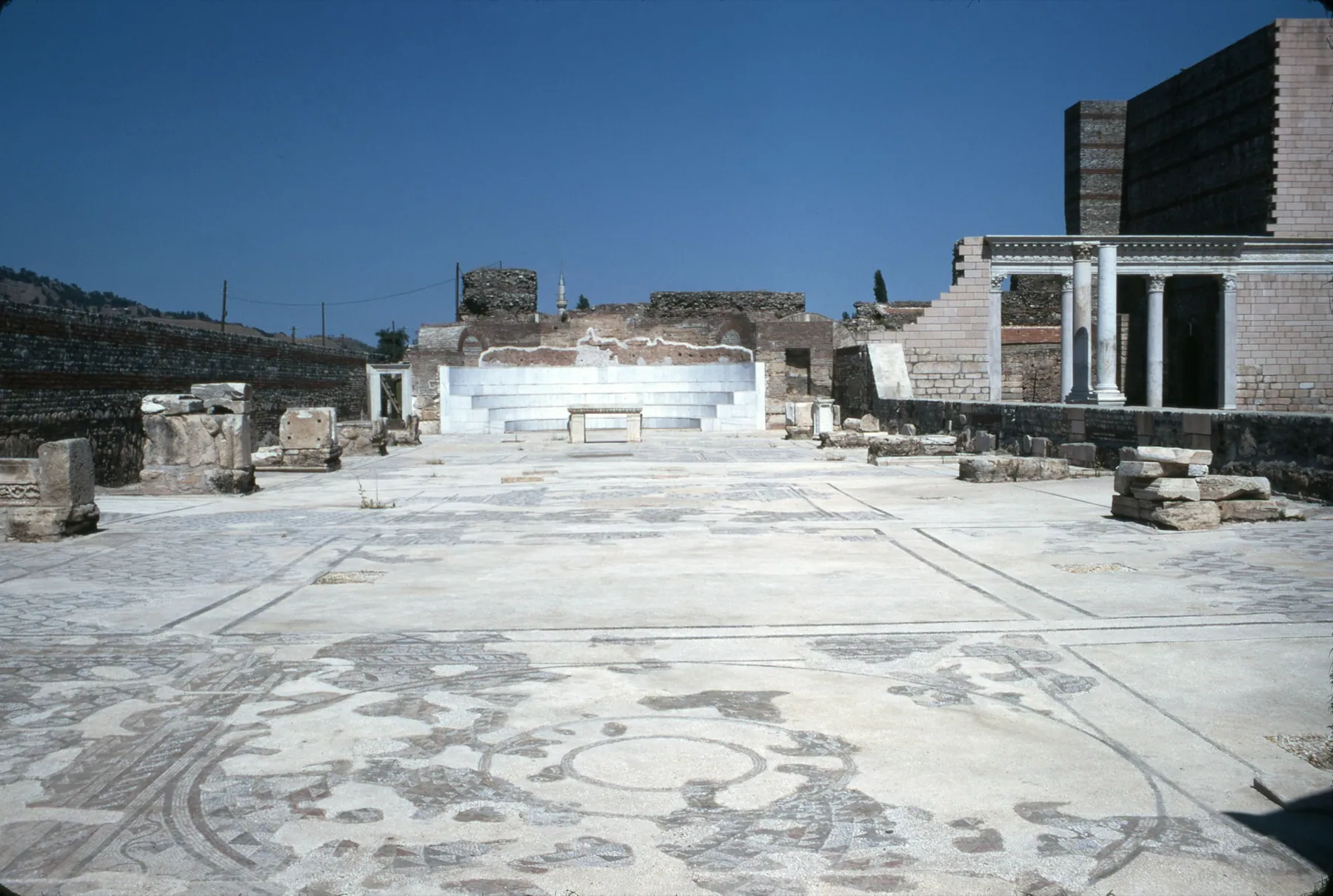
The synagogue took over the south-eastern part of the Roman bath-gymnasium complex beside the city's main street. Its phase plan shows four stages, from a series of rooms to a single long basilical hall with an apse at the west. Visitors entered from the east into a colonnaded forecourt, roofed around its sides and open in the centre, where a large marble krater served as a fountain for washing hands. Two platforms flanking the central door into the main hall carried shrines that must have held the Torah. The main hall, over 50 metres long, had its roof about 14 metres above the floor on massive stone piers. Some 1,400 square metres of floor mosaic covered its bays. In the apse, three tiers of marble benches perhaps seated the elders. A huge marble table guarded by pairs of lions, both older than the synagogue and reused, probably served for reading the scrolls, and four thin columns around the central mosaic panel may have marked a teacher's place. The walls were faced with marble inlay (skoutlosis) in geometric and floral patterns, with a camel, birds and fish. The architect is unknown.
La vita nella sinagoga
The inscriptions record a congregation that furnished its hall gift by gift over several generations. Most of the eighty or so Greek texts record donations of decoration and furnishings made in fulfilment of vows. One donor, together with his wife Regina and their children, paid for the marble inlay and painting from the gifts of almighty God. The central floor mosaic was given by a man described as a priest and teacher of wisdom, and in the fourth century the brothers Stratoneikianos and Synphoros Flavius gave the apse mosaic. A freestanding marble menorah carries the name Socrates, perhaps its donor, and a small Hebrew plaque reads [S]everus; another Hebrew text reads shalom. One inscription mentions marble inlay for the nomophylakion, the place where the Law was kept, and a plaque that John Kroll links to the Torah reads 'Having found, having broken, read, observe.' Several menorah reliefs and fragments of freestanding menorahs were found. The congregation also reused older pagan pieces: inscribed blocks from the sanctuary of Cybele, a relief of two goddesses and a marble temple model.
Distruzione
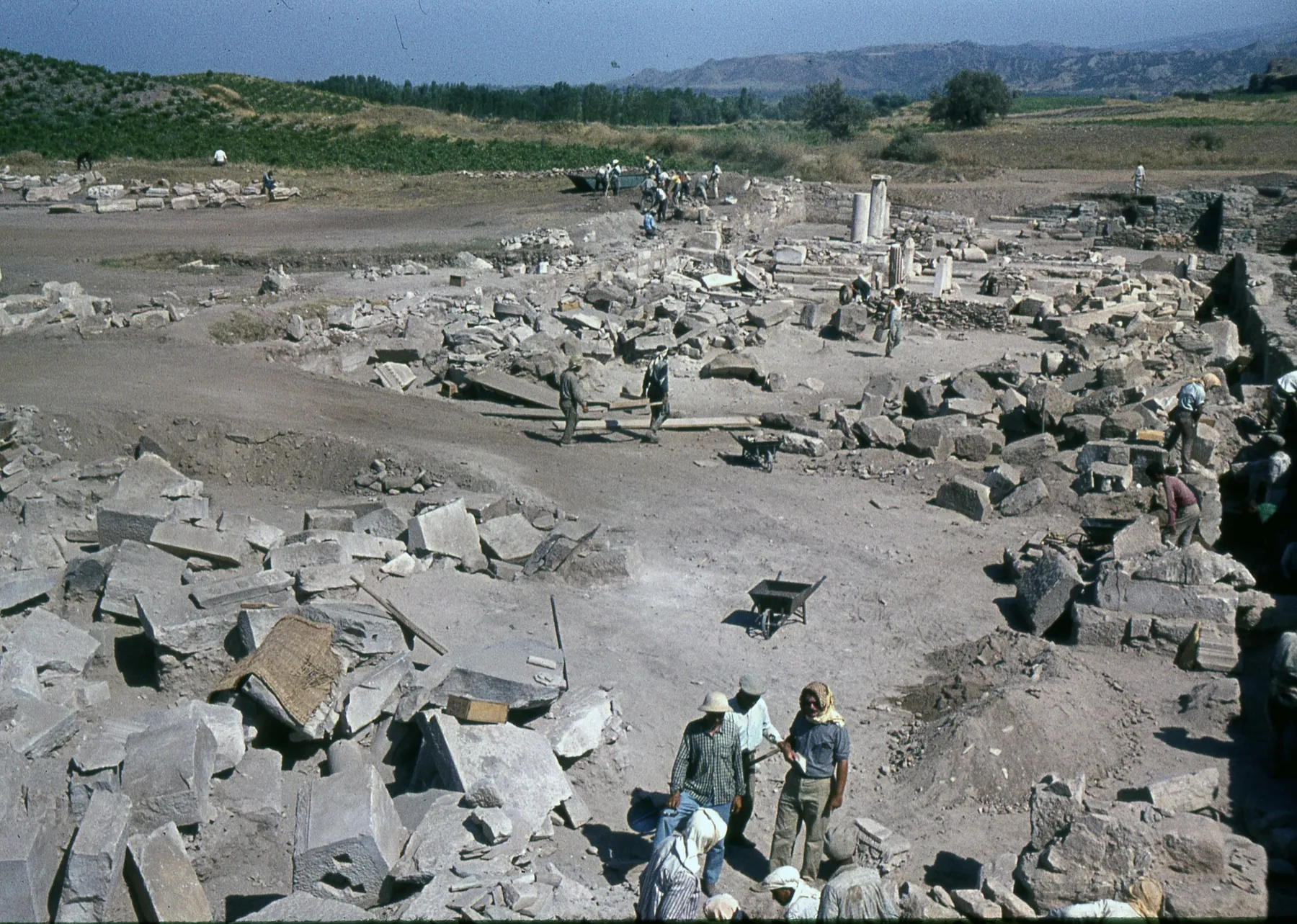
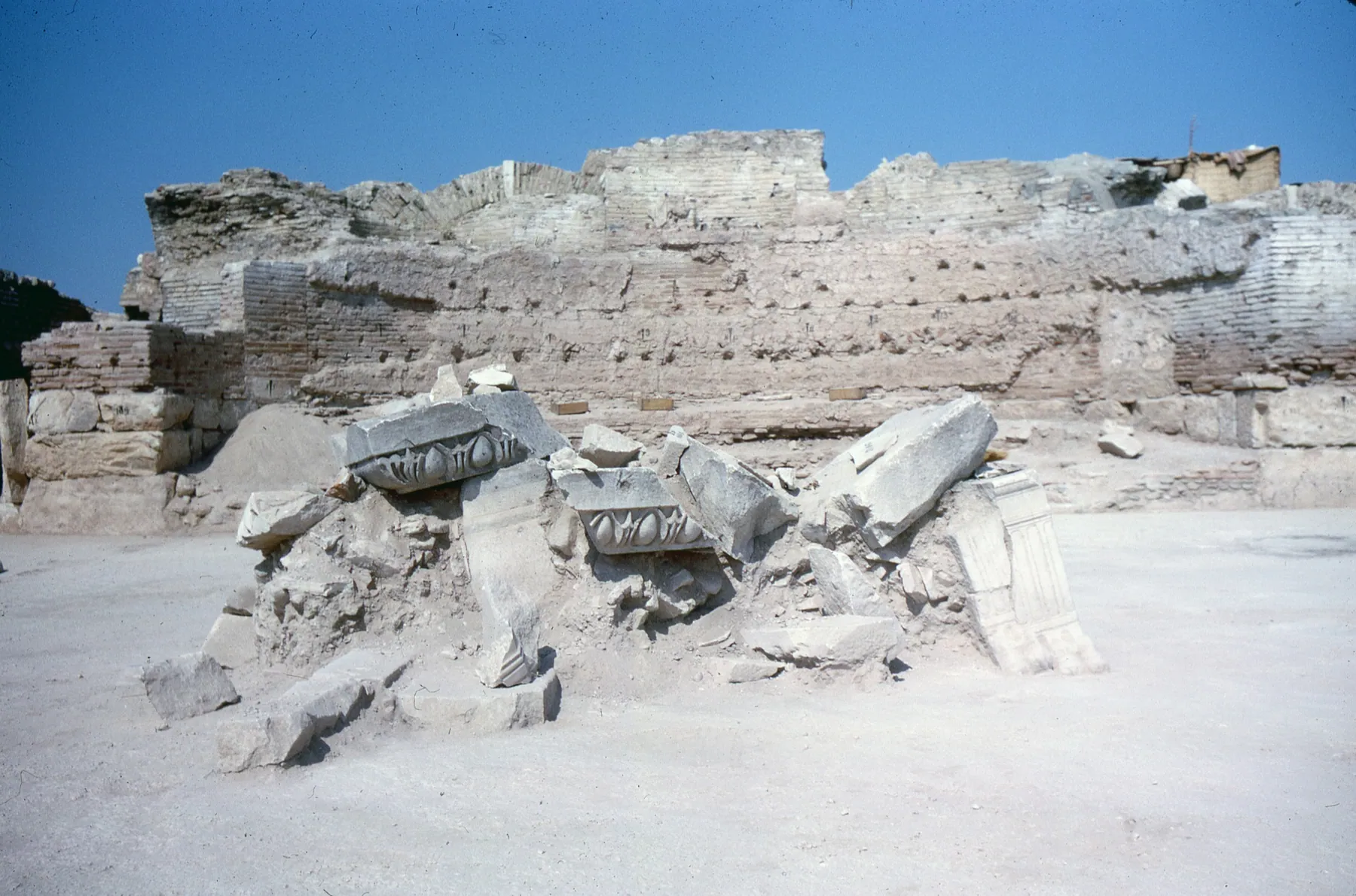
No source read records a deliberate attack on the synagogue itself. The Archaeological Exploration of Sardis states that the synagogue was abandoned after an earthquake in the early seventh century CE, together with much of the rest of the city. Other accounts put the end of Sardis down to war: the Byzantine Legacy site, drawing on Clive Foss and Jane Ayer Scott, says the city's destruction in the early seventh century is marked by violent burning in the archaeological record as the result of a Persian attack, and Harvard Magazine says Sardis may have been destroyed by Persian invaders in that century. The date 616 CE, often given for a Sasanian Persian sack, appears in the sources read only as the end of the city's prosperous period, not as the date the synagogue fell. When the excavators reached the hall in 1962 and 1963 they found its walls broken down and its floor covered with collapsed marble blocks, among them reused inscribed blocks from the sanctuary of Cybele. Who or what brought the building down, earthquake or enemy, is therefore unresolved.
Il destino della comunità
What happened to the Jews of Sardis after the city's destruction in the early seventh century is unknown from the sources consulted. The abandonment of the synagogue came at the same moment as the collapse of much of the late Roman city, and none of the sources read records Jewish life at Sardis afterwards or any later building used by Jews there. The site was later occupied only by the small village of Sart, and the synagogue's existence was forgotten until the excavation of 1962. Earlier, in the second century, Melito, the Christian bishop of Sardis, had written hostile passages about the Jews in his Peri Pascha; scholars disagree over whether these were aimed at the local community, and Lynn Cohick argued that Melito's sermon and the heyday of the synagogue did not coincide. The building's inscribed panels are now kept in the Manisa Museum. Whether any Jews remained in the area under Byzantine rule after the early seventh century is unknown.
Il luogo oggi
The synagogue is a standing, partly rebuilt ruin in the open-air archaeological site of Sardis at Sart, beside the bath-gymnasium. Between 1965 and 1973 the expedition lifted the mosaics, reset them in reinforced concrete panels in their original places, and rebuilt walls and columns, recreating the coloured marble decoration mostly with modern elements; inscribed panels went to the Manisa Museum and were replaced by painted casts, and the fountain krater by a concrete cast. So much of what visitors see is restoration rather than original fabric. The original wall heights are not given in the sources read. Weather damaged the concrete bedding over the next fifty years, and a protective roof on steel columns, resting on the 1960s walls, was completed in March 2022.
Nomi importanti
Stratoneikianos Flavius
4th c. CEDonor of the apse mosaic, 4th century CEStratoneikianos is named, with his brother Synphoros Flavius, in the inscription of the mosaic in the apse of the Sardis synagogue, which the expedition dates to the fourth century CE. The apse, with its three tiers of marble benches, was the most prominent part of the main hall, so the brothers paid for one of its focal decorations. Nothing else about him is recorded in the sources read.
Biografia o fonte →Synphoros Flavius
4th c. CEDonor of the apse mosaic, 4th century CESynphoros Flavius and his brother Stratoneikianos gave the floor mosaic in the apse of the main hall in the fourth century CE, according to its dedicatory inscription as reported by the Archaeological Exploration of Sardis. The apse held the tiered benches that perhaps seated the elders. His family name Flavius suggests Roman citizenship, but nothing more about him is known from the sources read.
Biografia o fonte →Regina
UnknownCo-donor of the marble wall decoration and paintingRegina is named in a Greek inscription from the main hall in which her husband, whose name is not given in the source read, records that he, with his wife Regina and their children, in fulfilment of a vow, paid from the gifts of almighty God for the marble inlay (skoutlosis) and the painting. She is the only woman named among the synagogue's donors in the sources consulted.
Biografia o fonte →Hai qualcosa da condividere?
Fotografie, documenti, storie di famiglia o ricordi di questa sinagoga e della sua comunità aiutano a mantenerne viva la storia.
- The Synagogue (essay)
- The Date of the Sardis Synagogue in Light of the Numismatic Evidence (AJA 109.3, 2005, abstract)
- Differing Approaches to Religious Benefaction: The Late Third-Century Acquisition of the Sardis Synagogue
- Sardis (Harvard Magazine, March-April 1998)
- Sardis
- Evolution of the Synagogue: Problems and Progress (review)
- Sardis Synagogue
Share a memory or thought
No comments yet. Be the first to add one.