
The story of Sečovce Synagogue
Sečovce, known in Hungarian as Gálszécs, is a market town in the Trebišov district of eastern Slovakia. Its Jewish community, independent from 1816 and Orthodox from 1869, was one of the largest in the Zemplén region: in 1880 its 1,019 Jews made up about a third of the town. The congregation's first synagogue, built in 1873 on today's Hodvábna Street beside the Trnávka stream, burned twice, and the community then built a new synagogue on another plot. This building, completed in 1904, is the subject of this entry.
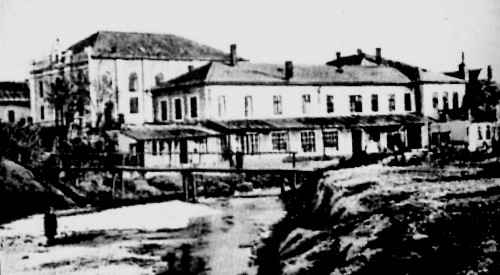
It stood in a side street, Jarková ulica, running from the main street down to the stream, at the centre of a small Jewish quarter: a school opened in 1903 stood to its south with the rabbi's flat and a mikveh in its basement, and a kosher butcher and bakery stood to the north. Pinkas Hakehillot describes it as Classic Moorish in style and 15 by 22 metres in size. Maroš Borský notes that because the community was strictly Orthodox the synagogue had no towers, and that it and the mikveh appear on many old postcards of the town.
After the Second World War a small group of survivors repaired the synagogue and prayed in it again, but when the community dwindled it became a warehouse for grain and hardware. In 1972 the central union of Jewish communities gave it to the state for a museum; despite that agreement the whole complex was demolished in 1976.
Where it stood for 72 years
Historic: Jarková ulica, a side street leading from Hlavná ulica (main street) towards the Trnávka stream, Sečovce (Gálszécs). Today: park area near the bus station, off P. O. Hviezdoslava Street, Sečovce (approximate).
Open larger map →The Jewish community
Jews are recorded around Sečovce from the early eighteenth century; a gravestone of 1711 was found in the old cemetery, and the census of 1736 lists one Jewish family. By 1820 about 60 families lived in the town. They had a prayer house by 1810, a cemetery from 1811 and an independent community from 1816, led for forty years by Rabbi Meir Kahana. Many Hasidic Jews from Galicia settled there in the later nineteenth century, and a dispute in 1884 between them and the liberal-leaning community president Ignatz Wirtschafter was settled by Rabbi Reinitz. The town had 1,026 Jews in 1919 and 1,138 in 1940. Jews dominated local trade: grain merchants such as the Wirtschafter and Hershkovicz families, the Schwarcz timber business, the Neuman wine trade and the Birnbaum distillery and printing house. Both local banks were Jewish-owned, and most of the town's lawyers and both its doctors were Jews. Between the wars the community counted around 250 families and ran a school, a yeshiva, a Talmud Torah and several charities; Zionist groups were strong, and Zeev Jabotinsky spoke in the town in 1934.
Architecture and design
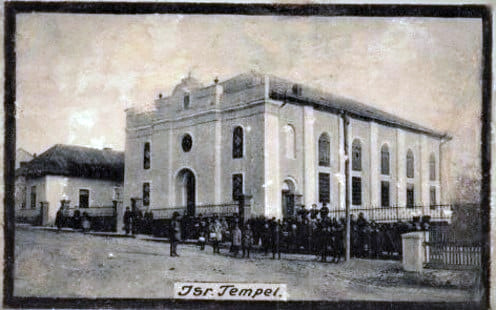
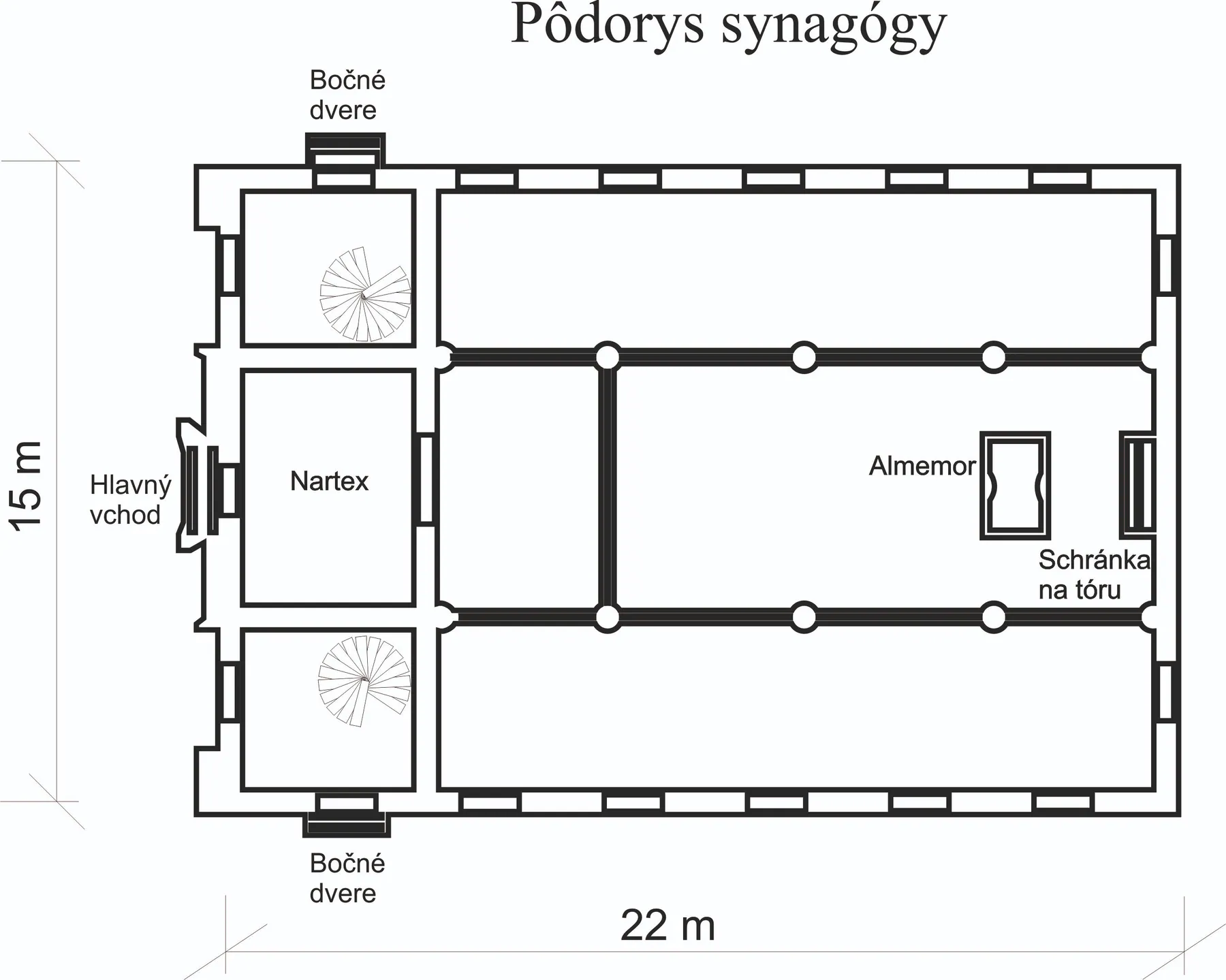
The synagogue was a two-storey rectangular hall, 22 metres long and 15 metres wide, under a hipped roof covered with sheet metal. Martina Diheneščíková calls its style Classicist and Moorish; because the congregation was strictly Orthodox it had no towers. The entrance front faced west. A large round-arched doorway, used only by men, had above it a round window with stained glass forming a Star of David, and the front ended in a parapet with relief decoration and stone Tablets of the Law inscribed in Hebrew. A 1910 postcard captioned 'Isr. Tempel' shows this front as a central projection with a stepped gable, flanked by narrower bays with paired windows, and a long side wall with tall arched windows. Women entered by side doors on the north and south and climbed two spiral stairs to a gallery on three sides, carried on six ornamental cast-iron columns. The vestibule, heated and floored in wood, served as a weekday prayer room. Inside, the walls and floor bore geometric oriental ornament and the blue ceiling was painted with gold stars. The ark stood on the east wall behind a wrought-iron rail, with the bimah raised in the centre. The architect is unknown.
Life inside the synagogue
The synagogue was built under Rabbi Yehoshua Baruch Reinitz, the community's most celebrated rabbi, who had led it since the 1870s, founded its yeshiva and in his last years revised the community statutes. Hasidic members, many of Galician origin, tended to pray and study in the separate study hall rather than in the synagogue. Reinitz was followed by Rabbi Aharon Kraus (1913-1922), noted for preaching in German and Slovak, and in 1924 by Rabbi Shmuel Menachem Klein, a Zionist, who died the following year. No new rabbi was appointed after him; the dayan Zalman Leib Adelis served as substitute rabbi and headed the yeshiva until it closed in 1932. On the eve of the Second World War Chaim Hecht and Aharon Kohn were the cantors and ritual slaughterers. The complex around the synagogue was the centre of religious education: the community school opened in 1903 with Hungarian, later Slovak and Hungarian, as its languages, and had 156 pupils in 1928 under its long-serving principal Jozef Blau; a Talmud Torah founded in 1888 stood beside it, where Rabbi Chaim Weinberger taught. A large modern mikveh was part of the synagogue building.
Destruction
No source records serious war damage to the synagogue itself, although the study hall was burned down and the old cemetery destroyed during the war. A local history says the synagogue and school were left damaged and abandoned, their furnishings, ritual objects and books lost or stolen. Survivors repaired the building and used it again for worship, for two or three years according to the local historian Peter Sklenčár, or until the community dissolved at the end of the 1960s according to Pinkas Hakehillot. It then stood empty and was used as a store for grain and for goods of a hardware shop, while the school building was nationalised and used by state schools. In 1972 the Central Union of Jewish Religious Communities handed the synagogue to the state so that a museum could be set up in it. Despite this agreement, the synagogue, the school and the neighbouring buildings were demolished in 1976, under Communist rule. The sources do not say which authority ordered or carried out the demolition. Borský also records the mikveh as demolished after the war.
The community’s fate
Under the Slovak State the Jews of Sečovce were pushed out of public schools and at least 40 Jewish businesses were aryanized in 1940-1941. Deportations by the Slovak authorities began at the end of March 1942: young men were sent via Žilina to Majdanek, and young women via Poprad to Auschwitz on 2 April; 75 young women escaped and hid. On 2 May 1942 about 300 Jews of Sečovce and 250 from nearby villages were held in Jonah Hershkovicz's grain warehouse, taken to the barracks in Trebišov and deported on 5 May to the Lublin district, the men to Majdanek and the others to the Lubartów ghetto. Small groups followed until autumn, among them the dayan Zalman Adelis and the district rabbi Menachem Gershon Moskovic. About 85 per cent of the community was deported in 1942; 150 people remained in 1943, and in May 1944 most of them left for western Slovakia. More than 700 Jews of Sečovce were killed. About 20 fought with the Slovak partisans and five fell. After liberation about 100 Jews gathered in the town; 98 lived there in 1948 and 60 in 1950, after emigration to Israel.
The site today
Nothing of the synagogue survives. According to the local historian Peter Sklenčár, as summarised by Martina Diheneščíková, the site of the synagogue is now an open park area, and an access road to the town's first seven-storey block of flats, connected to P. O. Hviezdoslava Street, was built across the site of the Jewish school. The Slovak gazetteer Pamiatky na Slovensku places the synagogue near today's bus station. Borský describes the place as an empty space beside a Communist-era housing estate. The newer Jewish cemetery of Sečovce survives and is maintained; the old cemetery was destroyed during the war. A second prayer house, on Blatná Street, stood until 2005 according to the community's KehilaLinks site. The exact plot of the synagogue has not been fixed from a cadastral map in this research.
Notable names
Yehoshua Baruch Reinitz
1823-1912 (Pinkas implies death in 1909)Chief rabbi of Sečovce from the 1870sReinitz, born in Güssing and trained at the Pressburg yeshiva of the Chatam Sofer, led the Sečovce community for more than four decades. He founded its great yeshiva, revived the burial society, ended the 1884 quarrel over the Hasidic study hall, and rebuilt the communal buildings after fires; KehilaLinks states that the new synagogue was built under his leadership. He revised the community statutes, approved in 1908. His grave in the Sečovce cemetery is still visited.
Biography or source →Aharon Kraus
UnknownRabbi of Sečovce, 1913-1922Kraus led the congregation in the new synagogue from 1913 to 1922, including the First World War, when about 250 local Jews were drafted and hundreds of Galician refugees arrived. Pinkas Hakehillot notes that he preached fluently in German and Slovak, unusual for rabbis of his time, and that his contacts with officials helped the Jews of Sečovce and of Slovakia more widely.
Biography or source →Shmuel Menachem Klein
died 1925Rabbi of Sečovce and head of its yeshiva, 1924-1925Klein came to Sečovce in 1924 from Šarišské Lúky and became both rabbi and head of the yeshiva. Pinkas Hakehillot describes him as combining Torah learning with broad general knowledge and as one of the religious Zionist leaders of his day. He died young in 1925, and no rabbi was appointed after him; the dayan Zalman Adelis acted as substitute.
Biography or source →Zalman Leib Adelis
died after deportation, 1942Dayan, substitute rabbi and yeshiva headAdelis served as dayan (religious judge) of Sečovce, stood in as rabbi after the death of Rabbi Reinitz and again from 1925, when no rabbi was appointed, and headed the local yeshiva until it closed in 1932. He was still the community's acting rabbi on the eve of the Second World War and was deported to Poland with others from Sečovce in 1942.
Biography or source →Pinchas Wintner
1882-1964Head of the Sečovce community during the Second World WarWintner, a prosperous textile merchant on the main square, led the community with Heinrich Hecht on the eve of the war and headed it after the 1942 deportations. Pinkas Hakehillot says he and his sons used their good relations with the Slovak authorities on behalf of the Jews who remained, and his family was the only one allowed to stay in Sečovce in May 1944. His business was aryanized in July 1941.
Biography or source →Do you have something to contribute?
Photographs, documents, family stories or memories of this synagogue and its community help keep its history alive.
- Secovce (Pinkas Hakehillot Slovakia, pp. 414-418)
- Synagogue Architecture in Slovakia: Towards Creating a Memorial Landscape of Lost Community (catalogue entry Sečovce, S0K1601, p. 200)
- Židovská komunita v Sečovciach (Acta theologica et religionistica 1/2016, pp. 87-99)
- Sečovce - synagóga
- Sečovce Life: Synagogues
- Sečovce (KehilaLinks home page)
- Rabbi Joshua Baruch Reinitz
- The Wintner Family
- List of synagogues in Slovakia
Share a memory or thought
No comments yet. Be the first to add one.