
The story of Sepphoris Synagogue
Sepphoris (Hebrew Tzippori, Byzantine Diocaesarea) was a leading city of Lower Galilee and, according to the Israel Nature and Parks Authority, the place where Rabbi Judah Ha-Nasi redacted the Mishnah around 200 CE. The synagogue described here stood north-east of the acropolis, beside a street running parallel to the main north-south street, in what its excavators took to be a residential quarter. It was found in 1993 during construction work at the edge of the archaeological park and was excavated for the Hebrew University of Jerusalem by Zeev Weiss and Ehud Netzer in 1993-1994 and by Weiss in 1996-1998.
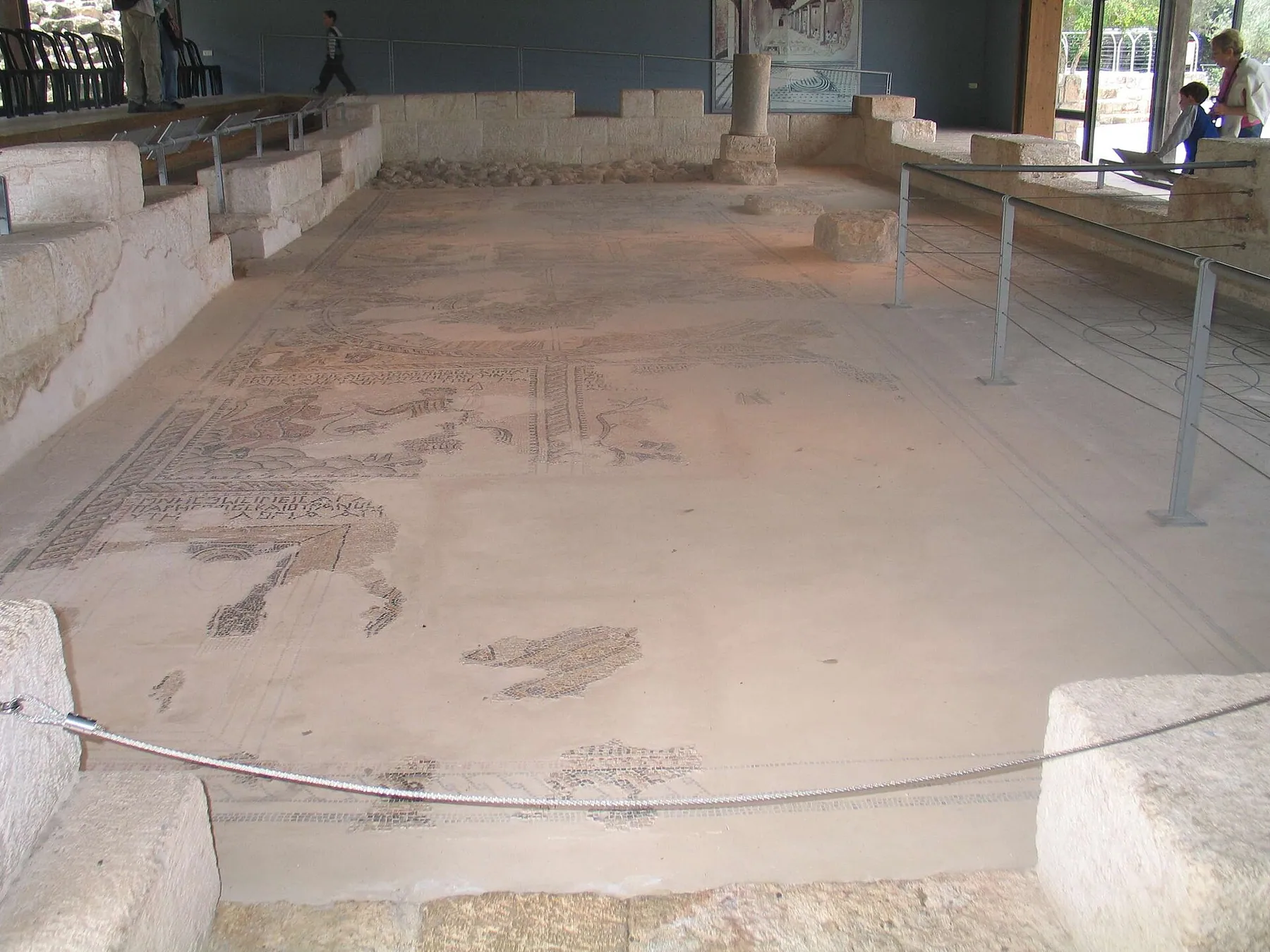
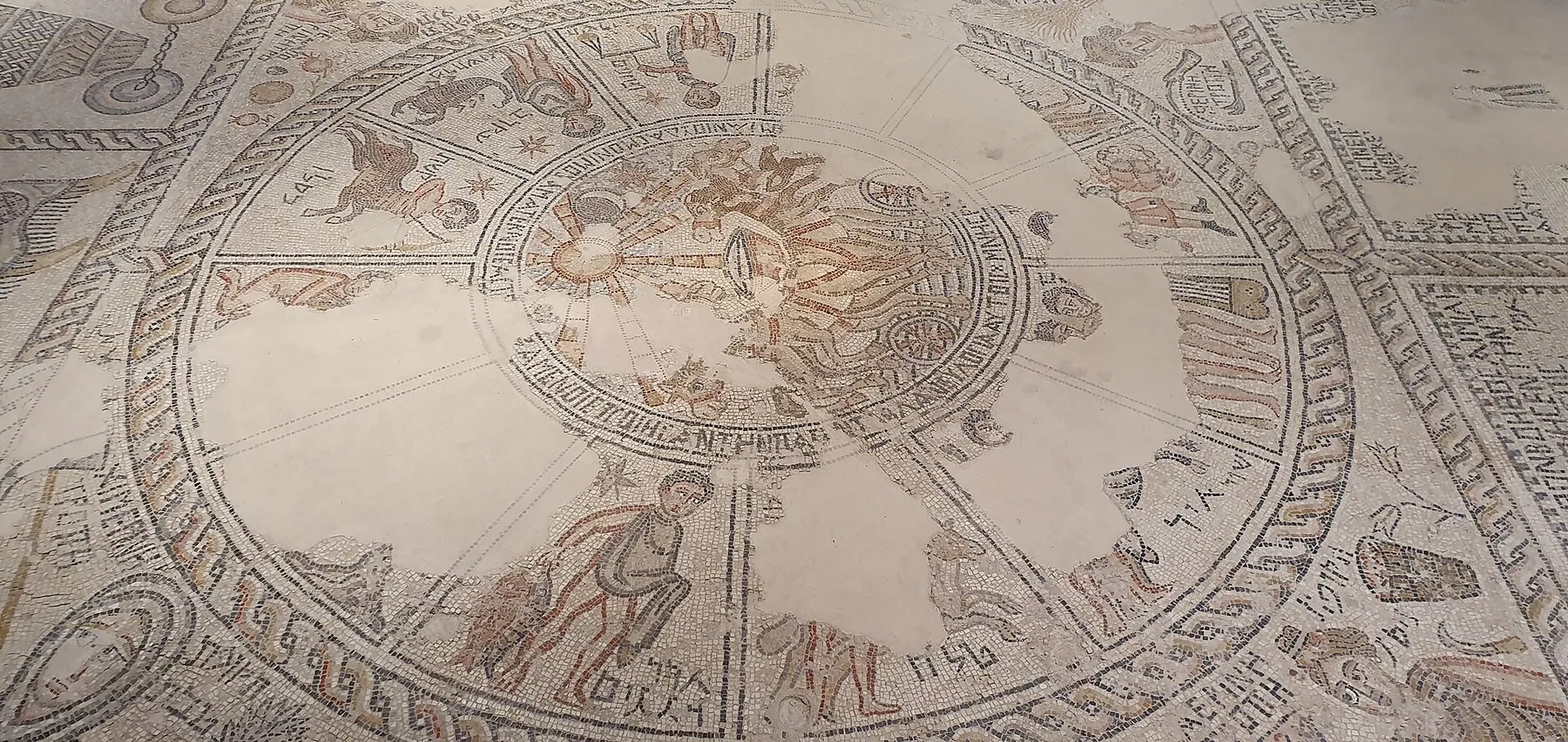
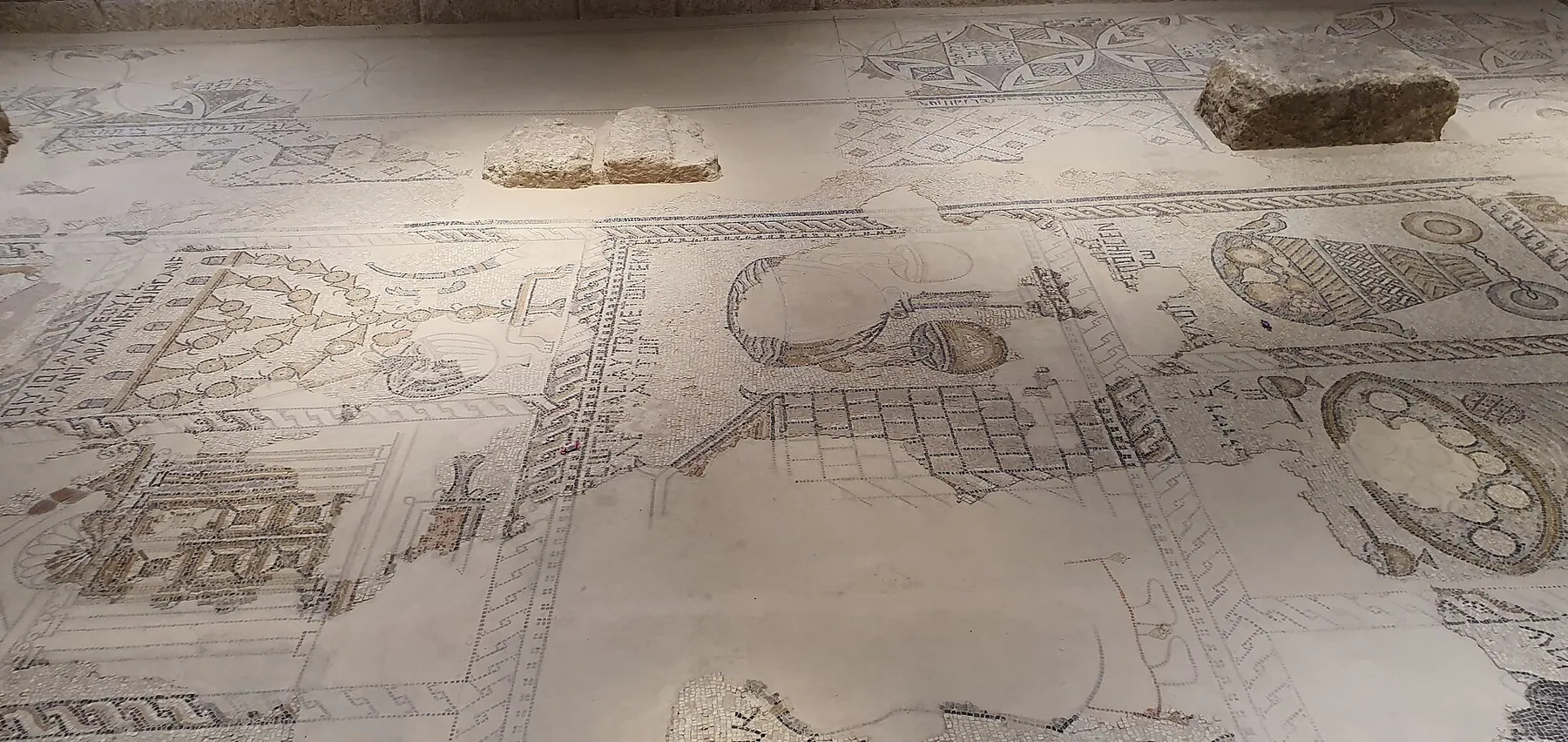
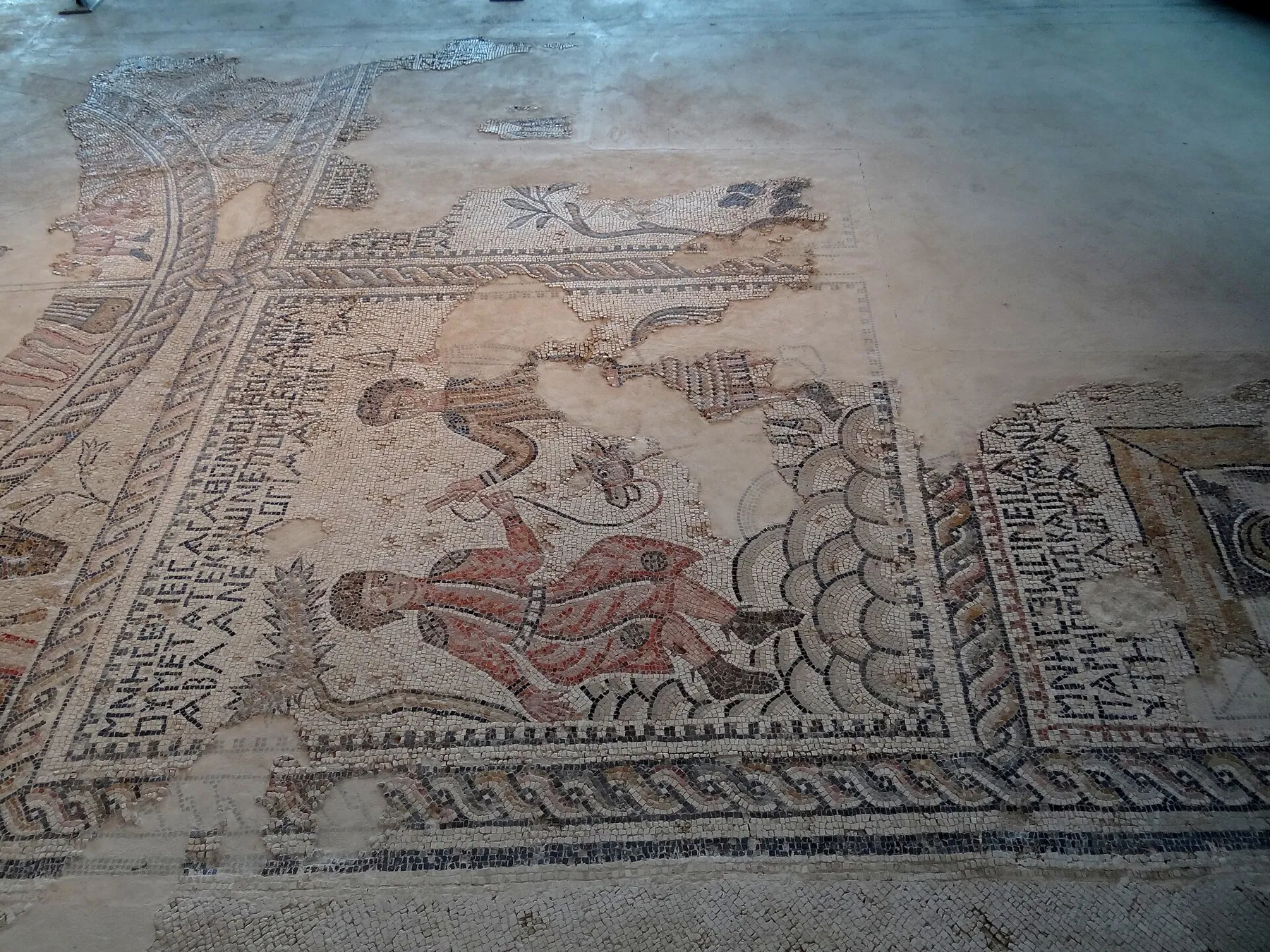
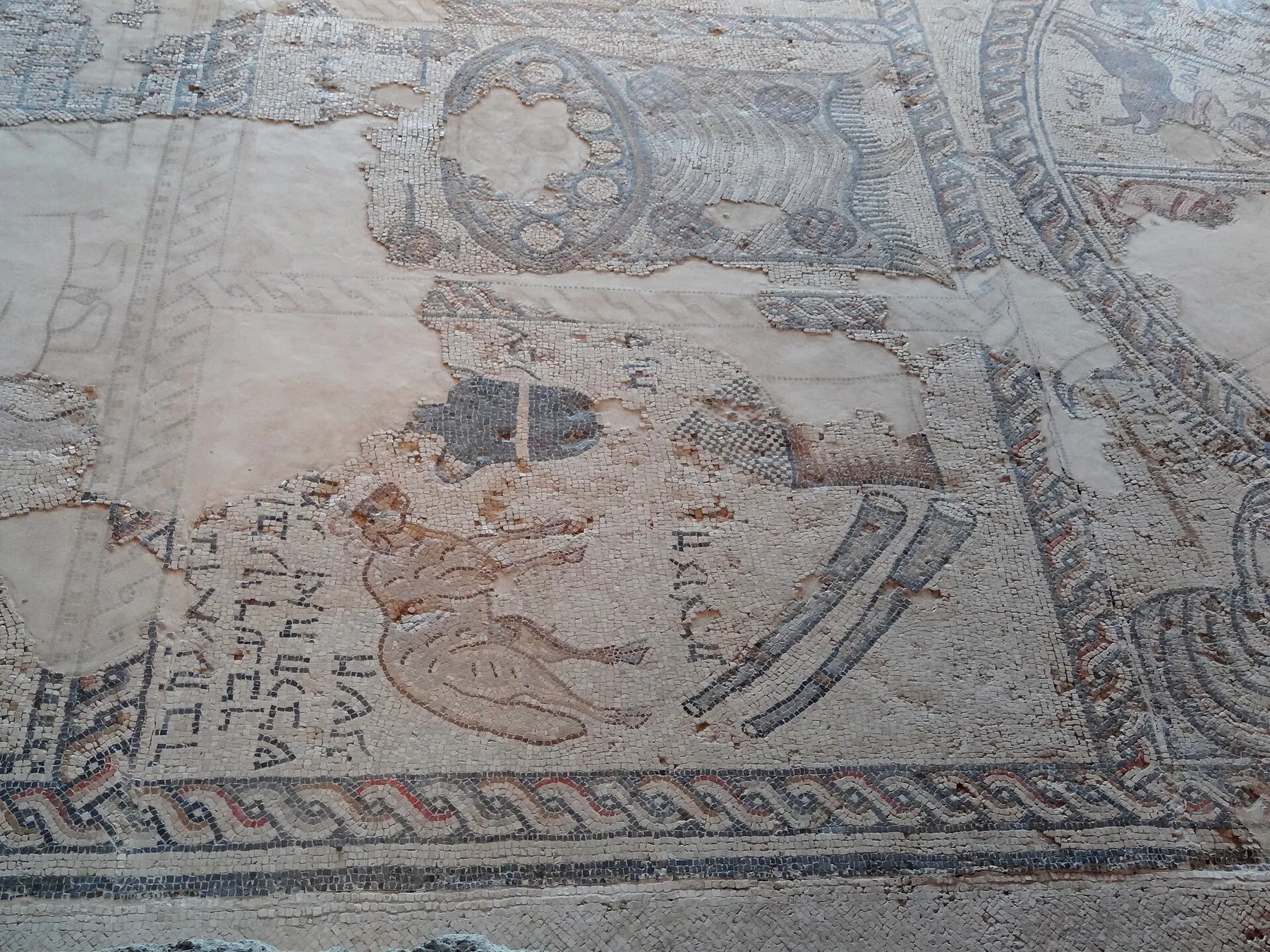
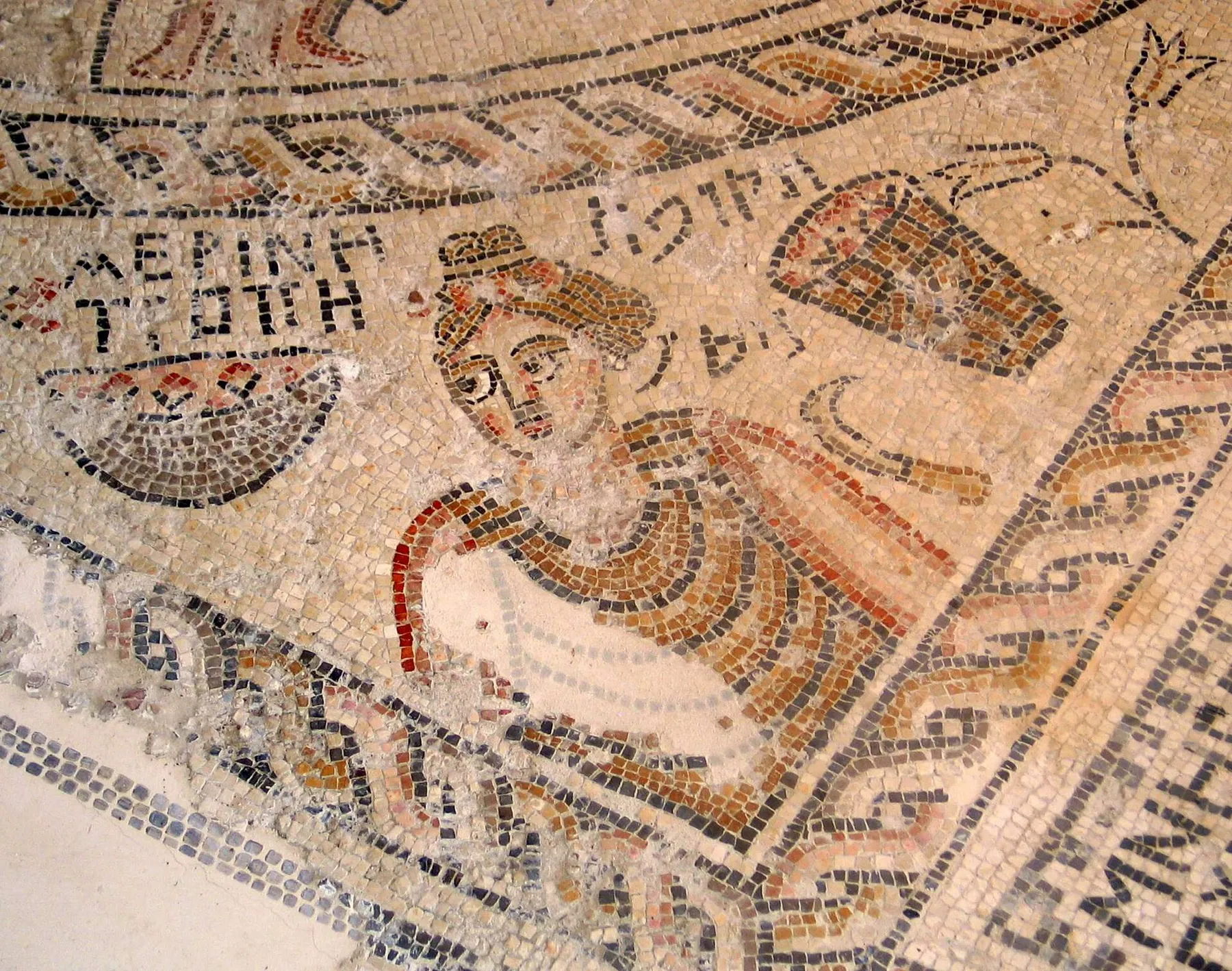
The building was an elongated rectangle of about 20.7 by 8 metres, with a narthex, a nave and a single aisle on the north. Weiss and Netzer dated its construction to the first half of the fifth century CE from coins found beneath the floor; Z. U. Maoz has since argued for the sixth century. The nave was paved with a figured mosaic of seven bands: lions flanking a wreath, an ark-like facade with two menorahs, Aaron at the altar, the daily offering, showbread table and first fruits, a zodiac around the chariot of the sun, the Binding of Isaac, and the visit of the angels to Abraham and Sarah. Dedications in Aramaic and Greek name the donors.
The excavators concluded that the synagogue was destroyed at the end of the Byzantine period. Its walls were later stripped; the floor remains in place.
Where it stood
Ancient Sepphoris (Diocaesarea), north-east of the acropolis; historic street name unknown. Today: Zippori National Park, near Moshav Tzippori, Lower Galilee, Israel. Pin from a published database of ancient synagogues (approximate).
Open larger map →The Jewish community
The Israel Nature and Parks Authority describes Sepphoris as a city often mentioned in the Talmud as Jewish, with study houses and eighteen synagogues; Rabbi Judah Ha-Nasi lived there for seventeen years and the Sanhedrin sat there. Weiss and Netzer write that the Jewish community kept its relative majority through the Byzantine period and built many synagogues, although only two of that period have been found, with some evidence of a third. At its height the Byzantine city covered more than 40 hectares and held perhaps 15,000 to 20,000 people. The Christian community was growing: two churches were built near the central crossroads in the late fifth or sixth century and the city had a bishop. This synagogue probably served the Jews of the surrounding residential area. Its inscriptions give the only names known for the congregation: families named in Aramaic, such as those of Yudan, Tanhum, Yose and Shimon, and others named in Greek, such as Boethos son of Aemilius and Paregorios. One donor is called a priest and another a Levite. No office-holder of the congregation is named in the sources read, and its size is unknown.
Architecture and design
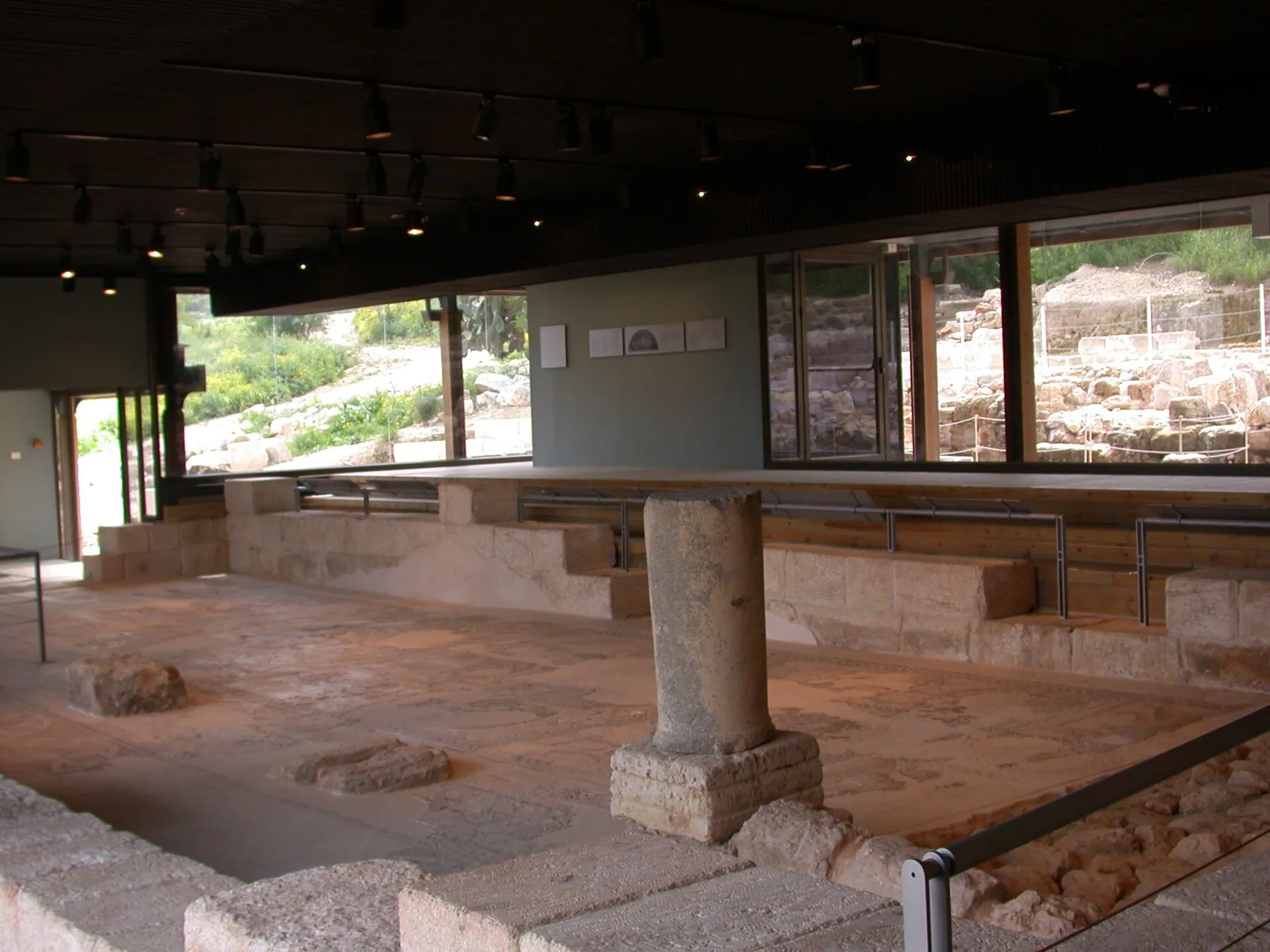
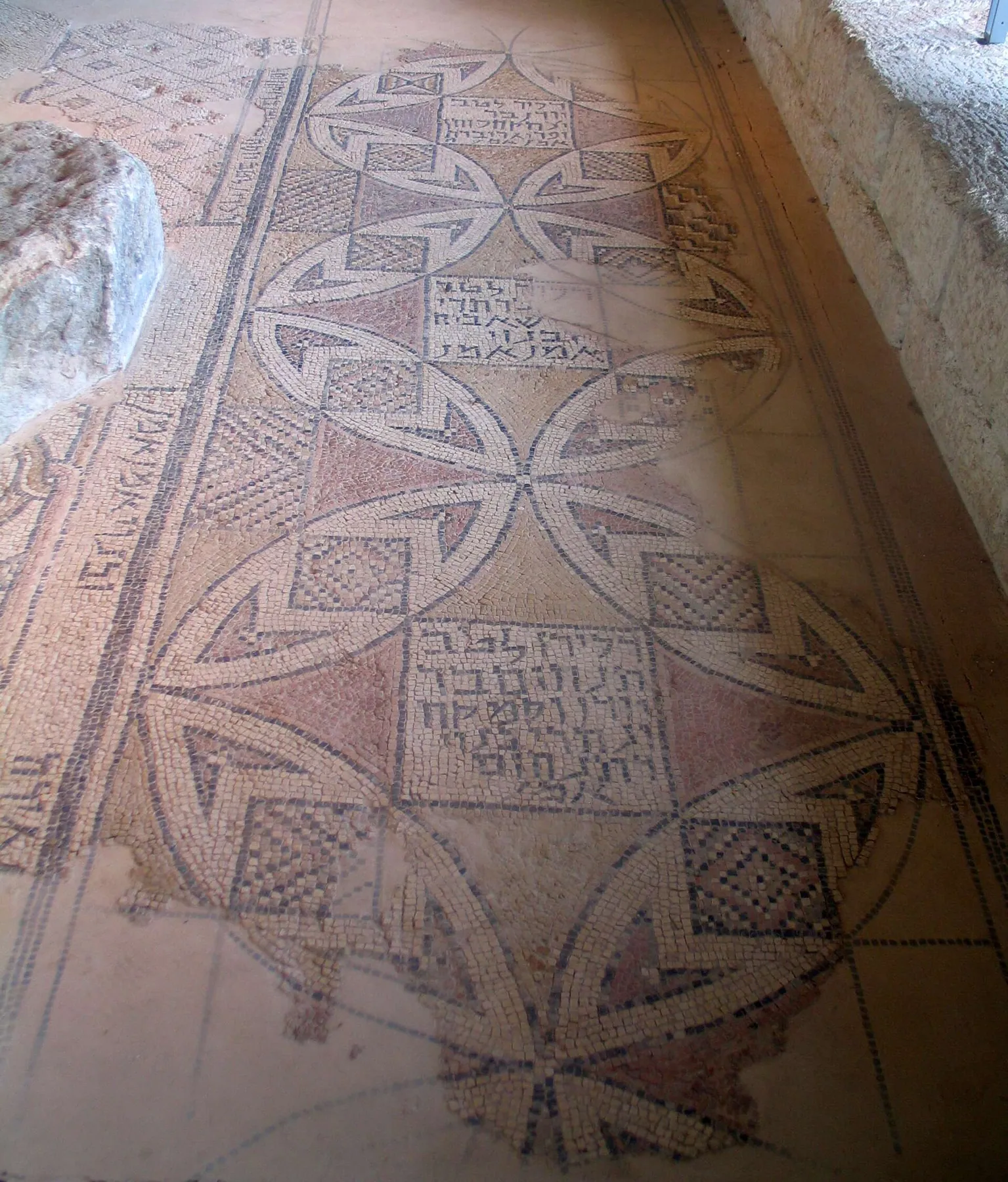
The building is the narrowest ancient synagogue so far uncovered in the country: about 20.7 metres long and 8 wide (the Epigraphy and Identity database gives 20.8 by 7.7). It was entered through a doorway in the south wall, not on the main axis; the long, narrow shape apparently results from fitting it into an existing urban setting. A narthex, with a water cistern beneath its floor, led into a main hall of 16.1 by 6.5 metres, divided lengthwise by a row of five supports into a nave and one aisle on the north side, where most ancient synagogues have two aisles. A raised bema of about 5 by 2.4 metres stood at the west end of the nave, so the hall faced away from Jerusalem. The nave mosaic measures about 13.5 by 4.5 metres and is divided into seven bands and fourteen panels framed by guilloche, all meant to be read facing the bema; the zodiac occupies a square of 3.3 metres. The aisle and the spaces between the columns had geometric carpets with Aramaic dedications. The height of the walls, the roof, the seating and the builder are unknown.
Life inside the synagogue
No account of the services held here survives; what is known comes from the floor. A worshipper entering crossed the scene of the three visitors to Abraham and Sarah and the Binding of Isaac, then the zodiac with the months and signs labelled in Hebrew and the seasons in Hebrew and Greek, then panels of Temple worship, and reached the bema past an ark-like facade flanked by menorahs. In this zodiac the chariot carries a rayed sun, not the figure of the sun god Helios. Weiss and Netzer read the whole programme as a message to the congregation that God, who promised Abraham descendants, would rebuild the Temple and redeem Israel, themes they also find in the prayers, sermons and liturgical poetry of the period. The donors paid for the floor panel by panel. Greek dedications in the nave record that Judah son of Monimos and Boethos son of Aemilius, each with his children, made a panel, in one case following a vow. Aramaic dedications in the aisle ask that families be remembered for good. The furnishings and the small finds were not described in the sources read.
Destruction
Weiss and Netzer, who dug the building, wrote in 1996 that the coin evidence shows it was built in the first half of the fifth century CE and was destroyed at the end of the Byzantine period, which here means the early seventh century. They do not name a cause for the synagogue itself. For the city as a whole they report that many Byzantine buildings show clear signs of destruction by fire, which could be linked to the Persian occupation, to the Arab conquest, or to an earthquake of unknown date. Sepphoris opened its gates to the Persians in 614 and was taken by force by a Muslim army, probably in 635; the volume's chapter on the Arab period says the cause and exact date of the fire cannot be established. No source read names anyone who destroyed the synagogue. The Epigraphy and Identity database of the University of Warsaw says only that the building fell out of use in the early Islamic period. Afterwards its stone was taken: the walls were destroyed, the side wall of the bema was looted, damaging the first mosaic band, and the narthex floor was lost.
The community’s fate
According to Weiss and Netzer the population of Sepphoris began to fall in the Early Arab period and the standard of living dropped; many buildings were abandoned or put to other uses. What became of this congregation is unknown. The 1996 exhibition volume gathers the few later traces of Jews in the town. Early Arabic polemic against the Umayyad family spoke of 'a Jew from the Jews of Sepphoris'. Documents from the Cairo Geniza, probably of the eleventh century, mention Yefet ben Amram of Sepphoris, author of a work on cemeteries and funerals, and a copyist, Shemaiah ben Abraham. Benjamin of Tudela, visiting about 1165, did not report a Jewish community. Petachya of Regensburg, in the late twelfth century, met a spice seller and physician named Nehoray who showed him a pedigree going back to Rabbi Judah Ha-Nasi; his account suggests this was the only Jewish family left. Some local families later held traditions that their ancestors had been Jews who converted to Islam or Christianity. There is no indication of Jews living there in the early Ottoman period. The Arab village of Saffuriyeh occupied the site until the 1948 war.
The site today
The remains lie in Zippori National Park, run by the Israel Nature and Parks Authority, on the northern part of the site, and are reached with the park entrance ticket. The mosaic floor is displayed where it was found, under a modern roofed and glazed shelter with a visitors' walkway around it. Photographs show low courses of stone wall around the floor and one column standing on a pedestal; how much of this masonry is original and how much is conservation work was not established in this research. Large parts of the nave mosaic are missing, the aisle carpet is badly damaged and the narthex mosaic is lost. The Byzantine-period building itself no longer stands.
Notable names
Yudan son of Isaac the Priest
5th century CE (date of the inscription)Donor named in an Aramaic mosaic inscription in the north aisleAn Aramaic dedication set in the geometric mosaic of the synagogue's north aisle reads: 'Remembered be for good Yudan son of Isaac the Priest and Parigri his daughter. Amen. Amen.' It records a gift towards the floor by a man of priestly descent and his daughter, the only woman named in the inscriptions read for this entry. Nothing else is known of them.
Biography or source →Judah son of Monimos
5th century CE (date of the inscription)Donor of the central panel of the zodiac mosaicA Greek dedication running in a band around the chariot of the sun at the centre of the zodiac asks that Judah son of Monimos be remembered for good and for benediction with his children, who 'made this whole panel following a vow'. He and his family therefore paid for the centrepiece of the synagogue's nave mosaic. Nothing else is known of him.
Biography or source →Boethos son of Aemilius
5th century CE (date of the inscription)Donor of a panel of the nave mosaicA Greek dedication in the nave mosaic, ending with the word Amen in Hebrew, reads: 'Be remembered for good Boethos son of Aemilius with his children. He made this panel. A blessing upon them. Amen.' The text is in Greek, like most of the dedications in the nave, while those in the aisle are in Aramaic. Nothing else is known of him.
Biography or source →Tanhum son of Yudan
5th century CE (date of the inscription)Donor named in an Aramaic mosaic inscription in the north aisleAn Aramaic dedication in the north aisle of the synagogue reads: 'Remembered be for good Tanhum son of Yudan and Samqah and Nehorai sons of Tanhum.' It commemorates a father and his two sons who gave towards the aisle mosaic. Whether his father Yudan is the Yudan son of Isaac the Priest named in a neighbouring inscription is not known.
Biography or source →Do you have something to contribute?
Photographs, documents, family stories or memories of this synagogue and its community help keep its history alive.
- Sepphoris in Galilee: Crosscurrents of Culture (exhibition volume, 1996): essays by Zeev Weiss and Ehud Netzer on Sepphoris in the Byzantine period and on 'The Synagogue Mosaic', and the chapter on Sepphoris in the Arab period
- Synagogue, Sepphoris (building 119)
- Sepphoris; Zippori; Saffuriye (site 88)
- The Sepphoris Synagogue: Deciphering an Ancient Message through Its Archaeological and Socio-Historical Contexts (publisher's page for the final report)
- Review of Z. Weiss, The Sepphoris Synagogue (2005)
- Inscriptions of Israel/Palestine, records SEPP0001 to SEPP0024 (Sepphoris synagogue; link opens record SEPP0003)
- Zippori National Park (visitor brochure, English)
- Zippori National Park
- Sepphoris (The Bornblum Eretz Israel Synagogues Website)
- Tzippori Synagogue
- Sepphoris Synagogue (photo set and description)
- The Sepphoris Synagogue Mosaic (Biblical Archaeology Review, September/October 2000; summary page only)
- The Sepphoris Mosaic
- File:Tsipori-2-273.jpg and other photographs of the ancient synagogue in Tsipori
Share a memory or thought
No comments yet. Be the first to add one.