
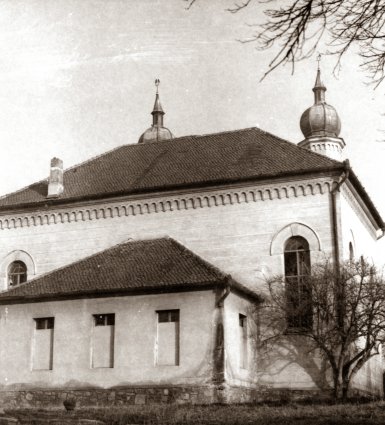
La storia di Sfântu Gheorghe Synagogue
Sfântu Gheorghe, called Sepsiszentgyörgy in Hungarian, is the seat of Covasna county in the Székely Land of eastern Transylvania; before 1920 and again from 1940 to 1944 it belonged to Hungary as the centre of Háromszék (Trei Scaune) county. Its Jewish community was small and, in the words of the Centropa witness Alice Kosa, 'the simplest one, a status quo community'. The Jewish cemetery south of the Protestant cemetery was used from the mid-nineteenth century, which gives a rough idea of when an organised community formed.
The synagogue stood in Csíki street, with the homes of the cantor and the shochet and a prayer house in the same compound, and a Jewish house of culture built on the square in front. Kosa, who grew up in the town, called it 'a beautiful synagogue'. A photograph she gave to Centropa shows the building in 1962, when she and her first husband, Francisc Pollak, were married there by Rabbi Deutsch of Brașov. A report by the Romanian national news agency Agerpres states that the synagogue was demolished at the beginning of the 1970s. When the synagogue was built, and by whom, has not been established.
Where it stood
Historic: Csíki utca, Sepsiszentgyörgy, Háromszék county; house number unknown. Today: Strada Ciucului, Sfântu Gheorghe, Covasna county, Romania; exact plot unknown (approximate).
Apri la mappa grande →La comunità ebraica
The Jewish community of Sepsiszentgyörgy was small. The JewishGen Cemetery Discovery Project records a Jewish cemetery south of the Protestant cemetery, used from the mid-1800s to the 1930s, with inscriptions in Hebrew, German and Hungarian, a mix that reflects the community's origins and its integration into Hungarian-speaking society. Alice Kosa, whose family lived in the town, described it as a Status Quo congregation, belonging neither to the Orthodox nor to the Neolog organisation, and said that the Jews of the town and county were not very religious: only her grandmother's generation still used the mikveh or took poultry to the shochet. The congregation nevertheless kept a rabbi, a cantor and a shochet. Kosa recalled the rabbi as young and modern and the cantor's two sons, aged twelve or thirteen, as fine singers. Their names are unknown. The Jews of the villages of Háromszék county looked to the town as their centre, and in 1944 they were concentrated there with the town's own Jews.
Architettura e design
The only known image is Alice Kosa's photograph of 1962, published by Centropa. It shows a free-standing rendered hall under a steep hipped roof of plain tiles. Below the eaves runs a decorative frieze of small arches, a corbel table, and the walls are pierced by tall round-headed windows set in shallow arched recesses. At least two corners of the roof carry small turrets with bulbous onion domes, each topped by a spike and a ball finial; the turret at the right stands on an octagonal drum with small openings. A low single-storey annex with its own hipped roof and rectangular windows is built against the long side of the hall, on a stone plinth; it may have been the women's section, a vestibule or a winter prayer room, but its use is unknown. A chimney rises from the main roof. Kosa remembered the cantor's and shochet's houses and a prayer house in the same area. The date of construction, the architect, the seating capacity and the arrangement of the interior are unknown, and no interior view has been found.
La vita nella sinagoga
Very little is recorded about worship in the building. Alice Kosa said she attended the synagogue only on the High Holy Days, and that the town's Jews were largely secular; the old customs, such as using the mikveh and having poultry slaughtered by the shochet, were kept mainly by the older generation in her childhood in the 1930s. The congregation followed the Status Quo rite. It employed a rabbi, a cantor, whose two young sons sang in the services, and a shochet, all of whom lived close to the synagogue in Csíki street, where there was also a separate prayer house. A Jewish house of culture stood on the square in front of the synagogue. After 1945 the few survivors who returned were placed under the supervision of the Jewish community of Nagyvárad (Oradea), according to Kosa, and the town no longer had a rabbi of its own. The synagogue was still used for ceremonies in 1962: that year Kosa and her first husband, Francisc Pollak, had their religious wedding there, conducted by Rabbi Deutsch, who came from Brașov.
Distruzione
No source found records damage to the synagogue during the Second World War, and Alice Kosa's photograph shows the building intact, with its roof, turrets and windows in place, in 1962. With the community reduced to a few families after the war and further emigration to Israel, the building lost its use. According to a 2025 report by the Romanian news agency Agerpres, the synagogue was demolished at the beginning of the 1970s, when Romania was under Communist rule. Kosa's own recollection is different: she said that it was demolished in the 1940s and that she thought the state had required its demolition. Her 1962 photograph rules out the earlier date, but her belief that the state demanded the demolition is the only statement about the actor; no document naming who ordered or carried out the work has been found, and it is not known whether the building was first sold. Kosa said that nothing was built on the plot afterwards.
Il destino della comunità
After Nazi Germany occupied Hungary on 19 March 1944, anti-Jewish laws were applied in Sepsiszentgyörgy, then part of Hungary, and Jews had to wear the yellow star from 5 April. On 2 May the police ordered them to report the next morning, and from 3 May the Jews of the town and of the former Háromszék county were held in an unfinished building without doors or windows on Strada Ciucului (Csíki street). The ghetto held about 850 people, including Jews from southern Csík county. Kosa's grandmother, then eighty-nine, was among them. After about a week the inmates were moved to the Reghin (Szászrégen) ghetto and from there deported to Auschwitz-Birkenau in early June 1944. Of the 756 Jews of Háromszék deported or sent to forced labour, only 148 survived, and 52 children under thirteen were murdered at Auschwitz. Kosa recalled that the town's young rabbi died in a concentration camp. Most survivors left for Israel, and only a few Jews remained in the town.
Il luogo oggi
Alice Kosa said that nothing was built on the synagogue's plot after the demolition and that the lot still existed when she gave her interview. The Jewish house of culture that stood in front of the synagogue survived; she said it was used by the state, for some years housed the town's public library and was later given to the Jehovah's Witnesses. In 2022 the town hall placed a small copper plaque marking the site of the former synagogue. The exact address has not been established in the sources consulted, so the map pin marks Strada Ciucului near the town centre and is approximate.
Hai qualcosa da condividere?
Fotografie, documenti, storie di famiglia o ricordi di questa sinagoga e della sua comunità aiutano a mantenerne viva la storia.
- Primăria Sfântu Gheorghe a montat în oraș pietre de poticnire în memoria evreilor deportați
- Reportaj: Victimele Holocaustului din fostul județ Trei Scaune, comemorate la Sfântu Gheorghe
- Alice Kosa (Centropa interview, tagged text on the synagogue)
- Alice Kosa (Centropa interview, full biography)
- The synagogue in Sfantu Gheorghe (photo, 1962)
- Sfântu Gheorghe ghetto
- List of synagogues in Romania
- Sepsiszentgyörgy (Sf. Gheorghe) Jewish cemetery
- Strada Ciucului, Sfântu Gheorghe (OpenStreetMap way 27533837)
Share a memory or thought
No comments yet. Be the first to add one.