
La storia di Sokolov Synagogue
Falkenau an der Eger, renamed Falknov nad Ohří and in 1948 Sokolov, is a town on the Ohře river in the Karlovy Vary region of western Bohemia. Jews are mentioned there as early as the fifteenth century, but a lasting community grew only after the restrictions on Jewish settlement were lifted in the mid-nineteenth century. A religious society was formed in 1864 and an independent congregation in 1873, and for its first decades the community prayed in a rented room. Earlier plans to build a synagogue were dropped, but in 1896-97 the congregation put up its own building on a plot it had bought by the Mauerteich pond on Schillerstraße. It was consecrated in August 1897, with the rabbi of Eger (Cheb) leading the ceremony.
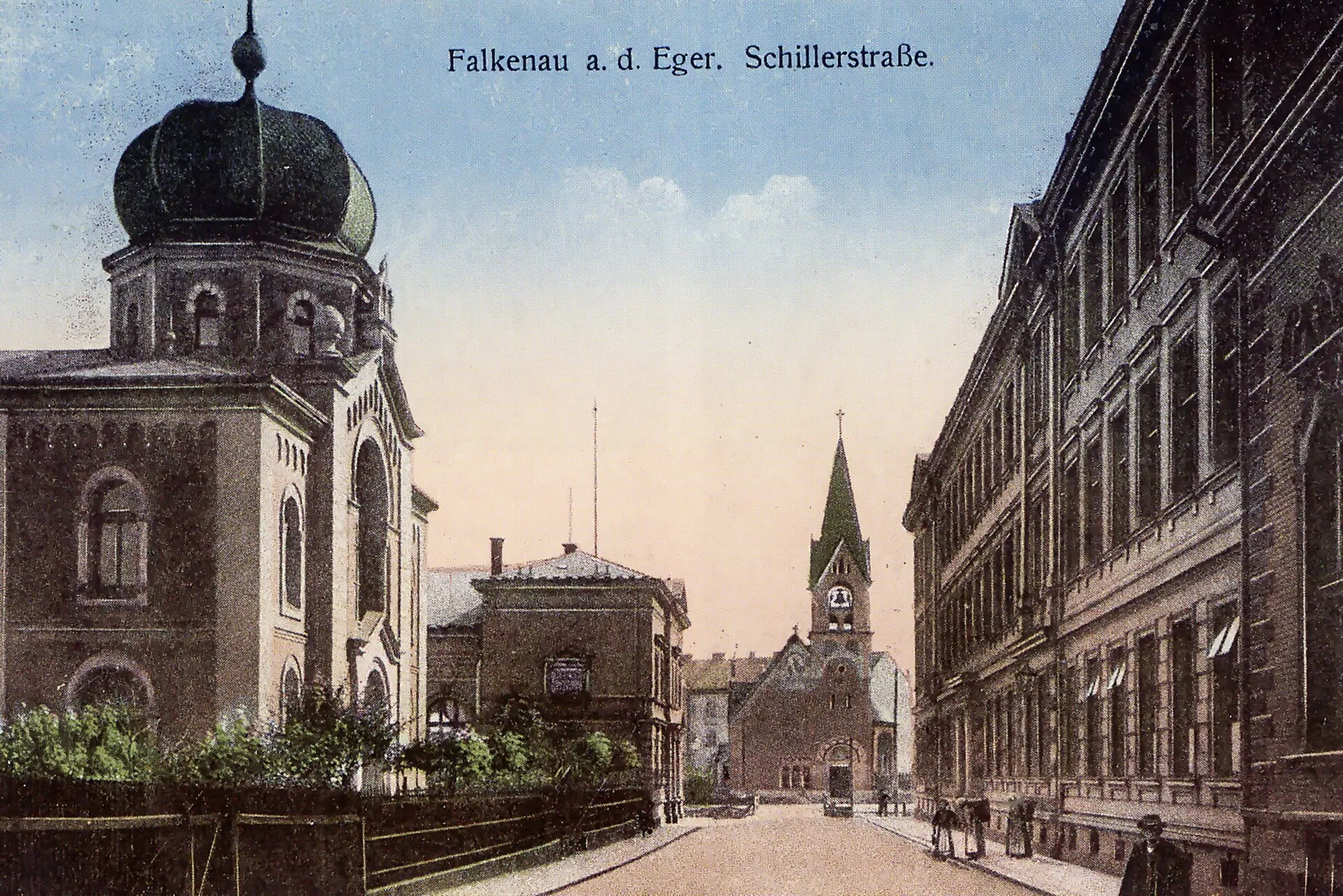
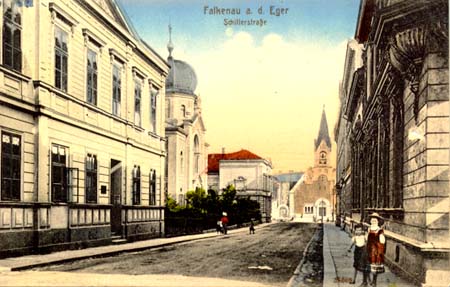
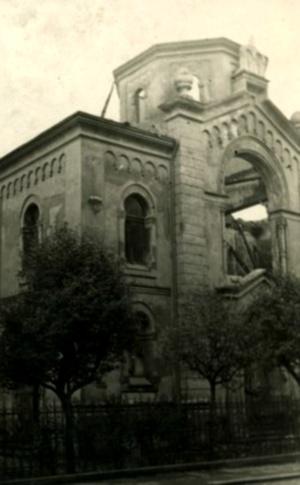
The synagogue was a domed historicist building, shown on several postcards of Schillerstraße. It served the town and the surrounding villages for just over forty years. After the Munich Agreement of September 1938 Falkenau was annexed to Nazi Germany, and on 10 November 1938 local members of the Sudeten German Party wrecked the synagogue and set it on fire. A photograph of 1939 shows the burnt-out shell, which was pulled down soon afterwards.
Where it stood for nearly 45 years
Historic: Schillerstraße, by the Mauerteich, Falkenau an der Eger. Today: approximately Maxima Gorkého Street, at the Ohře medical house (No. 1568), Sokolov, where a memorial plaque recalls the synagogue (approximate).
Apri la mappa grande →La comunità ebraica
A Jewish presence in Falkenau is documented from the fifteenth century, and figures collected by Treixler and Wlaschek and quoted by the Jüdische Gemeinden site record three Jewish families around 1550 and about twenty persons around 1650. The modern community was small at first: two families lived in the town in 1849 but about 24 families around 1865, after the end of the residence restrictions of 1848. A religious society was established in 1864 and became an independent congregation (Kultusgemeinde) in 1873; it acquired its own burial ground at the end of the 1870s. The Jewish population of the town rose from about 160 in 1875 and 136 in 1890 to 223 in 1900 and 248 in 1910. In 1921 the town had 208 Jews, while the congregation as a whole, including members in surrounding villages, counted 484; its peak is given as up to 500 members. The town's Jewish population then fell to 170 in 1930. The memorial documentation of the Czech Academy of Sciences places the community's greatest economic and demographic growth in the second half of the nineteenth century, the period in which the synagogue was built and the congregation reached its largest size.
Architettura e design
The architect is unknown. The building stood on a plot by the Mauerteich on Schillerstraße and was built in 1896-97; the memorial documentation of the Czech Academy of Sciences calls it a representative building in the Neo-Romanesque style, while the German Wikipedia article, following Alicke, calls it historicist. Two coloured postcards of Schillerstraße show it set back behind a garden and a low fence at the side of the street, with the spire of a church closing the view beyond. The main block rose to a tall square tower crowned by a large onion-shaped dome with a slender finial, its drum pierced by round-headed windows. Lower corner pavilions with round-arched windows flanked the entrance front, and the walls were articulated with pilaster strips and arched corbel friezes. A photograph of 1939 shows the same building from close by after the fire: the dome is gone, but the stepped gable with finials, a large arched opening in the main front and the corner pavilions with their arched windows still stand. Capacity and the interior arrangement are unknown.
La vita nella sinagoga
Before the synagogue was built the congregation held its services in a rented prayer room, and earlier plans for a synagogue were abandoned before the Schillerstraße site was bought. The new building was consecrated in August 1897 in ceremonies led by the rabbi of Eger, the nearest large community, which suggests that Falkenau did not then have a rabbi of its own; the name of that rabbi was not found. For about forty years the synagogue was the religious centre of a congregation of some two hundred Jews in the town and several hundred more in the surrounding villages that belonged to the Falkenau Kultusgemeinde. The community also maintained its walled cemetery, in use from the end of the 1870s. No source read in this run names a rabbi, cantor or president of the congregation, records its religious orientation, or describes the services, festivals and associations that met in the building, so daily life inside the synagogue remains largely undocumented.
Distruzione
After the Munich Agreement of September 1938 Falkenau was occupied by Nazi Germany and became part of the Reichsgau Sudetenland. During the Kristallnacht pogrom on 10 November 1938 the synagogue was attacked. The memorial documentation of the Czech Academy of Sciences states that it was destroyed by local members of the Sudeten German Party, the Nazi party of the Sudeten Germans; the German Wikipedia article, based on Alicke's lexicon, says it was set on fire. A photograph dated 1939 shows the building as a burnt-out shell: the dome and roof are gone, the windows are empty and a great arched opening gapes in the front, although the outer walls still stand behind the fence and trees. The Jüdische Gemeinden site says only that the forty-year-old building was destroyed. The description of a postcard on Wikimedia Commons states that the synagogue was burned and demolished by the Nazis in 1939; no other source read gives the date of demolition or names who carried it out, and no document of the demolition was found.
Il destino della comunità
Immediately after the Munich Agreement of September 1938 most of the Jews of Falkenau left the town , and their later fate is not traced in the sources read. Only 55 Jews were counted in Falkenau in 1938. Those who stayed in the town were deported in 1942, according to the Jüdische Gemeinden site and JewishGen's cemetery register; the destinations and the number who were murdered are not given in the sources read. Four Stolpersteine for members of the Kronberger family, Walter, Eduard, Ida and Oscar, recall individual victims of the community. After the Second World War JewishGen records only a very small congregation, named Sokolov but with its seat in Kraslice. The fate of the community's last officials is unknown.
Il luogo oggi
Nothing of the synagogue survives. The street once called Schillerstraße ran through what is now central Sokolov; the pin marks is the side wing of the former Hotel Ohře, now the Ohře medical house, number 1568 in Maxima Gorkého Street, whose facade carries a granite memorial plaque to the destroyed synagogue and the victims of the Holocaust, unveiled in 2002. Whether the plaque stands exactly on the former plot or merely nearby is not stated in the sources read. The walled Jewish cemetery of Sokolov still exists but looks neglected.
Hai qualcosa da condividere?
Fotografie, documenti, storie di famiglia o ricordi di questa sinagoga e della sua comunità aiutano a mantenerne viva la storia.
Share a memory or thought
No comments yet. Be the first to add one.