
История Synagogue of Sopot (Zoppot)
The first Jewish residents of Zoppot, a fishing village that became a fashionable Baltic resort near Danzig, are recorded around 1860. For decades the families belonged to the community of Neustadt (Wejherowo), and services were held in private guesthouses, often led by a travelling preacher. In 1912 an independent congregation was founded, and a donation from the Danzig merchant Caspar Silberstein made a synagogue possible. It was built in 1913–1914 on Roonstrasse to designs by the Sopot architect Adolf Bielefeldt, and was consecrated on 26 May 1914 by the Danzig rabbi Robert Kaelter in the presence of the town's leading citizens. In 1920 Zoppot became part of the Free City of Danzig, and in the 1920s thousands of Jewish emigrants from Poland and Russia passed through on their way to the Americas. The NSDAP won an absolute majority in the Free City. In the November pogrom of 1938, on the night of 12–13 November, SA men looted the synagogue and set it on fire; the second attempt burned it to its foundations.
Where it stood for 24 years
Historic: Roonstrasse, Zoppot. Present day: ul. Jarosława Dąbrowskiego 1, Sopot, Poland.
Открыть большую карту →Еврейская община
Jewish residents are first documented in Zoppot around 1860: there were five Jewish families in 1869, 38 Jews in 1895, 99 in 1902 and 86 in 1910, about 0.7 per cent of the population. Until 1912 they belonged to the community of Neustadt (Wejherowo), when an independent congregation was founded. At about the same time as the synagogue it laid out a cemetery on Grosse Katzerstrasse. After 1920, when Zoppot joined the Free City of Danzig, hundreds of Jewish families from Poland and Russia came to the town as a stopover on their way to North or South America; in the 1920s their number reached several thousand at a time. About 400 who stayed formed a separate community with their own institutions and cemetery. After 1933 the Zionist movement gained growing influence.
Архитектура и дизайн
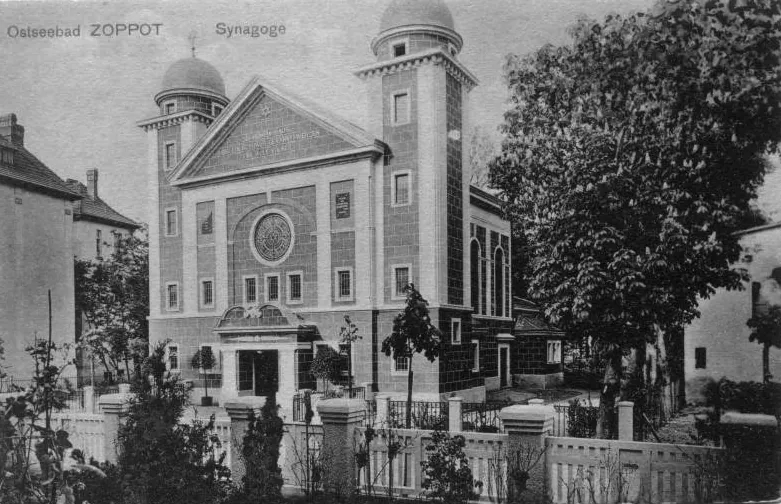
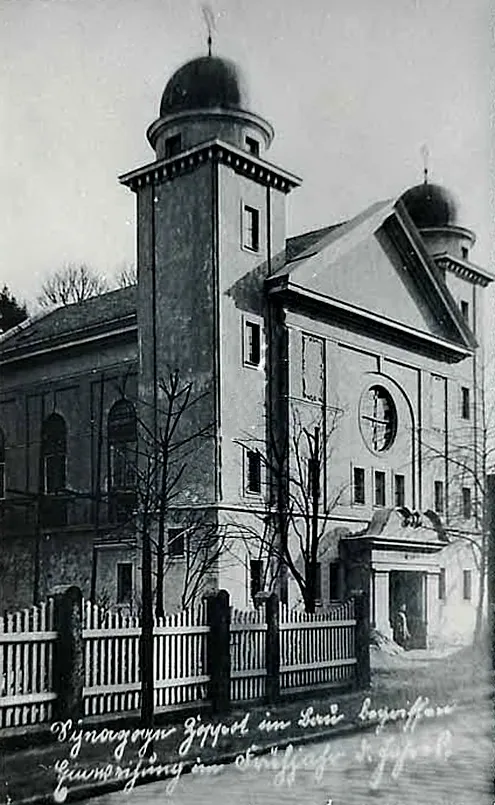
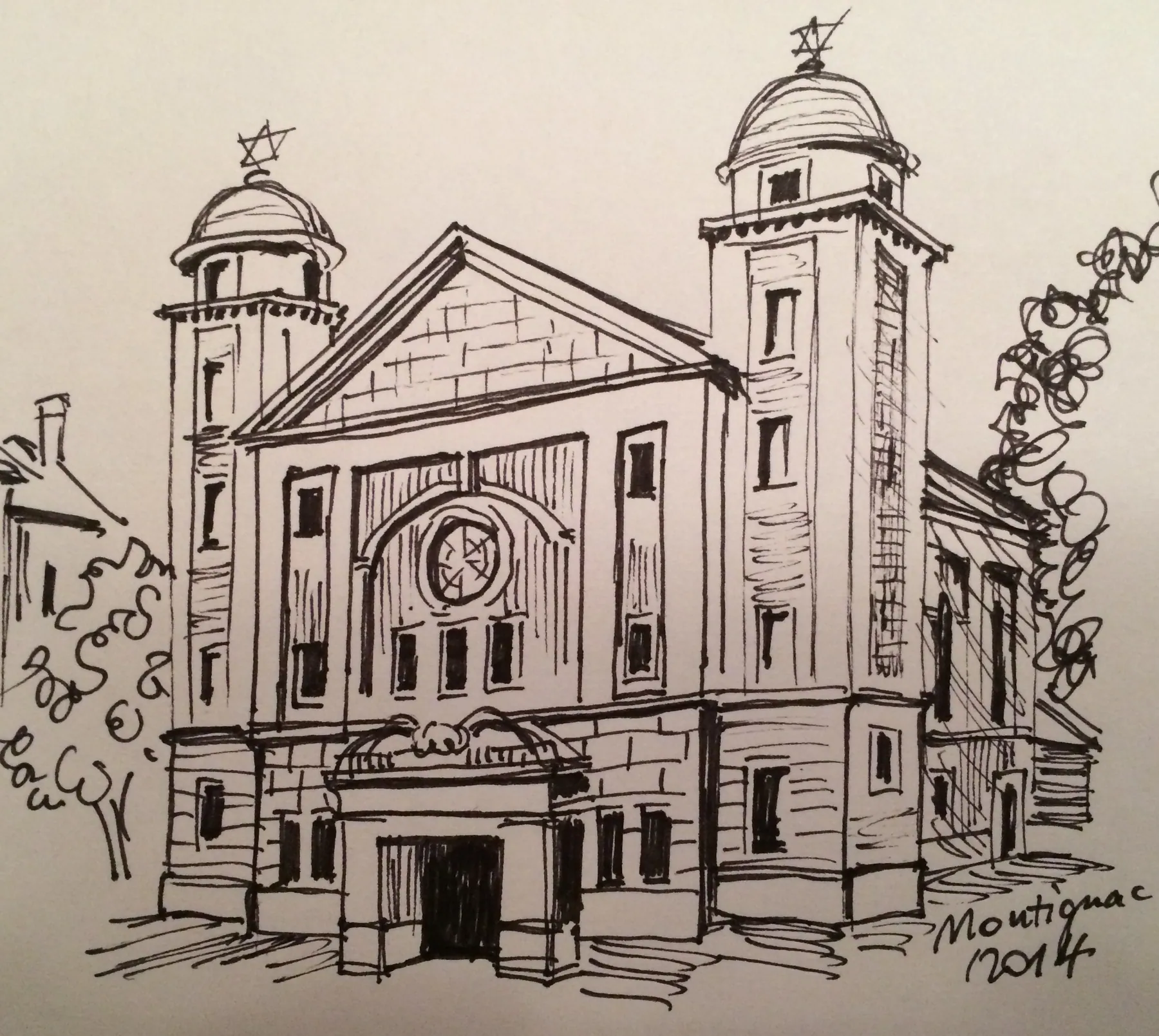
The synagogue was designed by Adolf Bielefeldt, an architect based in Sopot, and built in 1913–1914 on Roonstrasse, today 1 Dąbrowskiego Street. The masonry building stood on a rectangular plan measuring 21.12 by 15.66 metres. Polish Wikipedia describes its style as modernist. Its entrance front was flanked by two square towers crowned with small domes, and the portal was decorated with a rose window. At the west end a spacious vestibule led into the main prayer hall, which was surrounded on three sides by galleries for women. The building stood in a garden, where the community celebrated the festival of Sukkot in the autumn. Postcards and photographs from about 1920 show the twin-towered front behind a low fence among villas.
Жизнь в синагоге
Before the synagogue was built, Zoppot's few Jewish families held services in private guesthouses, usually led by an itinerant preacher, or travelled to the synagogue in Wejherowo. The new building gave the young congregation, founded in 1912, a home of its own. Its consecration on 26 May 1914 by Rabbi Robert Kaelter of Danzig was a civic event attended by the whole town leadership. Each autumn the community celebrated Sukkot in the garden around the synagogue. In the 1920s the town's Jewish population swelled with emigrants from Poland and Russia waiting to travel on to the Americas, and those who settled for good formed a separate Eastern European community with its own prayer rooms.
Разрушение
The Free City of Danzig was governed by the Nazi party with an absolute majority, and in autumn 1937 there were already pogrom-like attacks on Jewish traders. During the November pogrom of 1938, which reached the Free City a few days after Germany, the Zoppot synagogue was attacked on the night of 12–13 November. SA men broke into Jewish homes, smashed furniture, stole jewellery and valuables and beat the occupants. They looted the synagogue and then set it on fire; the first attempt failed, but the second burned the building to its foundations. The Polish Church Building Society bought the ruins and plot later that year to build a Catholic church, but the Nazi mayor, Eryk Temp, blocked the sale and had the town council seize the property.
Судьба общины
The pogrom of November 1938 drove most Jews out of Zoppot and the Free City. When the Second World War began in September 1939, only about 140 Jews remained in the town. After Danzig was annexed to Germany they were soon deported to the General Government in occupied Poland; their individual fates are not recorded in the sources consulted. By 1945 only about 50 Jews were living in the town. After the war a new Jewish community formed in Sopot, numbering 545 people in 1947, but most of its members emigrated in the following years. The Jewish cemetery was officially closed at the end of the 1940s and partly restored from the 1980s.
Место сегодня
Nothing of the synagogue survives. In the 1960s a block of flats for a teachers' housing cooperative was built on the plot at 1 Dąbrowskiego Street. In 1990 the Nissenbaum Family Foundation placed a plaque on the building's wall; it was stolen in 1993, and in 1999 a new plaque in Polish and English was put up, funded by Mira Ryczke-Kimmelmann, a former Jewish resident of Sopot. The Jewish cemetery in Upper Sopot survives in part.
Значимые имена
Adolf Bielefeldt
early 20th centuryArchitectAdolf Bielefeldt was an architect based in Zoppot who designed the town's synagogue, built in 1913–1914 on Roonstrasse. His design had a twin-towered entrance front with small domes and a rose window over the portal, with women's galleries on three sides inside. The building was burned to its foundations in November 1938.
Биография или источник →Robert Kaelter
early 20th centuryRabbiRobert Kaelter, rabbi of Danzig, consecrated the new Zoppot synagogue on 26 May 1914 in the presence of the whole town leadership. The small resort community had until then held services in private guesthouses or travelled to Wejherowo, and the new building gave it a permanent place of worship.
Биография или источник →Вам есть чем поделиться?
Фотографии, документы, семейные истории и воспоминания об этой синагоге и её общине помогают сохранить её историю.
Share a memory or thought
No comments yet. Be the first to add one.