
La historia de Adass Jisroel Synagogue, St. Gallen
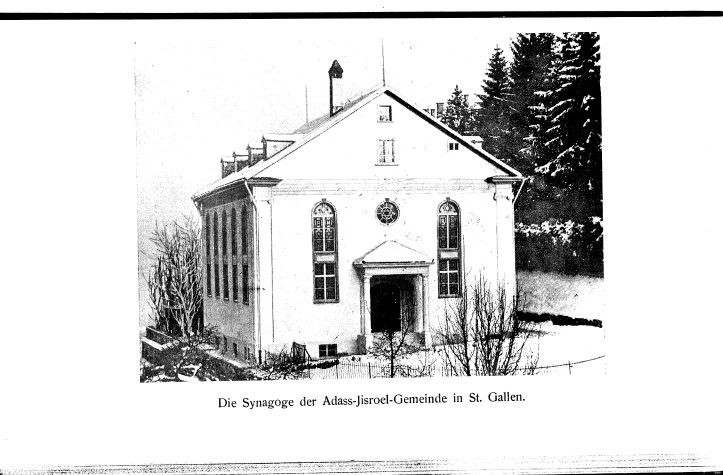
St. Gallen had two Jewish congregations for most of the first half of the twentieth century. The older Israelitische Kultusgemeinde, founded in 1863, worshipped in the Moorish-style synagogue of 1881 on the Frongartenstrasse, which still stands. Jews from Poland, Russia, Lithuania, Galicia and Romania, who had come to the city since the late nineteenth century, prayed in their own small minyanim, and in 1917 three of their associations united as the Jüdische Gemeinde Adass Jisroel. In 1918 the new congregation bought an older factory building of the firm Einstein & Cie. on the Kapellenstrasse and, with a collection and a loan, had it rebuilt as a synagogue by the St. Gallen architect Anton Aberle. The Jüdisches Jahrbuch für die Schweiz called it the first synagogue built by East European Jews in Switzerland. It was consecrated on 11 Adar 5679, 11 February 1919. The building stood opposite the Methodist chapel that gave the street its name, in the Haldenquartier; neighbours called it the 'Judechele'. Services were held there until 1952, when most of its members had emigrated and the two communities merged. The building was then pulled down and the plot rebuilt with a block of flats.
Where it stood for nearly 35 years
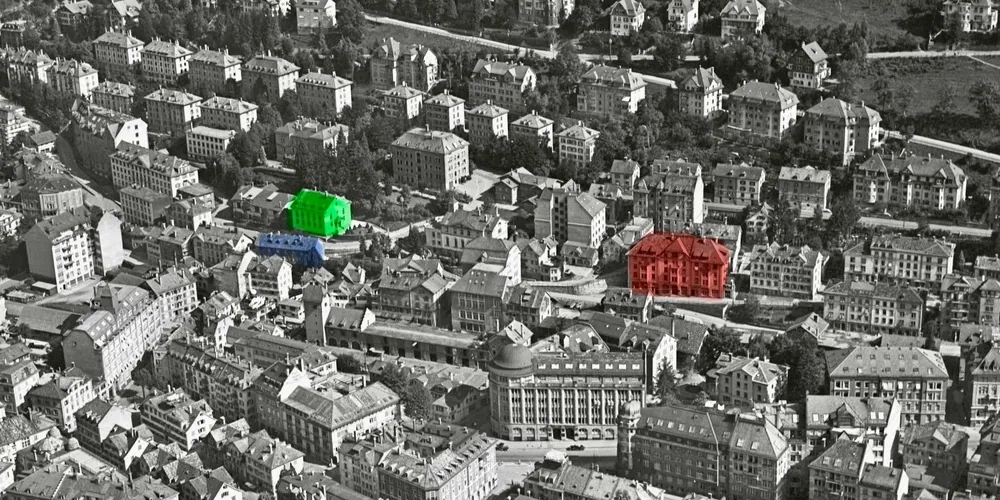
Historic: Kapellenstrasse 3, St. Gallen (opposite the Methodist chapel). Today: apartment building at Kapellenstrasse 3, 9000 St. Gallen (approximate: present address, assumed unchanged).
Abrir mapa ampliado →La comunidad judía
East European Jews began to settle in St. Gallen in the late nineteenth century, many fleeing pogroms, and their numbers grew after 1905 and again after the collapse of the Austro-Hungarian monarchy. In 1916 the Jüdisches Jahrbuch für die Schweiz counted 600 to 700 'Ostjuden' in the city who formed their own congregations and associations apart from the established community. The yearbook of 1918/19 credits Chief Rabbi A. J. Kuk, who spent the second year of the First World War in St. Gallen, with persuading the groups Talmud Thora, Minjon-Verein and Agudas Achim to unite; Adass Jisroel was founded from them in 1917 (the yearbook of 1921 and the ETH archive give 25 January, the 1918/19 yearbook 25 February). In 1921 it had 105 members and about 500 souls, against about 300 in the older community. Its board was headed by M. Mirelmann, with A. Hauser, H. Kuschernsohn, A. Kutner, L. Fichmann and B. M. Flaks. It ran a Jewish school of about 100 children, a burial society founded in 1904, a women's association, a Zionist group, the hiking club Blau-Weiss and the sports club Makkabi.
Arquitectura y diseño
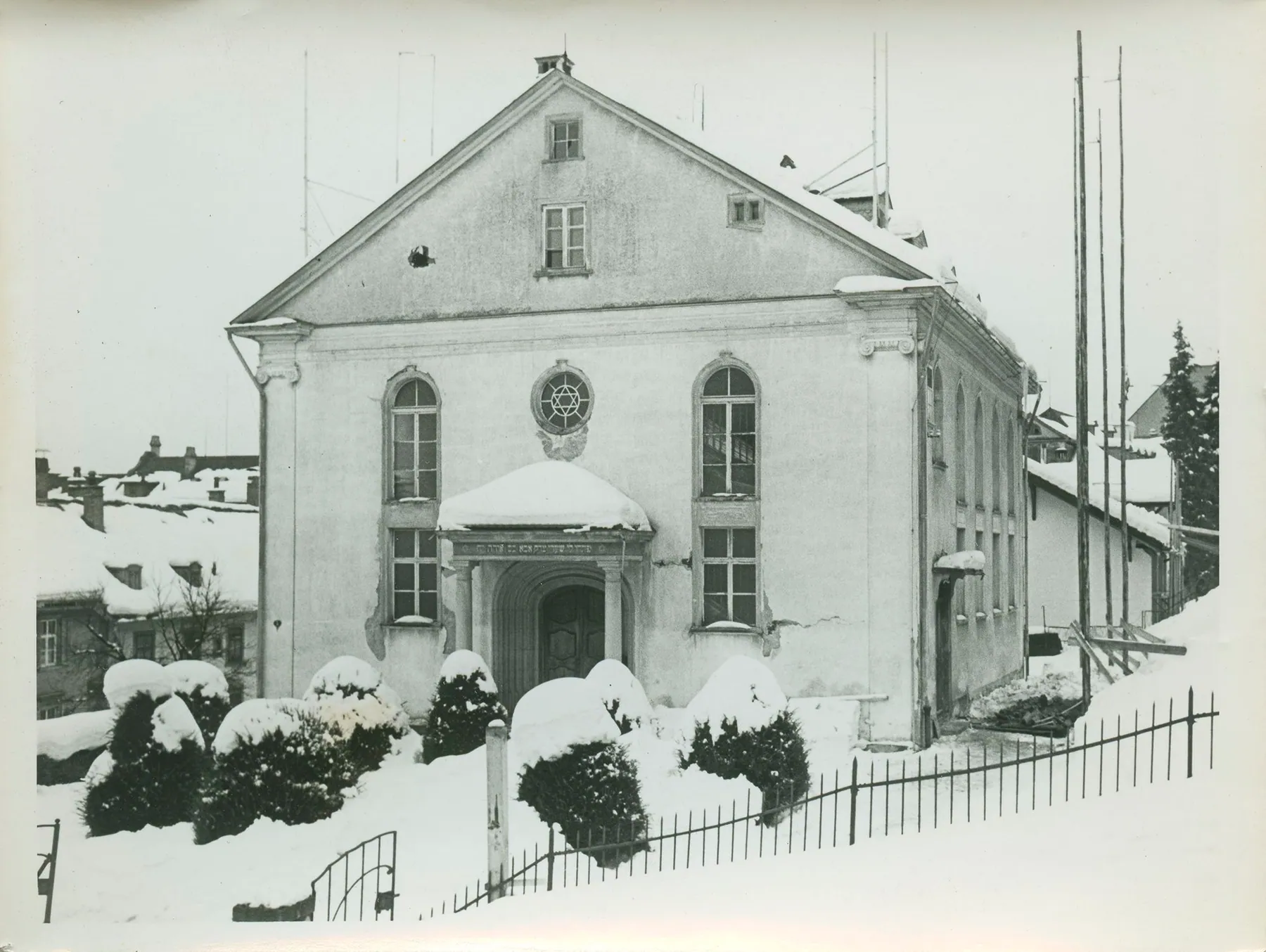
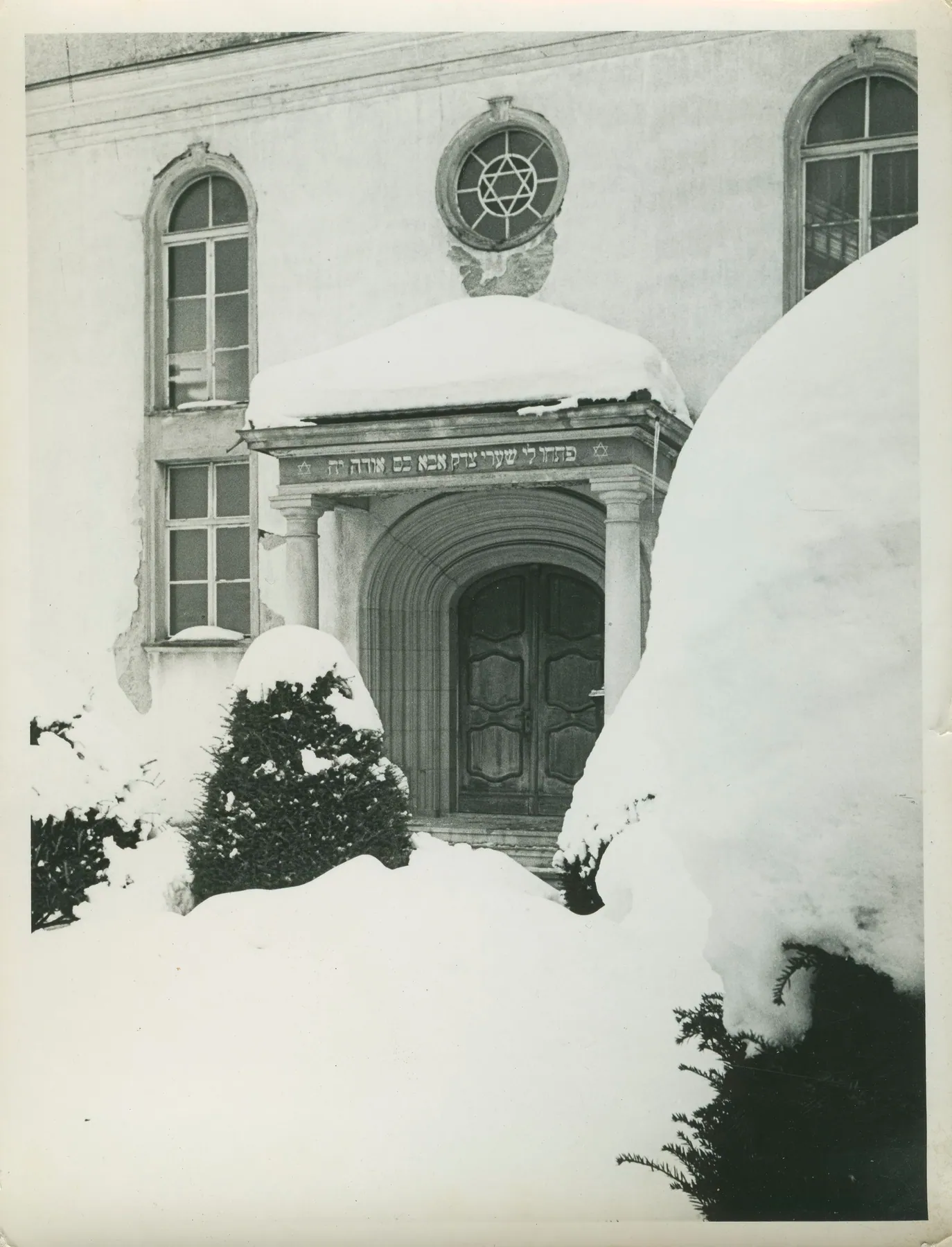
Aberle did not build anew: he converted an existing factory building of Einstein & Cie. The 1918/19 yearbook says the congregation wanted 'not a showy building but a modest house of God that makes its effect by its very simplicity'. Inside, the former factory became a prayer hall two storeys high with a women's gallery running round three sides; a schoolroom was fitted into each upper floor and a mikveh into the basement. Photographs of 1918 and about 1952 show a free-standing, rendered building with a steep pedimented gable on the entrance front, framed by corner pilasters and crowned with a small chimney or finial. Two tall round-headed windows flank a round window filled with a Star of David, with smaller windows above in the gable. The entrance has a small portico on two columns with a Hebrew inscription on the lintel, set before an arched door. The long side has a row of tall windows. The capacity is unknown.
La vida dentro de la sinagoga
The congregation was East European Orthodox; the yearbook explains that its members had been welcome in the existing Swiss synagogues but never felt fully at home there because of differences of minhag, the customs of prayer. Besides daily and Sabbath services the building housed the community's school: the 1921 yearbook places the Jewish school, with about 100 children, in the synagogue itself, and an ETH archive photograph of 1921 shows a class of the religious school 'Schare Torah' with its owner and head, Rabbi M. Heiselbek. Around 1920 the congregation employed M. Arkin as cantor and teacher, though the post was vacant in 1921. Hans Tobler, who grew up opposite, recalled hearing the rabbi chant on the Sabbath and knowing the Jewish New Year and Sukkot from the building. In March 1936 he found swastikas daubed on the two columns of the entrance portico and the words 'Jude verrecke' written on the landing, at a time when the Nazi 'Deutsches Heim' stood a few hundred steps away.
Destrucción
The synagogue was not damaged by war: Switzerland was neutral and the congregation used the building until 1952. By then most of its members had emigrated to Israel and America, and in 1952 Adass Jisroel merged with the Israelitische Kultusgemeinde. The ETH archive's note on its photographs says that with the merger the synagogue on the Kapellenstrasse was given up, and the remaining East European minyan moved to the community house on the Frongartenstrasse. Two photographs by the St. Gallen photographer Lautenschlager, dated about 1952, record the building in snow 'shortly before the demolition'. Alemannia Judaica's address list gives the demolition as 1952, while the former city archivist Ernst Ziegler writes that services ended in 1952 and the building was demolished in 1953. No source read names who sold the building, who bought it or who carried out the demolition; Alemannia Judaica says only that the plot was rebuilt with a block of flats.
El destino de la comunidad
Adass Jisroel was not destroyed by persecution; it dissolved through emigration and merger. Its members had come as refugees from the Russian Empire and Eastern Europe, and many left St. Gallen in the years after the Second World War for the new State of Israel and for America. Swiss neutrality spared the city's Jews from deportation, but relatives of local families were murdered in the Holocaust, and Alemannia Judaica lists ten people born in or long resident in St. Gallen who perished under the Nazis, among them Berthold Knoller, who died in St. Gallen on 27 June 1945 after liberation from Bergen-Belsen. The city also received Jewish refugees: from 1939 to 1944 it was a centre for preparing refugee children for emigration to Palestine, in 1944 1,386 Hungarian Jews arrived from Bergen-Belsen, and in 1945 1,200 survivors from Theresienstadt. In 1952 the two congregations united as one Jewish community, which had about 100 members in 1969 and about 130 in 2014.
El lugar hoy
The synagogue stood at Kapellenstrasse 3 in the Haldenquartier of St. Gallen, opposite the former Methodist chapel and nearly opposite the house 'Grundstein' at Wassergasse 13. According to Alemannia Judaica the plot was rebuilt with a block of flats after the demolition, and OpenStreetMap today shows an apartment building at Kapellenstrasse 3. Nothing of the synagogue is known to survive on the site, and no marker for it is recorded in the sources read. The older synagogue of 1881 on the Frongartenstrasse, where the merged community still worships, was restored and rededicated in 2004.
Nombres destacados
Anton Aberle
1876-1953Architect of the conversion, 1918-19Aberle was a St. Gallen architect who, according to Alemannia Judaica, had already built several commercial and residential buildings in the city. Ernst Ziegler calls him a well-known architect of the time. For Adass Jisroel he converted the former factory building of Einstein & Cie. on the Kapellenstrasse into a synagogue with a two-storey prayer hall, a women's gallery on three sides, schoolrooms on the upper floors and a mikveh in the basement, consecrated in February 1919. He died in 1953, the year Ziegler gives for the demolition.
Biografía o fuente →A. J. Kuk (probably Abraham Isaac Kook)
1865-1935Chief rabbi whose mediation united the East European groups, c. 1915-16The Jüdisches Jahrbuch für die Schweiz 1918/19 writes that the founding of Adass Jisroel was made possible by the persistent efforts of 'Oberrabbiner A. J. Kuk', who was staying in St. Gallen in the second year of the war, and who brought the rival associations Talmud Thora, Minjon-Verein and Agudas Achim to unite. The name and date fit Abraham Isaac Kook, chief rabbi of Jaffa, who was caught in Europe by the war and reached London via Switzerland in January 1916.
Biografía o fuente →M. Mirelmann
UnknownPresident of Adass Jisroel, c. 1920-1925Mirelmann is named as president of the Jüdische Gemeinde Adass Jisroel in the Jüdisches Jahrbuch für die Schweiz of 1921, with A. Hauser as vice-president and H. Kuschernsohn as treasurer, and Alemannia Judaica gives him (spelled Mirlemann) as president around 1925. He thus led the congregation in the first years after the synagogue opened. The 1918/19 yearbook praises the congregation's energetic president for acquiring the building, probably Mirelmann, though it does not name him. Nothing more about his life was found.
Biografía o fuente →M. Arkin
UnknownCantor and religious teacher, c. 1920Alemannia Judaica states that Adass Jisroel employed its own cantor and religious teacher, M. Arkin, around 1920, in the years just after the synagogue on the Kapellenstrasse was consecrated. By the time of the 1921 yearbook the post of cantor and teacher was listed as vacant. No further details of his life, origin or later career were found in the sources read.
Biografía o fuente →M. Heiselbek
UnknownRabbi; owner and head of the religious school 'Schare Torah', 1921An ETH Archiv für Zeitgeschichte photograph of 1921 shows a class of the institute 'Schare Torah', described as the religious school of Adass Jisroel, with its owner and head Rabbi M. Heiselbek seated at the right of the front row. The 1921 yearbook places the congregation's Jewish school, of about 100 children, in the synagogue building. Nothing more about Heiselbek was found.
Biografía o fuente →¿Tiene algo que aportar?
Fotografías, documentos, historias familiares o recuerdos de esta sinagoga y su comunidad ayudan a mantener viva su historia.
- St. Gallen (Kanton St. Gallen, Schweiz): Jüdische Geschichte / Synagoge
- BA BASJ-Archiv / 309: Jüdische Gemeinde St. Gallen (10 photographs, 1918-1969)
- «Judechele» und «Deutsches Heim» – zwei ungleiche Nachbarn
- Abraham Isaac Kook
- Kapellenstrasse 3, St. Gallen (OpenStreetMap way 145470775)
- Wassergasse 13, St. Gallen (OpenStreetMap way 145470786)
Share a memory or thought
No comments yet. Be the first to add one.