
Historia Steenwijk Synagogue
Steenwijk, in the north-west of Overijssel, had Jewish residents from before 1700 and a congregation that grew to 284 people in and around the town by 1840. Services were first held in a private house; in 1813 the community bought a room on the Gasthuisstraat and in 1819 turned it into a synagogue. In the 1850s a dispute over religious reforms split the congregation. Its reconciliation in 1869 was marked by a new synagogue on the same street, at the corner of the Kornputsingel, in the old Gasthuispoort area; a municipal research report gives its address as Gasthuisstraat 56. A Jewish school stood beside it from 1917.
The synagogue was still in use in 1940. During the occupation the NSB (Dutch Nazi) mayor used it as a store for furniture cleared from Jewish homes, but the building and its fittings came through the war intact. Services resumed briefly, and the last wedding was held there in 1947. The sources disagree on what followed: the Jewish Cultural Quarter says it was sold in 1948 and stood until 1952, while the 2022 report says the community sold it in 1951 to buyers who turned it into a garage, and that it was demolished in 1984.
Where it stood for nearly 85 years
Historic: Gasthuisstraat 56 (Gasthuispoort), corner of the Kornputsingel, Steenwijk. Today: corner of Gasthuisstraat and Kornputsingel, 8331 Steenwijk, site of a bank building (approximate).
Otwórz większą mapę →Społeczność żydowska
The first Jewish family settled in Steenwijk before 1700. Around 1720 the town council tried to attract Jewish merchants to stimulate trade, with little effect at first, but several families came during the eighteenth century. The community buried its dead from about 1775 at the Schapendrift south of Noordwolde and from about 1795 in its own cemetery on the Eesveenseweg, enlarged in 1807, 1860 and 1911. Civil equality came in 1796. The Jewish population of Steenwijk and its surroundings rose from 32 in 1795 and 78 in 1809 to 284 in 1840, then fell to 199 in 1869, recovered to 224 in 1899 and stood at 123 in 1930. Most Jews worked in the textile trade or as butchers; a large spice business was Jewish-owned, and some Jews sat on the town and provincial councils. Children were first taught in a room of the municipal school, then in a Jewish school of 1849, and from 1917 in a new school next to the synagogue. A separate small Jewish quarter, the Jodenpol, existed in the nearby colony of Willemsoord from 1830 to 1890.
Architektura i projekt
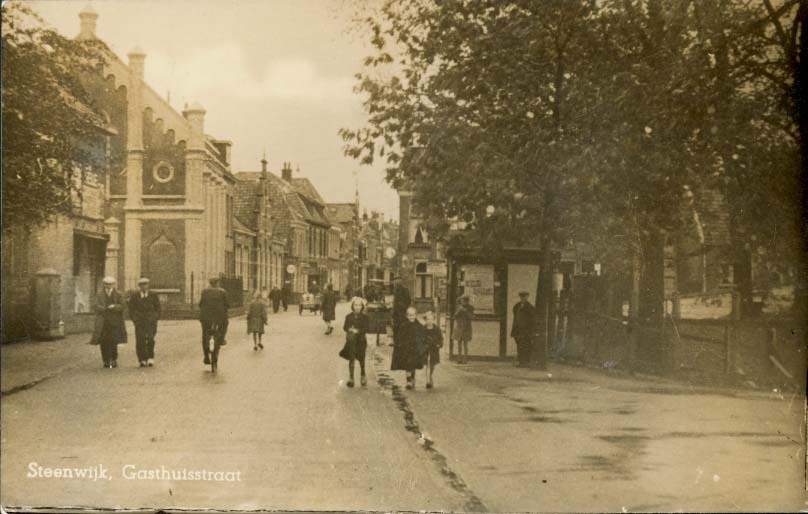
The only image found is a postcard captioned 'Steenwijk, Gasthuisstraat', dated about 1943 by the NIOD. It shows the synagogue on the left side of the street as a tall, rendered or brick gabled front set slightly back behind a low railing. The facade is framed by slender corner pilasters or buttresses ending in small capped turrets, and further pilasters divide it vertically. In the upper part is a round window, and the top of the gable is finished with a stepped or corbelled band. Below, a large round-arched recess frames the entrance area. The design reads as a modest version of the eclectic, Moorish-tinged synagogue fronts built in Dutch provincial towns in the later nineteenth century, but no written description was found. The architect, the builder, the seating capacity and the interior arrangement are unknown. The Jewish school of 1917 stood next door, at Gasthuisstraat 46 according to the municipal research report.
Życie w synagodze
The congregation was run by a board (kerkbestuur) and a council, with a treasurer who collected funds for the poor of the Holy Land. Several societies were attached to it: a burial society, a society that cared for the synagogue's furnishings, and a society for the study of Torah. The school beside the synagogue gave the children their religious education from 1917. No rabbi, cantor or teacher is named in the sources read, and it is not known whether Steenwijk had its own religious teacher in the twentieth century or shared one with neighbouring communities. The synagogue's Torah scrolls and ceremonial objects survived the occupation untouched. After liberation the community met again on 20 May 1945 under the chairmanship of Mozes van Zuiden, and services were held for a short time, but the building was no longer used regularly. The last wedding blessing in the synagogue took place in 1947. Some of the ritual objects were later given to the Jewish Historical Museum in Amsterdam.
Zniszczenie
The synagogue was not damaged in the war. During the occupation the NSB mayor of Steenwijk, De Lang, a Dutch Nazi installed under the Nazi occupiers, ordered the homes of deported and hidden Jews to be cleared and their furniture stored at several places in the town, among them the synagogue at Gasthuisstraat 56 and the Jewish school next door. Much of this property was taken by NSB members and evacuees and never returned. The building itself and its interior survived. After the war the small surviving congregation could not keep it in use. According to the Jewish Cultural Quarter it was sold in 1948 and eventually demolished, and the copper plaque on the site says it stood there until 1952. The municipal research report of 2022, by contrast, states that the community sold it in 1951 to Hendrik and Moos de Vroome, who converted it into a garage, and that the building was finally demolished in 1984. Neither source says who carried out the demolition.
Los społeczności
Steenwijk's Jews were subjected to the same anti-Jewish measures as elsewhere in the Netherlands. The registration of January 1941 counted 109 people of full or partial Jewish descent in the town, and about 120 lived there at some point during the war. In March 1942, 27 men were summoned to the labour camp Conrad near Rouveen; ten went into hiding and seventeen went to the camp, of whom seven later escaped. In early October 1942 most Jews of the Kop van Overijssel who had not gone into hiding were taken to Westerbork, ten men from Steenwijk among them. In early April 1943 another thirteen Jewish Steenwijkers were taken from their homes after the order to report to Vught, and on 10 April 1943 the region was declared 'Judenfrei', apart from four Jews in mixed marriages. Those deported were murdered in the camps in the East. About half of Steenwijk's Jews survived, most in hiding. In 1951 the community numbered 23; it was dissolved in 1964 and joined to that of Zwolle.
Miejsce dzisiaj
The synagogue stood at the corner of the Gasthuisstraat and the Van den Kornputsingel, on the western edge of Steenwijk's old town, where the street meets the ring road along the former town moat. Nothing of the building survives. A bank building now occupies the corner, and a copper plaque marking the site of the synagogue was placed on it in October 2007. The exact plot boundaries have not been checked against a cadastral map. The Jewish cemetery on the Eesveenseweg survives and is maintained by the municipality; its 180 gravestones were restored by 2001 and its cleansing house was rebuilt in 1985.
Ważne postacie
Mozes van Zuiden
UnknownChairman of the first postwar meeting of the Steenwijk congregation, May 1945Van Zuiden chaired the meeting of the Jewish community of Steenwijk held on 20 May 1945, the first after liberation, and sat with Jacob Adler, Meijer Kan, Siegfried de Leeuw and Marcus Gokkes on the local Committee for Jewish Interests. He thus led the survivors during the short period when services resumed in the synagogue, before its last wedding in 1947 and its sale. Nothing more about his life was found in the sources read.
Biografia lub źródło →Czy masz coś do przekazania?
Zdjęcia, dokumenty, historie rodzinne lub wspomnienia o tej synagodze i jej społeczności pomagają zachować jej historię.
- Steenwijk (Joodse gemeenten)
- Steenwijk (Jewish communities)
- 'Wij zitten hier met een moeilijk geval': Roof en rechtsherstel van Joods (on)roerend goed in de gemeente Steenwijkerland tijdens en na de Tweede Wereldoorlog
- Prentbriefkaart van de Gasthuisstraat in Steenwijk met synagoge, circa 1943 (record 161546)
- Gasthuisstraat and Kornputsingel, Steenwijk (OpenStreetMap ways 1365998705 and 6513824)
Share a memory or thought
No comments yet. Be the first to add one.