
The story of Stobi Synagogue
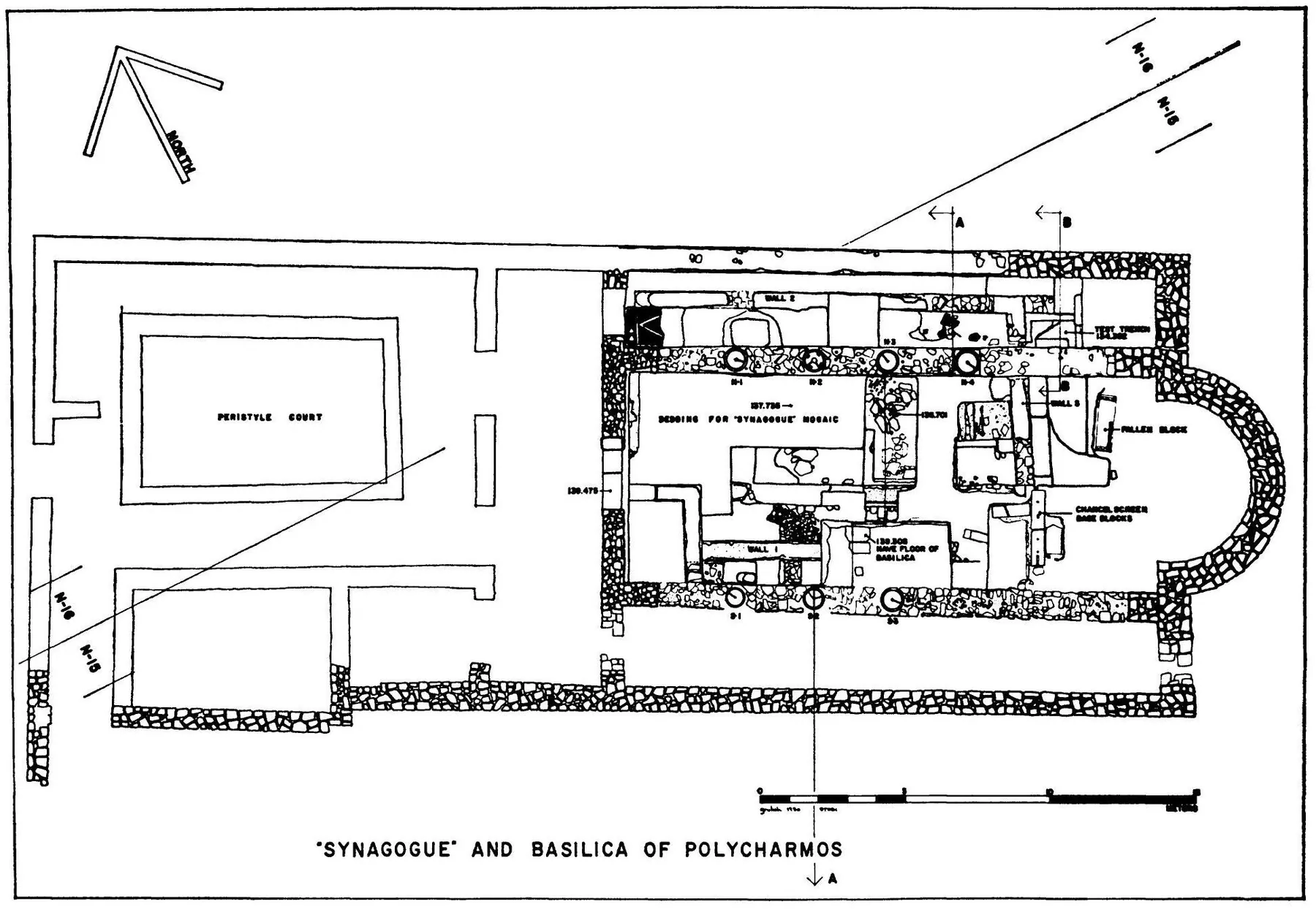
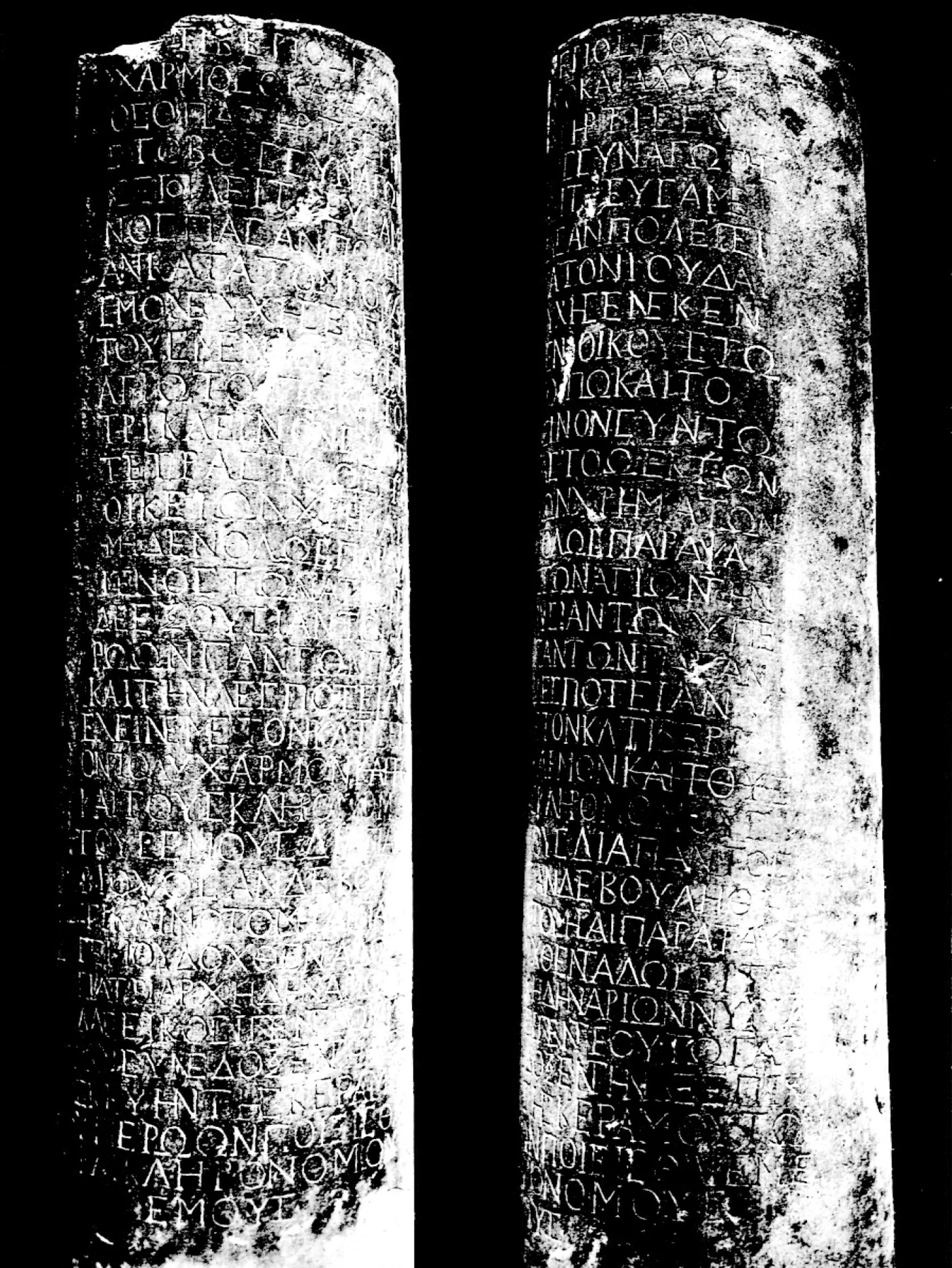
Stobi was a Roman and late antique city at the meeting of the Crna and Vardar rivers, near present-day Gradsko in North Macedonia. Its synagogue is known first from a marble column found in 1931 in the forecourt of a ruined basilica. The long Greek inscription on it records that Claudius Tiberius Polycharmos, also called Achyrios, 'father of the synagogue at Stobi', gave rooms, a dining room and a four-columned court to the 'holy place' at his own cost, while keeping the upper storey for himself and his heirs. For some decades the basilica itself was taken by several scholars to be the synagogue. The Yugoslav-American excavations directed by James Wiseman and Djordje Mano-Zissi from 1970 showed instead that it was a church standing on two older buildings. The lower one, Synagogue I, was the building of Polycharmos; it was destroyed in the late third century. Synagogue II, built above it early in the fourth century, was a hall of about 13.3 by 7.85 metres with a mosaic floor, painted walls and a masonry base against its east wall. It was pulled down and a three-aisled basilica was raised over it, at the end of the fourth century according to the excavators' first reports, or in the fifth century according to later studies. No source records who took the site from the Jewish community, or how.
Where it stood
Ancient Stobi, in the Stobi archaeological park beside the A1 (E-75) motorway about 3 km from Gradsko, Gradsko Municipality, North Macedonia. The remains lie under the Synagogue Basilica (Central Basilica), south of the Civil Basilica, entered from the Via Principalis Inferior. No street address; the pin is approximate.
Open larger map →The Jewish community
Almost everything known about the Jews of Stobi comes from this building. The Polycharmos inscription shows a community organised enough, by the second or third century CE, to have a 'father of the synagogue' and a sacred treasury: the donor stresses that he paid from his own means without touching the sacred funds. Anyone who altered his arrangements was to pay 250,000 denarii to 'the patriarch', whom scholars usually take to be the Jewish patriarch in Palestine, although a local official has also been suggested. Polycharmos bore the names of a Roman citizen and states that he had lived his whole life according to Judaism; because he is not called a Jew outright, some scholars have asked whether he was a proselyte. Other finds name further members: a woman, Posidonia, who dedicated an offering 'to Holy God'; Alexander, a phrontistes or curator, who paid for work on the building; and Eustathios, whose name appears beside a menorah on a small bronze plaque. The size of the community and the occupations of its members are unknown. The finds suggest that it was active from the second century until about the middle of the fifth.
Architecture and design
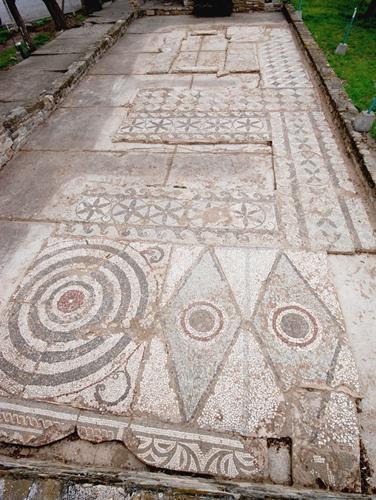
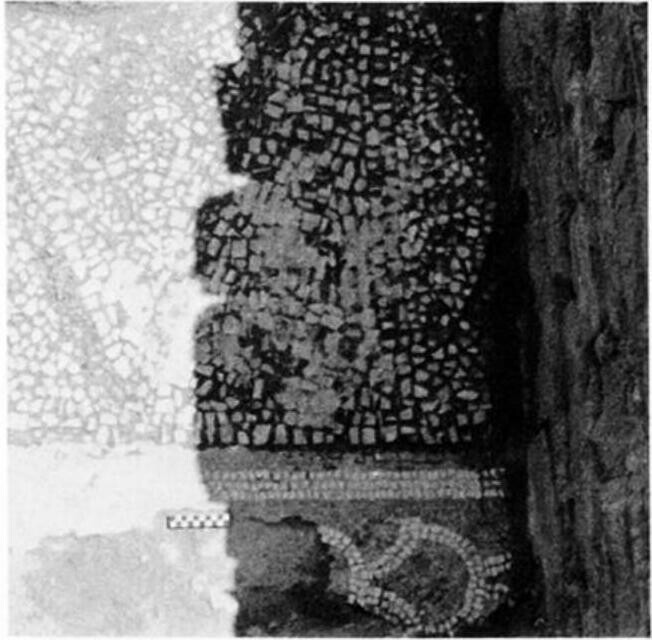
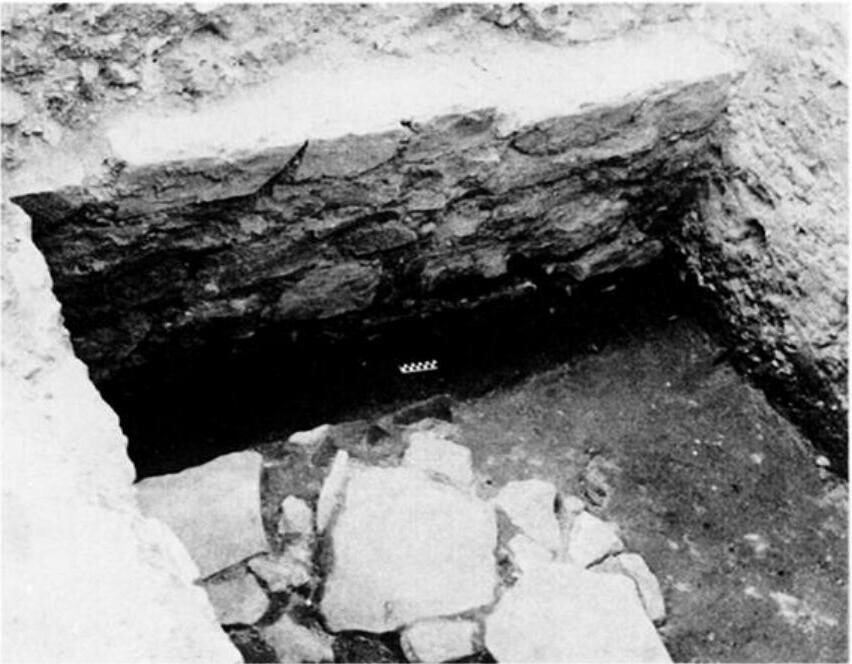
Synagogue I is known only in pieces: a flagstone floor, a wall of rough-hewn blocks and concrete 0.6 metres wide, a threshold block and fragments of painted wall plaster. According to the inscription it included rooms, a triclinium and a tetrastoon, with living quarters on the floor above. Synagogue II was purpose-built on the same spot. Its main room measured about 7.85 by 13.3 metres inside and was not quite rectangular. A mosaic covered the floor except for a strip along the south wall, where a layer of flat stones may have carried a bench. A rectangular brick and concrete foundation stood against the east wall on the axis of the room; the excavators thought it a suitable base for the Torah ark. The walls had a stone and mortar socle with mud brick above and were painted with geometric patterns in bright colours, and windows and doors were framed with stucco mouldings. Smaller rooms adjoined the hall, and a corridor led to the neighbouring residence that the excavators named the House of Psalms. A menorah was scratched into the plaster of one wall. The architect and the seating capacity are unknown.
Life inside the synagogue
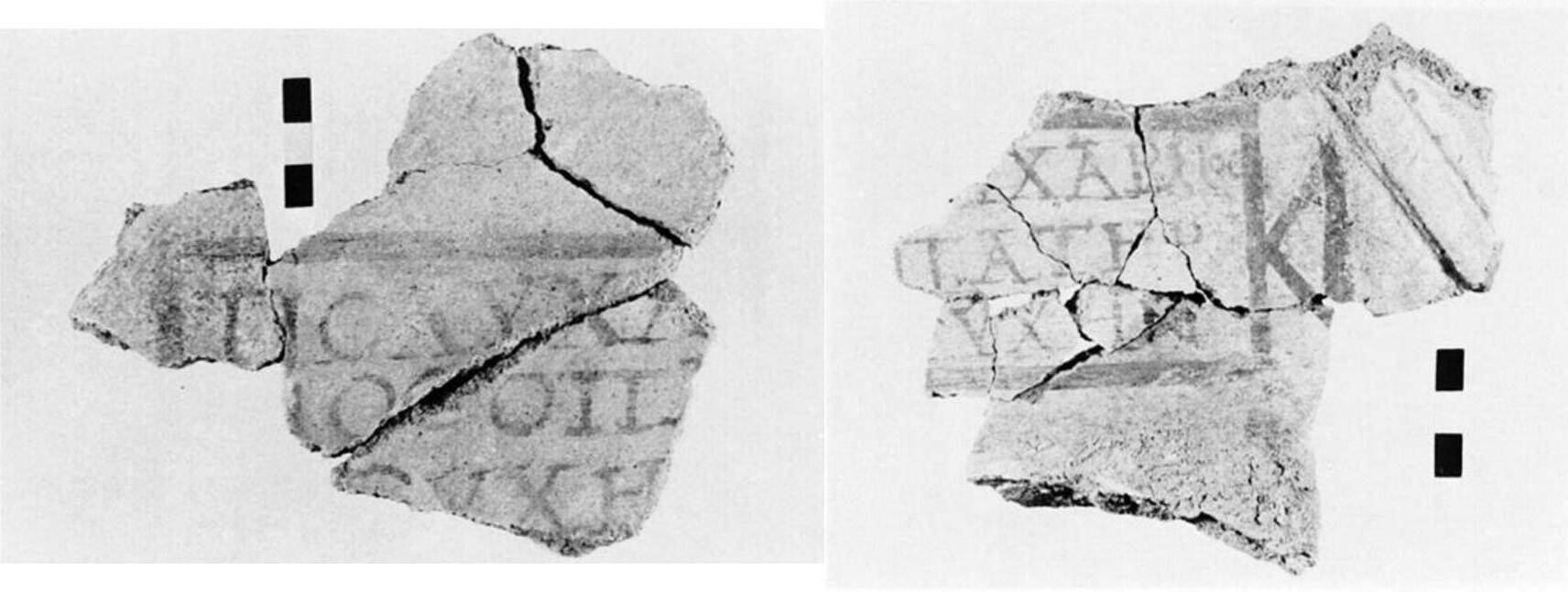
What happened inside is glimpsed only through dedications. On a wall of Synagogue I a text painted in red letters on a white ground was repeated several times: 'Polycharmos the father, (in accordance with) a vow.' A small copper plaque, once nailed to an offering, reads 'Posidonia to Holy God, a vow'. The column inscription calls the building the 'holy place' and lists a triclinium, a dining room, which points to communal meals as well as prayer; it also shows the benefactor's family living upstairs, with the duty of keeping the roof tiles in repair. In Synagogue II Greek graffiti were cut into the wall plaster, and three menorahs were incised in a side room. A later inscription on a round marble slab records that Alexander, the phrontistes, restored part of the complex, either its porch or the mosaic of a colonnaded walk. An inscription of the later fourth century, not yet published, is reported to record a donor's vow to the God of Israel. All of these texts are in Greek. No rabbi, cantor or teacher is named, and nothing is recorded about the services.
Destruction
Synagogue I ended in the late third century: its floor lay under a destruction deposit of that date, which later writers connect with an earthquake. Synagogue II replaced it. In their first reports James Wiseman and Djordje Mano-Zissi wrote that Synagogue II 'was destroyed before the end of the fourth century' and that a three-aisled basilica was built above its ruins near the end of that century or early in the fifth; the latest coin under the church's narthex floor was an issue of Valentinian II (383-392 CE). They added that the circumstances in which a site holy to the Jewish community passed under Christian control 'remain to be determined'. Later studies place the end of the synagogue in the fifth century and the church at its close. The roof tiles had been carefully removed and stored and some walls were repaired and kept, which suggests that the hall was still sound when the church builders began. Dean Moe, one of the excavators, suggested in 1977 that the building came into Christian hands by force; Alexander Panayotov notes that there is no direct evidence of a forced transfer. Who ordered the demolition is not recorded.
The community’s fate
The sources are silent about the Jews of Stobi after their synagogue was replaced. A small plaque or seal with a menorah and the name Eustathios, which one scholar dates to the fifth century, and the wider spread of finds suggest that Jews still lived in the city around the middle of that century. By then Stobi was a Christian city with its own bishops: a bishop of Stobi, Budios, had attended the Council of Nicaea in 325, and the city's Episcopal Basilica was begun about 400. Imperial law was also turning against synagogues. Panayotov points to the law issued by Theodosius II in 438, which he thinks probably sealed the fate of the synagogue at Stobi and of others in the region. The city itself declined soon afterwards. It was sacked by the Ostrogoths under Theodoric in 479, struck by an earthquake in 518 and abandoned in the late sixth century. Whether the Jewish community left, converted or lived on until the city was abandoned is unknown, and none of the sources consulted mentions a later Jewish inscription from Stobi.
The site today
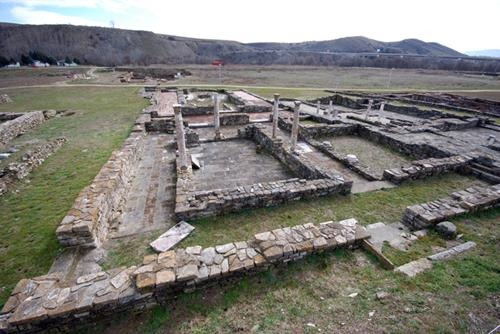
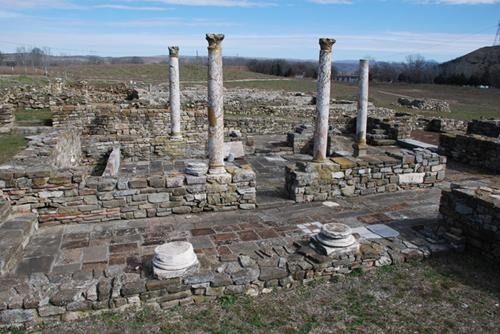
The site lies inside the Stobi archaeological park near Gradsko, managed by the National Institution Stobi. What a visitor sees is the church: the low stone walls of a three-aisled basilica with an apse, brick-paved aisles, column bases on the stylobates and a forecourt in which a few columns have been set upright again. The two synagogues lie beneath its floor and nothing of them stands above ground; photographs published by the site's managers show the nave dug out below the level of the aisles, exposing older wall stumps. A large part of the Synagogue II mosaic was lifted for restoration in the 1960s. The Polycharmos column is in the National Museum in Belgrade, where the excavators also recorded the Eustathios plaque. The excavated rooms of the House of Psalms adjoin the basilica on the south.
Notable names
Claudius Tiberius Polycharmos (also called Achyrios)
2nd or 3rd century CEDonor of Synagogue I; 'father of the synagogue at Stobi'Polycharmos is named on the marble column found in 1931, where he calls himself father of the synagogue at Stobi and says he lived his whole life according to Judaism. In fulfilment of a vow he gave rooms, a dining room and a four-columned court to the holy place at his own expense, keeping the upper storey for himself and his heirs and setting a fine of 250,000 denarii, payable to the patriarch, on anyone who changed this. Painted texts on the walls of Synagogue I repeat his name. No portrait of him exists.
Biography or source →Alexander
Unknown (late 3rd to 5th century CE)Phrontistes (curator) of the synagogueAlexander is named in a Greek inscription on a round marble slab from the building, which gives him the title phrontistes, a curator or overseer. According to the National Institution Stobi he rebuilt the porch of the synagogue around the end of the third century; Alexander Panayotov describes the same text as recording his repair of the mosaic floor of a colonnaded walk in the late fourth or fifth century. He probably paid for the work himself. Nothing else is known about him.
Biography or source →Posidonia
Unknown (before the early 4th century CE)Donor of a votive offering in Synagogue IPosidonia is known from a small rectangular copper plaque found in 1970 just below the tile bedding of the Synagogue II mosaic, near the centre of the later nave. The plaque had been nailed to an offering and reads 'Posidonia to Holy God, a vow'. The excavators assigned it to Synagogue I. She is the only woman named among the finds from the building, and nothing more is known of her life.
Biography or source →Do you have something to contribute?
Photographs, documents, family stories or memories of this synagogue and its community help keep its history alive.
- The Synagogue Basilica (Stobi archaeological site, buildings)
- Excavations at Stobi, 1970 (American Journal of Archaeology 75, 1971, pp. 395-411), section 8 'The Building Complex of Polycharmos'
- Excavations at Stobi, 1971 (American Journal of Archaeology 76, 1972, pp. 407-424), section 3 'The Synagogue-Basilica' and site plan
- Daily Life of Jews in the Early Byzantine Balkans and the Aegean (New Europe College Yearbook 2024-2025, vol. 1, pp. 227-244)
- Ancient Jewish Communities in Macedonia, Thrace and Upper Epirus (Gerión 33, 2015, pp. 211-227)
- Donation of Claudius Tiberius Polycharmus to the synagogue of Stobi (IJO I Mac1; CIJ I 694; I.Stobi 19)
- [46] Donation of a Judean Synagogue by Polycharmos (II-III CE), Stobi
- Uncovering the Heritage: The Jewish Community in Stobi
- Археолошки локалитет Стоби (Archaeological site Stobi)
- Stobi (JewishGen Cemetery Discovery Project, International Jewish Cemetery Project entry)
- The Episcopal Basilica, the Via Sacra, and the Semicircular Court at Stobi, R. Macedonia (Niš and Byzantium X, 2012), abstract
- Stobi
- Антички театар, Stobi (OpenStreetMap way 226161294), used with the 1971 site plan
Share a memory or thought
No comments yet. Be the first to add one.