

The story of Strakonice Synagogue
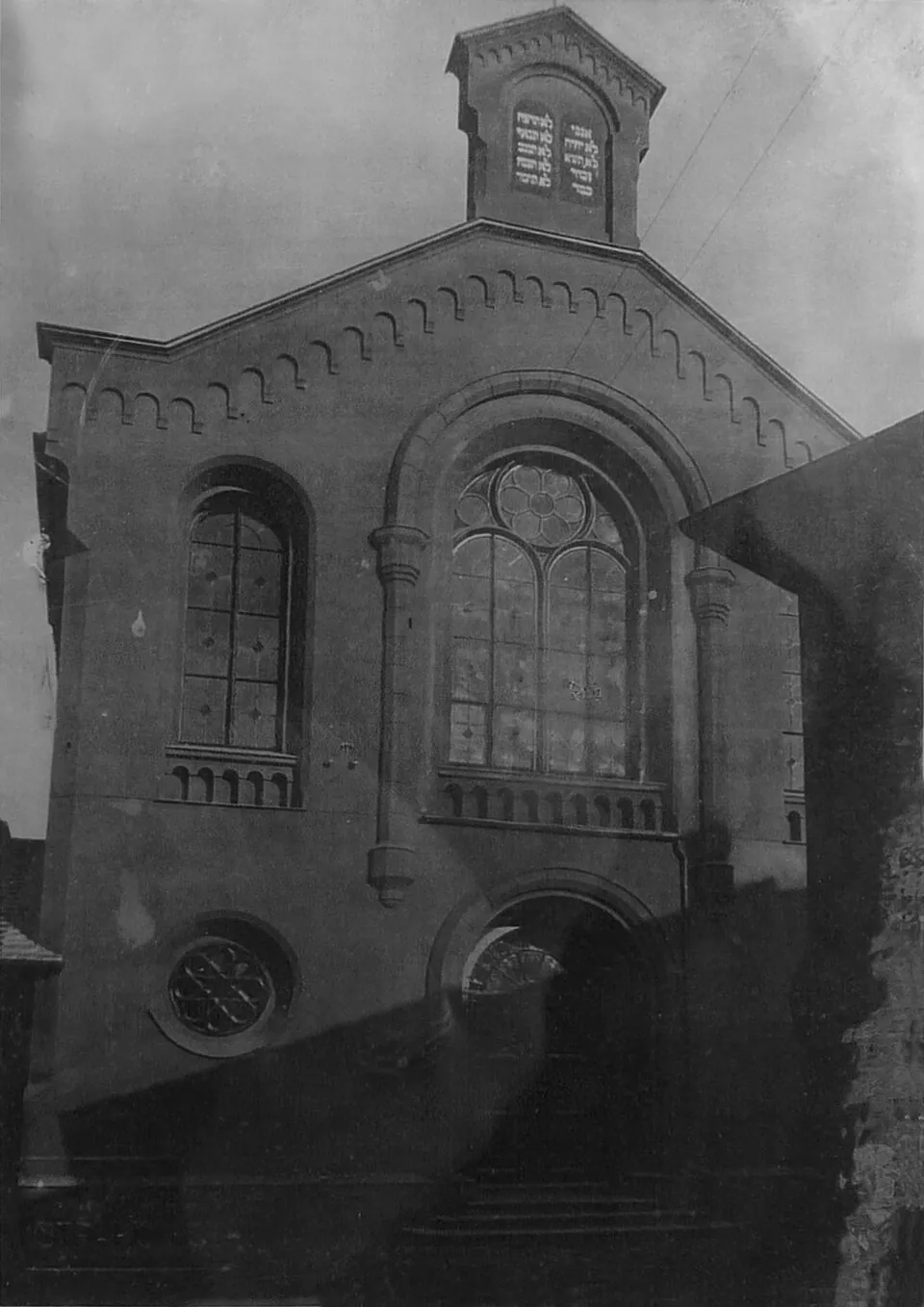
Strakonice, a town in South Bohemia at the meeting of the Otava and Volyňka rivers, had Jewish residents from at least the early sixteenth century. They lived across the Volyňka in a small quarter in Bezděkov still known as Židovna. Two earlier prayer houses on the site were lost: the oldest burned in 1741 and its wooden successor collapsed in 1858, according to a local account during a wedding. Around 1860, when Jews in Austria gained equal rights, the community built a new synagogue for 18,000 Austrian guilders on the same plot on the east bank of the river. The local historian Josef Havrda, writing in 1934, called it the finest synagogue in South Bohemia of its day. The surviving photograph shows a tall neo-Romanesque front with a large round-arched window and a small turret carrying the Tablets of the Law. Next to it stood a single-storey community house with a boardroom and the sexton's flat. The building served the congregation until the Nazi occupation, was used as a store during the war and from 1951 served a Protestant church as a prayer house. It was demolished in 1976 during the clearance of the old Jewish quarter.
Where it stood for nearly 120 years
Historic: Jewish quarter (Židovna), southern Bezděkov, east bank of the Volyňka, Strakonice; street and house number unknown. Today: site of a 1970s department store development in central Strakonice; pin is the town centre (approximate).
Open larger map →The Jewish community
A note in the books of the Order of Malta shows Jews in Strakonice by the early sixteenth century, and in 1509 or 1511 two Jews were executed there on a ritual-murder charge despite the intervention of the Royal Chamber. The settlement grew in the seventeenth century; there were 12 Jewish families in 1724 and about 25 by the 1830s, when the quarter had 14 houses on both banks of the Volyňka joined by a wooden bridge. The burial brotherhood was founded on 15 January 1807, and the cemetery west of the town has gravestones from 1736. From 1810 a Jewish-founded workshop made fezzes, and by 1900 Jewish firms ran four fez factories in Strakonice and Mutěnice employing over 3,000 people. The community peaked after the railway arrived: about 95 families in 1878 and 326 Jews among 7,112 inhabitants in 1890. Many owners later moved to Vienna, and numbers fell to 136 in 1910 and 95 in 1930. A Jewish school, public from 1875, closed in 1908.
Architecture and design
The architect and builder are unknown. Local sources describe the building as neo-Romanesque, and the one surviving exterior photograph, taken about 1930, bears this out. It shows a tall rendered gable front under a shallow pitched roof edged by a frieze of small round arches. The centre is a broad round-arched bay framed by slender half-columns, filled by a large window with tracery of round lights above two tall arched lights; below it a round-arched doorway is reached by steps. To the left are a tall round-arched window and, lower down, a round window with rosette tracery. On the ridge sits a small square turret with a pointed roof, carrying the twin Tablets of the Law with Hebrew lettering. Havrda records a main door for men and a side entrance for women that was opened only at the High Holy Days, a women's gallery on pillars, and benches made by the craftsman Jan Vlastimil Plánek. The gallery pillars began to fail in 1926 and needed repair. A photograph of the interior is held on Wikimedia Commons. Capacity is unknown.
Life inside the synagogue
The congregation's rabbis included a member of the Fürth family, the regional rabbi Emanuel Polák, Dr. Pražák, Lamberk (1893), Denković, Emanuel Sittig from 1896, Bachrach, Dr. Volf during the First World War and Arnold Flaschner from 1923. Several rabbis also taught at the Jewish school, which Sittig directed until his death in 1898. During the First World War a cantor named Menkes arrived and stood in for the rabbi when he was away. A boardroom in the community house next door served as a second, smaller prayer room. The lay leaders were the manufacturer Fuchs when the synagogue opened, the lawyer Max Brock from 1914 to 1932 and the merchant Zikmund Kohn after him. The Chevra Kadisha, which celebrated its centenary in 1907, gave large sums to the poor, and the community also had a women's association and a club called Harmonie. The last Jewish service in the building was held by American soldiers at Rosh Hashanah, on 9 September 1945.
Destruction
No source read records damage to the synagogue during the Nazi occupation. After the deportations it stood without a congregation and was used as a storage building. After the war the building was not returned to Jewish worship. From 1951 it served as a prayer house of a Protestant church: Jüdische Gemeinden names the Brethren church, while the South Bohemian regional guide names the Czechoslovak Hussite Church. In the 1970s, under Communist rule, the remaining Jewish houses on the east bank of the Volyňka, the synagogue and the community house among them, were demolished to clear ground for a department store. The guide and the description of the photographs on Wikimedia Commons give 1976 as the year of the synagogue's demolition; Jüdische Gemeinden says the mid-1970s. None of the sources read names the body that ordered or carried out the demolition. The houses on the west bank had already been removed earlier in the twentieth century for the Fezko works.
The community’s fate
The Jewish population of Strakonice had fallen to 95 by 1930, as families moved to Vienna, Prague and elsewhere. Services continued in the synagogue until the Nazi German occupation of Bohemia and Moravia in March 1939. In 1942 there were still 82 Jews in Strakonice. They were deported in 1942 and 1943, and by 1943 no Jews were left in the town, which ended the community's history. The deportation route and the number of victims and survivors were not found in the sources read. The congregation was not refounded, and the synagogue was never again used for regular Jewish worship. Several of the community's Torah scrolls are now in synagogues in California. The Jewish cemetery, with about 480 gravestones, survives on U Židovského hřbitova street west of the town, and the local museum covers Jewish life in Strakonice.
The site today
The synagogue stood on the east bank of the Volyňka in the former Jewish quarter of Bezděkov, now part of central Strakonice. The houses of the quarter on that bank were cleared in the 1970s for a department store, so the plot now lies within a modern commercial development; the exact footprint was not identified in the sources read. Nothing of the building survives. Since 2007 a Star of David memorial has recalled the synagogue. The Jewish cemetery, about two kilometres west of the castle, is the main surviving Jewish site in the town.
Notable names
Arnold Flaschner
UnknownRabbi of Strakonice from 1923Flaschner became rabbi of Strakonice in 1923 and was still in office when Josef Havrda wrote his history of the community in 1934, so he led services in the synagogue during its last full decade of use, when the congregation had shrunk to under a hundred people. His later life and fate were not found in the sources read.
Biography or source →Emanuel Sittig
died 1898Rabbi and teacher in Strakonice from 1896Sittig came to Strakonice in 1896 as rabbi and teacher and directed the community's two-class Jewish public school until his death in 1898. Havrda lists him among the rabbis who served the synagogue built around 1860, at a time when the town's fez industry had made the congregation one of the larger in South Bohemia.
Biography or source →Max Brock
UnknownChairman of the Strakonice Jewish community, 1914-1932Brock, a lawyer, chaired the Jewish community of Strakonice from 1914 until December 1932, through the First World War and the founding of Czechoslovakia. His years in office included the start of repairs to the synagogue in 1926, when the pillars carrying the women's gallery began to give way. He was followed as chairman by the merchant Zikmund Kohn.
Biography or source →Zikmund Kohn
UnknownChairman of the Strakonice Jewish community from December 1932Kohn, a merchant, succeeded Max Brock as chairman of the Strakonice Jewish community in December 1932 and held the office when Havrda's history was written in 1934. As lay head of the shrinking congregation he was responsible for the synagogue and community house in its last years before the Nazi occupation. His later fate was not found.
Biography or source →Jan Vlastimil Plánek
UnknownCraftsman who made the synagogue's benchesHavrda's 1934 history of the Strakonice Jews records that the benches of the synagogue built around 1860 were made by Jan Vlastimil Plánek. He is the only person named in connection with the building's construction and fitting-out; the architect and builder of the synagogue itself are not recorded in the sources read.
Biography or source →Do you have something to contribute?
Photographs, documents, family stories or memories of this synagogue and its community help keep its history alive.
- Strakonitz (Böhmen)
- The History of the Jews in Strakonice (in The Jews and Jewish Communities of Bohemia in the Past and Present, 1934, pp. 613-615)
- 38. Strakonice (Židovské památky v jižních Čechách)
- File:Synagoga Strakonice 01.jpg
- File:Synagoga Strakonice 02.jpg
- Historie židovské obce na Strakonicku (master's thesis, 2011)
- Strakonice (OpenStreetMap relation 438853)
Share a memory or thought
No comments yet. Be the first to add one.