
הסיפור של Stráž Synagogue
Stráž is a small town in the Tachov district of western Bohemia, close to the Bavarian border, known in German as Neustadtl am Klinger. Jews are recorded there from the fourteenth century, and the town's Jewish cemetery, first mentioned in 1450, is counted among the oldest in Bohemia. For centuries the community worshipped in a temple that was said to be about two hundred years old when a great fire swept the town in 1876. That fire destroyed the whole Jewish quarter, the temple with part of its ritual objects, and the community's historical records.
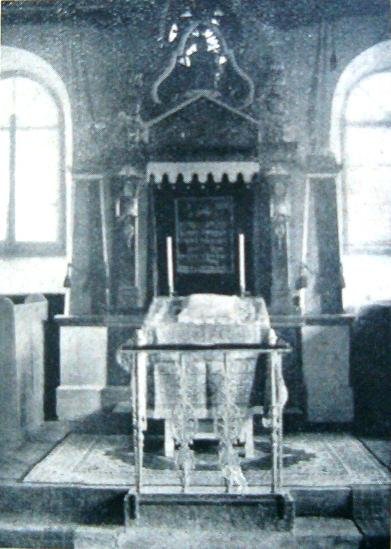
The congregation rebuilt. In 1883 it had a new synagogue erected, and at the same time a community house containing a school and a mikveh. The only image of the new building found is a historical photograph of its interior, showing the Torah ark between two round-arched windows. Services were held there until 1938, though by then the community had shrunk to about thirty people. In November 1938, a few weeks after the border region was annexed by Nazi Germany under the Munich Agreement, the synagogue was set on fire. The burned-out ruin stood for some years and was demolished in the 1950s. The site, the architect and the size of the building are not recorded in the sources consulted.
Where it stood for 55 years
Historic: Neustadtl am Klinger (Stráž), probably in or near the Jewish suburb; street and house number unknown. Today: unknown; placeholder pin at the centre of Stráž, 348 02, Tachov district, Plzeň Region (approximate).
פתיחת מפה גדולה ←הקהילה היהודית
Jewish families settled in Stráž, which received town rights in 1331, in the fourteenth century; some were refugees from persecutions in Germany. An organised community is recorded in the sixteenth century, when about fifteen Jewish families lived in the town around 1580. By 1620 only two families remained, and the early community was probably expelled; Jews were documented again in the second half of the seventeenth century and formed a new congregation. It grew to 18 families in 1724 and about 45 families around 1820-1830, and in the first half of the nineteenth century 47 families were permitted to live there. From the middle of the century Jewish families increasingly left for larger cities. About 75 Jews lived in Stráž around 1880, about 80 around 1900, 45 in 1921 and 31 in 1930. The Jews of nearby Bernartice, whose own community dissolved around 1900-1910, buried their dead in the Stráž cemetery. A suburb known as the Judenvorstadt was the centre of Jewish settlement, and many of its houses still stand.
אדריכלות ועיצוב
Almost nothing is recorded about the appearance of the synagogue of 1883. No exterior view was found, and the architect, builder, style, seating capacity and exact plot are unknown. It was built together with a separate community house that held a school and a ritual bath, so the congregation had a small complex of buildings. The one surviving photograph, an undated interior view, shows the eastern end of the prayer hall. The Torah ark stands on a raised platform between two tall round-arched windows. It is framed by columns and topped by a carved crest bearing the tablets of the Law, with a fringed valance hanging over the curtained opening. Two candlesticks stand on the ark's ledge, and in front of it is a reading desk on slender turned legs with a cloth over it. Patterned carpets cover the floor in front of the ark and steps lead up to it. The plain walls and simple round-headed windows suggest a modest hall.
החיים בבית הכנסת
The synagogue of 1883 served a congregation that was already declining when it was built, with about 75 members around 1880. Services continued in it until 1938. The community house beside it held the congregation's school and its mikveh. A Jewish elementary school in the town had closed around 1850, so by the time the new buildings went up only a religious school remained. The congregation also kept up its ancient cemetery north-west of the town square, enclosed by a rubble-stone wall, where the Jews of Bernartice were buried as well. The names of the rabbis, teachers, cantors and lay leaders who served the synagogue have not been found in the sources consulted; the Geni project for the Jewish families of Stráž holds very little information. By the 1930s only about thirty Jews remained, too few to sustain a full community life.
הרס
Under the Munich Agreement of 30 September 1938 the border regions of Czechoslovakia, Stráž among them, were annexed by Nazi Germany. A few weeks later, during the pogrom of 9-10 November 1938, the synagogue was set on fire. The local source states only that it was set on fire in November 1938 and does not name who did it. Research on the pogrom in the annexed border regions shows that the attacks there were carried out mainly by local SA units and the Hitler Youth, with auxiliary police, SS men and the Gestapo involved to a lesser degree; about 35 synagogues in the region were burned or damaged. The Nazis also desecrated the town's Jewish cemetery in 1938, and most of its gravestones were later removed and used for road building. The burned-out ruin of the synagogue survived the war and was demolished in the 1950s, under Communist rule in Czechoslovakia. No source consulted gives the exact year or says who ordered or carried out the demolition.
גורל הקהילה
When the border region was annexed in the autumn of 1938, about thirty Jews still lived in Stráž. The sources consulted do not say how many of them fled into the interior of Czechoslovakia after the Munich Agreement and how many stayed. Those who remained in the town or within reach of the Nazi authorities were later deported; the dates, transports and destinations of the deportations of Stráž Jews are not recorded in the sources read. According to the Jüdische Gemeinden site and the JewishGen cemetery survey, only one of the deported Jews of Stráž returned. No Jewish community was re-established after the war. A letter of 1987 from Františka Weilová, described as the widow of the last local Jew, is cited by the JewishGen survey. Today the town has fewer than a thousand inhabitants and no Jewish residents, and the cemetery is owned by the Jewish community of Plzeň.
האתר כיום
The exact plot of the synagogue has not been identified in the sources consulted, so it is not possible to say what occupies it today, and no surviving fragment of the building is recorded. The map pin is a placeholder at the centre of Stráž. The town's most important Jewish monument is the cemetery about 1.1 km north-west of the square, whose oldest surviving gravestone dates from 1579. About fifty stones remained after the war and fourteen more were found in the 1970s. In 2009 volunteers of Aktion Sühnezeichen restored the cemetery and re-erected about 35 recovered gravestones. Many houses of the former Jewish suburb still stand.
יש לכם משהו לתרום?
תמונות, מסמכים, סיפורי משפחה וזיכרונות מבית הכנסת ומהקהילה שלו עוזרים לשמור על ההיסטוריה שלו בחיים.
Share a memory or thought
No comments yet. Be the first to add one.