
La storia di Švihov Synagogue
Švihov (German: Schwihau) is a small town in the Klatovy district of the Plzeň region, south of Plzeň, known for its moated castle. Jews are recorded there from 1570, and from the middle of the eighteenth century the Jewish families, many of them butchers, lived together in a single lane, the Jewish street, today Vrchlického Street. Švihov became the religious centre for Jews of the surrounding villages, with its own school, registers and burial ground.
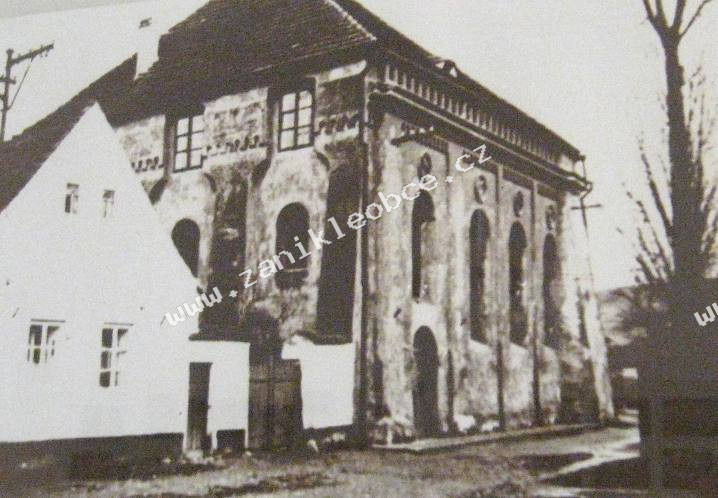
The first synagogue was a wooden building of unknown age. In 1773 a great fire swept through the Jewish street and burned the synagogue, the school and most of the houses. Ten years later the community received permission to build again, and in 1783 a new masonry synagogue was put up. Photographs taken in the twentieth century show a tall rendered hall with rows of round-arched windows and a steep tiled roof, standing directly on the street.
The congregation shrank sharply from the late nineteenth century as families moved to larger towns, and by the interwar years services were held only rarely. Ownership passed to the Klatovy community in 1928 and, in 1942, under the Nazi occupation, to the emigration fund. After the war the building was sold to a private couple. It decayed, and was pulled down around 1960; a family house now stands on the plot.
Where it stood for nearly 180 years
Historic: Judengasse (Jewish street), Švihov, former cadastral plot 111. Today: Vrchlického street, parcel 112, house no. 211, 340 12 Švihov, Klatovy district (approximate: site point given by Zaniklé obce).
Apri la mappa grande →La comunità ebraica
A Jewish family is first documented in Švihov in 1570, and permanent settlement dates from the Thirty Years' War. The old cemetery east of the town was in use by the 1640s. For much of the seventeenth and eighteenth centuries the records chiefly concern the payments the Jews owed the manorial lords, the Czernin family. The town council repeatedly petitioned to expel them or move them outside the walls, but the lordship refused, and around 1736 to 1746 the families were concentrated in the Jewish street through a forced exchange of houses. There were about 15 families around 1720, 11 in 1747, 16 in 1782 and 17 in 1846. Švihov acted as a regional centre: Jews from Chudenice, Dolany, Polín, Malinec and Vlčí belonged to it or buried their dead in its cemetery. The community ran a school from the seventeenth century and a private German-language school until 3 October 1893, when its last 13 pupils moved to the public elementary school. Numbers then fell quickly through emigration to the cities: 79 Jews in 1890, 46 in 1900, 24 in 1922 and about 20 in 1930.
Architettura e design
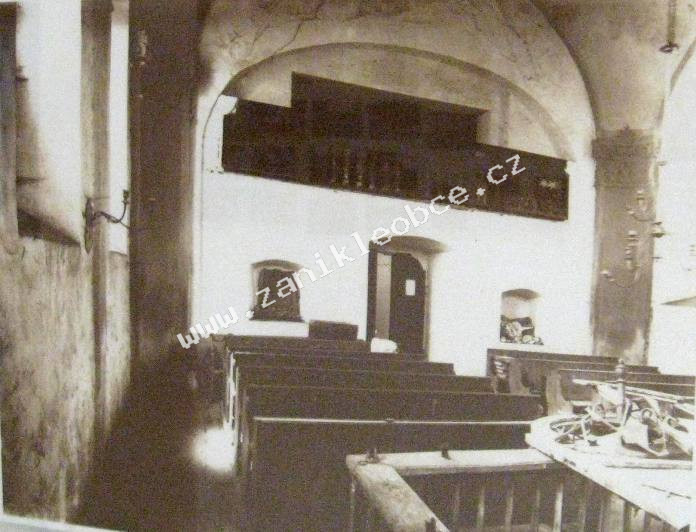
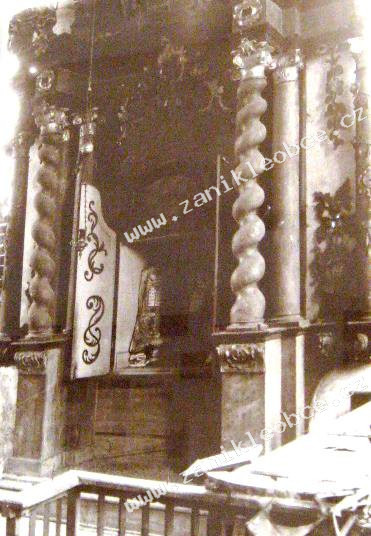
The synagogue of 1783 was a free-standing masonry hall on the Jewish street, built, according to the 1783 building application read by the archivist František Teplý, on the site of a burned-out house at the end of the lane next to the lord's tannery and oriented to the east. A photograph of about 1920 shows a tall rendered building with a steep tiled roof and a heavy cornice. Its long street side is articulated by pilasters into bays, each with a tall round-arched window and a small round window above; a round-arched doorway opens at street level. The gable end has two storeys of windows, the upper ones rectangular, which suggests rooms or a gallery at that end. An interior view of about 1955 shows a vaulted hall with a women's gallery behind a solid parapet, rows of benches facing forward, and plastered walls. The Torah ark on the east wall, photographed before 1939, was a richly carved Baroque piece with twisted columns, carved foliage and wooden doors, with an eternal light hanging before it. Czech sources call the building Rococo. The architect, builder and seating capacity are unknown.
La vita nella sinagoga
Because the congregation was small, it could rarely afford a rabbi for long, and services were usually led by local cantors. Teplý's history names Philipp Kohner as district rabbi in the late eighteenth and early nineteenth centuries, before he left for Plzeň, and Augustin (Angelus) Kafka, district rabbi in 1835, who moved to Plzeň as district rabbi in 1836. Later rabbis or religious officials recorded are Lazar Fürth (1843), Simon Fürth (1860) and Siegfried Bret (1909). Teachers of the Jewish school included Isaak Schnurmacher, Bernard Schnurmacher, who died of cholera in 1836, Samuel Mandelbaum and Leopold Wolfner. Around 1780 Christian youths disturbed services, and in 1787 the district magistrate, citing the Edict of Tolerance, ordered that no one be disturbed in practising religion. The local history site Zaniklé obce describes the congregation as following a Reform rite with church-like pews while keeping a women's gallery. In the interwar period services were held only rarely, and they presumably ended under the occupation. A Torah scroll from the community survives with a congregation in New Mexico.
Distruzione
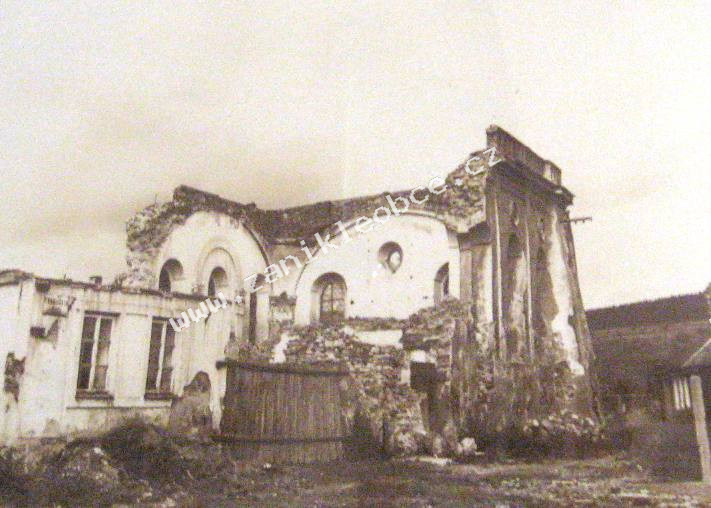
No source found records damage to the synagogue during the Second World War. According to a land-register summary posted on Zaniklé obce, the building belonged to the Švihov community until 1928 and then to the religious community of Klatovy; from 1942 to 1948, under the Nazi occupation and its aftermath, it was registered to the emigration fund. In 1949 it was sold to a private couple. It was not maintained: an interior photograph of about 1955 shows the hall neglected and empty. The building was demolished around 1960. A photograph from the town office of Švihov shows it in the course of demolition, with the roof gone and the walls partly broken down. Sources differ slightly on the date: about 1960 (Zaniklé obce and the Czech tourist portal Kudy z nudy), the 1960s (JewishGen Cemetery Project) and the early 1960s (Jüdische Gemeinden). Who ordered or carried out the demolition, whether the private owners or a Communist-era authority, is not recorded in the sources read.
Il destino della comunità
By 1930 only a few Jewish families, about twenty people, were left in Švihov. They lived under Nazi German occupation from 1939, when Švihov became part of the Protectorate of Bohemia and Moravia. According to the JewishGen Cemetery Project, the remaining Jews were probably deported to concentration camps in the autumn of 1942. Jüdische Gemeinden records that at least sixteen Jews born in Švihov or long resident there were murdered in the Shoah. The exact transports and the places where they died are not given in the sources read. One woman and her daughter returned after the war; they emigrated to the United States in 1955. No Jewish community was re-established. Both cemeteries survive: the old cemetery, with about 140 Baroque and Classicist gravestones, is owned by the Jewish community of Plzeň and was restored in 1990 to 1991, while the new cemetery of 1878 keeps only a few stones.
Il luogo oggi
The synagogue stood on the former Jewish street, now Vrchlického Street, on what was cadastral plot 111. That plot has since been merged into parcel 112, where a privately owned family house, number 211, was built after the demolition. Nothing of the synagogue is visible. The Zaniklé obce database marks the site at about 49.4814 N, 13.2861 E, near the centre of the town below the castle. The two Jewish cemeteries, the old one about 500 metres east of the town near the railway and the new one close by, are the only physical remains of Jewish life in Švihov.
Nomi importanti
Philipp Kohner
UnknownDistrict rabbi at Švihov, late 18th to early 19th centuryFrantišek Teplý's history of the Schwihau Jews lists Philipp Kohner, living in house no. VII, as the local district rabbi, recorded in 1789, and says he left to become district rabbi in Plzeň by about 1825. Pavel Frýda's article names him as one of only two rabbis documented as serving the 1783 synagogue. A Philipp Kohner also appears as district Jewish judge in an 1806 document. Nothing further on his life was found.
Biografia o fonte →Augustin (Angelus) Kafka
c. 1792-1870District rabbi at Švihov, recorded 1835Kafka is listed by Teplý as the local district rabbi in 1835 and is one of the two rabbis named by Pavel Frýda as having served in the Švihov synagogue. In 1836 he moved to Plzeň as district rabbi. Teplý records that he died in Plzeň on 16 May 1870 at the age of 78. His tenure fell in the period when Švihov was still a regional centre for the Jews of the surrounding villages.
Biografia o fonte →Hai qualcosa da condividere?
Fotografie, documenti, storie di famiglia o ricordi di questa sinagoga e della sua comunità aiutano a mantenerne viva la storia.
- Schwihau (Böhmen)
- The History of the Jews in Schwihau (František Teplý, in Gold, Die Juden und Judengemeinden Böhmens, 1934, pp. 342-347), English translation
- Švihov (Klatovy district) - Jewish cemeteries
- Švihov - synagoga (place entry 7395)
- Stručně o synagoze ve Švihově a zdejším židovském osídlení
- Švihov-schrána na tóru (photo page)
- Starý a nový židovský hřbitov ve Švihově
Share a memory or thought
No comments yet. Be the first to add one.